

Business
Currency in circulation at Rs10.9tr | The Express Tribune

KARACHI:
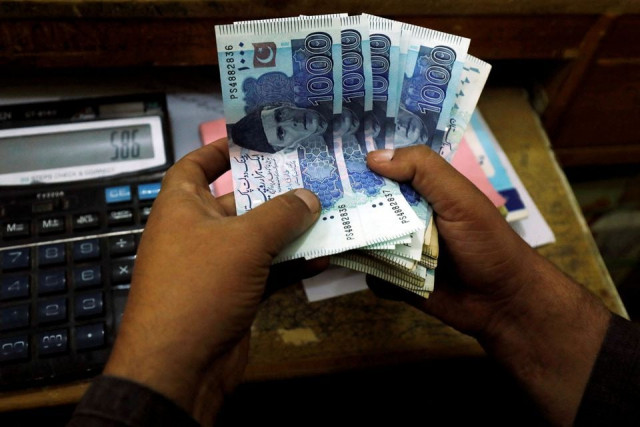
Pakistan’s broad money (M2) supply rose to Rs41.63 trillion, registering a week-on-week increase of Rs346 billion. On a fiscal year-to-date basis, M2 has expanded by Rs838 billion, while the calendar year-to-date growth stands at Rs346 billion.
On an annual basis, the broad money recorded a substantial rise of Rs6.01 trillion, supported by higher deposit mobilisation and balance-sheet expansion within the banking sector, according to data compiled by Optimus Capital Management.
A closer look at the composition of money supply shows that total bank deposits climbed to Rs30.66 trillion, increasing by Rs367 billion during the week and by Rs4.22 trillion compared to the same period of last year.
In contrast, the currency in circulation declined by Rs27 billion on a weekly basis to Rs10.92 trillion, suggesting a partial shift away from cash holdings. Consequently, the currency in circulation as a share of M2 eased to 26.2%, down 0.3 percentage point week-on-week, although it remains 0.6 percentage point higher year on year.
On the asset side, net foreign assets (NFA) of the banking system improved by Rs102 billion during the week under review to Rs880 billion, contributing positively to the overall monetary expansion. Net domestic assets (NDA) rose by Rs243 billion to Rs40.75 trillion, mainly driven by strong private sector credit growth.
Credit to the private sector increased sharply by Rs412 billion during the week, taking total outstanding credit to Rs10.76 trillion. Islamic banking continued to lead incremental credit growth, while conventional banks recorded a moderate expansion.
In contrast, the net federal government borrowing dipped by Rs66 billion on a weekly basis to Rs37.16 trillion, indicating some fiscal restraint or a greater reliance on non-bank sources of financing.
Moreover, the State Bank of Pakistan (SBP) conducted an auction of Pakistan Investment Bonds (PIBs – Fixed Rate) on Wednesday. The auction, which offered two-year (zero-coupon), three-year, five-year, 10-year and 15-year tenors, attracted total bids of Rs2.06 trillion. The central bank accepted Rs450 billion through competitive bids, with total acceptance rising to Rs546.3 billion after including non-competitive bids and short selling.
Furthermore, the Pakistani rupee appreciated by three paisa against the US dollar in inter-bank trading and closed at Rs279.97 compared to the previous day’s close at Rs280.
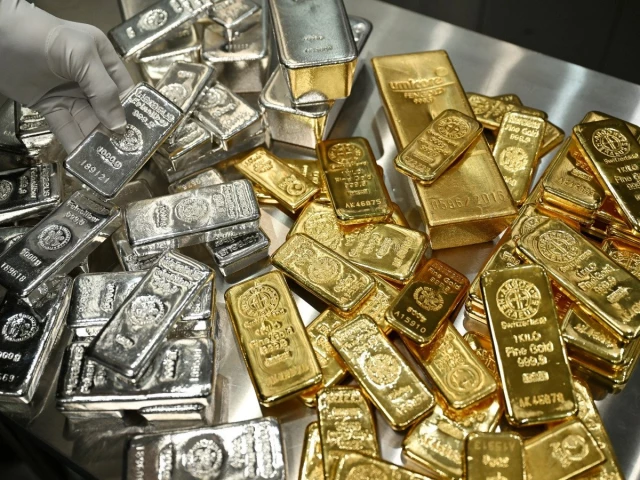
Gold prices recorded a sharp increase in the local market as the price of 24-karat gold per tola surged by Rs4,300 to settle at a record high of Rs486,162. The price of 10 grams of 24-karat gold increased by Rs3,687 to Rs416,805, according to the All Pakistan Sarafa Gems and Jewellers Association.





Now one of the biggest sportswear firms, Anta’s rise follows a playbook adopted by many Chinese giants.
Source link
Business
Gold price prediction today: Will gold prices continue to be volatile? Key levels to watch out for April 27, 2026 week – The Times of India

Gold price prediction today: Gold prices will closely track movements on the rate decisions by several central banks, including the US Federal Reserve, this week, says Manav Modi, Senior Analyst, Commodity Research at Motilal Oswal Financial Services Ltd.Gold is currently consolidating after sharp swings in a broad range, indicating a pause rather than a reversal. Price action shows a higher-high structure intact, but the recent sideways movement suggests indecision near the upper supply zone around 158,000–160,000. The formation resembles a short-term flag/triangle continuation pattern, where a breakout on either side will define the next directional move. Volume has tapered slightly, reinforcing the consolidation narrative.Gold prices recently moved from the upper band toward the mid-band (20 DMA), and are now attempting to stabilize. The bands have started to contract, signaling a potential volatility expansion ahead. Sustaining above the mid-band (~150,500–151,000 zone) keeps bullish bias intact, while a breakdown below this could trigger a deeper mean reversion toward the lower band.For the week, immediate support for gold prices is placed at around Rs 150,500, which is followed by stronger support near Rs 148,500. On the upside, the resistance stands at around Rs 155,500, and after that the key supply zone is at Rs 158,000. A decisive close for gold above Rs 158,000 levels can then resume the broader uptrend. However, a break in gold prices below levels of Rs 148,500 may shift the momentum to bearish in the near term.The economic docket is filled with data points and events this week as the focus will be on FED, BOJ, ECB and ECB policy meetings. US consumer confidence, GDP, inflation and durable goods orders data will also be in radar.(Disclaimer: Recommendations and views on the stock market, other asset classes or personal finance management tips given by experts are their own. These opinions do not represent the views of The Times of India)

British families tell BBC Panorama how the Iran war is affecting their monthly budgets.
Source link


UNCTAD, Maritime and Port Authority of Singapore launch partnership

Lexie Brown denies Klay Thompson cheated on Megan Thee Stallion with her

Strait of Hormuz disruption ‘systemic shock’ threatening SE Asia: ERIA

-

 Sports1 week ago
WWE WrestleMania 42 Night 2: Live match results and analysis
-

 Sports1 week ago
NCAA men’s gymnastics championship: All-time winners list
-

 Fashion1 week ago
UK’s Sosandar returns to profitability amid robust FY26 performance
-

 Politics6 days ago
UK’s Starmer seeks to deflect blame over Mandelson appointment
-

 Entertainment1 week ago
Ruby Rose old essay resurfaces detailing night of alleged Katy Perry assault
-

 Entertainment7 days ago
Lee Anderson, Zarah Sultana kicked out of UK Parliament for calling PM ‘liar’
-
 Business1 week ago
No fuel shortage: Govt assures 100% domestic LPG, PNG, CNG supply amid Hormuz energy crunch – The Times of India
-
 Business7 days ago
How Trump’s psychedelics executive order could unlock stalled cannabis reform