

Business
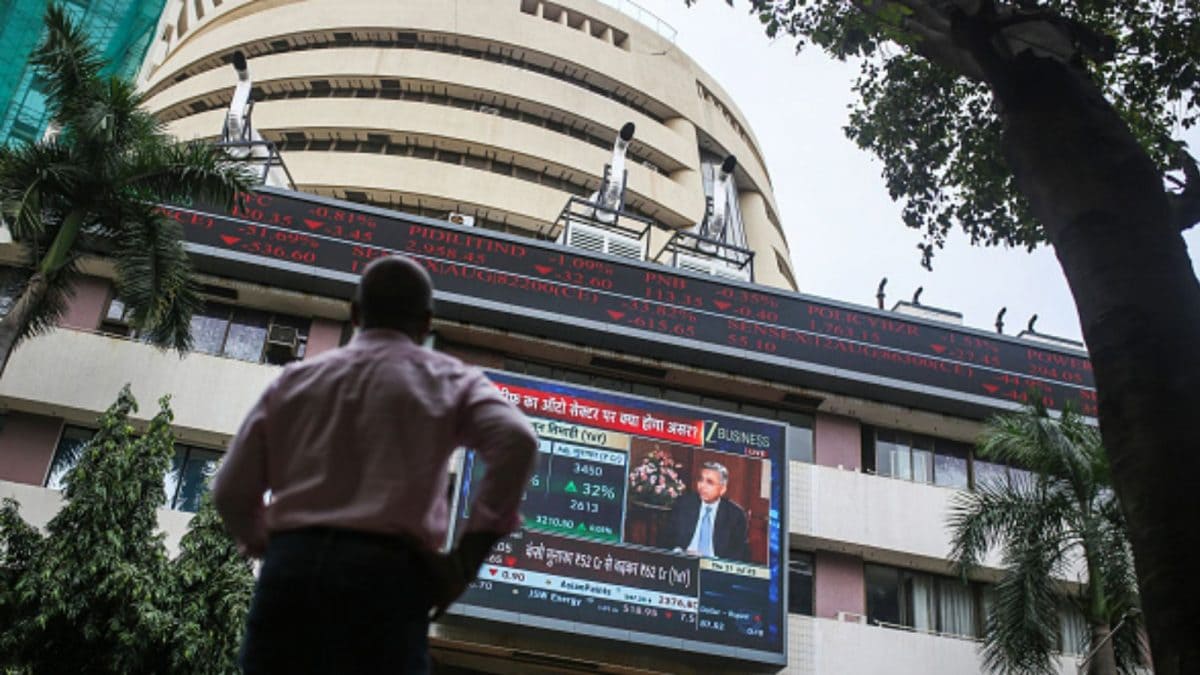
Stock Market Update: Sensex Rises Over 50 Points, Nifty Above 25,250; Eternal, Sun Pharma Gain 2% Each

Last Updated:
A day after Indian equity markets witnessed heavy selling pressure, benchmark indices are likely to open marginally higher on Wednesday



Stock Market Today
A day after Indian equity markets witnessed heavy selling pressure, benchmark indices are likely to open marginally higher on Wednesday. However, sentiment remains cautious as global cues continue to stay weak amid escalating geopolitical tensions.
The early indicator of market direction, GIFT Nifty, was trading 0.05 percent higher at around 8:00 AM.
Trading on Dalal Street is expected to remain stock-specific with the Q3 earnings season in full swing. Companies such as Eternal, Dr Reddy’s Laboratories, Hindustan Petroleum and PNB Housing Finance are scheduled to announce their quarterly results today.
Rupee At Record Low
The Indian rupee opened at a record low of 91.07 against the US dollar on Wednesday.
Global cues
Asian markets extended their losses on Wednesday, weighed down by renewed geopolitical concerns after the US President issued fresh warnings to European nations over the Greenland issue. Japan’s Nikkei slipped 0.35 percent after government bond yields rebounded, a day after a sharp selloff.
Trump has imposed a 10 percent tariff on eight European countries, effective February 1, with the rate set to rise to 25 percent in June, after they opposed his plans to acquire Greenland.
Overnight, Wall Street recorded its worst session since April last year, according to Bloomberg, with market volatility touching its highest level since November. Both the S&P 500 and the Nasdaq ended more than 2 percent lower.
The spotlight this week remains on the World Economic Forum in Davos, where global leaders have raised concerns over the dominance of “superpowers”. Canadian Prime Minister Mark Carney, in a key address, said the “rules-based international order” is effectively dead.
 Click here to add News18 as your preferred news source on Google.
January 21, 2026, 09:11 IST
Read More





United Airlines CEO Scott Kirby (L) and American Airlines CEO Robert Isom listen as U.S. Transportation Secretary Sean Duffy speaks to reporters outside the White House on October 30, 2025 in Washington, D.C.
Kevin Dietsch | Getty Images
United Airlines CEO Scott Kirby confirmed Monday that he contacted American Airlines about a potential merger, a possibility American rejected.
“I approached American about exploring a combination because I thought we could do something incredible for customers together,” Kirby said in a statement. He said he shared his “big, bold vision” because he was confident it could win regulatory approval.
American rejected the idea and its CEO, Robert Isom, last week said such a merger would be bad for customers and “anticompetitive.”
Kirby had floated the idea to the Trump administration earlier this year, according to people familiar with the matter who weren’t authorized to discuss the private conversation, in hopes that the combination would mean a big global airline to compete with foreign rivals
American declined to comment on Kirby’s Monday statement.
“I was hoping to pitch that story to American, but they declined to engage and instead responded by publicly closing the door,” Kirby said in his statement Monday. “And without a willing partner, something this big simply can’t get done.”
He said that “American’s public comments make it clear that a merger like this is off the table for the foreseeable future” but outlined his vision for a combined airline.
Kirby reiterated that the country has deficit with foreign airlines that fly more than half of the long-haul seats into the U.S., with most of the customers being Americans.
“The combined scale of United and American would be a better way to compete with foreign carriers,” he said.
President Donald Trump said he was against the idea of a combination last week.
“I don’t like having them merge,” he told CNBC’s “Squawk Box” on Tuesday morning. He said he would, however, like someone to buy struggling discount carrier Spirit but he also suggested that the federal government could “help that one out.”
Spirit and the Trump administration are in advanced talks for a rescue package.

Sam Sidhu, CEO of Customers Bank.
Courtesy: Customers Bank
Nearly half an hour into a conference call on Friday to discuss first-quarter results with analysts, Customers Bank CEO Sam Sidhu revealed something unusual — up until that point, he hadn’t actually been speaking.
“The prepared remarks you heard on my behalf today were delivered by my AI clone, not read by me,” Sidhu said, calling it a potential first for a public company earnings call.
The point of the stunt, he said, was to underscore a broader shift happening as Customers Bank, a $25.9 billion asset lender catering to startups and small businesses, embraces artificial intelligence.
Customers Bank has signed a multiyear partnership with OpenAI in which the AI giant will embed engineers at the company to help it automate lending and client onboarding, CNBC has learned exclusively.
The deal is part of Sidhu’s effort to get ahead of other banks in the industry’s race to transform itself using AI agents as a new digital workforce. His strategy hinges on automating core banking processes — slashing loan timelines from weeks to days, for instance — and scaling growth without adding staff at the same pace.
While many bankers have described AI in broad terms like productivity gains, Sidhu is tying it directly to financial targets.
Sidhu told CNBC that the project will improve the firm’s efficiency ratio from about 49 to the low 40s, boosting the bank’s returns starting next year.
The relationship with OpenAI — which has targeted finance as one of its core industries, even hiring former bankers to train its models — will be a symbiotic one for the AI giant, according to the bank CEO.
“We’re going to be co-creating enterprise solutions they could potentially sell to other banks in the future,” Sidhu said. “The goal here is end-to-end, automated agentic led workflow” for lending, deposits and payments.
OpenAI said it was proud to help Customers Bank “as they build a more intelligent operating model that empowers employees, strengthens client service, and sets a new standard for regional banking,” chief revenue officer Denise Dresser said in a statement provided to CNBC.
Always-on workers
The bank expects to roll out AI agents across lending, deposits and payments over the next six to 12 months.
If they succeed, closing a commercial loan will go from taking 30 to 45 days, including underwriting, document collection and legal negotiations, to about seven days, Sidhu said.
Opening accounts for complex commercial clients, which can take more than a day, will be collapsed to under 20 minutes using conversational AI and automated document gathering, he said.
“When you have an autonomous agent, you’re essentially creating a digital worker … and they can work around the clock,” Sidhu said.
Customers Bank has been laying the groundwork for this announcement for years, first tapping OpenAI in 2023 because Sidhu had what he describes as a tiny investment in the AI giant through his contacts in the venture capital world. The OpenAI deal signed last week broadens their relationship, enabling AI engineers into the bank’s processes, he said.
The bank is among a handful of smaller lenders that target the startup and venture capital community, and it reportedly bid for Silicon Valley Bank in 2023 amid the regional banking crisis that year.
Key advantage
While it is a relatively tiny firm compared to the likes of JPMorgan Chase, which has $4.9 trillion in assets, Customers Bank has a key advantage, according to Sidhu, who began his career at Goldman Sachs in 2004. The megabanks have sprawling global operations and far higher complexity and regulatory standards for AI implementation, he said.
“Smaller banks are not going to be expected to have the same level of frameworks as many of the larger banks,” he said. Regulators want community and regional banks “to be able to compete with larger banks.”
The lender already uses AI to write half the firm’s software code and has saved 28,000 hours of work so far, equal to not hiring about 15 full-time employees, he said.
“This is an opportunity for us to potentially slow that hiring … and do more revenue per employee,” he said.
The bank is also exploring entering new businesses that would have been prohibitively expensive to tackle before AI agents. For these AI-native business lines, smaller teams oversee automated systems that handle work previously requiring large numbers of humans, he said.
Unlike typical software licensing agreements, Sidhu said both sides are contributing resources to build new tools together, with OpenAI gaining real-world use cases inside a regulated financial institution.
“It’s going to benefit our investors. It’s going to benefit our customers,” Sidhu said. “Our regulators will hopefully also be happier over time, because they’re going to see us reducing risk as well.”

Spotify is increasing its push beyond music and podcasts as the company on Monday announced a new fitness category partnership with Peloton Interactive.
The deal will make more than 1,400 Peloton classes available to Spotify Premium subscribers across most of its global markets, embedding fitness content directly into Spotify’s existing audio and video ecosystem, according to the companies. The offering includes strength training, Pilates, barre, yoga, meditation and more.
“As we continue to forge a path deeper into wellness, our work with Spotify is just our latest move to expand our reach and capture new revenue streams through Peloton’s unmatched experience, content and instruction,” Peloton’s chief commercial officer, Dion Camp Sanders, said in the release.
Neither company disclosed financial terms, but the partnership is an indication of both companies’ strategic priorities.
For Spotify, the move represents a deeper expansion into wellness, opening up new engagement and monetization pathways beyond its core music and podcast business. Fitness content keeps users on the platform longer and creates opportunities to layer in subscriptions, advertising and creator-driven revenue streams, the company said in a release.
Spotify said more than 150 million fitness playlists are already active globally, with nearly 70% of Premium users reporting they work out monthly.
“Fitness is a natural extension of how people already use Spotify today — to get motivated, recover and reset,” a Spotify spokesperson told CNBC.
Spotify is also building out a broader creator ecosystem around fitness beyond Peloton, working with fitness creators like Yoga With Kassandra, Caitlin K’eli Yoga, Sweaty Studio and Chloe Ting who can monetize through existing tools such as the Spotify partner Program.
For Peloton, the agreement accelerates its pivot away from a hardware-centric model toward scalable, high-margin content distribution. CEO Peter Stern said the deal also builds on his international expansion ambitions.
“Spotify provides a global stage for our instructors, in which they have now the ability to meet hundreds of millions of Spotify Premium subscribers,” Stern told CNBC.
By tapping Spotify’s reach, Peloton is gaining exposure without requiring users to own its equipment or subscribe to its standalone app.


Prince Harry makes key statement as King Charles heads to US visit
United Airlines CEO confirms he approached American Airlines about merger

‘House of the Dragon’ unveils ‘more brutal’ season 3 trailer at CCXP Mexico

-

 Sports1 week ago
NCAA men’s gymnastics championship: All-time winners list
-

 Sports1 week ago
WWE WrestleMania 42 Night 2: Live match results and analysis
-

 Politics6 days ago
UK’s Starmer seeks to deflect blame over Mandelson appointment
-

 Fashion1 week ago
UK’s Sosandar returns to profitability amid robust FY26 performance
-
 Business1 week ago
No fuel shortage: Govt assures 100% domestic LPG, PNG, CNG supply amid Hormuz energy crunch – The Times of India
-

 Entertainment7 days ago
Lee Anderson, Zarah Sultana kicked out of UK Parliament for calling PM ‘liar’
-
 Business7 days ago
How Trump’s psychedelics executive order could unlock stalled cannabis reform
-
 Business1 week ago
Exercise to test response to offshore energy threat involving vessels and drones