

Business
Maha infrastructure committee approves Metro Line 8 to connect Mumbai-Navi Mumbai Airports

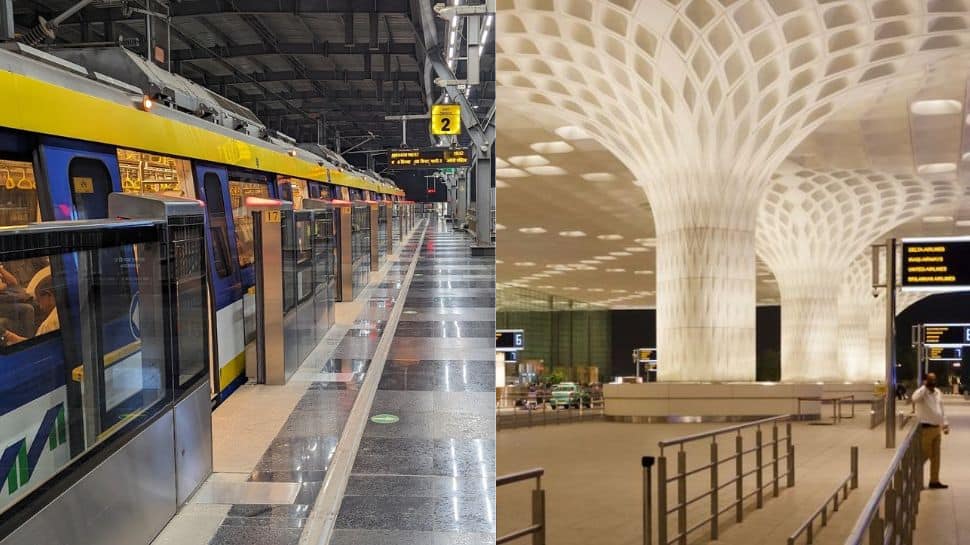
Mumbai: In a high-level meeting of the Cabinet Infrastructure Committee, Maharashtra Chief Minister Devendra Fadnavis issued several directives to accelerate the state’s transport and connectivity landscape. The committee granted formal approval to the ambitious Metro Line 8 and key highway projects in Nashik and Gadchiroli.
The committee approved the 35 km Metro Line 8 of the Gold Line, a high-speed corridor designed to connect Chhatrapati Shivaji Maharaj International Airport (CSMIA) and the Navi Mumbai International Airport (NMIA).
Of the 35 km, 9.25 km will be underground and 24.636 km elevated. The Gold Line is designed as a crucial infrastructure link to reduce travel time between Mumbai and Navi Mumbai. There will be a total of 20 stations, including six underground from CSMIA Terminal 2 to Ghatkopar East and 14 elevated from Ghatkopar West to NMIA Terminal 2. The average distance between two stations will be 1.9 km. The estimated cost will be Rs 22,862 crore.
Nearly 30.7 hectares of land is required at an estimated cost of Rs 388 crore. CM Fadnavis directed officials to complete land acquisition and all regulatory approvals within the next six months, with a mandate to complete the entire project within three years thereafter.
With NMIA set to handle significant passenger traffic, seamless movement between the two airports will be crucial for transit flyers, airline crew, cargo operators and outstation travellers. Road travel between the points where the airports are located currently takes over 70-90 minutes, depending on traffic.
The Gold Line was earlier planned jointly by the Mumbai Metropolitan Region Development Authority (MMRDA) and City and Industrial Development Corporation of Maharashtra Limited, which will now be constructed through a public-private partnership model by CIDCO in association with a private consortium.
To bolster connectivity in Eastern Maharashtra, CM Fadnavis ordered acceleration of the extended Samruddhi Mahamarg arms. These include the Nagpur-Gondia and Bhandara-Gadchiroli highway sections. He emphasised that projects must adhere to strict timelines to prevent cost overruns and delays.
In view of the upcoming Kumbh Mela, the committee fast-tracked the 66.15 km Nashik City Outer Ring Road (Parikrama Marg) with an approved budget of Rs 3,954 crore.
Additionally, to facilitate mineral transport in Gadchiroli, the committee approved improving the Navegaon More – Konsari – Mulchera – Hedari – Surjagarh highway. This 85.76 km stretch will be upgraded to a four-lane cement concrete highway.
CM Fadnavis, who was accompanied by Deputy Chief Minister and Finance Minister Ajit Pawar, underscored the importance of “readiness”, stating that all necessary permissions must be secured before physical work commences. “Projects must be completed within the stipulated period; there should be no lingering delays,” he noted.

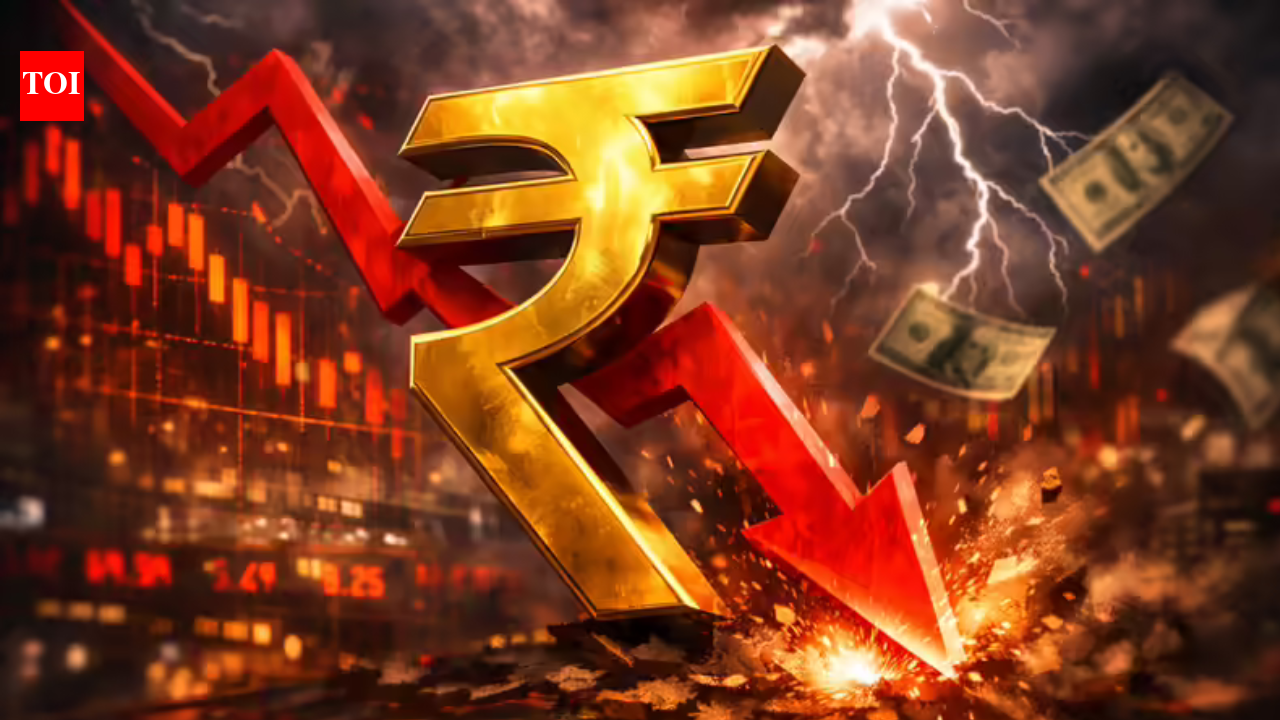
Rupee tumbled to a record low of 95.40 against US dollar in early trade on Tuesday, falling another 17 paise after already ending the previous session at its weakest-ever closing mark. Previously on Monday, the currency had declined sharply by 39 paise to close at 95.23 against the greenback.This comes as global uncertainty continues to be fueled by intensifying Middle East tensions, dragging down financial markets. Crude oil prices have remained elevated, intensifying concerns around inflation and slowing economic growth. During Monday’s trade, rupee opened at 94.95 in the interbank foreign exchange market before sliding throughout the session to settle at 95.23.The cautious sentiment was reflected on Dalal Street as well as benchmark indices tumbled in red. BSE Sensex was trading at 77,090.12, down 179.28 points or 0.23% as of 9:40 am. NSE Nifty50 also dipped to 24,036.95, down 63.85 points or 0.26%.Dilip Parmar, Senior Research Analyst, HDFC Securities told PTI, “The Indian rupee has hit a record low as the dollar recovered and crude oil prices held firm. This ongoing surge in oil prices, combined with foreign fund outflows, is putting a visible strain on India’s trade balance and broader economy. Persistent dollar demand is expected to keep the pressure on the rupee in the short term, driving the USD/INR higher toward the 95.35 and 95.70 levels.“Foreign Institutional Investors remained net buyers in equities worth Rs 2,835.62 crore on Monday, based on exchange figures. In the commodity market, oil prices continued to soar. Crude oil prices were trading at nearly $113 per barrel on May 5 as fresh attacks in the Strait of Hormuz heightened fears over the stability of the US-Iran ceasefire.

A Spirit Airlines plane sits parked at Hollywood Burbank Airport in California, April 16, 2026.
Justin Sullivan | Getty Images
Spirit Airlines struggled for years, battered by larger, cash-rich airlines that copied its business model as well as by failed mergers, higher costs and, most recently, a surge in jet fuel prices because of the war in Iran. It then faced the most unforgiving foe: time.
“We just kind of ran out of runway,” CEO Dave Davis said in an interview with CNBC on Monday.
Spirit had hoped to exit bankruptcy, its second in less than a year, in mid-2026. Four days before the U.S. and Israel attacked Iran, a conflict that has sent fuel prices skyrocketing, Davis said he and his team were optimistic that the exit strategy could still work. But that was contingent on fuel prices moderating in April.
They didn’t.
“Late March, early April, it became clear that it was going to be tough for us to get through,” Davis said, noting that crude oil prices were above $100 a barrel.
Time’s up
Other airlines leave printed instructions for travelers affected by the Spirit Airlines shut down at LaGuardia Airport’s Marine Air Terminal in New York on May 2, 2026.
Leslie Josephs/CNBC
To try to save the company from collapsing, Davis and others inside Spirit talked to the Trump administration about a bailout.
“We got connected with some various folks in government, including [Commerce] Secretary [Howard] Lutnick, through some contacts,” he said. “These guys … particularly Commerce, very eager to help.”
The Trump administration had been working on an offer for a $500 million loan to keep the airline afloat in a plan that could have given the U.S. government an up to 90% stake in the carrier. Bondholders weren’t on board and floated a counter proposal.
“Our bondholders also worked very hard to try to get something done,” Davis said.
The two sides were far apart on deal terms and it was clear by Thursday that it wasn’t going to work.
“I think we just ran out of time,” he said.
Spirit said some 17,000 people, both direct and indirect airline workers, lost their jobs in the airline’s collapse. Other carriers, smelling blood, had been circling for nearly a year if not longer, and within hours of the airline’s collapse were scrambling to both fly ticketed Spirit customers and add to their schedules in the absence left by Spirit’s yellow planes.
What’s next?
A Spirit Airlines poster on a LaGuardia Airport shuttle bus the day the airline shut down.
Leslie Josephs/CNBC
Spirit hired longtime airline executive Davis, most recently chief financial officer at Sun Country, in April 2025, about a month after the company zipped out of its first bankruptcy. Critics said it avoided bigger changes in that first bankruptcy, like shedding more assets to get costs down.
Last August, the airline filed for Chapter 11 bankruptcy protection again, facing many of the same problems, though it had slashed flights, gotten rid of some of its Airbus jets and furloughed crew members to save cash.
Davis previously worked at Northwest Airlines, which combined with Delta Air Lines in 2008, and also worked at US Airways, which merged with American Airlines in 2013. Along with United Airlines and Southwest Airlines, the four airlines control about 80% of U.S. capacity, after a major wave of consolidation.
More consolidation is likely and “what the lower end of the industry needs,” Davis predicted. He said if Spirit’s planned acquisition by JetBlue Airways wasn’t blocked by a judge two years ago, “I believe that we wouldn’t be in the situation we are right now.”
Low-fare airlines for a time were a headache for big legacy carriers, since they swooped into markets and offered eye-catching fares.
“There was no better exemplar of that than Spirit,” Davis said.
But then the big airlines started to copy some of the budget model, offering no-frills basic economy tickets and other add-on fees. That hurt carriers like Spirit, which was profitable in the 2010s but hadn’t turned a profit since 2019.
“Everybody saw the low-cost airlines just taking massive share,” he said. “The shoe was completely on the other foot then, than where it is today.”
He said another benefit the larger airlines have is their huge credit card programs, in which they earn money from banks when customers swipe their credit cards, a business that gives them a bigger cash cushion to weather shocks like high fuel prices.
Davis said in Spirit’s final days he was between Washington and the company headquarters in Dania Beach, Florida, trying to get to a deal. Some staff members, including pilots, didn’t get final word about the airline’s last flights until they were getting close to landing Friday night or early Saturday.
“You can’t announce ahead of time that you’re going to shut down,” he said. “What happens is vendors stop working. Fuelers stop fueling. Some crew members probably don’t come in. So then you’ve got airplanes and people and passengers scattered all over the place in foreign countries. It needs to be done in a very orderly way, and it needs to be done all at once.”
Davis said he is staying on at Spirit to oversee the airline’s closure. Leased planes will go back to lessors. Owned ones will get sold. Gates will be overseen by airports and likely used by other airlines. About 130 other employees are set to stay on for that work as well.
When asked if he would stay in the industry, Davis said: “I just love airplanes, and I like the industry, so I’ll probably never leave it, although sometimes it’s very trying and taxing on a person.”
Heineken has announced a substantial investment exceeding £44 million into hundreds of its pubs across the UK, a move expected to create approximately 850 jobs.
The Dutch brewing giant’s Star Pubs operation, which manages 2,350 sites nationwide, is undertaking this significant financial commitment despite a challenging period for the pub sector.
The industry has faced considerable pressure over the past year, grappling with escalating labour costs and increases in national insurance contributions.
Concurrently, consumer spending has been constrained by concerns over inflation and rising unemployment, further impacting pub revenues. However, pubs did receive additional business rates support from the government last month, aimed at alleviating some of these financial burdens.
Lawson Mountstevens, managing director of Star Pubs, indicated that the investment strategy is partly designed to bolster revenues and help the group navigate the recent “sustained increases in running costs”.
This year, £44.5 million will be allocated to upgrades for 647 pubs. A notable 108 of these venues are earmarked for particularly significant cash injections, with each transformation costing at least £145,000.
Heineken clarified that while the majority of its pubs are group-owned, they are independently operated by local licensees. A key focus for this investment, particularly in the lead-up to the 2026 football World Cup, will be on sports-focused venues.
The pub firm and brewer has a history of significant investment in British pubs, having pumped £328 million into the sector since 2018. Work has already commenced at 52 locations, including eight projects dedicated to reopening boarded-up pubs that have endured lengthy closures.
Mr Mountstevens also urged the government to reduce the tax burden on pubs, arguing it would ease cost pressures and foster further job creation within the industry.
He stated: “We can only do so much; the root-and-branch reform of business rates that the industry has been calling for over many years is urgently required, as well as a lowering of the burden of taxation on pubs, including VAT and beer duty.”
He concluded with a direct appeal: “We are calling on the Government to support us in bringing out the best in the Great British pub.”


Vibrant Gujarat Regional Conference attracts $37 bn, led by textiles

Lauren Sánchez Bezos trains with NYC firefighters ahead of Met Gala 2026

US-Iran talks progressing with Pakistan’s efforts, says Araghchi amid Hormuz tensions

-

 Tech1 week ago
A Brain Implant for Depression Is About to Be Tested in Humans
-
 Business1 week ago
‘I had £20,000 stolen and had to fight a 13-month fraud reporting rule to get it back’
-

 Tech1 week ago
Almost 90% of women leave tech industry within 10 years | Computer Weekly
-

 Sports7 days ago
Pro wrestling star Steph De Lander reveals how colleague’s advice helped lead her to title triumph at ACW
-
 Business1 week ago
Pakistan’s oil market is fuelling the crisis | The Express Tribune
-

 Entertainment1 week ago
Melania Trump says ABC should ‘take a stand’ on late-night host Kimmel
-

 Tech7 days ago
This Ambitious Laptop Doesn’t Leave Much Room for Your Hands
-

 Entertainment1 week ago
Norway joins Type 26 Frigate Programme to boost NATO naval power