

Business
GameStop’s Ryan Cohen eyes ‘very big’ consumer megadeal that could increase company’s value tenfold


GameStop wants to acquire a publicly traded consumer company that’s far larger than the video game retailer in a deal that could be “transformational” for the company, CEO Ryan Cohen told CNBC in an interview Friday.
“It’s gonna be really big. Really big. Very, very, very big,” Cohen said of the size of the acquisition. “It’s transformational. Not just for GameStop, but ultimately, within the capital markets … this is something that really has never been done before within the history of the capital markets.”
Cohen declined to name the company’s targets – saying only he’s seeking a publicly traded consumer company that’s undervalued, “high quality, durable, scalable with growth prospects” and has a “sleepy management team” behind the wheel. He claimed if the investment pans out, it has the “potential to make [GameStop] worth several hundreds of billions of dollars.”
“If it works, it’s genius. If it doesn’t work, then, you know, it will be totally, totally foolish,” Cohen, the co-founder and former CEO of Chewy, acknowledged. “But I believe we have the components to make it work, and I’m very confident in the ability to make the asset much, much, much more efficient … we’ve got the governance structure, we’ve got the capital, we have the operational expertise.”
While Cohen has transformed GameStop from a dying legacy retailer into a money making business, it’s unclear how an acquisition in the consumer space could increase its worth to over $100 billion – a herculean task for a business with a $10.5 billion market cap.
One investment banker in the consumer and retail space was skeptical Cohen could pull it off, saying there are very few businesses in the sector that could increase GameStop’s value so dramatically.
“I’ve never seen it,” the person said. “Unless you’re talking about radically transforming a business model or something, it just doesn’t happen in retail.”
Another agreed.
“It’s easy to say something,” the person said. “It’s a lot harder to do it.”
GameStop’s ambitions to balloon in size first came to light in early January. The company unveiled a new, all-or-nothing equity incentive for Cohen that will only pay out if it reaches a market cap of $100 billion and sees $10 billion in cumulative earnings before interest, taxes, depreciation and amortization.
If GameStop’s acquisition plans succeed and its market value hits $100 billion or more, Cohen gets his payday — but he said he hopes “all shareholders do” as well.
Since taking over as GameStop’s CEO in September 2023, Cohen has dramatically cut costs, improved the retailer’s profitability and grown its collectibles business, even as overall sales have sagged.
Between GameStop’s fiscal 2023 third quarter, when Cohen took over, and its fiscal 2025 third quarter, its most recent quarter, GameStop’s gross margin has grown by 7 percentage points and net income has climbed to $77.1 million, up from a loss of $3.1 million. In fiscal 2024 and 2025, the retailer posted consecutive annual net incomes following five straight years of losses.
The company’s success has attracted interest from Michael Burry — the investor who became famous after betting against the U.S. housing market ahead of the financial crisis — who recently disclosed that he’s been buying shares.
“Ryan is making lemonade out of lemons,” Burry said in a Monday Substack post. “He has a crappy business, and he is milking it best he can while taking advantage of the meme stock phenomenon to raise cash and wait for an opportunity to make a big buy of a real growing cash cow business.”
Over the last two years, GameStop has also amassed a more than $9 billion cash pile between cash on hand and marketable securities – money the company had been using to invest in bitcoin.
When asked if GameStop will liquidate its bitcoin holdings to help fund its acquisition plans, Cohen said he was “not prepared to say,” but called his new strategy “way more compelling than bitcoin.”
“It’s similar to Berkshire Hathaway, except what Berkshire did in decades we’re attempting to do in a much shorter time in terms of creating that much value,” said Cohen. “We can go in there and apply the Chewy and [GameStop] mindset of like brutal efficiency and increase the profitability of the company very, very quickly and so we could capture a lot more value by focusing on this under optimized asset, and then eventually we could move on to the next one, but, you know, we’ll see what happens.”


Interest rates are widely expected to remain at 3.75% as Bank of England policymakers prioritise curbing above-target inflation while also monitoring economic growth, according to expert analysis.
The Bank’s Monetary Policy Committee (MPC) is anticipated to leave borrowing costs unchanged when it announces its latest decision on Thursday, marking its first interest rate setting meeting of the year.
This follows a rate cut delivered before Christmas, which was the fourth such reduction.
At the time, Governor Andrew Bailey noted that the UK had “passed the recent peak in inflation and it has continued to fall”, enabling the MPC to ease borrowing costs. However, he cautioned that any further cuts would be a “closer call”.
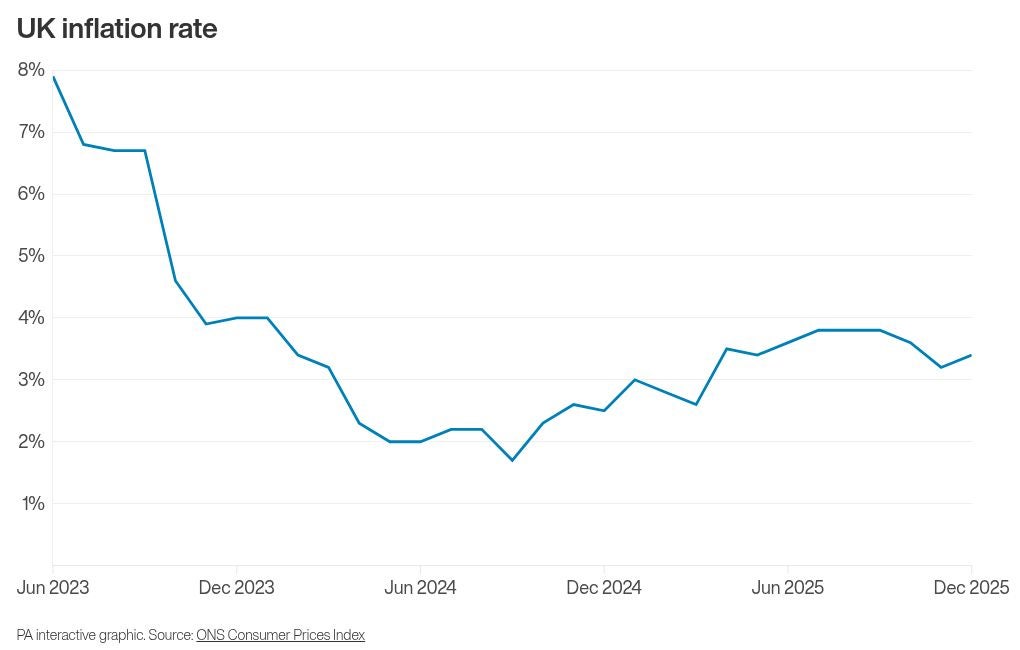
Since that decision, official data has revealed that inflation unexpectedly rebounded in December, rising for the first time in five months.
The Consumer Prices Index (CPI) inflation rate reached 3.4% for the month, an increase from 3.2% in November, with factors such as tobacco duties and airfares contributing to the upward pressure on prices.
Economists suggest this inflation uptick is likely to reinforce the MPC’s inclination to keep rates steady this month.
Philip Shaw, an analyst for Investec, stated: “The principal reason to hold off from easing again is that at 3.4% in December, inflation remains well above the 2% target.”
He added: “But with the stance of policy less restrictive than previously, there are greater risks that further easing is unwarranted.”
Shaw also highlighted other data points the MPC would consider, including gross domestic product (GDP), which saw a return to growth of 0.3% in November – a potentially encouraging sign for policymakers.
Matt Swannell, chief economic advisor to the EY ITEM Club, affirmed: “Keeping bank rate unchanged at 3.75% at next week’s meeting looks a near-certainty.”
He noted that while some MPC members who favoured a cut in December still have concerns about persistent wage growth and inflation, recent data has not been compelling enough to prompt back-to-back reductions.
Edward Allenby, senior economic advisor at Oxford Economics, forecasts the next rate cut to occur in April.
He explained: “The MPC will continue to face a delicate balancing act between supporting growth and preventing inflation from becoming entrenched, with forthcoming data on pay settlements likely to play a decisive role in shaping the next policy move.”
The Bank’s policymakers have consistently voiced concerns regarding the pace of wage increases in the UK, which can fuel overall inflation.
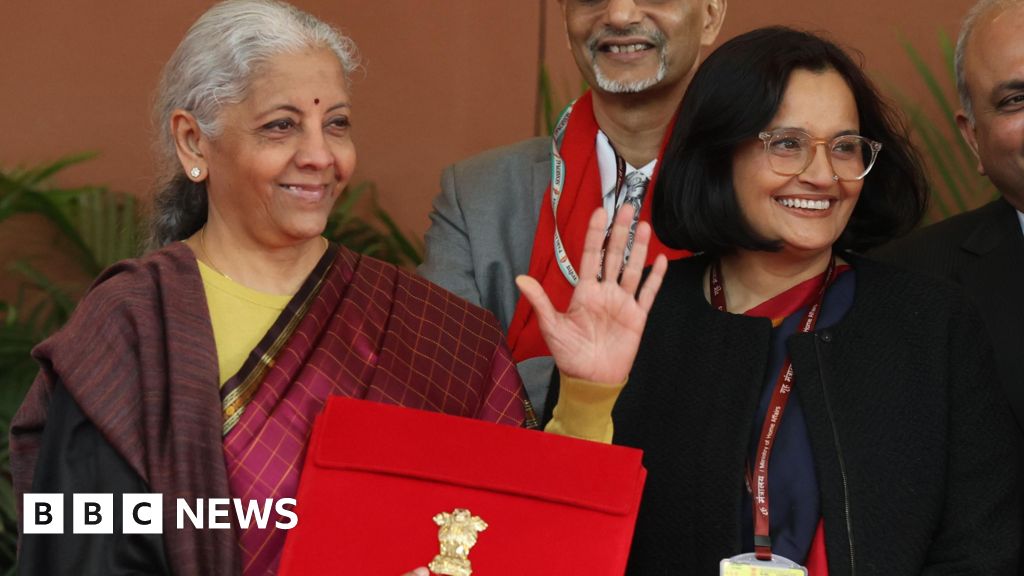
India’s budget focuses on infrastructure and defence spending and tax breaks for data-centre investments.
Source link
Business
New Income Tax Act 2025 to come into effect from April 1, key reliefs announced in Budget 2026

New Delhi: Finance Minister Nirmala Sitharaman on Sunday said that the Income Tax Act 2025 will come into effect from April 1, 2026, and the I-T forms have been redesigned such that ordinary citizens can comply without difficulty for ease of living.
The new measures include exemption on insurance interest awards, nil deduction certificates for small taxpayers, and extension of the ITR filing deadline for non-audit cases to August 31.
Individuals with ITR 1 and ITR 2 will continue to file I-T returns till July 31.
“In July 2024, I announced a comprehensive review of the Income Tax Act 1961. This was completed in record time, and the Income Tax Act 2025 will come into effect from April 1, 2026. The forms have been redesigned such that ordinary citizens can comply without difficulty, for) ease of living,” she said while presenting the Budget 2026-27
In a move that directly eases cash-flow pressure on individuals making overseas payments, the Union Budget announced lower tax collection at source across key categories.
“I propose to reduce the TCS rate on the sale of overseas tour programme packages from the current 5 per cent and 20 per cent to 2 per cent without any stipulation of amount. I propose to reduce the TCS rate for pursuing education and for medical purposes from 5 per cent to 2 per cent,” said Sitharaman.
She clarified withholding on services, adding that “supply of manpower services is proposed to be specifically brought within the ambit of payment contractors for the purpose of TDS to avoid ambiguity”.
“Thus, TDS on these services will be at the rate of either 1 per cent or 2 per cent only,” she mentioned during her Budget speech.
The Budget also proposes a tax holiday for foreign cloud companies using data centres in India till 2047.


Netflix’s exciting February line up revealed

Netherlands’ goods exports to US fall 4.7% in Jan-Oct 2025

I Tested 10 Popular Date-Night Boxes With My Hinge Dates

-

 Sports5 days ago
PSL 11: Local players’ category renewals unveiled ahead of auction
-

 Tech1 week ago
Strap One of Our Favorite Action Cameras to Your Helmet or a Floaty
-

 Sports1 week ago
Wanted Olympian-turned-fugitive Ryan Wedding in custody, sources say
-

 Entertainment1 week ago
Three dead after suicide blast targets peace committee leader’s home in DI Khan
-

 Tech1 week ago
This Mega Snowstorm Will Be a Test for the US Supply Chain
-

 Sports1 week ago
Storylines shaping the 2025-26 men’s college basketball season
-

 Entertainment1 week ago
UFC Head Dana White credits Trump for putting UFC ‘on the map’
-

 Entertainment5 days ago
Claire Danes reveals how she reacted to pregnancy at 44