

Fashion
ICE cotton remains stable; bearish tone persists after WASDE report


The most actively traded March cotton contract eased by 0.02 cent to settle at 61.59 cents per pound after trading as high as 62.28 cents earlier in the day. The more actively traded May cotton futures contract gained 0.55 cent, or 0.90 per cent, to settle at 63.78 cents per pound.
ICE cotton futures were largely steady after the USDA’s February WASDE report signalled higher global production and stocks alongside lower consumption and exports for 2025–26.
The data, largely in line with expectations, weighed on sentiment, though a weaker US dollar limited losses.
March closed marginally lower, while May gained 0.90 per cent.
Most contracts traded higher by between 2 and 32 points. Contracts from May 2026 through October 2027 recorded their second consecutive higher close, indicating mild strength in deferred months.
Weak US economic data pushed the dollar lower against major currencies, making dollar-denominated cotton relatively cheaper for overseas buyers.
Trading volume was extremely heavy at 131,395 contracts, just below Monday’s 2026 high of 139,728 contracts. Historically, cotton has traded above 100,000 contracts only 25 times, with 15 of the top 18 volume days occurring in the past 12 months, showing that large volumes can occur without major price swings.
USDA February estimates place 2025–26 global cotton production at 119.86 million bales (January: 119.43 million) and ending stocks at 75.11 million bales (January: 74.48 million). The USDA cut its 2025–26 global cotton consumption forecast by 200,000 bales and its export forecast by 60,000 bales.
Market analysts said the data were within expectations and that prices have retreated from recent highs. The market appears oversold and could rebound towards 64 cents.
Meanwhile, Intercontinental Exchange data showed ICE-certified No. 2 cotton stocks at 95,158 bales as of February 9, compared with 93,561 bales a day earlier.
This morning (Indian Standard Time), ICE cotton for March 2026 traded at 61.87 cents per pound (up 0.28 cent), cash cotton at 59.59 cents (down 0.02 cent), the May 2026 contract at 64.04 cents (up 0.26 cent), the July 2026 contract at 65.76 cents (up 0.28 cent), the October 2026 contract at 67.41 cents (up 0.23 cent), and the December 2026 contract at 67.21 cents (up 0.12 cent). A few contracts remained at their previous closing levels, with no trading recorded so far today.
Fibre2Fashion News Desk (KUL)












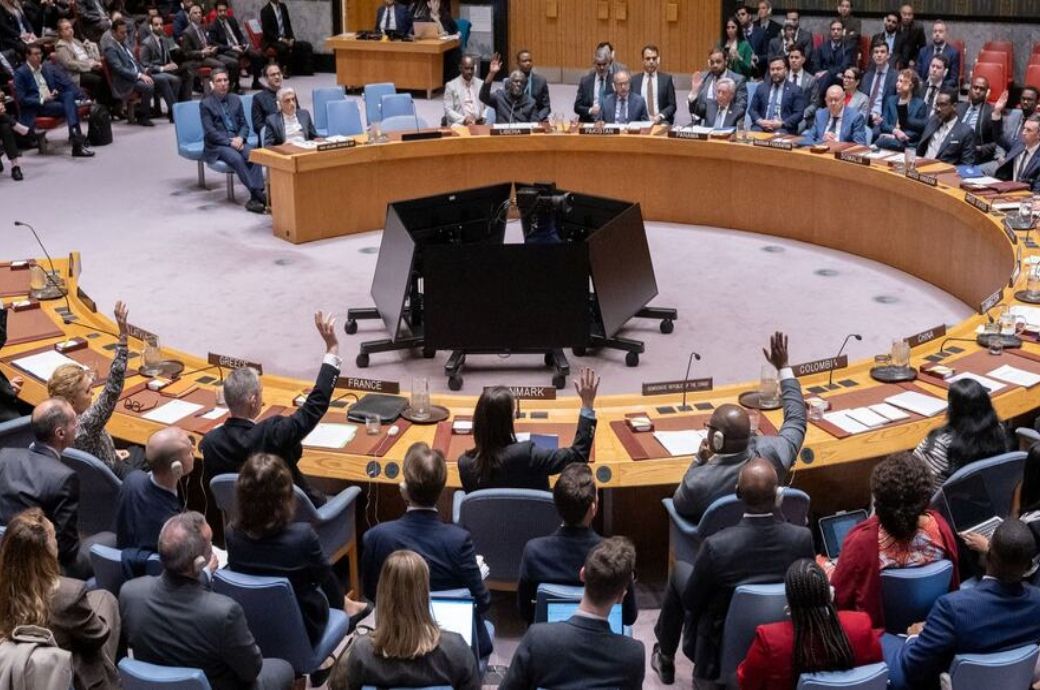
The vote followed multiple rounds of negotiations.
The UN Security Council has rejected a draft resolution submitted by several Gulf states that would have strongly encouraged countries to coordinate defensive efforts and deter attempts to interfere with navigation through the Strait of Hormuz.
By a vote of 11 in favour to two against (China, Russia), with two abstentions, a draft resolution submitted by several Gulf states could not be adopted.
Abdullatif bin Rashid Alzayani, Minister for Foreign Affairs of Bahrain and Council President for April, presided over the meeting. “We [member states of the Gulf Cooperation Council] declare loudly and unequivocally before this Council, which is charged with the maintenance of international peace and security, that [Iran] has no right to close this waterway to international navigation,” he said.
He cautioned that if the Council permits the Strait of Hormuz to remain closed today, “such a scenario would inevitably be replicated in other straits and waterways, thereby transforming the world into a jungle where force, arrogance and hegemony prevail”.
However, by a vote of 11 in favour to two against (China, Russia), with two abstentions (Colombia, Pakistan), the draft resolution could not be adopted.
The Chinese representative said that the proposed draft “failed to capture the root causes and the full picture of the conflict in a comprehensive and balanced manner”. Noting that it contained one-sided condemnations, he stressed that “this war should never have happened” and called on the United States and Israel to cease what he described as illegal military actions.
He also called on Iran to stop its attacks and noted that his delegation is currently working alongside Moscow on an alternative resolution to address the situation, according to a UN press release.
Beijing and Moscow announced plans to introduce an alternative text soon. “Our draft will be concise, equitable and balanced,” said the Russian representative.
“The objective of this draft is obvious,” stated Iran’s representative, as it seeks to “punish the victim for defending its sovereignty and vital national interests in the Persian Gulf and the Strait of Hormuz while providing political and legal cover for further unlawful acts by the aggressors”.
Fibre2Fashion News Desk (DS)
ETI is a composite index for payroll employment. When it increases, employment is likely to grow as well, and vice versa.
The Conference Board employment trends index for the US declined to 105.72 in March, from an upwardly revised 105.84 in February.
Job seekers continue to face a challenging market, according to economist Mitchell Barnes.
The share of consumers who report ‘jobs are hard to get’ climbed to 21.5 per cent in March and reflects a 5-percentage point rise YoY.
“Job seekers continue to face a challenging market,” said Mitchell Barnes, economist at the US think tank, said in a release. “This is evident in the ETI as several components moderated in March. Overall, the US economy has remained surprisingly resilient, but rising geopolitical uncertainty may contribute to ongoing employer hesitancy to add more workers.”
The share of consumers who report ‘jobs are hard to get’—an ETI component from the Consumer Confidence Survey—climbed to 21.5 per cent in March and reflects a 5-percentage point (pp) rise year on year (YoY).
The share of small firms reporting that jobs are ‘not able to be filled right now’ declined by 1 pp in March to reach 32 per cent.
Fibre2Fashion News Desk (DS)


This AI Button Wearable From Ex-Apple Engineers Looks Like an iPod Shuffle

Tom Holland calls Christopher Nolan ‘The Odyssey’ ‘an absolute masterpiece’

Transfer rumors, news: Liverpool, Real Madrid work on mega midfield swap deal

-
Uncategorized7 days ago
[CinePlex360] Please moderate: “Trump signals p
-
 Business7 days ago
Jaguar Land Rover sees sales recover after cyber attack
-

 Entertainment6 days ago
Joe Jonas shares candid glimpse into parenthood with Sophie Turner
-

 Tech6 days ago
Our Favorite iPad Is $50 Off
-

 Fashion1 week ago
China’s Anta Sports posts record $11.62 bn revenue in 2025
-

 Politics6 days ago
Iran can sustain Strait of Hormuz closure for years, will cut US military logistics: Official
-

 Sports5 days ago
UConn Final Four run could trigger a $50M furniture giveaway for Massachusetts-based Jordan’s Furniture
-
 Business6 days ago
Video: Why Is the Labor Market Stuck?