

Business
How packaging and logistics companies are automating their warehouses


DHL Autonomous Robot at work.
Source: DHL
Workers at DHL Group used to walk close to a half marathon each day just to classify, pick and move items across massive warehouses.
Now, their distance and efforts are greatly reduced by autonomous mobile robots that can unload containers for the package delivery and supply chain management company with a speed of up to 650 cases per hour.
“That is what we look forward to, and where we’ve been successful in deploying technology at scale over the last five years, going from when we started in 2020 with 240 projects, and now we’re up to 10,000 projects,” Tim Tetzlaff, DHL’s global head of digital transformation, told CNBC.
The company’s autonomous innovations have accelerated processes at 95% of DHL’s global warehouses. Item-picking robots in one warehouse have increased units picked per hour by 30%, while autonomous forklifts at that same warehouse have contributed a 20% increase in efficiency, the company said.
Tetzlaff said automation is important for the company because it’s such a labor-intensive business.
“We still have the ambition to grow our business even further, but if you look at where these distribution centers should be located … it’s typically very tough to find additional labor or even additional spaces just to build these warehouses there,” he said.
DHL is one of multiple fulfillment companies moving toward automation and leveraging artificial intelligence as the industry works toward greater efficiency.
On an earnings call with analysts in late January, United Parcel Service CEO Carol Tomé said the company deployed automation in 57 buildings in the fourth quarter, bringing its total to 127 automated buildings, with plans for 24 more in 2026.
“This year, we plan to further automate our network and as a result, we expect to increase the percentage of U.S. volume we process through automated facilities to 68% by the end of the year, up from 66.5% at the end of 2025,” she said.
Similarly, FedEx has said it sees automation as an opportunity to enhance its workers’ jobs, installing robotic arms to help process small packages at its Memphis hub and working with AI company Dexterity to leverage robots for loading boxes into containers. Its “Network 2.0” initiative is working to increase the efficiency of its package processes.
The company recently announced a partnership with Berkshire Grey to launch a fully autonomous robot to unload containers and optimize operations.
It estimates that the global warehouse automation market is expected to exceed $51 billion by 2030.
“We now have about 24% of our eligible average daily volume flowing through 355 Network 2.0-optimized facilities,” CEO Raj Subramaniam said on a call with analysts in December.
A human fleet
A worker unloads packages from a FedEx truck in San Francisco, California, US, on Wednesday, Dec. 17, 2025.
David Paul Morris | Bloomberg | Getty Images
With the rise of automation, companies are weighing the balance between their human workers and their technological innovations.
UPS has announced layoffs north of 75,000 over the past year as the company focuses on efficiency and cuts down its partnership with Amazon amid a multiyear turnaround plan.
The company also said it closed 93 buildings in 2025 and plans to shutter at least 24 buildings in the first half of 2026.
“What’s happening is you’re seeing a cascading effect of sites being closed that are legacy conventional facilities, a lot of labor required to run those facilities, to a much more nimble, quicker, automated, consolidated facility,” Executive Vice President Nando Cesarone said on the January call.
In a statement to CNBC, a UPS spokesperson said the company is focused on making jobs easier for its employees and that the AI and robotics take on repetitive tasks that “make us more efficient in other functions.”
FedEx did not respond to requests for comment on how the company is balancing its workforce and technology. Subramaniam said on the most recent earnings call that the Network 2.0 initiative has resulted in “structural cost reductions” but the company has not publicly disclosed job cut amounts.
Teamsters, the union representing workers from many of the major packaging companies, said it will remain focused on ensuring its team members have a voice at the table when it comes to technology.
“We never want to get in the way of technology and its development, but all of that, it must support workers, and it cannot work against them ever,” spokesperson Lena Melentijevic told CNBC. “It’s the workers who are the backbone of each one of these companies and who are essential to their success, and we are here to advocate for them and hold companies accountable.”
DHL’s Tetzlaff said the company wants its automation to complement human labor instead of replacing it altogether. Regardless of how much DHL’s technology improves, Tetzlaff said the dexterous tasks of packaging and shipping remain in the hands of the employees.
“In the time where we deployed 8,000 collaborative robotics into our operation worldwide, we still hired 40,000 people,” he said.
The biggest area where DHL has deployed its robotics is in item picking, with more than 2,500 robots using trained arms to select items for packages. This past holiday season, to keep up with the Black Friday and Christmas demand, the company added 30% capacity to its robotic fleet.
“There’s an advantage for us as a company, having a great human fleet of workers that is motivated and likes the job, but complementing this with a robotic fleet that we can scale up and down and have that flexible stability to deal with change, the peaks throughout the year, be it bigger changes like Covid, be it [customer] profile changes and so on,” he said.
The path forward for investment
DHL Autonomous Forklift at work.
Source: DHL
Still, it’s unlikely there will be a near future in which warehouses are full of humanoid robots, according to supply chain expert and Accenture logistics and fulfillment lead Benjamin Reich.
Humanoid robots have been gaining intense popularity as tech companies innovate human-like machines, with Nvidia CEO Jensen Huang saying he believes the innovation is fast moving. At the January CES trade show, Google announced a partnership with Boston Dynamics, the same company working with DHL, to augment the tech company’s new robot named Atlas.
But Reich said among his clients, he’s seeing that “humans are still in the lead.”
“We are also not seeing a replacement of jobs, but a shifting that you’re more looking for skill sets on the market to serve the gap between degree of automation, operational tasks as well as organizational,” Reich told CNBC.
The automation is angled toward specific jobs, he added, with robots taking over repetitive tasks and companies instead “redirecting” their hiring toward technical roles instead of eliminating job growth altogether.
Reich said the industry is seeing rising investments into automation, with the biggest gains coming not from replacing people, but through increasing the efficiency of the supply chain and warehouse execution processes.
There are also factors in the broader industry that are impacting the workforce, according to Ronny Horvath, the transportation and logistics lead at Accenture. There’s a shortage of skilled workers who have both the manual skills and the organizational skills needed for the sector, and there’s also competition among companies for warehouse personnel based on pay, benefits, lifestyle and more.
“So automation can also help, not replacing but augmenting that gap, that void, that has been left by just not getting the workers that you have today,” Horvath said. “And we see a lot of clients, they have an automation or robotic strategy … but they still have the plans to hire human workers as well.”
Horvath added that the industry is reaping the rewards of its new technology. He’s seen companies able to adjust to deliver on high demand, increase efficiency and work toward more automated processes to keep up with warehousing.
According to an Accenture study from March, 51% of factories globally expect to have fully automated warehouses by 2040, and 70% of transportation logistics executives treat autonomous supply chains as a top investment priority.
“There’s almost no autonomous structure existing at the moment,” Horvath said. “So most or some of these clients are starting from scratch, and this will take time until these investments are done and until they also reap the benefits out of it for all those areas.”


A Nike logo is displayed at a Nike store in Austin, Texas, Feb. 5, 2026.
Brandon Bell | Getty Images
Shares of Nike fell in extended trading Tuesday after the retailer warned sales will fall for the rest of the calendar year, led by an expected 20% decline in its key China market during the current quarter.
Chief Financial Officer Matt Friend said during the company’s earnings call that Nike expects sales for its current fiscal fourth quarter to drop between 2% and 4%, compared with Wall Street estimates of a 1.9% increase, according to LSEG.
For the duration of the calendar year, Friend said, the company expects sales to fall by a low single-digit percentage, led by growth in North America and offset by declines in China. That outlook wasn’t comparable to estimates.
Nike beat expectations across the business on both the top and bottom lines for its fiscal third quarter, but its guidance left investors with more questions about how long its turnaround will take. Friend also cautioned that Nike’s guidance was based off of where the global economic picture stands today — and it could change given recent geopolitical volatility.
“We also recognize that the environment around us has become increasingly dynamic, and we could experience unplanned volatility due to the disruption in the Middle East, rising oil prices and other factors that could impact either input costs or consumer behavior,” said Friend. “We are focused on what we can control.”
Shares fell more than 8% in extended trading.
Here’s how the world’s largest sneaker company did for its fiscal third quarter, compared with estimates from analysts polled by LSEG:
- Earnings per share: 35 cents vs. 28 cents expected
- Revenue: $11.28 billion vs. $11.24 billion expected
The company’s reported net income for the three-month period that ended Feb. 28 was $520 million, or 35 cents per share. That’s a 35% decline from $794 million, or 54 cents per share, a year earlier. That plunge came as Nike’s gross profit margin slid 1.3 percentage points to 40.2%, “primarily due to higher tariffs in North America,” the company said.
Sales were flat at $11.28 billion, compared to $11.27 billion last year.
While Nike beat expectations on the top and bottom lines, it posted a mixed picture regionally. Nike’s largest market of North America continued to show steady growth, as revenue climbed 3% to $5.03 billion, but that was just shy of Wall Street’s expectations of $5.04 billion, according to StreetAccount.
Meanwhile, Nike’s Greater China market continued to shrink, with revenue down 7% to $1.62 billion during the quarter. Still, that total beat analyst estimates of $1.50 billion, according to StreetAccount.
Nike is continuing to work through a colossal turnaround under CEO Elliott Hill. About a year and a half into his tenure, Hill has made strides in repairing parts of the business, but has been clear that it’ll take time for the entire company to improve given the retailer’s scale and complexity.
He reiterated that expectation on Tuesday, saying in a news release that “the pace of progress is different across the portfolio.”
“The areas we prioritized first continue to drive momentum,” Hill said. “The work is not finished, but the direction is clear, our teams are moving with focus and urgency, and our foundation is getting even stronger to build the future of NIKE.”
Friend said Nike’s turnaround efforts “will continue to impact results over the balance of the calendar year.”
Nike’s recovery was already coming at a tough time as a global trade war dented its efforts to improve profitability and drive sales from inflation-weary shoppers. But now the athletic company will have to contend with a new war in the Middle East that’s already led to rising gas prices and is expected to send consumer prices even higher, which could push shoppers to cut back on nice-to-haves like new clothes and shoes to save money elsewhere.
“We continue to be encouraged by the momentum in North America. We’ve got a strong order book for summer,” Friend said. “We’re seeing positive signs and sell through. We’re not seeing a consumer reaction to what’s going on in the Middle East at this point in time, in North America.”
Hill has focused in part on revitalizing Nike’s business with wholesale partners as opposed to direct sales on its website and in stores. Wholesale revenue climbed 5% to $6.5 billion.
Meanwhile, direct sales slid 4% to $4.5 billion.

It is thought that thousands of people may have lost their jobs at Oracle, one of the world’s largest tech companies.
Source link
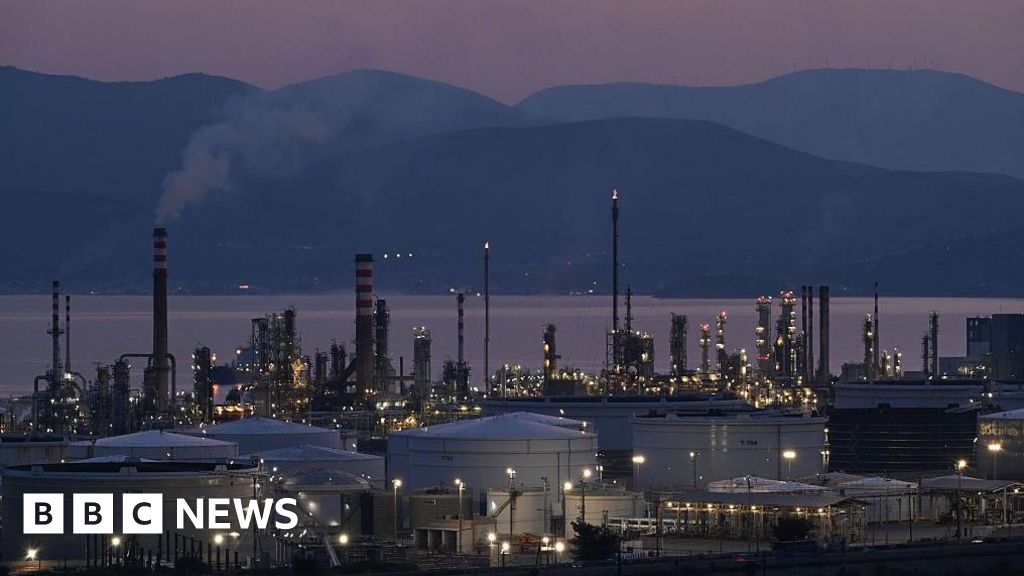
The US-Israel Iran war has halted almost all traffic in a key waterway and the price Brent crude has surged.
Source link

Nike shares fall 9% on weak outlook, expected 20% sales decline in China

Prince Harry surprises crowd by calling attendees his source of hope

Wrigley Field to host Big Ten/SEC volleyball doubleheader

-

 Politics1 week ago
Afghanistan announces release of detained US citizen
-

 Sports1 week ago
Broadcast industry CEO says consolidation is ‘essential’ to compete for NFL soaring media rights prices
-

 Entertainment1 week ago
UN warns migratory freshwater fish numbers are spiralling
-

 Tech1 week ago
Can a Home Appliance Fix the Problem of Soft-Plastic Waste?
-
 Business1 week ago
Property Play: Home flippers see smallest profits since the Great Recession, real estate data firm says
-
 Business1 week ago
Gold prices soar in Pakistan – SUCH TV
-

 Fashion1 week ago
ICE cotton slips on weaker crude, profit booking
-
 Business1 week ago
More women are entering wealth management, but few are in advisory roles, study finds