

Business
Pricy airfare, airport chaos test travelers’ willingness to fly this year


Travelers wait in line at a Transportation Security Administration (TSA) checkpoint at George Bush Intercontinental Airport (IAH) in Houston, Texas, US, on Thursday, March 26, 2026.
Mark Felix | Bloomberg | Getty Images
TOKYO/NEW YORK — Genevieve Price considers herself a great flight hacker.
The 35-year-old naturopathic doctor based in San Diego usually buys basic economy tickets when she visits her family in New Jersey and then uses her Alaska Airlines frequent flier status to pick a seat, something that’s usually not allowed for those no-frills fares.
“I like to travel a lot,” Price told CNBC at New York’s John F. Kennedy International Airport, where she was returning from Rome.
But Price said she has her limits, and is planning to cap the spending she does on future flights, such as no more than $900 to Rome, where her partner is from.
Consumers’ willingness to fly is being put to the test this spring as soaring fuel prices are leading to higher airfares. Cathay Pacific, SAS, Finnair and others are among the carriers that have already raised fares.
Travelers also have to contend with hourslong airport security lines in the U.S. because of the second government shutdown in half a year that’s hitting the Transportation Security Administration, leaving many frustrated.
Fuel and fares
Fuel at major U.S. airports was going for $3.98 on Wednesday, up nearly 60% since before the U.S. and Israel attacked Iran on Feb. 28.
The conflict has meant crisis for the aviation industry, particularly in the Middle East, where airspace closures have forced carriers to cancel flights and take longer and costlier routes.
Airlines will brief investors starting early next month on the longer-term impacts, but they immediately started raising airfare or increasing fuel surcharges on tickets to help cover the rising costs.
United Airlines CEO Scott Kirby told reporters at a company event in Los Angeles this week that airfare could go up 20% this year. Customers appear willing to keep booking even though carriers are passing those high fuel costs along to travelers, he added.
Other airlines have also said demand has held up.
Delta Air Lines CEO Ed Bastian told a JPMorgan industry conference earlier this month that demand has remained strong in recent weeks and that the airline is “well-positioned” to recapture the spike in fuel from its own sales.
U.S. airlines have seen solid demand for years. International travel has been a strong point, particularly for high-end leisure travel, which has brought so many visitors that governments from Japan to Spain have taken steps to reduce overtourism, while locals have protested.
But airline executives said they will prune flights if demand falls.
“We’re certainly going to be nimble in terms of capacity to make sure that supply and demand stay in balance,” American Airlines CEO Robert Isom said at the JPMorgan conference.
United, for its part, is preparing for fuel prices to remain elevated through next year and is cutting about 3 percentage points off of its capacity in off-peak travel times, like midweek and redeye flights, Kirby told employees this month.
Fares up
Some of the higher fares are already here.
Fares for flights across the Atlantic from the U.S. were going for $1,059, with three weeks advanced purchase, up 26.5% from the prior week, according to a Deutche Bank note on Monday.
Domestic routes, including transcontinental flights and flights to and from Hawaii, were also up, the report said.
Mary Jean Erschen-Cooke, a nurse from Cuba City, Wisconsin, who was setting out earlier this month from Tokyo on a 10-day trip through Japan with her husband, Paul, said she has a host of domestic U.S. family trips this year.
“We haven’t booked our flights, but we should,” she said, adding that she and her husband would consider driving for one of them. She noted that gasoline prices are also up, which will affect driving.
Security snarls
The TSA PreCheck line at terminal B in LaGuardia Airport in East Elmhurst, Queens, New York City, on March 27, 2026.
Leslie Josephs | CNBC
Along with higher airfare, travelers are facing challenges at airports this spring.
TSA officers have been working without regular pay since Feb. 14 because of an impasse in Congress over funding for the Department of Homeland Security. Nearly 500 TSA officers have quit, according to DHS and elevated call-outs have left airports short-staffed.
That’s led to long security lines at major airports around the U.S., including in Houston, New York, and Atlanta. Wait times have exceeded three hours in some locations — longer than some of the flights those airports offered — as lines have snaked through terminals and outside of airports.
Elizabeth Leddy, a 38-year-old classical pianist based in New York, said she flies several times a year. The long security lines, which were running nearly 90 minutes at LaGuardia Airport for TSA PreCheck flyers on Friday, could be a deterrent for her doing that in the future.
Leddy said that if the security line was three to four hours long, “I feel like I could just drive.”
DHS has blamed Democrats for the closure, which has become the longest partial shutdown in U.S. history. As of Friday afternoon, the Senate had passed a potential deal to end the shutdown, thought its fate was unclear.
President Donald Trump separately said he would sign an order to get the more than 50,000 TSA officers paid. TSA officers will start getting paychecks as early as Monday, DHS said Friday.
The Trump administration this week sent Immigration and Customs Enforcement officers to several U.S. airports, though DHS hasn’t specified what their duties are. ICE officers, who also sit under the DHS umbrella, are still getting paid during the partial shutdown.
ICE officers were seen at New York’s LaGuardia Airport on Friday morning watching security lines.
“Even if this manages to slightly reduce wait times (we’re still reading about terrible wait times, so we’re far from big improvement), ICE presence could cause some individuals to fear traveling and upset TSA workers not getting paid,” Bernstein said in a note on Thursday. “Seems possible passenger throughput softens over the coming days and TSA screening YoY growth for this week turns slightly negative.”






First, to be sure, Amazon isn’t without competitors in any of the segments it is in, including e-commerce. Major US retailers like Walmart and Target both have broad-based, rapidly-expanding online retail arms, and offer their own versions of Amazon’s Prime subscription service.
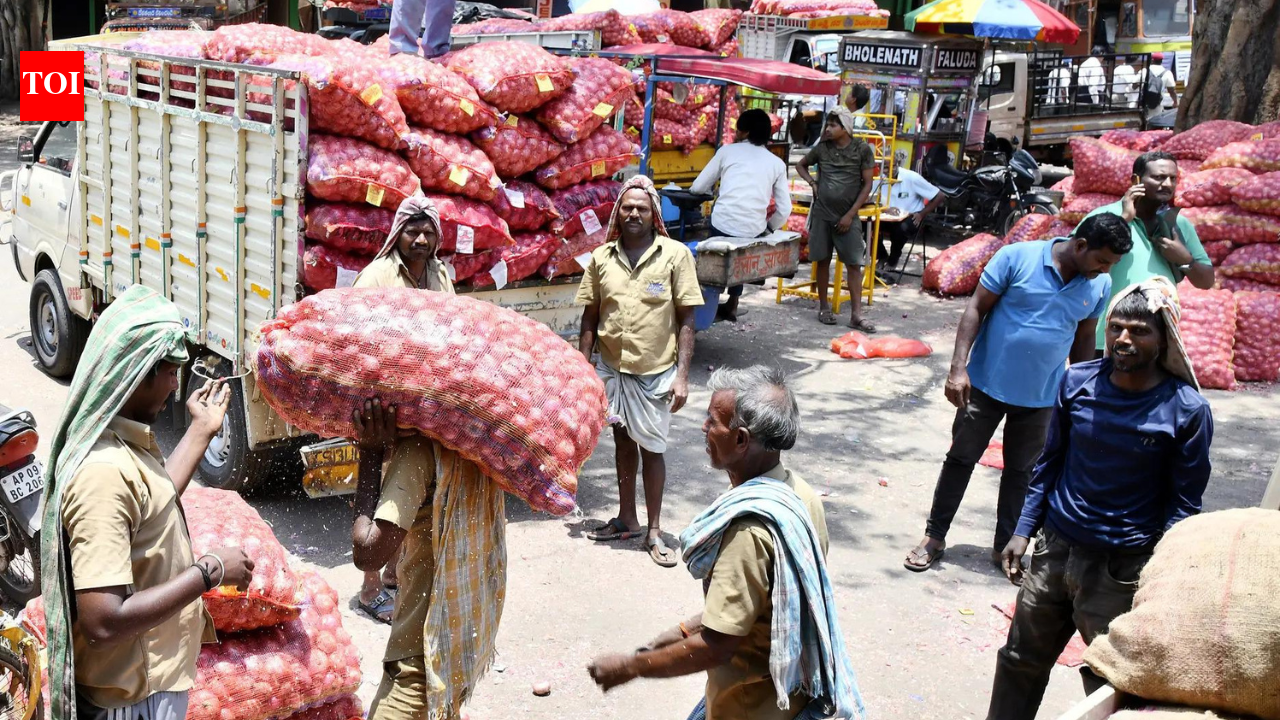
Rain clouds rolled over Maharashtra’s onion belt. Then came war winds from West Asia. Prices collapsed. Crops rotted. Farmers counted losses in rupees — and sold tears by the quintal. Across Nashik, Solapur and Chhatrapati Sambhajinagar, onion growers are reaping a bitter harvest this season as wholesale prices at agriculture produce market committees (APMCs) have crashed far below production costs.Prakash Galadhar, a farmer hailing from Paithan taluka in Chhatrapati Sambhajinagar, hauled 1,262kg of onions he had harvested to market last week. After deductions for labour, loading and transport, his final balance showed he owed the trader Re 1.In Satana APMC of Nashik district, farmer Jitendra Solanke brought 30 quintals hoping to recover at least part of his investment. Traders first offered Rs 50 a quintal. After he protested, rate climbed to Rs 175 a quintal — Rs 1.75 a kg.Still, numbers refused to add up. “I spent Rs 1,200 per quintal to grow crop. After sale, labour and transport charges, only Rs 500 remained. The loss mounted to Rs 36,000,” Solanke said.Inputs have become expensive — seeds, fertilisers, diesel, mechanised farming and labour costs have all risen sharply — while market prices have sunk into mud.“We sell onions at Rs 4 to Rs 5 per kg while production cost is over Rs 12,” said Bhausaheb Jagtap, a farmer from Pune district. “After paying everybody, nothing is left,” Jagtap said.Prices have been sliding since Feb this year. At Lasalgaon APMC in Nashik — country’s largest onion wholesale market and benchmark for national rates — the kitchen staple is currently selling between Rs 400 and Rs 1,600 a quintal. Nearly 80% of arrivals fetch less than Rs 800 a quintal.In Solapur APMC, arrivals on May 13 touched 14,756 quintals. Prices ranged from Rs 100 to Rs 1,700 a quintal, or Rs 1 to Rs 17 a kg. A year ago, onions sold there for Rs 2,500 to Rs 3,000 a quintal.Growers said break-even price stands near Rs 18 a kg. “Losses are massive because nearly 80% of onions are selling between Rs 400 and Rs 800 per quintal,” said Bharat Dighole, president of Maharashtra Onion Growers’ Association.Market experts blamed a perfect storm: bumper arrivals, weak domestic demand, export disruptions and rain-damaged produce flooding mandis.“Geopolitical tensions involving Iran, US and Israel disrupted export markets and reduced overseas demand,” said Vikas Singh, vice president of Horticulture Produce Exporters’ Association of India.Unseasonal rain between March 19 and 21 added another blow to the farmers. Showers lashed Nashik district just as summer onion harvest began, damaging ready crop and triggering rot during storage. “Only 30% of produce was grade-1 quality,” said Prakash Jadhav, head of onion department at Solapur APMC. “Rain damage and long storage hurt quality.”Farmers are demanding onions be brought under minimum support price, pegging at Rs 3,500 a quintal. Growers’ groups want Maharashtra govt to compensate farmers by Rs 1,500 a quintal for distress sales.(Inputs from Prasad Joshi)

India emerged as one of the fastest-growing steel markets as global steel prices rose across major regions in April and early May, according to a Goldman Sachs report. In its “Global Steel: The Steel Market Barometer – May Update”, Goldman Sachs said average hot rolled coil (HRC) prices increased across nearly all major markets in April, led by Brazil with a 10 per cent month-on-month rise, followed by Japan at 6.5 per cent and China at 2.9 per cent. “On a YTD basis, Brazil’s HRC steel price performance has been the strongest in our sample (+21%), followed by the US (+15%) with other regions also showing price increases from 6%-13%,” the report said, as quoted by ANI.India continued to show strong rise within this global uptrend, with crude steel production rising 11 per cent year-on-year in March, compared with 10 per cent year-to-date growth and 7 per cent in February, the report said. Meanwhile, long steel prices also firmed in April across key regions, with Brazil recording a 12 per cent rise in rebar prices, followed by Europe at 6.9 per cent and the Black Sea region at 6.1 per cent. On the supply side, China’s steel output continued to contract, falling 3.2 per cent year-on-year in the first two weeks of May. Commenting on the sector, Goldman Sachs said, “On the industry level, while the anti-involution effort and long-term capacity cut plan for the Chinese steel sector remain intact, we see delayed execution in 2026E in terms of both capacity and production discipline.” Region-wise trends showed mixed performance across major producers. Europe’s crude steel output rose 16 per cent month-on-month in March, though it remained lower year-on-year and on a year-to-date basis. In the US, average weekly steel production increased 3 per cent in April, while utilisation rates averaged 79.6 per cent. Goldman Sachs added that infrastructure activity in China remained resilient despite weakness in the property sector, while manufacturing improved and construction softened. It projected broadly stable steel prices across major global markets through 2026, with US prices expected to remain stronger than those in Europe, China and Brazil.


Military jets’ crew members safely eject after Idaho air-show collision

Pete Davidson’s friends support comic against ex Elsie Hewitt allegations

Indy 500: Counting Down The 10 Best Finishes In Race History

-

 Entertainment5 days ago
Conan O’Brien hat tricks as Oscar host
-

 Tech1 week ago
Could Contact-Tracing Apps Help With the Hantavirus? Not Really
-

 Tech1 week ago
I Tried the Best Captioning Smart Glasses, and Only One Leads the Pack
-

 Fashion5 days ago
Italy’s Zegna Group’s Q1 growth boosted by strong organic performance
-

 Sports1 week ago
Bobby Cox, legendary Atlanta Braves manager who led 1995 World Series champions, dead at 84
-

 Entertainment1 week ago
Martin Short: Facing tragedy with joy
-

 Entertainment1 week ago
Tom Brady gets back at Kevin Hart during Netflix roast
-

 Entertainment1 week ago
Martha Stewart: How to make an omelet