

Business
Trump Tariffs Likely To Result In US GDP Go Down By 40-50 Bps: Report


Last Updated:
The US inflation is expected to stay above the 2 per cent target through 2026, driven by supply-side effects of tariffs and exchange rate movement, report said

The US decision to impose steep tariffs on Indian goods is set to weigh on the American economy by stoking inflationary pressures and slowing growth, the SBI said in its report. (AI-generated Photo)
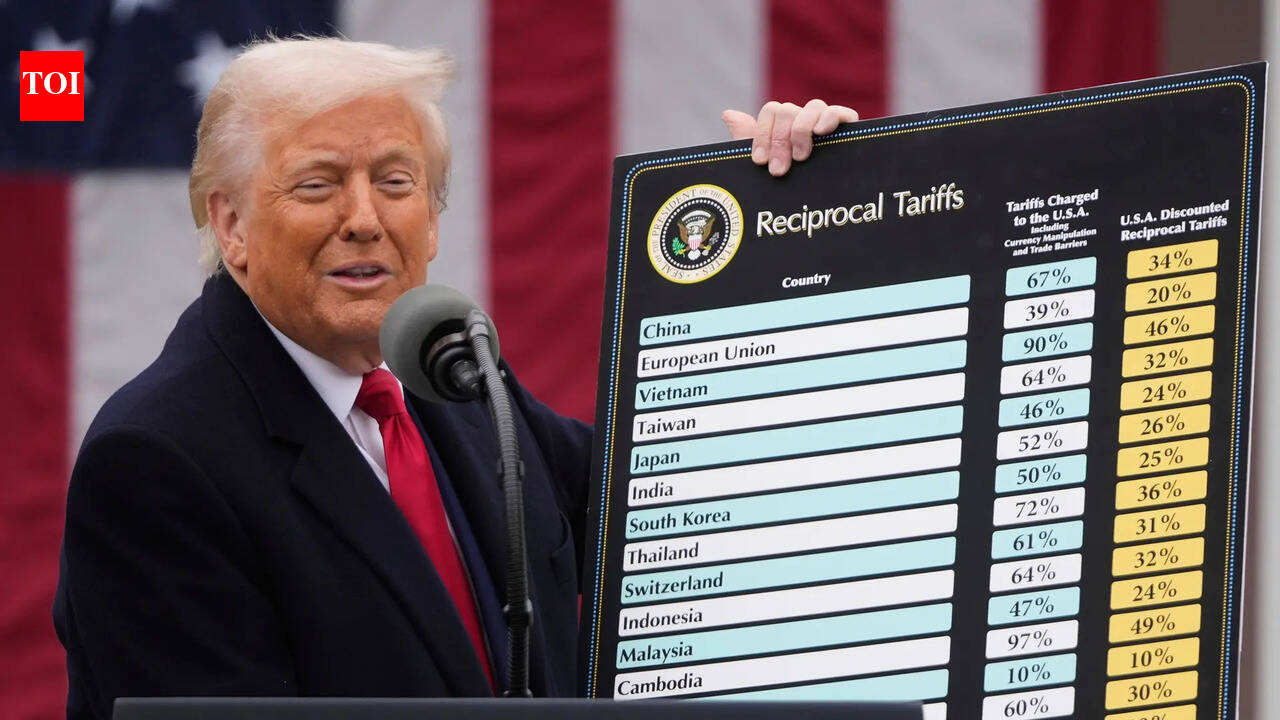
As Indian exporters brace for the impact after additional 25 per cent US tariffs on key goods came into effect on Wednesday, reports said that Trump tariffs are likely to affect the US GDP by 40-50 bps by triggering inflationary pressures.
The US inflation is expected to stay above the 2 per cent target through 2026, driven by supply-side effects of tariffs and exchange rate movement, according to a report by SBI Research.
“The US is beginning to show signs of renewed inflationary pressure, driven by the pass-through effects of recent tariffs and a weaker dollar – particularly in import-sensitive sectors such as electronics, autos, and consumer durables,” the report mentioned.
The US decision to impose steep tariffs on Indian goods is set to weigh on the American economy by stoking inflationary pressures and slowing growth, the SBI said in its report.
“We believe that US tariffs is likely to affect US GDP by 40-50 bps and higher input cost inflation,” it added.
Addressing the Fed’s annual conference in Jackson Hole in the US, Federal Reserve Chair Jerome Powell is trying to balance rising prices and risks in a fragile job market. He said the effects of higher tariffs on prices are “now clearly visible”.
US wholesale prices jumped nearly 1 per cent in July – the fastest increase in over three years – as tariff war resulted into rising costs. The Producer Price Index rose 3.3 per cent year-on-year, with services, processed goods, and tariff-heavy imports like furniture and apparel seeing sharp price hikes.
Economists warn that unless tariffs are rolled back, families in the US will face more pressure on their budgets.
Earlier, the Department of Homeland Security (DHS) circulated a draft notification that it was imposing on Wednesday (US time) an additional 25 per cent tariff on India to address “threats to the United States by the Government of the Russian Federation”.
That is to be on top of the 25 per cent announced earlier, with exemptions for some items like electronics and pharmaceuticals.
(This story has not been edited by News18 staff and is published from a syndicated news agency feed – IANS)

Saurabh Verma covers general, national and international day-to-day news for News18.com as a Senior Sub-editor. He keenly observes politics. You can follow him on Twitter –twitter.com/saurabhkverma19
Saurabh Verma covers general, national and international day-to-day news for News18.com as a Senior Sub-editor. He keenly observes politics. You can follow him on Twitter –twitter.com/saurabhkverma19
Read More






Royal Mail is poised to scrap Saturday second-class letter deliveries across the UK by December, having reached an agreement with the staff trade union on the nationwide implementation of the changes.
This significant overhaul, which will see second-class post no longer delivered on Saturdays and the service adjusted to every other weekday, brings an end to a lengthy dispute with unions. The reforms will initially extend to 240 delivery offices as part of a wider trial, before being fully implemented across the entire 1,200-strong UK network by the end of the year.
The deal struck with the Communications Workers Union (CWU) includes a 4.75% pay rise for staff, alongside improved terms for those who joined Royal Mail on or after 1 December 2022. Employees on legacy contracts will receive a 3% salary increase. Additionally, Royal Mail has agreed that new starters will be offered contracts based on standard 37-hour working weeks, and around 6,000 part-time postal workers will have the option to increase their average weekly hours as part of the changes.
CWU members are now set to be consulted on the agreement.
Alistair Cochrane, chief executive of Royal Mail, said: “This agreement with the CWU paves the way for Universal Service reform rollout and represents a significant investment in our people.
“Moving ahead with reform will make a real difference to Royal Mail’s quality of service, supporting the delivery of a reliable, efficient and financially sustainable postal service for our customers across the UK.”
Regulator Ofcom last year gave the green light to Royal Mail’s plans to scale back second class letter deliveries, starting from July 28.
It launched the changes across 35 delivery offices as a pilot, but has yet to expand this nationwide due to a disagreement with the union.
It kicked off intensive talks with the CWU at the beginning of February to resolve the dispute.
Under the Universal Service Obligation, Royal Mail must keep Monday to Saturday deliveries for first class post and maintain the target for second class letters to arrive within three working days.
The group has argued the changes to second class deliveries are crucial to helping it maintain the letter delivery service and ensure it is sustainable for the future.
It comes as Royal Mail has continued to fail to meet delivery targets set by Ofcom and amid MP concerns over practices in the postal service and worries that parcels are being prioritised over letters.
In a cross-party Commons committee session last month, the CWU told MPs the postal service had become “chaotic” with Royal Mail workers being told to leave doctors’ and hospital letters on racks to prioritise parcels.
Royal Mail’s owner Daniel Kretinsky, who was also giving evidence to the committee, insisted there was no “management decision” for parcels to be prioritised over letters and argued the service cannot be fixed until plans for reform of the USO are put in place.
On the agreement with Royal Mail, the CWU said in a statement to its members: “It is now imperative that all branches, representatives and members have the opportunity and time to fully consider this agreement properly, not only on the basis of how we have moved the company significantly on all the key issues, but also in its wider context around why USO reform is necessary and why we must shift our focus to changing the role of Ofcom and create a level playing field with our competitors.
“Delivering change will always be difficult but we are clearly in a stronger position to support our members under the terms of this agreement.”

The UK could face some food shortages by the summer under a worst case scenario drawn up by government officials.
Source link

The U.S. Internal Revenue Service (IRS) building stands after it was reported the IRS will lay off about 6,700 employees, a restructuring that could strain the tax-collecting agency’s resources during the critical tax-filing season, in Washington, D.C., Feb. 20, 2025.
Kent Nishimura | Reuters
A version of this article first appeared in CNBC’s Inside Wealth newsletter with Robert Frank, a weekly guide to the high-net-worth investor and consumer. Sign up to receive future editions, straight to your inbox.
For seven years, wealthy Americans faced a looming deadline to take advantage of tax provisions that were set to expire at the end of 2025. While the One Big Beautiful Bill Act alleviated much of the uncertainty by making most of the cuts permanent, lawyers and tax accountants say the ever-shifting tax code requires constant planning.
With this year’s Tax Day now behind us, here are five of the most important planning strategies wealthy investors and high earners are thinking about for next year and beyond.
1. Long-short tax-loss harvesting
Last year’s tax bill permanently raised the estate tax exemption to $15 million per person, up from $13.99 million. (It was initially set to be cut in half at the end of 2025.)
The higher threshold has prompted a shift in focus from minimizing federal estate taxes to lowering taxes on income and capital gains. Minimizing capital gains has become crucial after several years of strong market gains, according to Mitchell Drossman, head of national wealth strategies in Bank of America’s chief investment office. The S&P 500 has surged more than 75% since the beginning of 2023.
“The biggest tax story to me is a capital gains and investing story,” said Drossman. “You have lots of clients who are sitting on significant gains.”
Investors are increasingly turning to long-short tax-loss harvesting, an aggressive form of a popular strategy, in order to minimize capital gains, Drossman said. With traditional tax-loss harvesting, investors sell losing assets to offset realized gains on others. Long-short tax strategies, on the other hand, borrow against the portfolio to buy short positions expected to fall and maintain long positions expected to thrive.
“If there’s natural volatility in the markets, you have, now, a greater amount of an asset base to choose from in terms of harvesting losses,” he said. “But when you look at your overall portfolio, you’re still kind of neutral.”
2. Bonus depreciation
The 2025 tax bill renewed bonus depreciation, allowing businesses to deduct the full cost of qualifying assets like machinery, computers or vehicles the first year they are used.
Adam Ludman, head of tax strategy at J.P. Morgan Private Bank, said many clients with operating businesses are investing with bonus depreciation in mind, such as buying private jets.
Real estate developers and investors are trying to get the most bang for their buck by assessing which parts of their properties can be depreciated faster, according to Ludman. For instance, while a commercial building can take 39 years to depreciate, a parking lot can be depreciated over 15 years, allowing owners to recover costs faster.
3. Changing domiciles
A wave of blue states are considering new taxes on top earners and high-net-worth individuals in order to cover cuts in federal aid. California’s one-time billionaire tax proposal may end up on the November ballot, while Maine and Washington have recently passed millionaire taxes.
Jane Ditelberg, chief tax strategist for Northern Trust Wealth Management, said a growing number of clients are asking how to change their tax status as these proposals gain traction. Depending on their state, residents can avoid state-level taxes by creating trusts in states with favorable trust income laws like Delaware.
The most straightforward way to avoid local taxes is to change your domicile, which is easier said than done, according to Jere Doyle of BNY Wealth. The senior estate planning strategist based in Massachusetts, which imposes a millionaire tax, said he has had clients move to New Hampshire and establish residency before selling their businesses.
But clients are often loath to take the steps necessary to establish intent not to return, Doyle said. For instance, moving to Florida may not be enough to avoid Massachusetts taxes if you refuse to sell your Martha’s Vineyard home, he said.
“Everyone thinks that if they spend 183 days in another state, you’re domiciled in that state. That’s not necessarily true. Each state’s a little bit different,” he said. “You [have] got to change where you vote, where your car is registered, even where your doctors are, what clubs you belong to, golf clubs, country clubs, things like that.”
4. Bunching charitable gifts
One notable drawback of last year’s tax bill was a reduction in the tax benefits of charitable giving for top earners.
The bill limits top-earning donors in two ways. First, starting this year, donors who itemize will only be able to deduct charitable contributions in excess of 0.5% of their adjusted gross income, or AGI.
Second, taxpayers in the 37% tax bracket will have their itemized deductions reduced by 2/37th of the value. This ceiling reduces the effective tax benefit from 37% to 35%.
Ditelberg said many clients accelerated their charitable giving last year before these new rules took effect. She said she anticipates clients will continue to “bunch” their donations, by giving a larger sum in one year rather than spreading it over multiple years, so they only trigger the 0.5% haircut once, either through their foundations or donor-advised funds.
5. Opportunity zones
The tax bill also offered an incentive for business owners and real estate owners to postpone selling their assets. The bill made permanent the qualified opportunity zone program, which allows investors to defer capital gains by rolling them over into a fund that invests in a low-income community.
The opportunity zone funds created under the first Trump administration still exist, but you can only defer the taxes until the end of the year. The new opportunity zones, which have yet to be designated, come with enhanced benefits, especially for investors in rural communities. For instance, if you hold your investment in a qualified rural opportunity fund for five years, your capital gains are reduced by 30% for tax purposes.
But you only have 180 days to roll over your gains, and the new opportunity zone rules don’t take effect until 2027, Ditelberg noted.
“If you’re thinking of incurring a major gain, you may want to defer it until August or September, instead of doing it in May or June, if you think you would like to take advantage of the opportunity zone deferral,” she said. “I think we’re going to see people who are incurring gains in the second half of this year.”
That said, investors are waiting to see what the new funds entail. Drossman said some clients are reluctant to invest in opportunity zones again after their previous investments underperformed.
“It’s a classic example of not letting the tax-tail wag the dog because these need to be sound investments,” he said. “Like with all investments, there is an element of risk and return.”


Caleb Wilson says bye to UNC after 1 year, off to NBA draft

Fighter jets escort PM Shehbaz’s aircraft on arrival in Qatar

US’ Kontoor Brands appoints Erinn Murphy to lead finance role

-

 Entertainment1 week ago
Queen Elizabeth II emotional message for Archie, Lilibet sparks speculation
-

 Tech1 week ago
Azure customers up in arms over ‘full’ UK South region | Computer Weekly
-

 Tech1 week ago
As the Strait of Hormuz Reopens, Global Shipping Will Take Months to Recover
-

 Fashion1 week ago
CII submits 20-pt agenda to Indian govt to back firms hit by Iran war
-

 Tech1 week ago
This AI Button Wearable From Ex-Apple Engineers Looks Like an iPod Shuffle
-

 Politics6 days ago
Indian airlines hit hardest after Dubai limits foreign flights until May 31
-

 Entertainment3 days ago
Palace left in shock as Prince William cancels grand ceremony
-

 Politics6 days ago
Chinese, Taiwanese will unite, Xi tells Taiwan opposition leader