

Tech
UK government consults on social media ban for under-16s | Computer Weekly


The UK government is consulting parents, children, technology companies and civil society groups over proposals to keep children safe online, including banning under-16s from social media.
A three-month consultation launched today, described by the government as the “most ambitious consultation on social media”, is seeking views on proposed measures to protect children against the potential harms of social media, artificial intelligence chatbots and gaming platforms.
The measures include age restrictions on the use of virtual private networks (VPNs), curfews on social media, and restrictions on a range of technology functions for children, including livestreaming and sharing their geographic location.
In its consultation document, the government stated that there would be no exemption for services that use end-to-end encryption.
Alongside the consultation, the government is planning to run live pilots with teenagers to test the impact of social media bans, overnight curfews and daily screen time limits.
In February, prime minister Keir Starmer announced plans, in a post on Substack, to implement a minimum age for social media “in a matter of months”, restrict addictive features such as endless scrolling and autoplay, and limit children’s access to VPNs.
The move follows announcements by a growing list of countries of their intention to introduce social media bans in the wake of Australia’s ban in December 2025. Germany, Spain and France are among those introducing such restrictions.
The UK government said parents are concerned about the impact social media is having on their children’s sleep, concentration and mental health, and are worried about children talking to chatbots and relying on their advice.
Parents and campaign groups have called for an outright ban, but children’s charities have warned that a blanket ban could drive children to less regulated parts of the internet or leave them unprepared when they do go online. The Online Safety Act brought in strong protections, but there is growing agreement that more needs to be done.
The government consultation seeks views on whether online platforms should be required to switch off addictive features, including infinite scrolling and autoplay, that could keep children hooked and interfere with their sleep.
The government acknowledged that requiring users to verify their age with technology providers raises privacy concerns. One way to enforce age limits would be to require every social media user in the UK to verify their age online. An alternative approach, as adopted by Australia, would be to use a range of age assurance measures, such as age verification, age estimation and inference.
The government said it would invite families and young people to share their views, and hold “community events”, influencer roundtables, and engage with schools and civil society organisations.
It has dedicated versions of the consultation document for young people and their parents and carers, which it said will make it easier for them to share their views.
Technology secretary Liz Kendall said: “We know parents everywhere are grappling with how much screen time their children should have, when they should give them a phone, what they are seeing online, and the impact all of this is having.”

Joe Gebbia, cofounder of Airbnb and the US Chief Design Officer appointed by Trump, was spotted in San Francisco today using a mysterious metallic device. In a social media post on X viewed over 500,000 times, a man who looks like Gebbia sits with an espresso at a coffee shop. He’s wearing metallic buds that bisect his ears, with a matching clamshell-shaped disc in front of him on the counter.
After the video was posted Monday morning, social media users were quick to suggest that this could be some kind of prototype from OpenAI’s upcoming line of hardware devices designed in partnership with famed Apple designer Jony Ive. An OpenAI spokesperson declined to comment on the potential Gebbia video after WIRED reached out. Gebbia also did not respond to a request for comment.
The device Gebbia appears to be wearing looks quite similar to the hardware seen in a fake OpenAI ad that was widely circulated on Reddit and social media in February. That video from last month seemingly showed Pillion actor Alexander Skarsgård interacting with an AI device that had a similar-looking pair of earbuds and a circular disc. At the time, OpenAI denounced the widely seen video as not real. “Fake news,” wrote OpenAI President Greg Brockman at the time, responding to a social media post.
The earbuds seen in the video of Gebbia also look quite similar in shape to the Huawei FreeClip 2, a pair of open earbuds released earlier this year. However, the clamshell seen on the coffee counter next to Gebbia is different from Huawei’s most recent headphone case. It would also be quite surprising if a government official were seen using Huawei tech, considering the Chinese company is effectively banned from selling its phones in the US due to security concerns.
WIRED’s audio experts say he’s most likely wearing open earbuds, as Gebbia’s pair share some similarities with Soundcore’s AeroClips or Sony’s LinkBuds Clip, though the cases for those buds don’t match what’s on the table in front of Gebbia. WIRED also ran the photo and video through software that attempts to identify AI-generated outputs and other deepfakes. The detection software, from a company called Hive, says the odds are low that this imagery of Gebbia was generated by AI. Still, AI detectors are not always reliable and can include false outputs. It’s possible that the entire post could be a synthetic hoax.
Could this be some kind of soft launch teaser for OpenAI’s hardware? The timing of this trickle out would make sense, since the company may ship devices to consumers sometime early in 2027. Still, OpenAI denied any involvement with the previous pseudo-ad for the metallic AI hardware, with its shiny earbuds and matching disc.
“There are Chinese components as well—we are totally open about it—but the key is that as we compile the software ourselves and install it in Finland, we protect the integrity of the product,” Pienimäki says.
What makes Sailfish OS unique over competitors like GrapheneOS or e/OS is that it’s not based on the Android Open Source Project, but Linux. That means it has no ties to Google—no need for the company to “deGoogle” the software; meaning there’s a greater sense of sovereignty over the software (and now the hardware). Still, it’s able to run Android apps, though the implementation isn’t perfect. Another common criticism is that it’s not as secure as options like GrapheneOS, where every app is sandboxed.
There’s a good chance some Android apps on Sailfish OS will run into issues, which is why in the startup wizard, the phone will ask if you want to install services like MicroG—open source software that can run Google services on devices that don’t have the Google Play Store, making it an easier on-ramp for folks coming from traditional smartphones without a technical background. You don’t even need to create a Sailfish OS account to use the Jolla Phone.
Jolla’s effort is hardly the first to push the anti-Big Tech narrative. A wave of other hardware and software companies offer a “deGoogled” experience, whether that’s Murena from France and its e/OS privacy-friendly operating system, or the Canadian GrapheneOS, which just announced a partnership with Motorola. At CES earlier this year, the Swiss company Punkt also teamed up with ApostrophyOS to deploy its software on the new MC03 smartphone. Jolla is following a broader European trend of reducing reliance on US companies, like how French officials ditched Zoom for French-made video conference software earlier this year.
The Phone
A common problem with these niche smartphones is that they inevitably end up costing a lot of money for the specs. Take the Light Phone III, for example, a fairly low-tech anti-smartphone that doesn’t enjoy the benefits of economies of scale, resulting in an outlandish $699 price. The Jolla Phone is in a similar boat, though the specs-to-value ratio is a little more respectable.
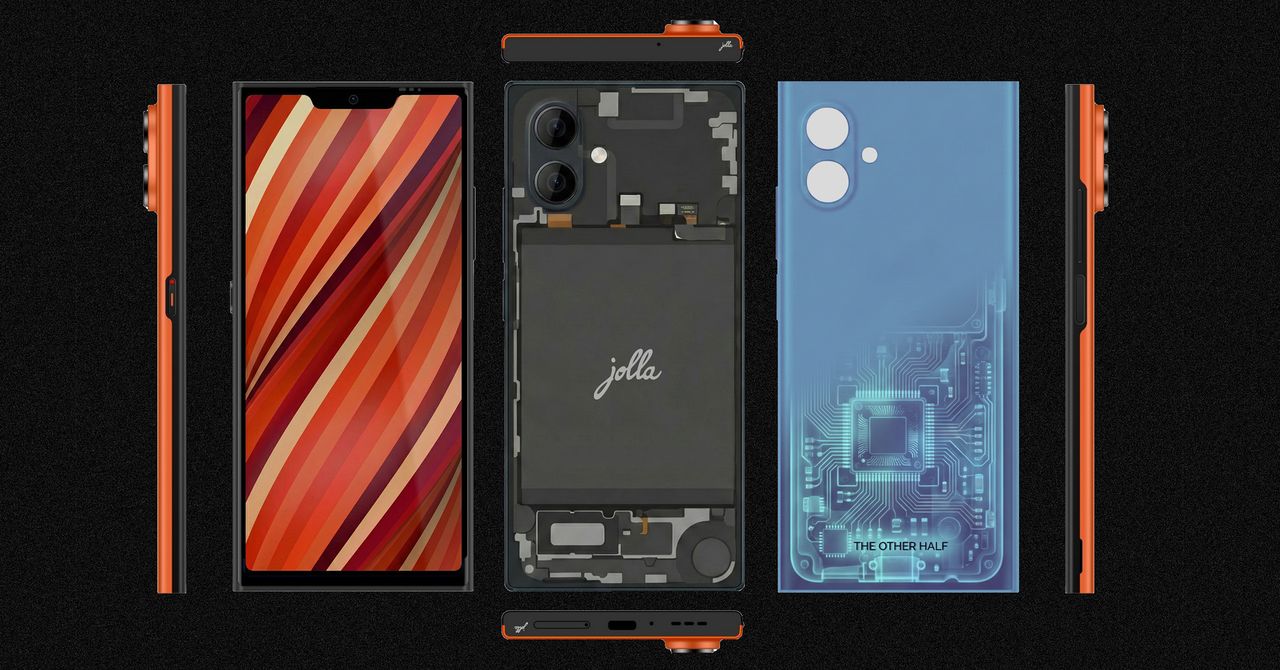
It’s powered by a midrange MediaTek Dimensity 7100 5G chip with 8 GB of RAM, 256 GB of storage, plus a microSD card slot and dual-SIM tray. There’s a 6.36-inch 1080p AMOLED screen, the two main cameras, and a 32-megapixel selfie shooter. The 5,500-mAh battery cell is fairly large considering the phone’s size, though the phone’s connectivity is a little dated, stuck with Wi-Fi 6 and Bluetooth 5.4.
Uniquely, the Jolla Phone brings back “The Other Half” functional rear covers from the original. These swappable back covers have pogo pins that interface with the phone, allowing people to create unique accessories like a second display on the back of the phone or even a keyboard attachment. There’s an Innovation Program where the community can cocreate functional covers together and 3D print them. And yes, a removable rear cover means the Jolla Phone’s battery is user-replaceable.

Shipping through the Strait of Hormuz—the narrow but vital oil trade route in the Middle East—has almost ground to a halt since the start of the United States and Israel’s war against Iran. Tankers in the region have faced military strikes and a spike in GPS jamming attacks, a new analysis says.
Since the first US-Israeli strikes against Iran on February 28, more than 1,100 ships operating across the Gulf region have had their GPS or automatic identification system (AIS) communications technology disrupted, says Ami Daniel, the CEO of maritime intelligence firm Windward. Ships have been made to appear as if they were inland on maps, including at a nuclear power plant, the firm says.
The analysis comes as maritime officials have warned of a “critical” risk to ships operating in the region and as the initial conflict has quickly expanded to involve countries across the Middle East. At least three tankers in the region have been damaged in the conflict.
“We’re seeing a lot of GPS jamming,” Daniel says of shipping in the Strait of Hormuz and surrounding areas. The levels of electronic interference are “way above the baseline” of usual interference, he says. “It’s becoming very dangerous to go in and out.”
Over the last few years, attacks against GPS and navigation systems have been on the rise—largely driven by the wars in Ukraine and Gaza. They can impact people’s phones or devices, but also disrupt the safety and navigation systems in planes and ships. The electronic interference largely comes in two forms: jamming and spoofing. During jamming attacks, satellite signals are overwhelmed so that positioning data isn’t available. Whereas spoofing can create false signals that make an object appear incorrectly on a map—for instance, making ships appear as if they are inland at airports.
Inaccurate location data can lead to ships running off course, potentially increasing the chances of them crashing into other tankers, running aground, or causing damaging oil spills. In warzones, electronic interference is often used to try and disrupt the navigation systems of drones or missiles, which can rely on location data to find and hit their targets.
Analysis of shipping data by Windward found that there has been an “escalating” level of electronic interference across Iranian, United Arab Emirates, Qatari, and Omani waters since the initial strikes on February 28. Daniel says that the majority of the activity the company has identified so far has been jamming rather than spoofing. The company’s analysis says it has identified around 21 “new clusters” where ships have had their AIS data jammed in recent days.
“Ships were falsely positioned at airports, a nuclear power plant, and on Iranian land, creating navigation and compliance risks,” a report from the firm says. “AIS signals have also been diverted to the Barakah Nuclear Power Plant and nearby waters, while hundreds of other vessels are creating circle-like patterns off UAE, Qatari, and Omani waters.”
GPS and AIS interference within the Strait of Hormuz and the surrounding area is not new. In June 2025, as Israel and Iran exchanged missile fire, significant jamming in the region was reported.
While almost all commercial air travel has been grounded around the Middle East, there have been signs of electronic interference on aircraft flying ahead of and around the strikes. “There are at least six new spoofing signatures in the Middle East,” says Jeremy Bennington, vice president of positioning, navigation, and timing strategy and innovation at technology firm Spirent Communications. “Hundreds of flights have been impacted. However, that decreased significantly over the weekend as flights have been canceled.”


What Is That Mysterious Metallic Device US Chief Design Officer Joe Gebbia Is Using?

Justin Timberlake legally attacks Long Island over driving footage

The ‘European’ Jolla Phone Is an Anti-Big-Tech Smartphone

-

 Politics5 days ago
What are Iran’s ballistic missile capabilities?
-
 Business6 days ago
Households set for lower energy bills amid price cap shake-up
-

 Entertainment1 week ago
Talking minerals and megawatts
-
 Business6 days ago
Lucid widely misses earnings expectations, forecasts continued EV growth in 2026
-
 Business1 week ago
Haryana Govt bars IDFC First Bank, AU Small Finance Bank over alleged Rs 590 crore fraud
-

 Sports1 week ago
Top 50 USMNT players of 2026, ranked by club form: USMNT Player Performance Index returns
-

 Sports5 days ago
Sri Lanka’s Shanaka says constant criticism has affected players’ mental health
-

 Tech6 days ago
Here’s What a Google Subpoena Response Looks Like, Courtesy of the Epstein Files