

Business
Pakistan plans to facilitate stranded ships | The Express Tribune

Will provide terminals, also working to rescue 50,000 containers of importers, exporters
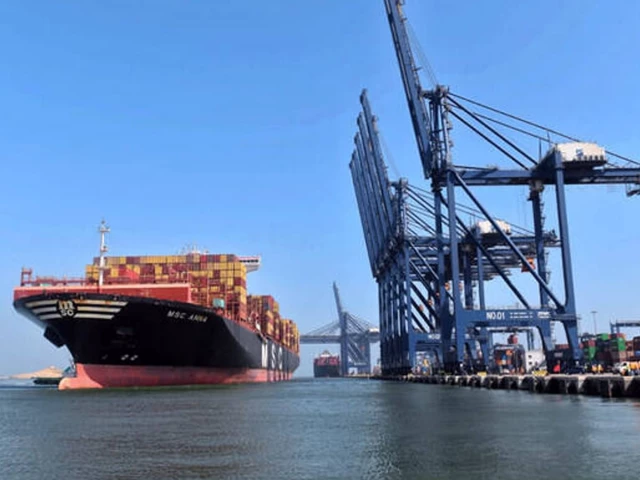
In this handout photo, taken and released by Karachi Port Trust, a container ship sits docked at the Karachi Port in Karachi on May 29, 2024. Photo: KPT
ISLAMABAD:
Pakistan has decided to offer off-dock and on-dock terminal facilities to vessels stranded in the sea following the US-Israel and Iran war.
At present, Pakistan has 23 shipping lines that offer off-dock and on-dock terminal services. Sources told The Express Tribune that 50,000 containers of importers and exporters had been stuck in the sea due to tensions in the Gulf region. The government is also working to rescue these containers.
According to sources, it is easy to provide on-dock terminal services to the arriving ships as scanning and other necessary systems and facilities are available there. However, it may be difficult to offer off-dock terminals, which are far away from terminals in the sea. “The Karachi Port Trust (KPT) has already provided a terminal to two ships that were stuck in the sea and one more vessel is also reaching,” sources said, adding that it was an opportunity for Pakistan to generate revenue as well.
Federal Minister for Maritime Affairs Muhammad Junaid Anwar Chaudhry on Thursday chaired a high-level meeting to assess the emerging logistical challenges facing Pakistan’s trade, particularly in the energy sector, amid geopolitical tensions in the region. An 11-member committee, constituted on the directives of Prime Minister Shehbaz Sharif to formulate a comprehensive response strategy aimed at safeguarding Pakistan’s maritime trade interests, has been tasked with submitting its recommendations within two days.
Speaking at the meeting, Junaid Anwar noted that Pakistan’s ports possess significant untapped potential to attract international shipping lines for transshipment operations, which could also ensure the long-term sustainability and growth of the country’s maritime sector.
The meeting reviewed potential risks and opportunities for the country’s maritime sector in light of the shifting global trade routes and disruptions in key international waterways.
The federal minister said the initiative reflected the government’s proactive approach to protecting Pakistan’s maritime interests while capitalising on the changing global trade dynamics. Meeting participants deliberated on the opportunities arising from the reported closure of major international shipping corridors and discussed measures to strengthen Pakistan’s position as a viable alternative transit and transshipment destination.
The committee also reviewed proposals for amendments to relevant rules and regulations, aimed at facilitating international transshipment operations through on-dock and off-dock terminals to enhance efficiency and ease of doing business. Special focus was placed on fully leveraging the potential of Gwadar Port as a regional transshipment hub and positioning it as an alternative in the face of regional instability.
Chairmen of Port Qasim Authority, Karachi Port Trust and Gwadar Port Authority also attended the meeting through zoom and briefed it on their operational readiness while highlighting the available capacity for container transshipment, bulk cargo handling and refueling services.
Members of the committee include Minister of State for Finance Bilal Azhar Kayani, Special Assistant to the Prime Minister on Maritime Affairs Vice Admiral (Retd) Iftikhar Ahmed Rao, secretaries of ministries of maritime affairs, commerce, and petroleum and natural resources, chairman of the Federal Board of Revenue, director general of National Logistics Corporation, member (Customs) FBR, additional secretary PM Office and senior technical adviser at the Ministry of Commerce.
Bilal Azhar Kayani, while sharing his insights, emphasised the need for the committee to present solid, practical and time-bound recommendations to effectively address the emerging challenges facing Pakistan’s maritime trade. At the conclusion, the minister said that with coordinated planning and timely policy decisions, Pakistan could transform its ports into key transshipment and logistics hubs, strengthen the country’s position in global maritime trade and ensure long-term economic sustainability.





Jenny Lennick’s colourful hair clips are sold across the US and around the world.
Source link

Lululemon store sign in London, March 2, 2026.
Peter Dazeley | Getty Images
Lululemon on Wednesday named Heidi O’Neill as the athleisure company’s new CEO, effective Sept. 8.
The news comes after the company has seen more than a year of disappointing performance and is embroiled in a dramatic proxy battle, with founder Chip Wilson criticizing the business.
Shares of the company sank more than 5% in extended trading.
O’Neill has held multiple roles at Nike, contributing to the sportswear behemoth’s growth. She also held positions at Levi Strauss, Hyatt Hotels and Spotify.
“Heidi is an inspiring leader and proven, consumer-driven brand strategist, with a rare ability to both imagine a new future for a brand and to create the structure and processes to deliver on that vision,” said Marti Morfitt, Lululemon’s executive chair of the board of directors, in a statement. “We selected Heidi because of the breadth of her experience, her demonstrated success delivering breakthrough ideas and initiatives at scale, and her ability to be a knowledgeable change and growth agent.”
O’Neill said in a statement that she plans to focus on building off of the company’s core foundation and unlock growth in global markets. O’Neill will start with a base salary of $1.4 million, according to an 8-K filing.
“I am humbled by the opportunity and energized by what the team is already building,” she said in her statement. “I look forward to joining the company and helping to define and deliver the organization’s next chapter of success.”
Lululemon has been struggling with weak sales and increased competition, as well as mounting costs from tariffs. In its last earnings report, the retailer said it expects tariffs to cost the company $380 million this year.
Wilson, Lululemon’s largest shareholder, has also been placing increased public pressure on the company to make changes to its board of directors. He did not immediately respond to a request to comment on the appointment.
In a statement, GlobalData managing director Neil Saunders said O’Neill has “a very strong pedigree in the activewear and sporting space” and “has an intimate knowledge of how the industry works.”
“There will be some, mostly activist investors, who see O’Neill as something of a safe and traditional choice,” Saunders said. “This argument is partly valid as a lot of cultural change is needed at Lululemon in order to improve performance. However, in our view, O’Neill is her own person who will come with an agenda of change.”
While at Nike, O’Neill played a key role in the company’s doomed direct-to-consumer sales strategy, where the brand pivoted away from wholesale partners in favor of its own website and stores under former CEO John Donahoe. When current CEO Elliott Hill took over as Nike’s next chief executive, he made it a priority to walk back the direct-selling plan.
Prior to leaving Nike, O’Neill also oversaw product and innovation at a time when the brand faced criticism for falling behind on new products and focusing too heavily on the same legacy lifestyle franchises, Dunks, Air Force Ones and Air Jordans. While the franchises briefly led to a surge in sales, fueling Nike’s growth to a $50 billion-plus brand, they ultimately became ubiquitous in the market and viewed as uncool by some consumers.
Now, Hill is still working on unwinding that strategy and clearing inventory from those franchises from the marketplace, which has hit Nike’s margins and led to a decline in sales online.

A Southwest Airlines Boeing 737 airplane lands at Los Angeles International Airport after arriving from Chicago on March 7, 2026 in Los Angeles, California.
Kevin Carter | Getty Images
Southwest Airlines forecast second-quarter earnings below analyst estimates, citing higher fuel prices, while holding off on updating its full-year 2026 forecast.
Southwest expects to earn between 35 cents and 65 cents a share in the current quarter, while analysts polled by LSEG expected 55 cents a share.
The airline in January forecast earnings per share of $4 this year, saying that it expected its new initiatives would pay off. Southwest has sought to increase revenue with checked bag fees and seat assignment fees.
“Achieving this outcome would require lower fuel prices and/or stronger revenue performance to offset higher fuel expense. The Company expects to provide updates to this guidance as appropriate,” Southwest said in an earnings release Wednesday.
Airlines have been either cutting their full-year forecasts or holding off on further forecasts because of volatile prices for jet fuel, generally their biggest expense after labor. They are also pulling back on their capacity growth plans to cut costs, which can drive up airfare when fewer seats are for sale.
Southwest said it expects its capacity to be flat to up no more than 1% in the second quarter, and unit revenues to rise by 16.5% to as much as 18.5% over last year.
“Demand continues to be strong, and we remain focused on controlling what we can control by managing costs, optimizing revenue initiatives, and directing capacity toward higher‑return opportunities,” CEO Bob Jordan said in the earnings release.
Here’s what the company reported for first quarter compared with Wall Street expectations, according to consensus estimates from LSEG:
- Earnings per share: 45 cents vs. 47 cents cents expected
- Revenue: $7.25 billion vs. $7.27 billion expected
Southwest swung to a profit of $227 million, or 45 cents a share in the first quarter, compared with a $149 million loss, or a loss of 26 cents per share, a year earlier.
Revenue rose nearly 13% to $7.25 billion compared with $6.43 billion in the year-earlier period.


‘RHOA’ alum and Kim Zolciak’s ex was 68

2026 NFL Draft Odds: Draft Positions for Ty Simpson, Jeremiyah Love, More
How a pivot to hair accessories led to business success

-

 Fashion7 days ago
France’s LVMH Q1 revenue falls 6%, shows resilience amid Iran war
-

 Entertainment1 week ago
Is Claude down? Here’s why users are seeing errors
-

 Tech1 week ago
The Deepfake Nudes Crisis in Schools Is Much Worse Than You Thought
-

 Tech1 week ago
Bremont Is Sending a Watch to the Moon’s Surface
-

 Sports1 week ago
PSL 11: Peshawar Zalmi win toss, opt to field first against Quetta Gladiators
-

 Tech1 week ago
Human-machine teaming dives underwater
-
 Business1 week ago
BP sees ‘exceptional’ oil trading result as Iran war sends crude costs soaring
-

 Fashion1 week ago
What no one is saying about the 2026 apparel slowdown