

Business
Stocks close down as oil rises and gold retreats

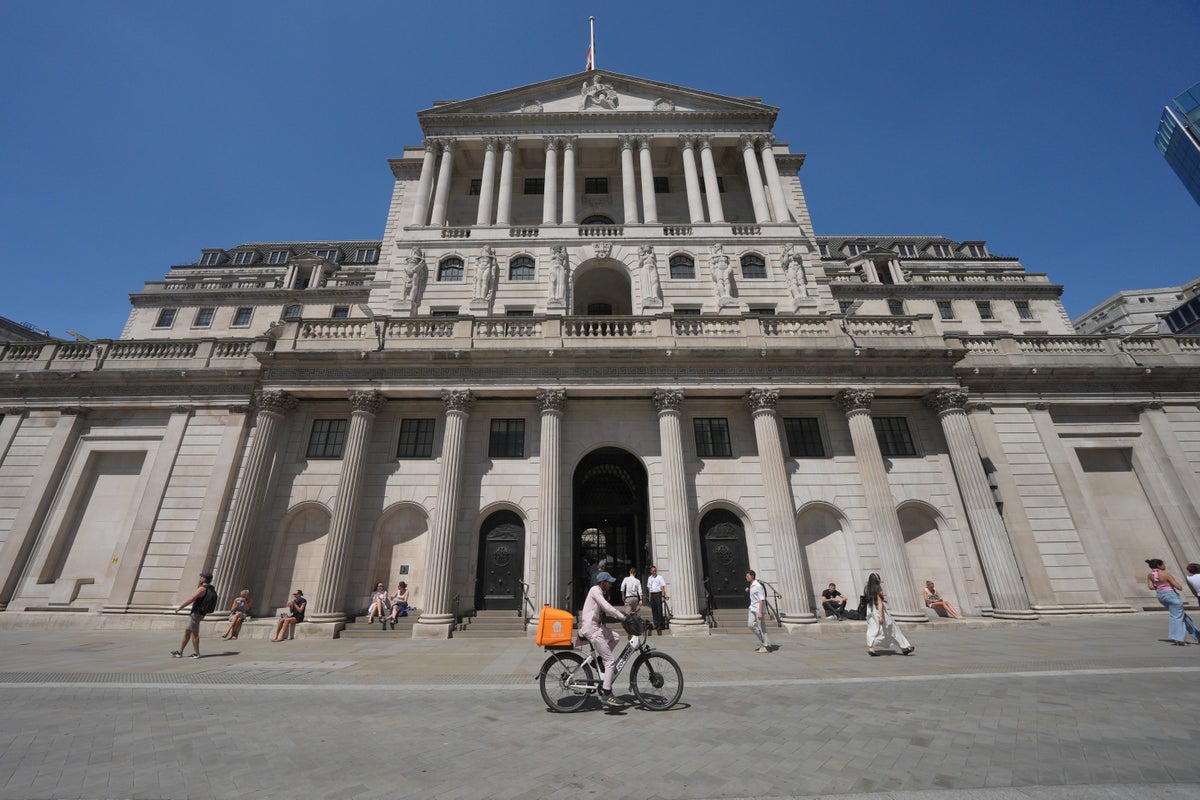
Stock prices in London and Europe closed firmly in the red on Thursday as markets continued to track developments in the Iran war, and digest this week’s interest rate decisions so far, before China’s is released later.
The US Federal Reserve left interest rates unchanged late on Wednesday, as did the European Central Bank and the Bank of England on Thursday. The People’s Bank of China releases its own rate decision at 1.15am UK time on Friday.
The World Trade Organisation (WTO) has warned, meanwhile, that the Middle East war could weigh heavily on already slowing global trade, with merchandise trade volume potentially growing just 1.4% this year, compared to 4.6% in 2025.
“Sustained increases in energy prices could increase risks for global trade, with potential spill-overs for food security and cost pressures on consumers and businesses,” WTO chief Ngozi Okonjo-Iweala warned.
Speaking of energy, US Treasury secretary Scott Bessent has said that Washington might “unsanction” Iranian oil that is already being shipped.
His comments to Fox Business came as energy prices made a renewed surge, after Iran hit the world’s biggest liquefied natural gas facility in Qatar and threatened to destroy the region’s energy infrastructure.
Mr Bessent added in the interview that the US government could also release more oil from its strategic reserves.
Meanwhile, President Donald Trump’s administration is not considering a ban on oil exports, a US official told news agency AFP, as the government scrambles to contain surging energy costs.
“Oil and gas export restrictions are not under consideration,” the Trump administration official said.
Brent oil was quoted at 110.46 US dollars a barrel at the time of the London equities close on Thursday from 108.21 dollars late on Wednesday.
The International Monetary Fund said it was monitoring the impacts of the war in Iran on global inflation and output, but that no countries had so far approached it for emergency assistance related to the conflict.
“If prolonged, higher energy prices will lead to higher headline inflation,” said IMF chief spokesperson Julie Kozack at a press briefing.
The FTSE 100 index closed down 241.79 points, 2.4%, at 10,063.50. The FTSE 250 was down 520.73 points, 2.4%, at 21,560.04, and the AIM all-share was down 25.36 points, 3.4%, at 727.85.
Oil major BP was the sole FTSE 100 riser, up 4.3%, while Shell lost 0.3%.
Gold miners were among the FTSE 100’s worst performers, with Endeavour down 7.9%, Fresnillo down 6.7%, and Antofagasta down 5.0%.
Gold was quoted lower at 4,603.53 dollars an ounce against 4,875.60 dollars.
While geopolitical tensions remain elevated, the resulting increase in energy prices has raised inflation concerns, reducing the likelihood of near-term rate cuts,” DHF Capital’s Bas Kooijman commented. “This has temporarily weighed on gold, as higher yields make non-interest-bearing assets less attractive.
“It is important to note that this movement reflects short-term market dynamics and profit-taking after record highs, rather than a change in gold’s long-term fundamentals.”
On AIM, Central Asia Metals lost 5.6%, after the miner reported a 2025 pre-tax loss of 58.5 million dollars (£43.7 million) from a 77.2 million dollars (£57.7 million) profit a year earlier, despite revenue rising, and declared a total dividend of 12p, down from 18p.
It also guided for between 12,000 and 13,000 tonnes of copper, 18,000 to 20,000 tonnes of zinc-in-concentrate, and 26,000 to 28,000 tonnes of lead-in-concentrate 2026 production. This compares with 13,311 tonnes of copper, 17,881 tonnes of zinc-in-concentrate, and 25,156 tonnes of lead-in-concentrate in 2025.
Sancus Lending soared 49%.
The alternative financial services provider said pre-tax profit jumped to £1.2 million in 2025 from £130,000 a year ago, while revenue climbed 32% to £22.1 million, and that the macroeconomic environment remained mixed while several structural trends supported its outlook.
Sancus cited continued undersupply of housing across the UK and Ireland, increasing regulatory pressure on traditional banks, and growing institutional and private wealth appetite for secured private credit strategies, among others.
Among small caps, gold exploration firm Mila Resources fell 9.6%, but announced that reverse circulation drilling is underway at its Yarrol gold project, with around half of the planned 1,600-metre programme completed despite adverse weather.
Mila said diamond drilling has extended the mineralised system to about 300 metres depth, confirming structural controls on gold mineralisation, with further assay results pending.
In other UK news, Prime Minister Sir Keir Starmer is sticking to his “red lines” on links with the EU, Downing Street said after the mayor of London, Sadiq Khan, called for Labour to pledge to rejoin the bloc at the next election.
However, Chancellor Rachel Reeves, earlier this week, set out plans to follow more of the EU’s rules, saying closer alignment would help bring down prices and inflation.
In European equities on Thursday, the CAC 40 in Paris closed down 2.0%, while the DAX 40 in Frankfurt ended down 2.8%.
Meanwhile, the dollar traded lower.
The pound was quoted at 1.3367 dollars at the time of the London equities close on Thursday, higher compared to 1.3334 dollars on Wednesday. Against the euro, sterling rose to 1.1597 euros from 1.1577 euros a day prior. The euro stood at 1.1527 dollars, higher against 1.1517 dollars. Against the Japanese yen, the dollar was trading lower at 158.09 yen compared to 159.45 yen.
Stocks in New York were lower. The Dow Jones Industrial Average was down 0.8%, the S&P 500 index down 0.7%, and the Nasdaq Composite down 0.8%.
The yield on the US 10-year Treasury was quoted at 4.27%, widening from 4.22%. The yield on the US 30-year Treasury was quoted at 4.84%, narrowing from 4.86%.
The Pentagon is seeking 200 billion dollars (£149.4 billion) in additional funds for the Iran war, a senior administration official has said, according to PA. The Washington Post first reported the request.
The department sent the request to the White House, according to the official, who spoke on condition of anonymity to discuss the private information.
Asked about the figure at a press conference on Thursday, defence secretary Pete Hegseth did not directly confirm the figure, saying it could change.
However, he said: “We’re going back to Congress and our folks there to ensure that we’re properly funded,” adding that it, “takes money to kill bad guys”.
Also, new US jobless claims fell more than expected last week, signalling continued resilience in the labour market, according to data released by the department of labour.
In the week ended March 14, initial claims for state unemployment benefits decreased by 8,000 to 205,000 from an unrevised 213,000 the week before. FXStreet had expected initial claims to stand at 215,000.
The highest stocks on the FTSE 100 were: BP, up 23.8p at 579.6p; Schroders, down 0.5p at 572.5p; Games Workshop, down 20.0p at 17,220.0p; Sage, down 1.40p at 835.8p; and Shell, down 11.5p at 3,450.0p.
The biggest fallers on the FTSE 100 were: Barratt Redrow, down 25.5p at 262.15p; NatWest, down 49.4p at 530.6p; Endeavour Mining, down 348.0p at 4,058.0p; M&G, down 23.6p at 278.5p; and Fresnillo, down 224.0p at 3,098.0p.
On Friday’s economic calendar, look out for UK public sector net borrowing, German producer inflation, and eurozone current account and trade data.
On Friday’s UK corporate calendar, JD Wetherspoon and Smiths Group report their half-year results.
Contributed by Alliance News
Business
Top stocks to buy today: Stock recommendations for May 7, 2026 – check list – The Times of India

Top stock market recommendations: Aakash K Hindocha, Deputy Vice President – WM Research, Nuvama Professional Clients Group has picked Godrej Properties, V-Mart Retail, and Dr Reddy’s Laboratories as the top stock recommendations for May 7, 2026. The analyst has also shared his outlook for Nifty, Bank Nifty. Let’s take a look:Index View: NiftyThe index has broken out of its consolidation band of 23750 – 24300 as global news flow acted as a tailwind in the second half of yesterday’s session. 24000 is now likely to act as base for an up move towards 24770 / 25000. A 2 week range has broken out, and initial upside can unfold for a target of 500 points higher.Bank NiftyBank Nifty as well has broken out from its sideways one-week range, the index had been underperforming for the past 1 week to Nifty while that underperformance seems to be ending now. The ongoing leg can now open for another 1000 pt upside for a target of 57100 odd.
Stock recommendations:
Godrej Properties (BUY):
- LCP: 1867
- Stop Loss: 1750
- Target: 2080
Godrej Properties is on the verge of an 18-month sloping trendline breakout which could potentially mark an end to its ongoing 6 quarter correction which eroded over 50% of market value from its all-time highs. Stock is likely to gain further traction given its weightage on the Nifty Realty index and strength across the board on the index. Nifty realty is by far the best sectoral index on percentage gain from turf to current highs in this broader market recovery started from fiscal 2027.V-Mart Retail (BUY):
- LCP: 650
- Stop Loss: 610
- Target: 714
An inverted head and shoulder pattern has broken out on daily charts of VMART. This is a textbook style formation given both shoulders in the pattern have spent an equal amount of time in its formation before breaking out. Stock has also closed at a 12 week high yesterday with results due today, expectations have built up on the counter while price action suggests a northward continuation to unfold.Dr Reddy’s Laboratories (BUY):
- LCP: 1311
- Stop Loss: 1265
- Target: 1420
The stock has broken out from its18-month consolidation on weekly charts with it completing its retest of the breakout as well. With Nifty Pharma index making a fresh all time high, a strong tailwind on all of its components are here to play. DRREDDY has ~10% weightage on the index and its rising 200 DMA is likely to act as a smoothened support going forward. Strong traction is likely to unfold once the stock starts trading above the 1325-1330 zone. (Disclaimer: Recommendations and views on the stock market, other asset classes or personal finance management tips given by experts are their own. These opinions do not represent the views of The Times of India.)
Deliveroo is set to significantly broaden its offerings beyond its core takeaway service, introducing a new feature that will allow customers to book restaurant reservations directly through its platform.
The initiative, named Deliveroo Reservations, is scheduled to launch initially in London this Thursday.
Customers will gain the ability to secure tables at a range of prominent London eateries, including Dishoom, Dove, Hide, Kricket, Barrafina, and Kolae. This expansion marks a strategic move for the company, which was acquired by US-based DoorDash for £2.9 billion last year.
The new reservation system integrates technology from SevenRooms, a restaurant booking platform business that DoorDash also purchased for approximately £900 million.
This integration follows DoorDash’s own expansion into restaurant bookings on its platform in the United States late last year, setting a precedent for Deliveroo’s latest venture.
This move is central to Deliveroo’s ambitions to grow beyond its established takeaway delivery model in the UK. While the feature will first be rolled out to restaurants in London, Deliveroo has indicated plans to extend the service across the wider UK later in the year.
Suzy McClintock, vice president for consumer and new verticals at Deliveroo, commented on the development: “This launch is about supporting restaurants to grow in new ways. Whether it’s a Deliveroo order or a reservation in store, we want to drive discovery, demand and revenue across every channel.”
She added: “By fully integrating SevenRooms into the Deliveroo app, we’re giving restaurants access to new customers and giving diners an easier way to discover and book some of London’s best tables – all in one place.”
Joel Montaniel, vice president and co-founder of SevenRooms, echoed this sentiment, stating: “Bringing reservations into the Deliveroo app gives London restaurants a new way to connect with diners and grow, while making it easy for consumers to discover and book great restaurants.”
Business
Warner Bros. Discovery books $2.9 billion net loss tied to Paramount deal, restructuring costs

An American flag flies at Warner Bros. Studio in Burbank, California, on Sept. 12, 2025.
Mario Tama | Getty Images
Warner Bros. Discovery on Wednesday reported a staggering net loss for the first quarter, but it has an explanation.
The company booked a net loss of $2.9 billion, far larger than the net loss of $453 million it reported in the year-earlier quarter.
The figure included $1.3 billion of “pre-tax acquisition-related amortization of intangibles, content fair value step-up and restructuring expenses” as well as the $2.8 billion termination fee that Warner Bros. Discovery owed Netflix after their pending transaction fell through in February.
Netflix walked away from its proposed deal to buy WBD’s assets after Paramount Skydance came in with a higher offer. Paramount agreed to pay the termination fee as part of its agreement to buy the entirety of WBD, but the cost lives on WBD’s books until the close of that deal.
Since the amount is refundable to Paramount under certain circumstances, such as if it were to terminate the deal with Paramount for a higher offer, the obligation would be shifted to WBD.
Paramount’s proposed acquisition received approval from WBD shareholders in April and is currently in the midst of a regulatory review process. On Monday, Paramount said in its earnings release that it has “made significant progress” toward closing the deal, which it expects to be completed in the third quarter.
WBD on Wednesday also reported first-quarter revenue that was down 1% year over year to $8.89 billion. The company’s adjusted earnings before interest taxes, depreciation and amortization was up 5% to $2.2 billion. WBD had $33.4 billion in gross debt at the end of the quarter.
Streaming continued to be a highlight for the company.
Total streaming revenue was up 9% to about $2.89 billion as subscriber revenue increased due to the expansion of HBO Max — WBD’s flagship streaming platform — in international markets. Advertising revenue for the unit was up 20% due to an increase in customers subscribing to the ad-supported tier.
The company said in a shareholder letter it exceeded its guidance of more than 140 million global streaming customers at the end of the first quarter, and it remains on track to surpass 150 million global subscribers by the end of the year.
WBD’s portfolio of pay TV networks, which includes CNN, TBS and the Discovery Channel, continued to weigh on the company. The linear TV networks reported $4.38 billion in revenue, down 8% from the prior year. The company said linear advertising revenue was down 11%, which was primarily driven by the absence of NBA media rights from its portfolio.
Revenue for the film studio division, meanwhile, increased 35% to $3.13 billion year over year.


Brazil’s apparel imports double in 5 years, momentum persists

India updates rules to clear FDI proposals within 12 weeks

Justin Baldoni on settlement with Blake Lively: ‘Very pleased’

-

 Sports1 week ago
Pro wrestling star Steph De Lander reveals how colleague’s advice helped lead her to title triumph at ACW
-
 Business1 week ago
PSX plunges over 4,800 points | The Express Tribune
-
 Tech1 week ago
This Ambitious Laptop Doesn’t Leave Much Room for Your Hands
-
Uncategorized1 week ago
[CinePlex360] Some plugins have failed to updat
-
 Fashion6 days ago
Canada’s Lululemon appoints Esi Eggleston Bracey to board of directors
-

 Tech7 days ago
Almost half of UK businesses hit by cyber attacks | Computer Weekly
-

 Fashion1 week ago
Egypt’s SCZONE signs $8-mn Turkish textile project in Qantara West
-
 Business1 week ago
BP profits more than double as oil trading booms amid Iran war