

Politics
Trump’s Tariffs Deemed Unlawful by Divided Appeals Court

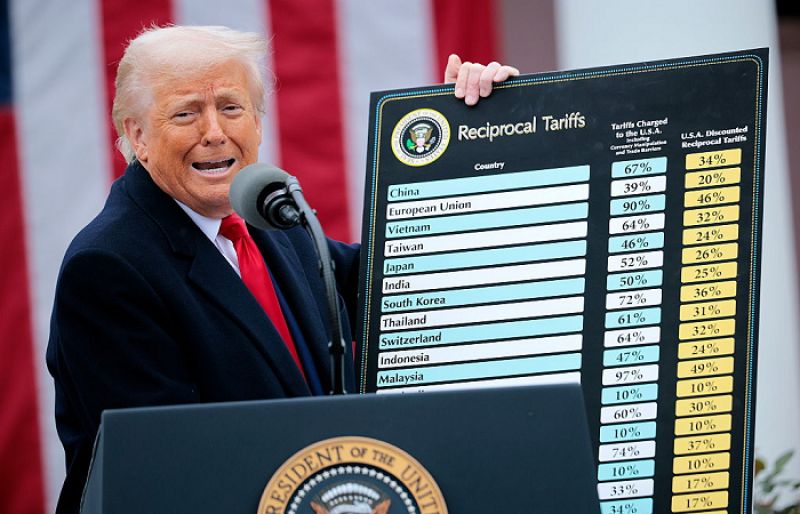

On Friday, a divided U.S. appeals court ruled that the majority of tariffs imposed by President Donald Trump are illegal, delivering a major setback to one of his key international economic policy tools. The decision challenges Trump’s use of these levies to influence global trade relations and could have wide-ranging effects on U.S. trade agreements, affected industries, and supply chains. Legal experts note that the ruling may also set an important precedent for how future administrations implement tariffs and other trade measures.
The court allowed the tariffs to remain in place through October 14 to give the Trump administration a chance to file an appeal with the US Supreme Court.
The decision comes as a legal fight over the independence of the Federal Reserve also seems bound for the Supreme Court, setting up an unprecedented legal showdown this year over Trump’s entire economic policy.
Trump has made tariffs a pillar of US foreign policy in his second term, using them to exert political pressure and renegotiate trade deals with countries that export goods to the United States.
The tariffs have given the Trump administration leverage to extract economic concessions from trading partners but have also increased volatility in financial markets.
Trump lamented the decision by what he called a “highly partisan” court, posting on Truth Social: “If these Tariffs ever went away, it would be a total disaster for the Country”.
He nonetheless predicted a reversal, saying he expected tariffs to benefit the country “with the help of the Supreme Court”.
The 7-4 decision from the US Court of Appeals for the Federal Circuit in Washington, DC, addressed the legality of what Trump calls “reciprocal” tariffs imposed as part of his trade war in April, as well as a separate set of tariffs imposed in February against China, Canada and Mexico.
Democratic presidents appointed six judges in the majority and two judges who dissented, while Republican presidents appointed one judge in the majority and two dissenters.
The court’s decision does not impact tariffs issued under other legal authority, such as Trump’s tariffs on steel and aluminium imports.
‘UNUSUAL AND EXTRAORDINARY’
Trump justified both sets of tariffs – as well as more recent levies – under the International Emergency Economic Powers Act.
IEEPA gives the president the power to address “unusual and extraordinary” threats during national emergencies.
“The statute bestows significant authority on the President to undertake a number of actions in response to a declared national emergency, but none of these actions explicitly include the power to impose tariffs, duties, or the like, or the power to tax,” the court said.
“It seems unlikely that Congress intended, in enacting IEEPA, to depart from its past practice and grant the President unlimited authority to impose tariffs.”
The 1977 law had historically been used for imposing sanctions on enemies or freezing their assets.
Trump, the first president to use IEEPA to impose tariffs, says the measures were justified given trade imbalances, declining US manufacturing power and the cross-border flow of drugs.
Trump’s Department of Justice has argued that the law allows tariffs under emergency provisions that authorise a president to “regulate” imports or block them completely.
Trump declared a national emergency in April over the fact that the US imports more than it exports, as the nation has done for decades.
Trump said the persistent trade deficit was undermining US manufacturing capability and military readiness.
Trump said the February tariffs against China, Canada and Mexico were appropriate because those countries were not doing enough to stop illegal fentanyl from crossing US borders, an assertion the countries have denied.
MORE UNCERTAINTY
William Reinsch, a former senior Commerce Department official now with the Centre on Strategic and International Studies, said the Trump administration had been bracing for this ruling.
“It’s common knowledge the administration has been anticipating this outcome and is preparing a Plan B, presumably to keep the tariffs in place via other statutes.”
There was little reaction to the ruling in after-hours stock trading.
“The last thing the market or corporate America needs is more uncertainty on trade,” said Art Hogan, chief market strategist at B. Riley Wealth.
Trump is also locked in a legal battle to remove Federal Reserve Governor Lisa Cook, potentially ending the central bank’s independence.
“I think it puts Trump’s entire economic agenda on a potential collision course with the Supreme Court. It’s unlike anything we’ve seen ever,” said Josh Lipsky, chair of international economics at the Atlantic Council.
The 6-3 conservative majority Supreme Court has issued a series of rulings favouring Trump’s second term agenda, but has also, in recent years, been hostile to expansive interpretations of old statutes to provide presidents newly-found powers.
The appeals court ruling stems from two cases, one brought by five small US businesses and the other by 12 Democratic-led US states, which argued that IEEPA does not authorise tariffs.
The Constitution grants Congress, not the president, the authority to impose taxes and tariffs, and any delegation of that authority must be both explicit and limited, according to the lawsuits.
The New York-based US Court of International Trade ruled against Trump’s tariff policies on May 28, saying the president had exceeded his authority when he imposed both sets of challenged tariffs.
The three-judge panel included a judge who was appointed by Trump in his first term.
Another court in Washington ruled that IEEPA does not authorise Trump’s tariffs, and the government has appealed that decision as well.
At least eight lawsuits have challenged Trump’s tariff policies, including one filed by the state of California.
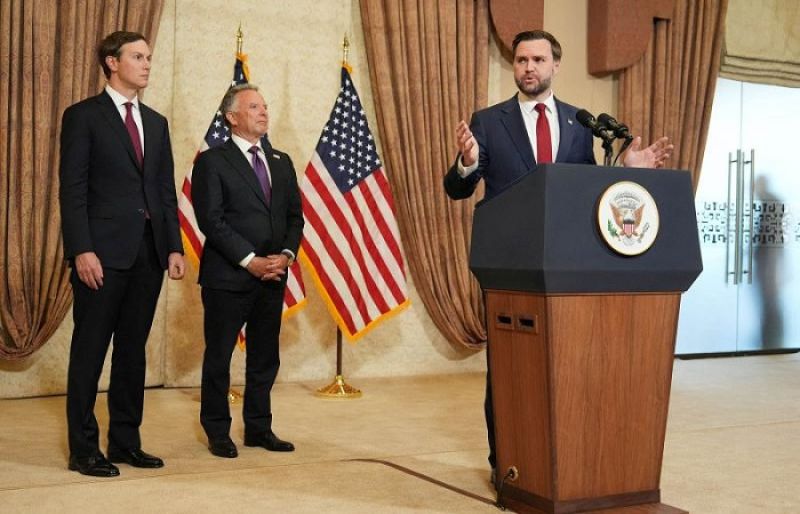
A US delegation led by Vice President JD Vance is en route to Pakistan and expected to land in Islamabad within hours for the second round of talks with Iran, President Donald Trump said on Monday.
Trump confirmed the development in an interview with the New York Post, saying he would be willing to meet Iranian leaders himself if progress is made in the talks.
Apart from Vance, the US delegation includes Trump’s son-in-law, Jared Kushner, and Special Envoy to the Middle East Steve Witkoff, as per a report by Axios.
If reports about the other delegation members are accurate, it would mean the US delegation is the same as in the first round of Iran talks held in Islamabad on April 11.
However, a source familiar with the plan told AFP on Monday that a US delegation will head to Pakistan “soon” for a new round of peace negotiations with Iran.
Meanwhile, mediator Pakistan — which brokered a two-week ceasefire between the two sides on April 8 — was making efforts to end the US naval blockade of Iranian ports and to ensure Iran’s participation in the peace talks.
With the ceasefire set to expire, a senior Iranian official told Reuters that Tehran was “positively reviewing” its participation following Pakistan’s efforts, but no final decision had been made.
The comments conveyed a clear change of tone from earlier statements ruling out attendance and pledging to retaliate for US aggression.
Separately, Deputy Prime Minister and Foreign Minister Ishaq Dar held a phone call with Iranian Foreign Minister Abbas Araghchi, emphasising the importance of continued dialogue and engagement to resolve all pending issues.
DPM Dar stressed that persistent dialogue was essential to ensure regional peace and stability, read a statement issued by the Foreign Office.
Since the announcement of the ceasefire, Tehran and Washington have disagreed on a number of issues, including Iran’s blockade of the Strait of Hormuz and the US naval blockade of Iranian ports.
Tehran effectively blocked the waterway and launched attacks against Israel and US bases across the Middle East in response to the joint US-Israel attacks on February 28.
Iranian Foreign Minister Abbas Araghchi, on April 17, announced the reopening of the strait for commercial vessels following the ceasefire in Lebanon.
However, Iranian authorities blocked the waterway again the following day, citing the US blockade of Iranian ports.
On April 18, the Islamic Revolutionary Guard Corps (IRGC) said that the US blockade represented “acts of piracy and maritime theft”.
“Until the US restores full freedom of navigation for vessels travelling from Iran to their destinations and back, the status of the Strait of Hormuz will remain tightly controlled and in its previous condition,” it said.
US Marines board Iranian vessel
The ceasefire had appeared in jeopardy after the US said it had seized an Iranian cargo ship that tried to run its blockade, and Tehran vowed to retaliate.
The US military said it had fired on an Iranian-flagged cargo ship headed towards Iran’s Bandar Abbas port on Sunday after a six-hour standoff, disabling its engines.
US Central Command released a video showing Marines descending ropes from helicopters onto the vessel.
Iran’s military said the ship had been travelling from China and accused the US of “armed piracy”, according to state media.
They said they were ready to confront US forces over the “blatant aggression”, but were constrained by the presence of crew members’ families on board.
Trump on Sunday warned that the US would destroy every bridge and power plant in Iran if it rejected his terms, continuing a recent pattern of such threats.
Iran has said that if the US were to attack its civilian infrastructure, it would strike power stations and desalination plants in its Gulf Arab neighbours.
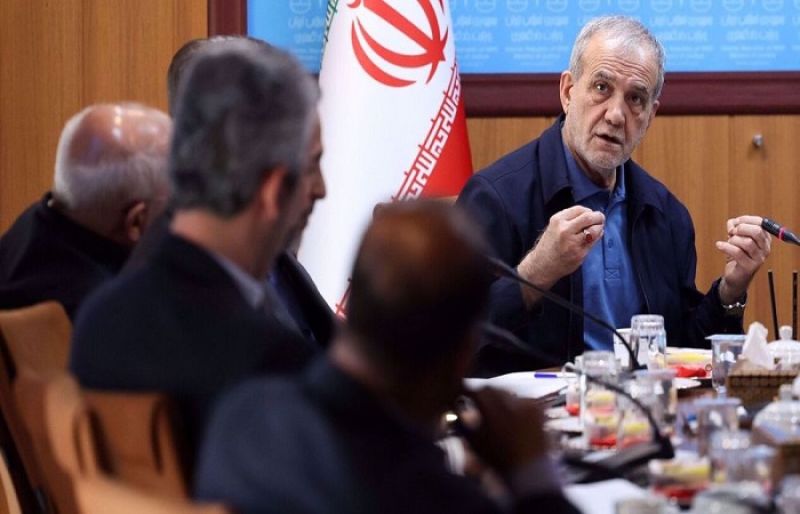
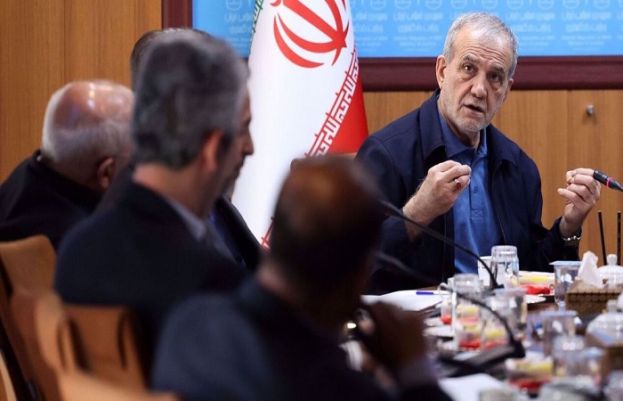
Iran’s President Masoud Pezeshkian says strengthening unity among Islamic countries is the most important way to counter conspiracies and prevent foreign powers from taking advantage.
Speaking during a supervisory visit to the Ministry of Justice on Monday, Pezeshkian received a comprehensive report on the ministry’s actions and missions under the special circumstances resulting from the recent US-Israeli aggression.
Pezeshkian noted that through “empathy, honesty, and collective participation, we can get past this stage and continue the country’s path toward dignity and progress.”
He highlighted the need for a rational approach toward regional and international developments, adding, “War benefits no one. While standing firm against threats, we must use every rational and diplomatic path to reduce tensions.”
He further noted that distrust toward the enemy and vigilance in interactions remain an undeniable necessity.
Following the US and Israel’s recent aerial strikes on Iran launched on February 28, Iran retaliated with barrages of missile and drone attacks on Israeli-occupied territories and US bases and interests in the region.
The president noted that passing through the battlefield does not mean the end of the road. Rather, it marks the beginning of a more important phase: the ‘Greater Jihad.'”
He described this as a struggle in which all people must play a role through patience, tolerance, cooperation, and active participation in rebuilding the country and solving its problems.
“This phase requires greater mental and social readiness than the war era,” he added.
Referring to the decisive role of the guidance of the Leader of the Islamic Revolution Ayatollah Seyyed Mojtaba Khamenei and martyr Leader of the Islamic Revolution Ayatollah Seyyed Ali Khamenei, Pezeshkian stated, “The support and directives of the great and martyred Leader of the Revolution have been a solid pillar for the government since the very beginning of its work.
“It was the coordination formed in the light of these guidelines that today makes effective decision-making and overcoming challenges possible,” he highlighted.
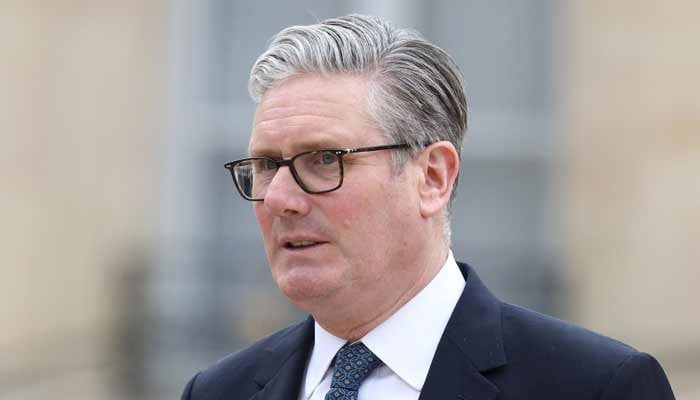
Embattled Prime Minister Keir Starmer said on Monday he had been wrong to appoint Labour politician Peter Mandelson as UK envoy to Washington, seeking to quell anger over a scandal surrounding Jeffrey Epstein’s long-time associate.
Starmer, already widely unpopular with the public and many Labour MPs, is struggling to manage a controversy that has threatened to bring down his leadership.
Addressing parliament about the deepening political row, Starmer said: “At the heart of this, there is also a judgment I made that was wrong. I should not have appointed Peter Mandelson.”
He faced fresh calls to quit last week after it was revealed that Mandelson — whose friendship with the late convicted US sex offender was long known — had become Britain’s envoy to Washington last year despite failing security checks.
Starmer has insisted that he and other ministers were not told until last week that Mandelson had failed the independent vetting process.
“It beggar’s belief that throughout the whole timeline of events, officials in the Foreign Office saw fit to withhold this information from the most senior ministers in our system, in government,” he told MPs.
“If I had known before he took up his post that (the) recommendation was that developed vetting clearance should be denied, I would not have gone ahead with the appointment.”
‘Unconventional’
Last Thursday, Starmer sacked the Foreign Office’s top civil servant, Olly Robins, telling MPs that he had set in motion a review of the security vetting process.
But ex-civil servants have accused Starmer of scapegoating Robbins, who will give his own account to a parliamentary watchdog committee on Tuesday.
Opposition leaders have called for the centre-left Labour leader to step down, with accusations ranging from incompetence to willful misleading of parliamentarians and the public.
Starmer told parliament in February that “full due process” was followed when Mandelson was vetted and cleared for the key role.
His Downing Street office has insisted that remains true because government rules meant the Foreign Office had the power to overrule vetting concerns, without the knowledge of Starmer and his top team.
On Friday, Downing Street took the unusual step of releasing a memo that insisted he had only found out about the vetting failure last Tuesday.
Senior ministers have so far rallied around Starmer.
“A judgement was made that the Trump administration was an unconventional administration and an unconventional ambassador could do a job for the United Kingdom,” Scotland Secretary Douglas Alexander said Monday.
“That judgement was wrong and the prime minister accepts that.”
‘He has to go’
Other ministers have argued that Starmer should remain in power amid the global tumult sparked by the Middle East war and other issues, including forging closer relations with the European Union.
But polls suggest Starmer is one of Britain’s most unpopular prime ministers ever.
If Starmer had known about the failed vetting “then he has to go, he has to resign”, retired dentist Andrews Connell, 59, told AFP.
“If he knew that’s really bad. If he didn’t know, he should have known.”
Pensioner Lyndia Shaw, 73, agreed saying Starmer is “absolutely hopeless, hopeless, and I feel that yes Mandelson should face the full force of the law without doubt”.
But retiree Duncan Moss, 67, said he would be “very worried if Starmer was to leave and to not run the country. I think he’s doing a very good job. I think he’s a very mature, experienced leader”.
Starmer sacked Mandelson in September 2025, seven months after he took up the post, after new details emerged about the depth of the ex-envoy’s ties to Epstein, who died in a US prison in 2019 while facing sex-trafficking charges.
UK police are investigating allegations of misconduct in office by Mandelson, 72, when he was a Labour minister more than 15 years ago. He was arrested and released in February.
Mandelson has not been charged and denies criminal wrongdoing.
Starmer and his Labour party are also bracing for a chastening set of local elections next month, including in the devolved Scottish and Welsh parliaments.


2026 NBA Draft Declarations Tracker: Florida’s Rueben Chinyelu Makes Decision

Education department forgives student loans for 21,200 borrowers: New changes explained

War Memes Are Turning Conflict Into Content

-

 Fashion4 days ago
France’s LVMH Q1 revenue falls 6%, shows resilience amid Iran war
-

 Sports1 week ago
The case for Man United’s Fernandes as Premier League’s best
-

 Entertainment1 week ago
Palace left in shock as Prince William cancels grand ceremony
-
 Business1 week ago
UK could adopt EU single market rules under new legislation
-

 Entertainment5 days ago
Is Claude down? Here’s why users are seeing errors
-

 Fashion1 week ago
Energy emerges as biggest cost driver in textile margins
-
 Business1 week ago
Delta Air Lines unveils first new Delta One suite in premium cabin arms race
-

 Tech1 week ago
A Lot of Shops Won’t Fix Electric Bikes. Here’s Why