Sports
Pegula reaches Charleston quarters | The Express Tribune
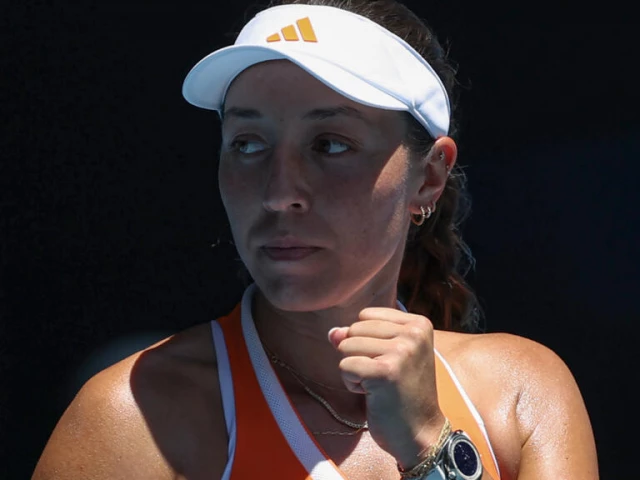
Jessica Pegula celebrates victory against Madison Keys. Photo: AFP
INDIAN WELLS:
Defending champion and top seed Jessica Pegula fought back to reach the WTA Charleston Open quarter-finals on Thursday, requiring a final-set tiebreak to see off Italy’s Elisabetta Cocciaretto 1-6, 6-1, 7-6 (7/1).
A resilient Pegula, the world number five from the United States, eventually progressed just a day after laboring more than three hours to beat 72nd-ranked Yulia Putintseva of Kazakhstan.
The latest hard-fought win, clocking in at just over two hours, was revenge for Pegula, who was stunned by Cocciaretto at Wimbledon last year.
Cocciaretto, ranked 43rd in the world, dominated the first set.
Pegula’s serve was notably wayward, with the American winning just 25 percent of first serve points.
“I don’t know what I was doing out there… Oh my gosh, that’s horrible,” said Pegula after.
Pegula rallied in the second set, but was immediately broken in a topsy-turvy final set, in which she trailed 1-4.
The American hauled it back to 4-4, but then found the net on a break point that would have given her the lead.
Two points from defeat at 4-5, Pegula fought back to 5-5 and they advanced into a deciding tiebreak.
Pegula drew first blood, going up 1-0 off Cocciaretto’s serve, then won every point on her own serve before Cocciaretto double-faulted to hand her the match.
“She beat me the last time we played, so there was a bit of a mental thing too, but I was able to serve really well, I think, at the end,” Pegula said. “And then I just held my nerve.”
Pegula, who won the title in Dubai in February, next faces Russia’s Diana Shnaider — a 6-3, 6-0 winner over Canadian Leylah Fernandez.
Swiss third seed Belinda Bencic also advanced, shrugging off a slow start to beat Czech Sara Bejlek 7-6 (7/4), 6-2 and line up a quarter-final clash with fifth-seeded American Madison Keys.
Keys beat Hungarian Anna Bondar 6-2, 7-5. AFP
Sports
Tommy Lloyd agrees to new 5-year deal with Arizona
INDIANAPOLIS — Head coach Tommy Lloyd has agreed to a new deal with Arizona, he announced on Friday.
“I’m staying at Arizona,” he said at a Friday news conference.
After days of ambiguous statements about his future when being asked about the North Carolina job opening, Lloyd agreed to a new five-year deal with the school.
“Arizona basketball, you guys know what it means to me, and when I say it’s a special place, that always comes from the bottom of my heart,” Lloyd said.
In a reference to rumored phone calls from Michael Jordan to Lloyd about the Carolina job — which Lloyd said never happened — the 51-year-old expressed his pride in staying in Tucson.
“I made a decision that my Michael Jordan is Steve Kerr, and I’m proud to be an Arizona Wildcat,” he said.
Per ESPN sources, Arizona’s new deal with Lloyd will make him one of the five highest-paid coaches in college basketball, as he’ll start in 2026-27 at nearly $7.2 million and will average $7.5 million over the life of the deal.
The deal also includes significant bonuses and additional commitment to staff salary pool. The buyout is expected to remain significant both ways, as the deal is fully guaranteed, and the buyout to leave for another job, which was $9 million under the old deal, is expected to remain high.
“To me it’s a holistic approach,” Lloyd said. “There’s not one thing anymore. Arizona basketball needs to become a locomotive where everything surrounding it is pushing it forward.”
Lloyd expressed his appreciation of both athletic director Desiree Reed-Francois and president Suresh Garimella on their work agreeing to the deal and projecting the future for Arizona basketball.
“Tommy Lloyd is the best coach in college basketball, and we have a strong conviction in the future of Arizona Basketball under his leadership,” Reed-Francois said in a statement. “Our program’s success this season — winning championships, competing on the sport’s biggest stage and excelling academically — is a testament to the standard that he and his staff have established. He has recruited and developed student-athletes of character who make a positive impact on our team, our campus and our community. Tommy has strengthened our foundation while honoring the tradition that makes Arizona Basketball one of the premier programs in the country, and we are thrilled that he will continue to lead this program at the highest level for years to come.”
“Coach Lloyd has led our men’s basketball program with clarity of purpose and a commitment to excellence,” Garimella said in statement. “This past season is among the finest in Arizona Athletics history, reflecting the culture he has built and the consistency of the program. He has reestablished Arizona Basketball as one of the nation’s best programs and leads a team that is unified and performing at the highest levels on the court and in the classroom. I am very pleased that we have come to an agreement extending his contract and his leadership. We look forward to continued success.”
Arizona’s players were excited for their head coach.
“I know Coach Lloyd was going to make the best decision for himself and his career,” senior guard Jaden Bradley said. “Excited that he signed back with Arizona. I know the fan base is excited as well, but I know he’s definitely focused on what’s going on here and just happy for him and his extension.”
“Super happy for Coach,” freshman forward Koa Peat said. “Tucson loves him. He loves Tucson … He’s one of the best coaches in the country and he depends on Arizona. That’s super special for us, for sure.”
North Carolina’s pursuit of Lloyd had lingered as a storyline over the Final Four, with Lloyd declining to outrightly dismiss the Tar Heels’ interest on multiple occasions.
“I’m a simple guy. I’m kind of just one thing at a time. I’m not a multitasker,” Lloyd said Thursday at his pregame news conference when he was asked about the vacancy. “You can ask my wife. So, I’m 100% locked in on Arizona basketball right now, and I’m excited to see what this team can do. I have a real strong belief in this team and this team deserves my full attention, so that’s what I’m giving.”
After Arizona’s win over Purdue last weekend, as part of a longer answer about the significance of the Wildcats advancing to the Final Four, Lloyd said, “Arizona is going to have another good coach after me. I promise you.”
When asked about those statements on Tuesday, Lloyd reiterated his point.
“It’s absolutely true,” he said. “There’s gonna be another coach. This is a great program. I didn’t say when.
“People are going to speculate all they want. Guys, this team has my full focus. Nothing, nothing — I promise you, nothing — is knocking me off that path.”
Since arriving at Arizona in 2021, Lloyd has guided the Wildcats to three regular-season conference championships, two in the Pac-12 and this year’s Big 12 title. They’ve earned a No. 1 or No. 2 seed in four of their five NCAA tournament appearances, advancing to the Sweet 16 or further four times.
Arizona swept both the Big 12 regular-season and conference tournament championships this season, and advanced to the program’s first Final Four since 2001.
He’s 148-35 in five seasons with Arizona.
Lloyd is 148-35 in five seasons with Arizona. His 148 wins are the most in NCAA history for a head coach in his first five seasons.
Prior to taking over at Arizona, Lloyd had been at Gonzaga since 2000, serving as an assistant coach under Mark Few for 20 seasons. The Bulldogs reached the NCAA tournament in every season that Lloyd was in the program, where he established himself as the best international recruiter and one of the premier assistant coaches in college basketball.
Lloyd and top-seeded Arizona will take on Michigan in Saturday’s Final Four.
ESPN’s Myron Medcalf contributed to this report.
Sports
MLB 2026: Inside 2016 Cubs World Series win rarity
IN THE HISTORY of Major League Baseball, there have been 670 World Series games and just four have featured three catchers appearing for the same team. But only once in all those years and all those contests have all three catchers also produced a hit and RBI — and it happened in one of the most famous Fall Classic games ever played.
Chicago Cubs manager Joe Maddon entered Game 7 of the 2016 World Series against the Cleveland Indians with a script, and though chaos reigned over the course of 10 intense innings, his three catchers — Willson Contreras, David Ross and Miguel Montero — didn’t waver from their jobs, playing crucial roles in securing Chicago’s victory.
A decade after the Cubs ended their 108-year World Series curse in Cleveland, here is the story of the three catchers who made their own history on that November night.
Catcher No. 1
MADDON DEVISED HIS Game 7 plan in the hurried hours the night before after his team forced a decisive final contest in a series they had once trailed 3-1.
Kyle Hendricks, MLB’s ERA leader that season, would start for the Cubs against Cleveland ace Corey Kluber. Even with more than a century of history weighing on the matchup, Maddon chose the 24-year-old Contreras to catch Hendricks over two more experienced options.
“For him to be a rookie, starting Game 7, was pretty insane now that I look back on it,” Ross said recently. “He was really young.”
Contreras debuted midway through the 2016 season, immediately showing he was ready for big moments when he hit a two-run, pinch-hit home run on the first pitch he saw as a major leaguer on June 17. He played 76 games during the regular season and started nine in the postseason as one of three catchers on Chicago’s deep roster.
“I haven’t been on too many teams where you feel like there is competition at catching,” Ross said. “We didn’t care about our stats. I was on my way out. Miggy [Montero] had a guaranteed contract, and Willson is up from the minors and excited to be part of the group.”
With Contreras behind the plate, Hendricks navigated through Cleveland’s lineup, allowing just one earned run over the game’s first 4⅔ innings. When Hendricks was removed in the fifth, the Cubs were seemingly in control, up 5-1, with Contreras driving in one of those runs on a fourth-inning double.
“He was not intimidated by the moment,” Maddon said recently. “A street fighter who put his passion on right after brushing his teeth. I trusted him. He played hard and wanted to win. May have been young but he was a huge part of us getting through Game 7.”
Catcher No. 1 had done his job.
Catcher No. 2
MADDON TRIGGERED PART TWO of his plan when he removed Hendricks after he walked Carlos Santana on some questionable ball-strike calls. With left-handed hitter Jason Kipnis coming up for Cleveland — and with Jon Lester entering the game, it was time for his personal catcher, Ross, to enter as well.
The quick hook for a starter who had rolled through the first four-plus innings has been questioned in the years since Chicago’s victory, but Ross recently offered his explanation for Maddon’s maneuver.
“You don’t want to be too late in Game 7,” he said. “You might be early, but you don’t want to be late. And Jon was firing bullets down in the bullpen.”
Taking out the slugging Contreras meant a downgrade at the plate, but Maddon believed it was worth it in order to give Lester the familiarity of Ross, who had already declared Game 7 would be the final game of his career.
“We had talked about that the day before,” Maddon said in a phone interview recently. “Jonny Lester was going to be a big part of that game. And I told David the day before, ‘Listen, when Jon comes in, you’re coming in with him. I don’t care when it is, you’re coming into the game.’
“I also gave Willson the heads-up, too, that that was going to happen. I did not want to ambush him.”
Known as Grandpa Ross, the 39-year-old was the heart and soul of the Cubs clubhouse, keeping things loose in a pressure-packed season along with being the stern voice in the room when needed. It seemed fitting for him to be behind the plate for some of the final outs as Chicago marched toward history.
“Going into my last game, it was nice to have a plan that I was going to get in no matter what,” Ross said. “Except, I came in and almost wrecked it.”
On the sixth pitch of the at-bat, Kipnis barely made contact on a grounder that rolled a few feet in front of home plate. Ross jumped on it and turned to fire to first baseman Anthony Rizzo.
Ross shook his head remembering the moment a decade later: “I threw the ball into the stands, almost killing Rizz.”
The throw was high and wide, causing a mini collision between Kipnis and Rizzo as Santana took third while Kipnis was awarded second. Two pitches later, Lester spiked a curveball that smacked Ross in the helmet, knocking him over and allowing Santana and Kipnis to come home. The score was 5-3, and the Cubs were imploding.
“Wait a minute, I’m the defensive specialist,” Ross was thinking. “What the hell is going on?”
The next inning Ross capitalized on a chance to atone for his defensive mistakes, blasting a 1-2 fastball by reliever Andrew Miller out to right-center field for the final home run of his 15-year career.
“Being able to connect on one was a little bit of a relief,” Ross said with a smile. “I let two in but got one back.”
Things calmed for the Cubs after that home run as Lester pitched into the eighth inning before Jose Ramirez chased him with an infield single.
Maddon’s plan moved to the next phase: bringing in hard-throwing closer Aroldis Chapman for a four-out, World Series Game 7 save.
Ross stayed in, even though he had only been behind the plate with Chapman on the mound for 4⅓ innings since his arrival in July.
The pairing did not go smoothly.
With two outs and the Cubs leading 6-3, Ross called seven straight fastballs to outfielder Brandon Guyer, who caught up to the last one, doubling to right-center and bringing Cleveland within two runs.
Undeterred, Ross called seven more fastballs to Rajai Davis, who golfed the seventh one down the left field line for a tying homer that set off pandemonium inside Progressive Field.
“I called a ton of heaters,” Ross recalled without much fondness. “It was probably a big mistake. Rajai Davis choked up on the bat like 4,000 feet and connected.
“Too many fastballs.”
Cubs’ game planner Mike Borzello added: “And then we get to Aroldis. We attacked that inning with all heaters and Davis winds up catching one. Was supposed to be up, it was down and he was able to drop the head on it and here we are in a tie game. Brutal.”
Catcher No. 3
BY NOW, MADDON’S plan was nearly out the window. Cleveland had stormed back and the threat of another year of Cubs heartbreak was rising.
Ross led off the ninth inning by drawing a walk from reliever Cody Allen. He was replaced by a pinch runner, ending his night — and career.
“That was a crazy way to go out,” he said. “I’m just glad it eventually went our way.”
In an unusual move, the Cubs were switching catchers between the eighth and ninth innings — but not pitchers. It’s normally the opposite in a game. But of course, this was no normal game.
That meant the rest of the night behind the plate would belong to Montero, who had begun the 2016 season as Chicago’s starter but had seen his playing time reduced when Contreras arrived in June. Montero remained an integral part of the team and showed his clutch aptitude by blasting a monumental pinch-hit grand slam against the Dodgers in the NLCS days earlier.
His Game 7 task was no small one: get a shaken Chapman through the ninth unscathed. After sitting for eight innings, the game was in Montero’s hands.
“It started the night before when we were alerted of the game plan by Joe,” Borzello recalled. “We knew that Willson was going to start and catch Kyle and go as far as that went. Then we were going to line change the battery and bring Rossy and Lester in. Those were a given.
“Miggy was on the fly.”
Montero and Chapman had to quickly lock in a game plan against the top of Cleveland’s lineup: Santana, Kipnis and Francisco Lindor.
“The one thing that got me the most nervous is I didn’t have a feel for the hitters,” Montero said. “I hadn’t caught one game in the playoffs. To come in with the game tied, it’s f—ing nerve-racking.”
Despite that feeling, he displayed calm in front of Chapman and instead of calling for fastballs as Ross had, Montero mixed it up with some off-speed pitches. Borzello had prepared for the moment the night before and understood Montero hadn’t had much time behind the plate.
“I knew there was probably some bitterness there,” Borzello said. “I told him, ‘You’re going to get in this game. You have to be locked in.’
“We’re going to have to trick them. Sliders and a couple splits. Chapman’s fastball wasn’t the same. Miggy did an unbelievable job.”
Chapman retired the side in order. He and Montero did their jobs in the most intense moment, one emotionally spent and one straight off the bench.
“I knew, if we could make it through the ninth, I’d feel good about it,” Montero said. “But I wasn’t sure. Chapman is beat up, man. I mean beat up. We had the top of the lineup for them.
“Like I said, it was really f—ing nerve-racking.”
Cubs exec Jed Hoyer added: “The ninth was the most harrowing, without a doubt. We were a sitting duck there, having a tired Chapman on the mound and he’s a mess. But Miggy did a heck of a job.”
Montero’s night was just beginning.
After a short rain delay interrupted play for 17 minutes, the Cubs came to the plate in the top of the 10th inning and broke through. Ben Zobrist doubled home a run and then Addison Russell was intentionally walked to load the bases with Montero at the plate.
After nine innings on the bench, one in the field and then a delay due to weather, finally, Montero was at the plate with a chance to add to Chicago’s lead. He sliced a 1-1 cutter from reliever Bryan Shaw through the left side of the infield for an RBI single and the Cubs lead grew to 8-6.
Like the two before him, catcher No. 3 had his hit and run driven in.
“The fact that all three catchers played on the defensive side and got at-bats and all had major contributions,” Borzello said. “You’re never going to see that in the history of the game. Game 7? Never again.”
Borzello’s next thought?
“We’re still not done.”
THE CUBS HAD the lead but needed to get through the bottom of the 10th and once again, their third catcher of the night would play a big part in it.
With their veteran relievers used up — and starter Jake Arrieta throwing in the pen on zero days rest — Maddon turned to 24-year-old righty Carl Edwards Jr. for the biggest three outs of his life.
Edwards got the first two batters, but his nerves began to show with a five-pitch walk to Guyer that brought the tying run to the plate. Davis, two innings after his tying home run, delivered an RBI single that cut Chicago’s lead to 8-7.
Maddon had seen enough. Knowing that lightly used switch-hitting outfielder Mike Martinez was on deck, he turned to Borzello.
“Which way, which way? Maddon asked.
“Righty. We want him righty,” Borzello answered.
Borzello’s preparation was crucial with the entire World Series coming down to a journeyman infielder who had entered in the top of the inning for his defense.
“This is big, because when you create a scouting report, you have to pay as much attention to the 25th man because who knows when he’s going to show up,” Borzello said.
Now, the career .194 hitter was about to take the most important at-bat of his life, and the Cubs wanted him taking it right-handed — so they brought in left-handed reliever Mike Montgomery. The 26-year-old Montgomery was finishing his first full year in the big leagues, and his nerves were clear to his catcher.
“The 10th inning when we got the lead, it was a little bit easier,” Montero said. “We got two outs — then it got complicated again.”
Montero and Montgomery met on the mound but neither knew how they were going to attack Martinez.
“Look, on his good days, you never know what you’re going to get with Miggy,” Montgomery said with a smile. “I said ‘Miggy, what do we got, what are we going to throw?’
“He goes, ‘I’ll let you know’ and then turns around and walks calmly away. I’m standing there, stunned.”
As he walked back to the dugout, Montero looked at Borzello for guidance.
“I know Michael Martinez, but Miggy doesn’t know him,” Borzello said. “I signal to him ‘curveball.'”
The Cubs dugout was filled with tension and no one outside of Borzello knew anything about Martinez, the man standing between them and the end of a 108 years of heartbreak.
“Lester and I were together in the dugout, and we didn’t know the plan,” Kyle Schwarber said. “Once you’re out of the game, you have no control. I ran down to Borzy.
“WHAT DO WE GOT? WHAT DO WE GOT?” Schwarber screamed.
Borzello turned to Schwarber and said, “We got curveball!”
“I ran back down the dugout, screaming, ‘WE GOT CURVEBALL, WE GOT CURVEBALL,” Schwarber said.
With the tying run at first base, Montero called for the curve — and Montgomery dropped one perfectly into his mitt. Strike 1 looking.
“I couldn’t feel my legs,” Montgomery said. “I set the International League record for wild pitches because of my curveball. Fast-forward two years, and it’s the pitch they’re calling to win the World Series. It had come a long way.”
Montero looked back into the dugout. Curve again.
“Why not?” Montero thought. “It worked once.”
The next one nipped the outside corner of the plate as Martinez swung and pulled a soft grounder to third base. Kris Bryant picked it up, threw to first and the Cubs had their elusive championship. Montgomery and Montero came through.
“Miggy is an unsung hero,” Ross said 10 years later.
“You forget he had the same pressure that I did,” Montgomery said in agreement.
Montero was the final performer of something that we might never see in a World Series game again. Three catchers, three hits, three RBIs — in a one-run win. All while catching multiple pitchers.
“The fact that all three guys were able to handle their role and contribute on both sides of the ball is incredible,” Borzello said, shaking his head.
“All three contributing like that is a great thread in that game,” Maddon said. “It really is.”
Hoyer added: “You think about a roster with three catchers, generally that third guy is there for protection only so you can use the other two. It’s pretty amazing they all had a role in that game.
“Big ones.”
Sports
Ranking top 2026 WNBA free agents: MVPs to rotation players
An unprecedented time in the WNBA is upon us. Over the next few weeks, the league will finally hold free agency for 100-plus players. Yes, you read that right: 100-plus. Free agency was put on hold while the league and Women’s National Basketball Players Association negotiated a new collective bargaining agreement, which was ratified by both sides in March.
Knowing that a huge payday could be on its way in 2026, all but two of the league’s veteran players agreed to contracts that would expire following the 2025 season — which means more than 80% of the league currently is not signed to a team.
That said, two major players are already off the board: New York Liberty star Breanna Stewart announced on her podcast this week that she’ll be returning to Brooklyn, and teammate Sabrina Ionescu told reporters Wednesday at USA Basketball camp in Phoenix that she’ll also be re-signing with New York.
The official timetable for free agency has yet to be announced nor shared with teams, sources told ESPN, as the long-form version of the CBA gets completed. A late February memo shared with front offices proposed that free agency could begin April 7 with formal signings starting April 12 if a deal was completed by March 10. But the terms of the new CBA were verbally agreed to March 18, and those dates were thought to be fluid.
Another factor at play is Friday’s two-team expansion draft (3:30 p.m. ET, ESPN) for the Toronto Tempo and Portland Fire. Each of the league’s preexisting teams can protect only five players, and Toronto and Portland can each pick only one player who is set to become an unrestricted free agent. That can include a player who is no longer core eligible, but the only benefit the expansion team would have in picking such a player would be that it can offer them a supermax salary.
With training camp still expected to begin on time April 19, this will be the most consolidated free agency period the league has ever seen — and with a $7 million salary cap in 2026, the most lucrative, as well.
ESPN ranked the top 55 free agents into tiers and broke down what factors could be at play as they make decisions this month. The players listed below are unrestricted free agents unless otherwise noted.

MVP-caliber
Napheesa Collier
Alyssa Thomas
A’ja Wilson
It is almost unheard of to see the league’s perennial MVP candidates all hit free agency at the same time. But the likelihood of these stars actually seeking new homes seems minimal. Aside from Stewart’s announcement, the Las Vegas Review Journal has reported that Wilson intends to re-sign with the Las Vegas Aces at the new $1.4 million supermax for 2026 as soon as possible. Collier and Thomas, meanwhile, seem content with the Minnesota Lynx and Phoenix Mercury, respectively.
What’ll be worth monitoring are the terms of their eventual deals: Will they end up on long-term contracts, and will they join Wilson in taking the supermax? The supermax constitutes 20% of the salary cap (up from 16.5% in the prior CBA), but historically some stars have been willing to take less than that amount in an effort to sign deals that help their squads sign more talent around them.
All-WNBA level
Kahleah Copper
Allisha Gray
Chelsea Gray
Jonquel Jones
Kelsey Mitchell
Nneka Ogwumike
Kelsey Plum
Jackie Young
This group consists of players who could be prime candidates to be cored by their teams, which is the WNBA’s version of the NFL’s franchise tag. The core rules don’t change in the new CBA until 2027; the most recent rules stipulated that players who have played two seasons while under the core designation cannot be cored again, meaning, of the aforementioned players, Copper, Jones, Ogwumike and Stewart are all ineligible for the designation.
Ionescu indicated that New York’s nucleus — which also features Jones — will remain intact. All eyes will be on whether Las Vegas can also retain its big three of Wilson, Chelsea Gray and Young. Young would be a no-brainer for teams to poach from Las Vegas if she wants to follow in the example of Plum and become a team’s centerpiece.
Caitlin Clark and the Fever, meanwhile, have made it abundantly clear since the season ended that priority No. 1 is to re-sign Mitchell. When Plum was traded to the Los Angeles Sparks last offseason, both sides envisioned it being a long-term partnership, not just a one-off, so it seems likely she will be back there. Elsewhere, does Ogwumike return to the Seattle Storm after coach Noelle Quinn was let go?
It’s possible some of these players end up with the $1.4 million supermax in 2026. If not, the regular max isn’t too much lower ($1.19 million in 2026).
All-Star-caliber
Veronica Burton (RFA)
Skylar Diggins
Brittney Griner
Dearica Hamby
Rhyne Howard (RFA)
Brionna Jones
Jewell Loyd
Ezi Magbegor
Kayla McBride
Arike Ogunbowale
Satou Sabally
Brittney Sykes
Kayla Thornton
Gabby Williams
With such a condensed free agency, some industry insiders predict there will be less movement than initially expected and that players will sign one-year deals to wait to see how the new landscape sorts itself out. So which players could potentially be on the move?
Griner’s presence on the floor was diminished by the end of her first season with the Atlanta Dream — does that fit still make sense for both parties? Ogunbowale’s future will be of primary interest, too, after her productivity dipped last season and then-rookie Paige Bueckers emerged as the clear franchise cornerstone for the Dallas Wings. Loyd shined for the Aces once she started coming off the bench, helping them win their third title. Is that the role that makes most sense for her moving forward?
Magbegor is also hitting free agency at an interesting time following the arrival of Dominique Malonga in Seattle. Must the Storm choose between the two young bigs? Free agency will reveal more about the vision for the team under new coach Sonia Raman (and GM Talisa Rhea).
Seattle is in a position similar to Minnesota of contending but not yet breaking through to win a title with its current iteration. One of the major storylines of free agency will be whether the Storm maintain most of their roster from last year or lean toward heavy changes.
Of note: Players from this group who are no longer core eligible are Diggins, Jones, Griner and Loyd.
High-level starters
Ariel Atkins
Shakira Austin (RFA)
DeWanna Bonner
Jordin Canada
Tina Charles
Natasha Cloud
Tiffany Hayes
Naz Hillmon (RFA)
Betnijah Laney-Hamilton (suspended, contract expired)
Marina Mabrey
Emma Meesseman
Alanna Smith
Azura Stevens
Courtney Vandersloot
Courtney Williams
There’s an assortment of players facing an interesting set of circumstances in this group. Will the Liberty run back the Cloud-Ionescu backcourt pairing, or go a different route? What does Laney-Hamilton’s future hold as she looks to return to the WNBA after missing a year because of a knee injury? Meesseman is always an unknown given her overseas commitments; does she return to the WNBA in 2026, and would New York want to give it another go with her?
Vandersloot and Atkins seem poised to be in the Chicago Sky‘s plans, with the former also a bit of a wild card as she returns from an ACL injury. Could a player such as Stevens be lured away from Los Angeles for a larger role or more money elsewhere? Veterans such as Bonner and Charles, similarly to Vandersloot, have more years behind them than ahead of them but can still make a difference for teams.
Players from this group who are no longer core eligible are: Bonner, Canada and Charles.
The situation for Mabrey is also tricky: The Connecticut Sun are clearly in a rebuild with young talent but are also relocating to Houston in 2027, with Comets and Sun front office personnel already working in tandem beginning this season. The impact of the franchise’s relocation on its free agency plans remains to be seen.
Key rotation players
Bridget Carleton
DiJonai Carrington
Alysha Clark
Sophie Cunningham
Temi Fagbenle
Tyasha Harris
Natisha Hiedeman
Natasha Howard
Lexie Hull (RFA)
Marine Johannes (reserve)
Cheyenne Parker-Tyus
Jessica Shepard
NaLyssa Smith (RFA)
Erica Wheeler
Sami Whitcomb
These players have the greatest variance in what their roles could look like depending on the makeup and vision of their teams. A player such as Carrington (who was traded from Dallas to Minnesota) is in an uncertain position as a midseason acquisition who proved her value, but there are a lot of unknowns regarding the direction the Lynx will choose. Smith thrived in Las Vegas following a midseason trade and helped the Aces to a championship, and might have found a new home there. The Fever have less uncertainty than others in that they have Clark and Aliyah Boston, both all-WNBA players, under contract, but they must decide whether they’ll look to return that pair’s surrounding cast of Howard (no longer core eligible), Hull and Cunningham.
-
Entertainment1 week agoLee Sang-bo dies at 45: Funeral details revealed
-
Sports1 week agoIllinois defense gets tough, ousts Houston to reach Elite Eight
-
Sports6 days agoUSMNT handed reality check by Doku, Belgium ahead of World Cup
-
Sports6 days ago2026 NCAA men’s hockey tournament: Schedule, results
-
Fashion1 week agoChina rolls out tariff cuts on Congo imports from April 1
-
Fashion7 days agoEU apparel imports slump 15.48% YoY in Jan; Bangladesh hardest hit
-
Business1 week agoHow do you spot a fake online review?
-
Sports6 days agoMan City show why they are worthy WSL title winners as tired United wilt