

Politics
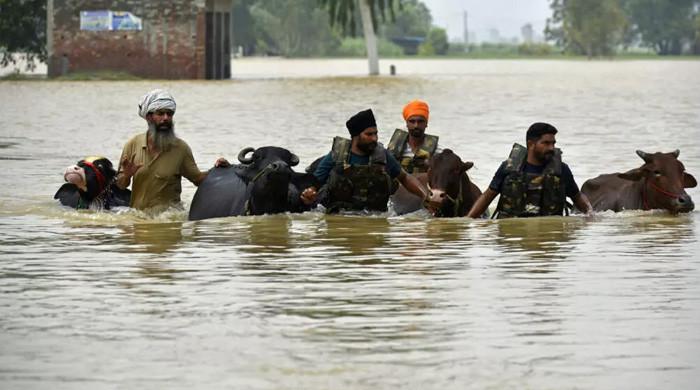
Villages marooned after deadly floods in India

- Thousands in flood-hit areas forced to seek shelter in relief camps.
- Modi assures Punjab CM of of federal government’s “full support”.
- Authorities say “huge loss of livestock” feared in devastating floods.
A thousand villages in India’s Punjab state are marooned by deadly floods, with thousands forced to seek shelter in relief camps, government authorities say.
Flooding across the northwestern state killed at least 29 people and affected over 250,000 last month, with the state’s chief minister calling it “one of the worst flood disasters in decades”.
The region is often dubbed India’s breadbasket, but more than 940 square kilometres (360 square miles) of farmland are flooded, leading to “devastating crop losses”, Punjab’s Chief Minister Bhagwant Mann wrote in a letter to Prime Minister Narendra Modi.
Modi on Monday assured him of the federal government’s “full support”.
Authorities have said they fear a “huge loss of livestock”, the full extent of which will only be clear when the waters recede, according to a bulletin issued by the state authorities late Monday.
India’s army and disaster teams have carried out vast rescue operations, deploying more than 1,000 boats and 30 helicopters to rescue the stranded or supply food.
“The most important thing is to save the lives of people and helpless animals trapped in the water,” Mann said in a statement.
Rivers in the region cross into Pakistan, where floodwater has also engulfed swathes of land.
Floods and landslides are common during the June-September monsoon season in the subcontinent, but experts say climate change, coupled with poorly planned development, is increasing their frequency, severity and impact.
Northwest India has seen rainfall surge by more than a third on average from June to September, according to the national weather department.
In the capital Delhi, relentless rains have swollen the Yamuna river — which breached its danger mark on Tuesday, inundating several areas and creating traffic snarl-ups lasting for hours.
Deadly floods triggered by record-breaking rain also killed dozens in India’s Jammu and Kashmir region last month.
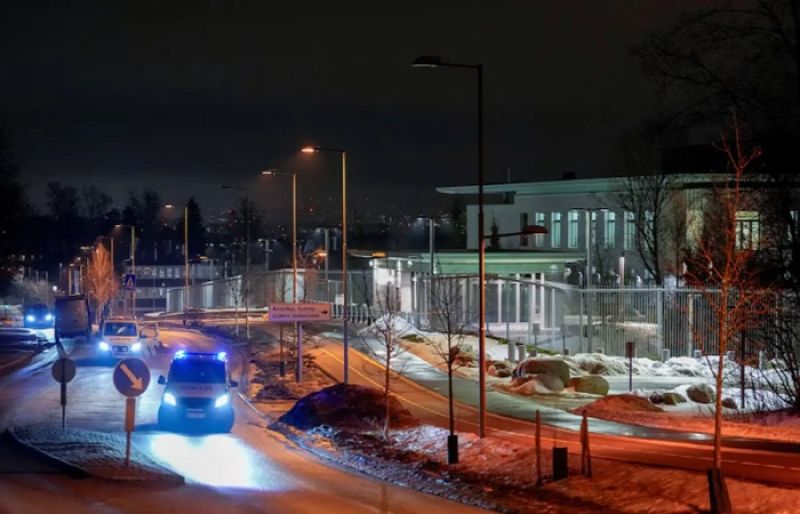

The US embassy in Oslo was hit by an explosion in the early hours of Sunday but no one was injured, police in the Norwegian capital said, adding the cause was not immediately known.
The blast occurred around 1am local time (0000 GMT) and caused only “minor material damage” to one of the building’s entrances, Oslo police said in a statement.
Investigators were examining the scene, while dogs, drones, and helicopters were involved in the search “for one or more potential perpetrators”, it said.
“Police view such incidents in public spaces as very serious, and are investigating the case with substantial resources and high priority.”
Police commander Michael Dellemyr told TV2 police would “not comment on anything related to the type of damage, what it is that has exploded and similar details, beyond the fact that there has been an explosion” because “it is very early in the investigation”.
He later told TV2 that police “have an idea of the cause”, adding: “It appears to us that this is an act carried out by someone.”
He said investigators were talking to witnesses, and TV2 reported that a bomb squad was at the scene.
Police said they were in contact with the embassy about the incident, and said several hours after the blast that the area around the building was considered “safe” for residents and passersby.
Police urged the public to report any tips or unusual observations from the area between midnight and 2am (2300 GMT and 0100 GMT).
Three ‘bangs’
US embassies have been placed on high alert in the Middle East over American military attacks in Iran and several have faced attacks as Tehran hits back at industrial and diplomatic targets.
But Dellemyr said there was no indication as yet that the incident at the embassy in Oslo was connected to the conflict.
“We’re not connecting it to the conflict. It’s far too early for that,” he told TV2.
Residents near the embassy described hearing the explosion.
A 16-year-old identified only as Edvard told TV2 that he was watching television when he heard the blast.
“My mother and I first thought it came from our house so we looked around a little, but then we saw the flashing lights outside the window and a ton of police,” he said.
“There were police dogs and drones and police with automatic weapons and helicopters in the air,” he said.
A group of three friends, meanwhile, told TV2 they were waiting for a taxi near the embassy when the explosion happened.
“We felt three ‘bangs’ that made the ground shake,” Kristian Wendelborg Einung said.
Once in their taxi, they drove past the scene and saw the street in front of the embassy covered in smoke.
“We arrived before the police. The blanket of smoke was very strange. It was like thick fog,” he said.
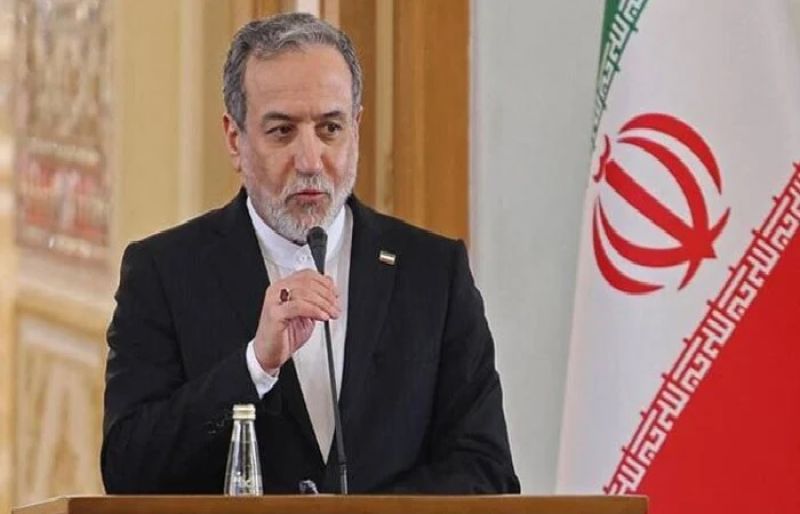

Iranian Foreign Minister Abbas Araghchi has blasted Washington’s reaction to President Masoud Pezeshkian’s extension of the hand of friendship to neighbors, saying that the gesture was almost immediately killed by US President Donald Trump.
“President Pezeshkian’s openness to de-escalation within our region — provided that our neighbors’ airspace, territory, and waters are not used to attack the Iranian People — was almost immediately killed by President Trump’s misinterpretation of our capabilities, determination and intent,” Araghchi wrote in a post published on his X account on Sunday.
He added that “If Mr. Trump seeks escalation, this is precisely what our Powerful Armed Forces have long been prepared for, and what he will get.”
Araghchi noted that responsibility for any intensification of Iran’s exercise of self-defense will lie squarely with the US administration.
The top Iranian diplomat highlighted that Trump’s week-long misadventure has already cost the US military $100 billion, in addition to the lives of young soldiers.
“When markets reopen, that cost will balloon, and directly be transferred to ordinary Americans at pumping stations,” he said.
Araghchi emphasized that Trump’s own National Intelligence Council, representing input from the 18 intelligence agencies of the US, determined that war on Iran is destined to fail.
The Iranian foreign minister went on to state that he had warned Trump’s envoys that war won’t improve Washington’s bargaining position, wondering whether such warnings were conveyed.
“The American People voted to end involvement in costly quagmires in the Middle East. Instead, they have ended up with an Administration that Netanyahu, after decades of failed attempts, finally managed to dupe into fighting Israel’s wars,” he said.
Araghchi finally described the ongoing US-Israeli aggression against Iran as “a war of choice pursued by a small cabal of ‘Israel Fighters,’ and ‘Israel First’ always means ‘America Last’.
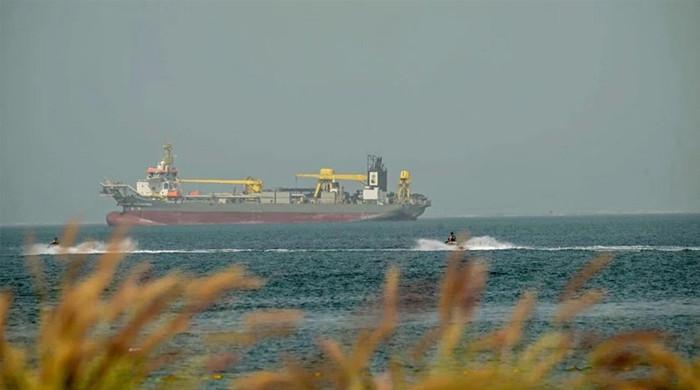
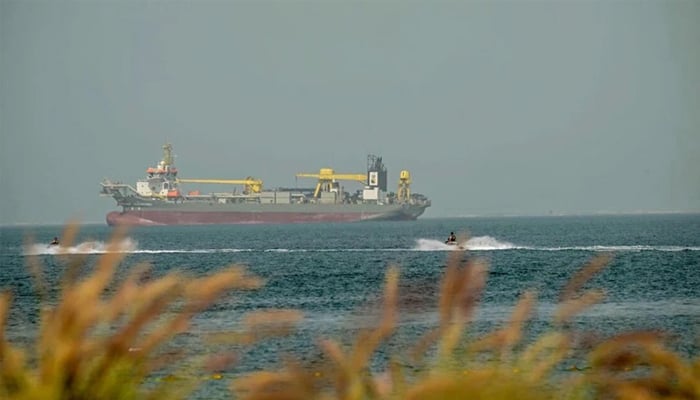
The global positioning system (GPS) capabilities of cargo ships, oil tankers and other vessels stuck in the Middle East because of the widening war are likely worse than those in your cell phone.
Experts say this deficiency explains why since the start of US-Israeli strikes, the jamming of satellite navigation signals has left about 1,000 ships in the Gulf and the Gulf of Oman unable to determine their location, either momentarily or continuously.
Dimitris Ampatzidis, a senior risk and compliance analyst for the energy market intelligence firm Kpler, told AFP the number represents about half of the vessels in the area.
The vast majority of those ships are located off the United Arab Emirates and Oman.
A satellite navigation system is made up of a constellation of satellites that send signals with the time to Earth, allowing the receiver to determine its precise location.
Modern smartphones receive signals from four groups of satellites: the American, European (Galileo), Russian (GLONASS) and Chinese (BeiDou) Global Navigation Satellite Systems (GNSS).
Most cell phones now use two GPS frequency bands — one that is older and fainter, and a second that is newer and stronger.
But “many ships only listen to the original civilian GPS signal, which is called the L1 C/A signal. It’s the one that’s been around since the early 1990s for civilian use,” Todd Humphreys, an engineering professor at the University of Texas at Austin, told AFP.
Most ships are thus unable to rely on the BeiDou or Galileo systems in the event that a GPS is jammed.
The situation is even worse for airplanes, due to aviation regulations.
“You will not find any aircraft flying in the world today whose built-in GPS receiver is capable of tracking and interpreting signals other than the GPS L1 C/A. So it´s out of date by 15 years,” Humphreys said.
Spoofing
Jamming a GPS signal is “not that complicated,” said Katherine Dunn, the author of an upcoming book of the history of GPS, “Little Blue Dot.”
All one needs is “another radio transmitter that can broadcast on the same frequency, but louder,” she said, which creates “a wall of mush.”
Spoofing is more sophisticated — and more dangerous, affecting a ship’s Automatic Identification System, or AIS.
Every vessel transmits a message per second over a universal radio frequency that announces its identity, destination and position.
Spoofing manipulates that system, causing the affected ship to send a fake, or even nonsensical, location — meaning that ships could appear to be on land in Iran or the Emirates.
Clocks
Today, GPS signals are not just used to determine location; they also power onboard clocks, radar systems and speed logs, Dunn said.
So even if the ships off the Emirates or Kuwait were protected from drone fire and escorted through the Strait of Hormuz, navigating without a GPS would be perilous.
“Given the size of the ships, electronic assistance has become necessary to steer them,” said one merchant marine captain who has sailed on cargo ships around the world.
Crews must “resort to using 20th-century instruments — radar or visible landmarks,” he told AFP on condition of anonymity.
Defensive jamming
Signal jamming is undoubtedly being used both offensively and defensively. Gulf states are directing their systems towards their own shores to ward off Iran’s satellite-guided Shahed drones — at the cost, deemed acceptable, of disrupting their own lives.
Israel did the same thing in 2024, as did Iran after its 12 days of conflict with Israel last year.
“Even if their own air traffic or maritime traffic or their delivery drivers or their dating apps are affected by GPS jamming and spoofing, they’ll do it, just like Israel did. Israel did it for a year in 2024,” Humphreys said.
For air and sea navigation, start-ups are developing alternative technologies using Earth’s magnetic field or inertial navigation.
But for ships today, navigating without a GPS is still far in the future.


Left-Handed People Are More Competitive, Says Science

Women’s Day 2026: Female Investors Cut FD Allocation From 45% To 20%, Boost Equity Funds

Prince William, Kate declare distance from Beatrice, Eugenie at royal event

-

 Sports1 week ago
LPGA legend shares her feelings about US women’s Olympic wins: ‘Gets me really emotional’
-

 Entertainment1 week ago
Pakistan’s semi-final qualification scenario after England defeat New Zealand
-

 Fashion1 week ago
South Korea’s Misto Holdings completes planned leadership transition
-
 Business1 week ago
Greggs to reveal trading amid pressure from cost of living and weight loss drugs
-

 Entertainment1 week ago
Bobby J. Brown, “The Wire” and “Law & Order: SUV” actor, dies of smoke inhalation after reported fire
-
 Business1 week ago
CNBC To Merge TV And Digital News Operations, Nearly A Dozen Jobs To Be Cut: Report
-

 Entertainment1 week ago
What’s new in Pokémon? Every game, update, surprise from 30th anniversary event
-

 Politics1 week ago
Iran launches retaliation against Israel, launches ballistic missiles