

Tech
‘It’s Undignified’: Hundreds of Workers Training Meta’s AI Could Be Laid Off

Hundreds of workers in Ireland tasked with refining Meta’s AI models have been told that their jobs are at risk as the company embarks on a sweeping new round of layoffs, according to documents obtained by WIRED.
The affected workers are employed by the Dublin-based firm Covalen, which handles various content moderation and labeling services for Meta.
The workers were informed of the layoffs over a brief video meeting on Monday afternoon and were not allowed to ask questions, according to Nick Bennett, one of the employees on the call. “We had a pretty bad feeling [before the meeting],” he says. “This has happened before.”
In all, more than 700 employees stand to potentially lose their jobs at Covalen, according to an email reviewed by WIRED. Roughly 500 are data annotators. Their job is to check material generated by Meta’s AI models against the company’s rules barring dangerous and illegal content. “It’s essentially training the AI to take over our jobs,” claims another Covalen employee, who asked to remain anonymous for fear of retaliation. “We take actions as the perfect decision for the AI to emulate.”
Sometimes, the work involves cooking up elaborate prompts to try to bypass guardrails meant to prevent models from serving up child sexual abuse material, say, or descriptions of suicide. “It’s quite a grueling job,” claims Bennett. “You spend your whole day pretending to be a pedophile.”
Last week, Meta announced plans to cut one in 10 jobs as part of sweeping layoffs aimed at making the company more efficient. A memo circulated by the company reportedly indicated that layoffs were motivated by a need to increase spending on other aspects of the business. Though the memo did not mention AI, the company recently announced plans to nearly double its spending on the technology. In January, Meta CEO Mark Zuckerberg said, “I think that 2026 is going to be the year that AI starts to dramatically change the way that we work.” In the email reviewed by WIRED, Covalen employees were told only that the layoffs were a result of “reduced demand and operational requirements.”
The latest round of layoffs marks the second time that Covalen has cut staff in recent months. In November, the company announced plans for job cuts (reportedly to number around 400), culminating in a worker strike. Between the two rounds of layoffs, Covalen’s headcount in Dublin is on track to be almost halved, according to the Communications Workers’ Union (CWU), whose members include some Covalen staff.
For affected Covalen workers, the search for new work will be hampered by a six-month “cooldown period,” during which they are unable to apply to a competing Meta vendor, claims the CWU. “It’s undignified, you know,” says the Covalen employee who asked to remain anonymous. “It’s rude.”
Meta and Covalen did not immediately respond to requests for comment.
Unions representing the affected employees are pushing for Covalen to enter negotiations over severance terms. They also hope to meet with the Irish government to discuss how AI is impacting workers in the country. “Tech companies are treating the workers whose labor and data helped build AI as disposable,” says Christy Hoffman, general secretary of UNI Global Union. “To fight back, it’s absolutely critical that workers organize and demand notice about the introduction of AI, training linked to employment, and a plan for their futures. Workers should also have the right to refuse to train their AI replacements.”
But some of those caught up in the layoffs are doubtful of their chances of securing stable employment in a labor market being rehewn in real time by AI and the deep-pocketed companies leading its development. “It’s a universal battle between downtrodden white-collar workers and big capital, really,” claims Bennett. “That normally only goes one way.”






Of all the gay hookup apps Brennan Zubrick uses, Sniffies, a cruising app for men interested in discreet sex-positive casual encounters with other men, is by far his favorite. Some of the most popular kinks among members on the platform include edging, cum play, and BDSM. “I overwhelmingly prefer the experience I get and the community I can access,” he tells WIRED. But Zubrick, who is 40 and based in Washington, DC, has a bad feeling that could soon change.
Tinder and Hinge parent company Match Group announced on Monday an investment of $100 million into Sniffies. The deal gives Match Group a large minority share and the choice to become the sole owner later on. The announcement has set off an intense firestorm of reactions from users who are second-guessing the direction of the company and the longterm sustainability of the app.
“Sniffies has long held its market position as the little guy, catering to a specific section of the gay community, and is somewhere people who might not be comfortable with Grindr—where no face-pic, no-chat culture runs rampant—go to connect with other like-minded people in a more direct and discreet way,” Zubrick tells WIRED.
“This partnership is about supporting that, not redefining it,” Sniffies founder and CEO Blake Gallagher said in a statement, noting that the investment will help the platform focus on three key areas users want: “stronger trust and safety, expansive network growth, and continued product improvements.” According to the agreement, Match Group will offer guidance on the right roles, procedures, and tech to help Sniffies build on its trust and safety efforts.
But users aren’t buying what Gallagher is selling. The Instagram post announcing the news was inundated with negative reactions, as users expressed worry over the strategic partnership. “Please don’t let this be the straightification of sniffies,” expressed one. “You sold out. Plain and simple. Where we moving to next boys?” added Marc Sundstrom, a user in Philadelphia. “Partnering with Match feels very gentrified and straight. Highly concerned about the app being allowed to be what it is in order to court investors,” wrote another. By Tuesday afternoon, comments on the post had been shut off.
Though it remains to be seen how Gallagher will position Sniffies in the months ahead, already users are saying this marks the beginning of the end for the app. “Straight people shouldn’t even know what Sniffies is for fuck sake,” one wrote in the r/askgaybros subreddit. And despite promises, some say a major corporation like Match is not ethically aligned with the indie spirit of Sniffies. On LinkedIn, the top comment under Gallagher’s post questioned the real intent behind Match Group’s investment. “Interested to see how ties to Palantir affect Sniffies’ growth. Hopefully this doesn’t become a surveillance application.”
Spencer Rascoff, who became CEO of Match Group in 2025, previously served on the board of Palantir, the defense tech and data mining company that has become a “technological backbone” of the Trump administration.
Sniffies maintains that it will continue to own and control how its user data is stored, handled, and protected. According to the company, there are no changes planned to its data practices as part of the investment.
But the outrage underscores the significance of platforms like Sniffies and what it would mean to a community of people who already feel like they have so few quality options for seeking desire online.
“It’s a mess and obviously to be expected. It’s definitely an indicator of its fast rise, so no shade, but we saw what happened with Grindr,” says Brad Allen, a 34-year-old event producer and the creator behind Club Quarantine, who joined Sniffies in 2023. “I really am pulling for them to somehow navigate this differently since it’s essential to the cruising community now. Hopefully the pop-up Candy Crush ads don’t light up too much in the bushes.”
The UAE has announced that it will leave OPEC and OPEC+ effective May 1, ending a membership that began in 1967—four years before the UAE itself was founded as a country. This signals a turning point in the UAE’s role in global energy.
The government statement, published on state news agency WAM, cited a comprehensive review of the country’s production policy and capacity as the basis for the move, calling it a reflection of “the UAE’s long-term strategic and economic vision and evolving energy profile.”
The decision, it said, is rooted in national interest and a commitment to meeting what it described as the market’s “pressing needs,” a reference to global demand that the UAE believes is being underserved at a time of significant supply disruption.
The statement acknowledged the geopolitical backdrop—including an ongoing conflict with Iran that has severely restricted tanker movements through the Strait of Hormuz, the narrow waterway between Iran and Oman through which roughly a fifth of the world’s crude oil and liquefied natural gas normally passes.
The EIA estimates that Iraq, Saudi Arabia, Kuwait, UAE, Qatar, and Bahrain shut in 7.5 million barrels per day of crude oil production in March, and 9.1 million barrels per day in April.
However, the statement framed the exit as policy-driven rather than reactive, noting that “underlying trends point to sustained growth in global energy demand over the medium to long term.”
A Long-Running Dispute
Tuesday’s announcement was not without precedent. In 2021, the UAE refused to endorse a production agreement to extend cuts to production unless its individual quota was raised, arguing that it had invested billions to expand capacity and was being unfairly constrained by figures set in 2018. A compromise was eventually reached, but the episode exposed a fundamental tension: The UAE wants to produce more, and OPEC’s quota system was holding it back.
That ambition has only grown since. State oil company ADNOC has a stated target of 5 million barrels per day by 2027, up from current production of around 3.4 million. Under the OPEC+ deal, the country has been held to roughly 3.2 million barrels per day while sitting on capacity above 4 million, a gap that made continued membership increasingly difficult to justify.
The UAE stressed that its exit does not signal a retreat from global energy responsibility. It pledged to bring additional production to market “in a gradual and measured manner, aligned with demand and market conditions,” and reaffirmed investment plans across oil, gas, renewables, and low-carbon technologies.
The statement noted that leaving OPEC would make the nation more flexible to respond to market dynamics; OPEC sets limits on production, meaning that the world’s biggest producers can often supply and sell more oil than they actually do.
By limiting supply, the group is able to support prices. This mechanism primarily benefits producers that rely heavily on oil revenue, a description that fits Saudi Arabia far more than the UAE, whose non-oil economy now accounts for roughly 75 percent of GDP.
Market Reaction and Wider Implications
The immediate market response was sharp. Brent crude, the European benchmark, surpassed $100 per barrel for the first time since 8 April, rising to $111 as of writing.
The longer-term implications for OPEC are more consequential. The group has been under strain for months, with several members—including Iraq, Kazakhstan, and the UAE itself—having overproduced their quotas and being required to compensate. The UAE’s departure strips the group of its third-largest producer at a time when supply dynamics are already fragile.
The exit follows Qatar’s departure from the group in 2019, and comes as OPEC prepared for a meeting in Vienna on Wednesday.
“The time has come to focus our efforts on what our national interest dictates and our commitment to our investors, customers, partners and global energy markets,” the statement read.
The UAE said it values more than five decades of cooperation within OPEC and wished the organization success going forward.
This story originally appeared on WIRED Middle East.
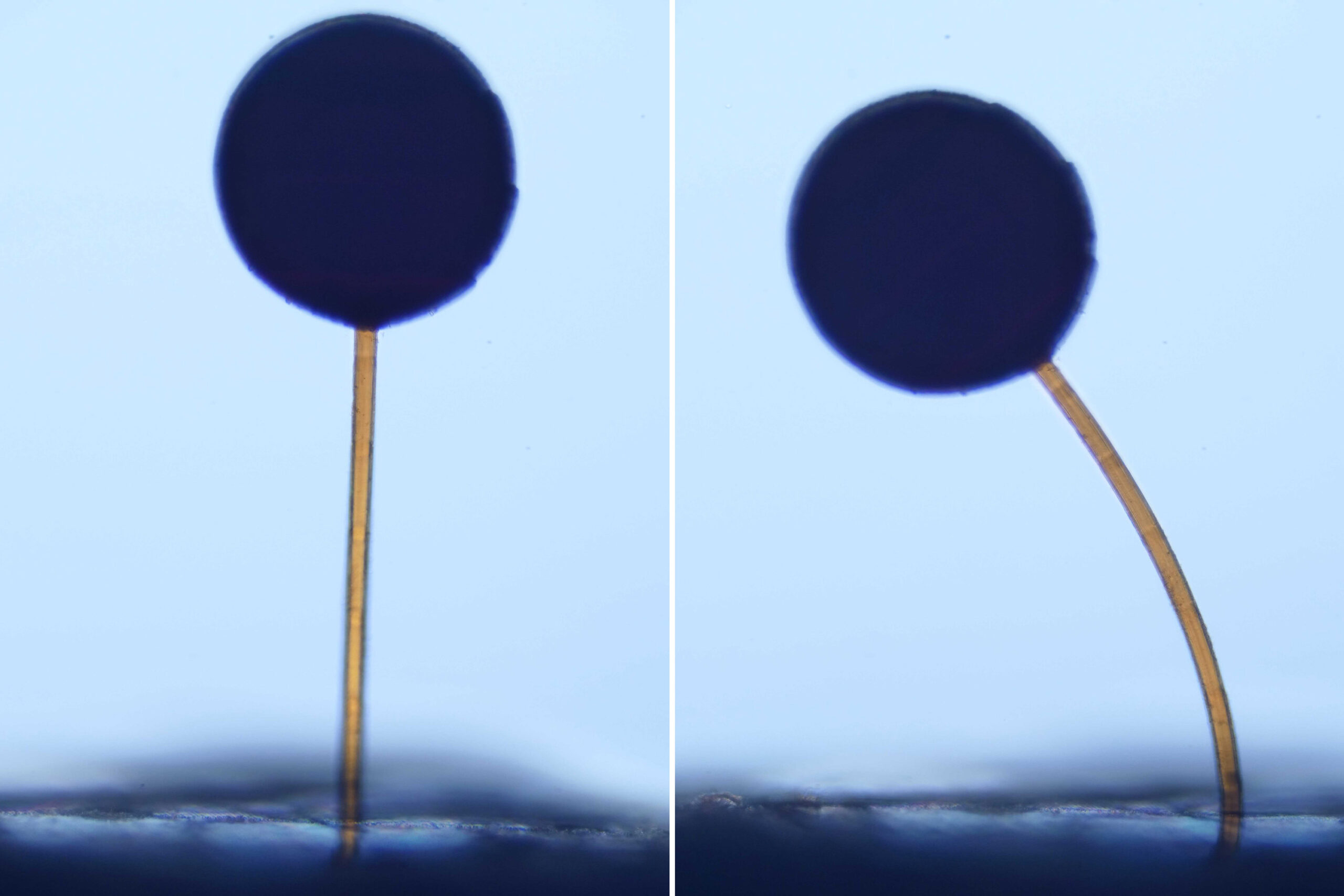
Under a microscope, a bouquet of lollipop-like structures, each smaller than a grain of sand, waves gently in a petri dish of liquid. Suddenly, they snap together, like the jaws of a Venus flytrap, as a scientist waves a small magnet over the dish. What was previously an assemblage of tiny passive structures has transformed instantly into an active robotic gripper.
The lollipop gripper is one demonstration of a new type of soft magnetic hydrogel developed by engineers at MIT and their collaborators at the École Polytechnique Fédérale de Lausanne (EPFL) in Switzerland and the University of Cincinnati. In a study appearing today in the journal Matter, the MIT team reports on a new method to print and fabricate the gel, which can be made into complex, magnetically activated three-dimensional structures.
The new gel could be the basis for soft, microscopic, magnetically responsive robots and materials. Such magno-bots could be used in medicine, for instance to release drugs or grab biopsies when directed by an external magnet.
Making objects move with magnets is nothing new, at least at the macroscale. We can, for example, wave a refrigerator magnet over a pile of paper clips that will trail the magnet in response. And at the microscale, scientists have designed a variety of magnetic “micro-swimmers” — components that are smaller than a millimeter and can be directed remotely by a magnet to squeeze through small spaces. For the most part, these designs work by mixing magnetic particles into a printable resin and pulling the entire swimmer in the direction of an external magnet.
In contrast, the MIT team’s new material can be made into even more complex and deformable structures with micron-scale precision. These features could enable a magnetic millibot to move individual features and perform more complex maneuvers.
“We can now make a soft, intricate 3D architecture with components that can move and deform in complex ways within the same microscopic structure,” says study author Carlos Portela, the Robert N. Noyce Career Development Associate Professor of Mechanical Engineering at MIT. “For soft microscopic robotics, or stimuli-responsive matter, that could be a game-changing capability.”
The study’s MIT co-authors include graduate students Rachel Sun and Andrew Chen, along with Yiming Ji and Daryl Yee of EPFL and Eric Stewart of the University of Cincinnati.
In a flash
At MIT, Portela’s group develops new metamaterials — materials engineered with unique, microscopic architectures that give rise to beyond-normal material properties. Portela has fabricated a variety of such metamaterials, including extremely tough and stretchy architectures and designs that can manipulate sound and withstand violent impacts.
Most recently, he’s expanded his research to “programmable” materials, which can be engineered to change their properties in response to stimuli, such as certain chemicals, light, and electric and magnetic fields.
From the team’s perspective, magnetic stimuli stand out from the rest.
“With a magnetically responsive material, we have control at a distance and the response is instantaneous,” says co-lead author Andrew Chen. “We don’t have to wait for a slow chemical reaction or physical process, and we can manipulate the material without touching it.”
For the new study, the team aimed to create a magnetically responsive metamaterial that can be made into structures smaller than a millimeter. Researchers typically fabricate microstructures by using two-photon lithography — a high-resolution 3D printing technique that flashes a laser into a small pool of resin. With repeated flashes, the laser traces a microscopic pattern into the resin, which solidifies into the same pattern, ultimately creating a tiny, three-dimensional structure, layer by layer.
While 3D resin printing produces intricate microstructures, using the same process to print magnetic structures has been a challenge. Researchers have tried to combine the resin with magnetic nanoparticles before printing the mixture. But magnetic particles are essentially bits of metal that inherently scatter light away or agglomerate and sediment unintentionally. Scientists have found that any magnetic particles in the resin can reduce the laser’s power at a given spot and weaken the resulting structure or prevent its printing altogether.
“Directly 3D printing deformable micron-scale structures with a high fraction of magnetic particles is extremely difficult, often involving a tradeoff between magnetic functionality and structural integrity,” says Sun, a co-lead author on the work.
A printed double-dip
The researchers created a new way to fabricate magnetic microstructures, by combining 3D resin printing with a double-dip process. The researchers first applied conventional resin printing to create a microstructure using a typical polymer gel, with no added magnetic particles. Then they dipped the printed gel into a solution containing iron ions, which the gel can absorb. The iron-soaked structure is then dipped again in a second solution of hydroxide ions. The iron ions in the gel bond with the hydroxide ions, creating iron-oxide nanoparticles that are inherently magnetic.
With this new process, the team can print intricate structures smaller than a millimeter, and add magnetic properties to the structures after printing. What’s more, they are able to control how magnetic a structure’s individual features can be. They found that, by tuning the laser’s power as they print certain features, they can set how cross-linked, or “tight” the gel is when printed. The tighter the gel, the fewer magnetic particles it can form. In this way, the researchers can determine how magnetic each tiny feature can be.
“This provides unprecedented design freedom to print multifunctional structures and materials at the microscale,” Sun says.
As a demonstration, the team fabricated ball-and-stick structures resembling tiny lollipops. The structures were less than a millimeter in height, with balls that were smaller than a grain of sand. The researchers printed the lollipops out of polymer gel and infused each ball with different amounts of magnetic particles, giving them various degrees of magnetism. Under a microscope, they observed that when they passed an ordinary refrigerator magnet over the structures, the lollipops pulled toward the magnet in various degrees, in a configuration that mimicked gripping fingers.
“You could imagine a magnetic architecture like this could act as a small robot that you could guide through the body with an external magnet, and it could latch onto something, for instance to take a biopsy,” Portela says. “That is a vision that others can take from this work.”
The team also fabricated a magnetically responsive, “bistable” switch. They first printed a small millimeter-long rectangle of polymer gel and attached to either side four tiny, oar-like magnetic structures. Each oar measured about 8 microns thick — about the size of a red blood cell. When the team applied a magnet on one end of the rectangle, the oars flipped toward the magnet, pulling the rectangle in the same direction and locking it in that position. When the magnet was applied to the other side, the oars flipped again, pulling the rectangle, like a switch, in the opposite direction.
“We think this is a new kind of bistable mechanism that could be used, for instance, in a microfluidic device, as a magnetic valve to open or shut some flow,” Portela says. “For now, we’ve figured out how to fabricate magnetic complex architectures at the microscale and also spatially tune their properties. That opens up a lot of interesting ideas for soft miniature robots going forward.”
This research was supported, in part, by the National Science Foundation and the MathWorks seed grant program.


Sniffies’ Users Worry About a ‘Straightification’ of the Gay Hookup App

Channing Tatum on ex Zoë Kravitz’s engagement to Harry Styles: ‘Surprised’

King Charles opens Congress speech with ‘everything in common except language’

-

 Politics1 week ago
UK’s Starmer seeks to deflect blame over Mandelson appointment
-

 Fashion1 week ago
UK’s Sosandar returns to profitability amid robust FY26 performance
-
 Business1 week ago
How Trump’s psychedelics executive order could unlock stalled cannabis reform
-

 Entertainment1 week ago
Lee Anderson, Zarah Sultana kicked out of UK Parliament for calling PM ‘liar’
-

 Fashion1 week ago
India, US to resume BTA talks today
-
 Business1 week ago
Exercise to test response to offshore energy threat involving vessels and drones
-
 Business1 week ago
Us-India Trade Talks: US–India trade deal: Where do talks stand & what to expect – explained – The Times of India
-

 Tech1 week ago
A Humanoid Robot Set a Half-Marathon Record in China