

Fashion
Middle East conflict clouds India’s FY27 GDP forecast of 7-7.4%: Govt


A ‘supply shock’ is apparent in the economy, it noted.
Other high-frequency indicators point to a degree of supply-side moderation in March, while demand-side indicators remain reasonably resilient.
The Middle East crisis has weighed on India’s industrial performance in early FY27, with softening business sentiment and e-way bill growth declining, the department of economic affairs said.
A ‘supply shock’ is apparent in the economy, it noted.
Though the crisis has slightly dampened bankers’ optimism regarding loan demand and terms for the Q1 FY27, financial instability is not a threat, it said.
Rising wholesale prices indicate emerging cost-push pressures that could transmit to consumer inflation if supply disruptions persist, said the report.
Though the crisis has slightly dampened bankers’ optimism regarding loan demand and terms for the first quarter (Q1) of FY27, financial instability is not a threat, it noted.
An accompanying demand compression is a serious concern, given high prices, rising inflation, and a reduced pace of economic activity, it added.
Fibre2Fashion News Desk (DS)












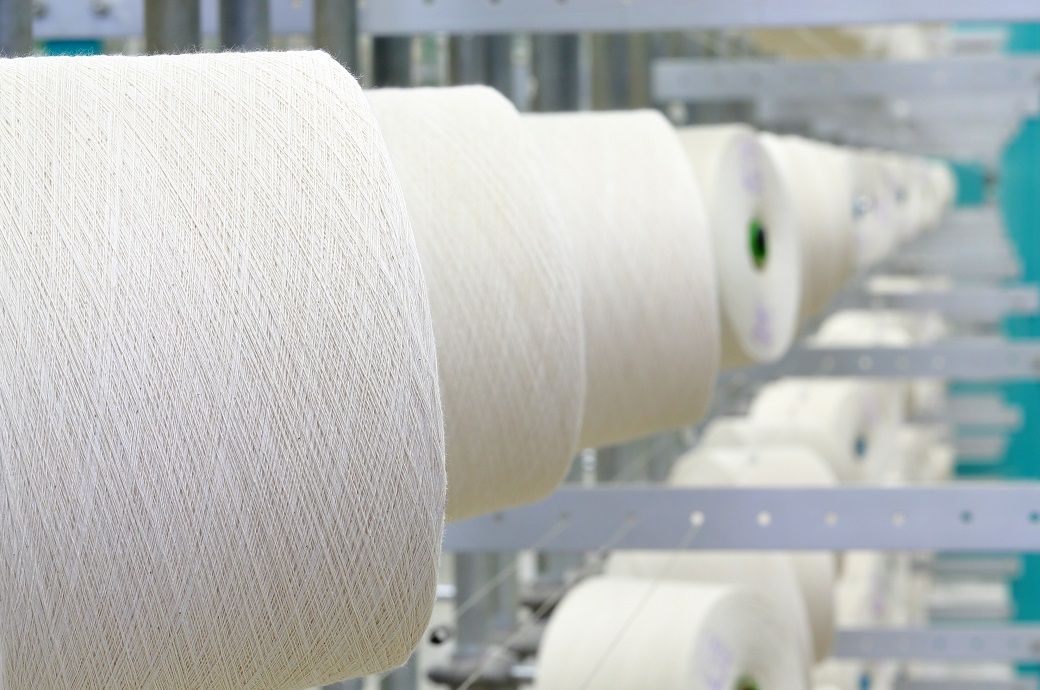
The Delhi cotton yarn market further rose due to costlier cotton. It witnessed price rise of ****;*–** per kg since last Thursday, although cotton yarn buying still remained limited. A trader from Delhi market told Fibre*Fashion, “Spinning mills are increasing cotton yarn prices without strong demand in the domestic market. Rising cotton prices also supported the momentum. But buyers and traders remained very cautious. They are not confident that current higher prices may sustain in the future.”
In Delhi, ** count combed knitting yarn was traded at ****;***–***(~$*.**–*.**) per kg (GST extra), ** count combed at ****;***–*** (~$*.**–*.**) per kg, ** count carded at ****;***–*** (~$*.**–*.**) per kg, and ** count carded at ****;***–*** (~$*.**–*.**) per kg today, according to market sources.

The 2,792 projects span sectors such as textiles and apparel, industrial and logistics parks, power (including oil, gas and renewable energy), skill development and transport, among others.
The Vibrant Gujarat Regional Conference in South Gujarat drew ₹3.53 lakh crore (~$37.12 billion) in investment commitments with 2,792 MoUs signed.
Projects span textiles, logistics, power and manufacturing, and may generate 2.82 lakh jobs.
The government also plans to promote garment units in tribal areas, creating over 25,000 work-from-home jobs for women.
The government also emphasised efforts to promote non-polluting industries and garment units in tribal districts like Dang, Tapi, Valsad and Navsari, with over 25,000 women expected to benefit from work-from-home employment opportunities.
Union Minister for Health and Family Welfare, Chemicals and Fertilisers, JP Nadda at the valedictory session said that the recent global developments highlight the need to reduce strategic dependencies and strengthen supply chains. He noted that global uncertainties should be leveraged as opportunities, with greater focus on boosting manufacturing through regional initiatives.
Highlighting South Gujarat’s strengths, Nadda said the region has emerged as a global hub, from Surat’s diamond and textile industries to the chemical and fertiliser clusters in Bharuch, Dahej and Ankleshwar. He added that linking garment manufacturing with textiles and tribal regions is opening new avenues for development, marking a significant step forward for the region and the state.
He further stated that the conference has laid a strong foundation for South Gujarat’s economic growth, positioning it for a major leap ahead.
Commending Gujarat’s economic contribution, Nadda said the state accounts for about 8 per cent of India’s GDP, 17 per cent of manufacturing output, 27 per cent of merchandise exports and 40 per cent of total cargo handling.
Fibre2Fashion News Desk (CG)

The company expects FY26 net sales of $3.43-3.5 billion, representing growth of 1 to 3 per cent. Gross margin guidance has been improved to 50.3-50.5 per cent, while operating income is projected at $230-262 million, with operating margin of 6.7 to 7.5 per cent. Diluted earnings per share (EPS) are forecast at $3.55-4, supported in part by temporary tariff relief.
Columbia Sportswear Company has raised its FY26 outlook, projecting $3.43-3.5 billion in sales and EPS of $3.55-4, aided by tariff relief.
Q1 sales were flat at $779 million, with profit declining due to US weakness and tariffs.
International growth remained strong.
The company expects wholesale recovery in H2.
Q2 sales are seen at $600-610 million, with a wider operating loss anticipated.
“We are updating our earnings guidance for 2026, based in part on a temporary improvement in US tariff rates,” said Tim Boyle, chairman and CEO.
He added that the company expects an inflection back to wholesale growth in the second half, supported by its Fall 2026 order book, noting that the ‘Engineered for Whatever’ campaign and product innovation are driving traction for its ACCELERATE Growth Strategy.
Q1 performance hit by US weakness, tariff pressures
Meanwhile, in the first quarter (Q1) ended March 31, 2026, net sales were largely flat at $779 million, down 3 per cent. International growth was offset by a US decline due to a weaker Spring 2026 wholesale order book and reduced inventory.
Operating income fell 10 per cent year-on-year (YoY) to $42 million, while operating margin declined to 5.4 per cent from 6 per cent. Net income dropped to $34.3 million, with EPS at $0.65 versus $0.75 last year. Gross margin contracted 20 basis points to 50.7 per cent due to tariff impact, the company said in a press release.
Boyle said the company still exceeded internal expectations, driven by early spring shipments and stronger demand in Europe and the US, with international markets leading growth. He added that the US slowdown was anticipated due to prior inventory and tariff-related decisions.
Columbia Sportswear ended Q1 with $535.4 million in cash and no debt.
Q2 outlook signals near-term pressure
For the second quarter (Q2), net sales are expected at $600-610 million, broadly flat YoY. The company anticipates an operating loss of 4.5 to 5.5 per cent of net sales, compared to 3.9 per cent last year, while diluted loss per share is projected at $0.37-0.46, based on an effective tax rate of around 20 per cent.
Fibre2Fashion News Desk (SG)


He Couldn’t Land a Job Interview. Was AI to Blame?

North India cotton yarn prices rise despite weak domestic demand

India among most resilient large EMs, better placed for future global shocks; policy reforms & strong buffers help: Moody’s – The Times of India

-

 Tech1 week ago
A Brain Implant for Depression Is About to Be Tested in Humans
-

 Tech1 week ago
Almost 90% of women leave tech industry within 10 years | Computer Weekly
-
 Business1 week ago
‘I had £20,000 stolen and had to fight a 13-month fraud reporting rule to get it back’
-

 Sports7 days ago
Pro wrestling star Steph De Lander reveals how colleague’s advice helped lead her to title triumph at ACW
-
 Business1 week ago
Pakistan’s oil market is fuelling the crisis | The Express Tribune
-

 Entertainment1 week ago
Norway joins Type 26 Frigate Programme to boost NATO naval power
-

 Entertainment1 week ago
Melania Trump says ABC should ‘take a stand’ on late-night host Kimmel
-

 Tech1 week ago
This Ambitious Laptop Doesn’t Leave Much Room for Your Hands