

Business
London stocks drift lower as Middle East tension simmers

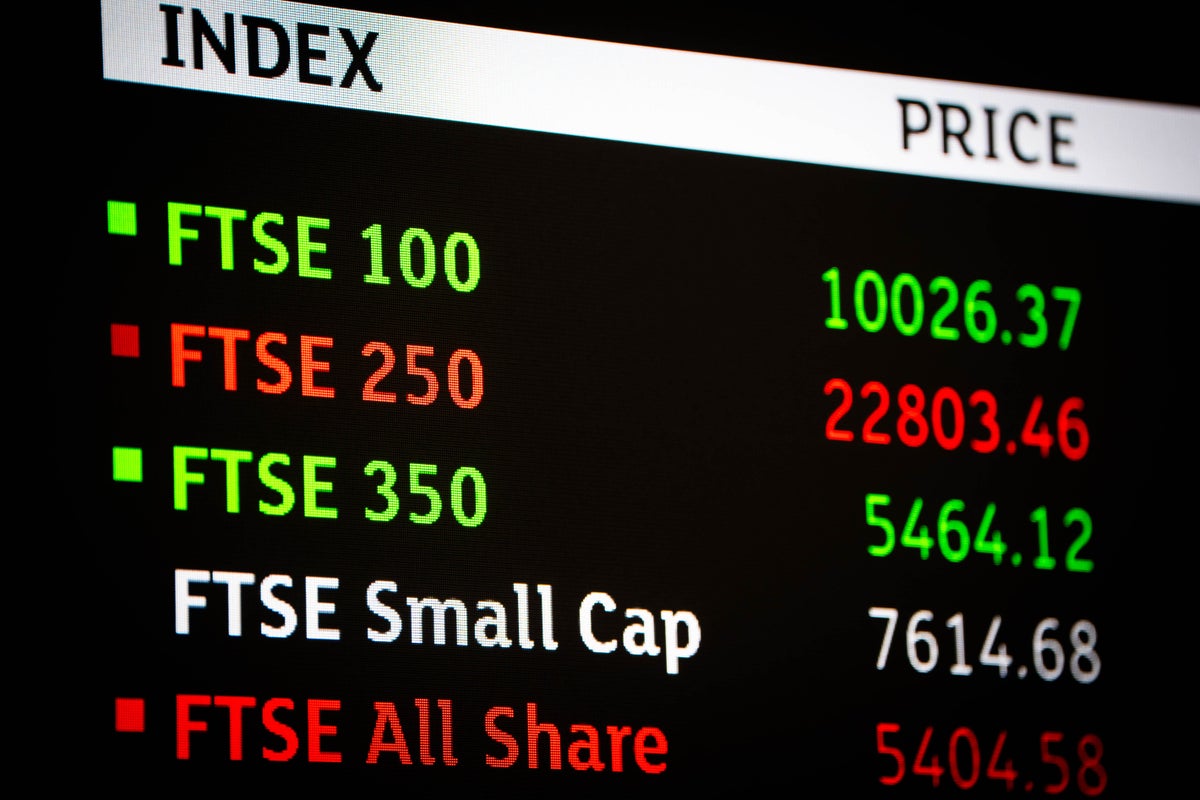
The FTSE 100 ended a losing week on the back foot as investors weighed UK local election results and fresh clashes between the US and Iran in the Middle East.
AJ Bell investment director Russ Mould said: “While officially the ceasefire between the US and Iran remains in place, an exchange of fire in the Strait of Hormuz has helped to extinguish some of the hope that a deal between the parties might be close.”
The FTSE 100 closed down 43.88 points, 0.4%, at 10,233.07. The FTSE 250 ended down 33.34 points, 0.2%, at 22,849.38, and the AIM All-Share fell 3.89 points, 0.5%, at 814.43.
For the week, the FTSE 100 fell 1.4%, the FTSE 250 rose 1.7% and the AIM All-Share advanced 2.0%.
Iranian media reported fresh “sporadic clashes” with US naval forces in the Strait of Hormuz on Friday, following a flare-up the night before, despite the ceasefire in the Gulf.
“For the last hour, sporadic clashes have taken place between the Iranian armed forces and American vessels in the Strait of Hormuz,” the Fars news agency said.
For its part, the US said its forces fired on and disabled two Iranian-flagged tankers that attempted to violate the blockade of Iran’s ports.
Nonetheless, secretary of state Marco Rubio said Washington was expecting a response from Iran on Friday to US proposals for a deal to end the conflict.
“We’re expecting a response from them today at some point… I hope it’s a serious offer, I really do,” Mr Rubio told reporters during a visit to Rome.
Brent crude for July delivery was trading at 101.49 dollars a barrel on Friday, up compared to 97.76 at the time of the equities close in London on Thursday.
The more downbeat mood in equities was reflected in Europe on Friday, where the Cac 40 in Paris ended down 1.1%, and the Dax 40 in Frankfurt ebbed 1.3%.
But US markets advanced once more after mixed economic data, with recent strong earnings continuing to underpin advances.
The Dow Jones Industrial Average was up 0.1%, the S&P 500 rose 0.7% while the Nasdaq Composite was up 1.3%.
The yield on the US 10-year Treasury widened to 4.37% on Friday from 4.36% on Thursday. The yield on the US 30-year Treasury narrowed to 4.94% on Friday from 4.95%.
US data was mixed on Friday with strong looking non-farm payrolls figures and a weak consumer confidence report.
The US economy added more jobs than expected in April, while the unemployment rate remained unchanged, according to the US Bureau of Labour Statistics.
Non-farm payrolls rose 115,000 in April, slowing from 185,000 in March, but beating 62,000 FXStreet consensus.
March’s total was revised upwards by 7,000 from 178,000, while February’s total was revised down by 23,000, meaning 156,000 jobs were shed.
The unemployment rate stayed stable at 4.3% in April, in line with consensus.
Morgan Stanley said the report will “build more confidence” in labour market stability while the Federal Open Market Committee “remains uncertain about whether higher oil prices will spill into slower growth or faster core inflation. Labuor market stability gives the Fed time to wait.”
But ING said while a second consecutive firm jobs report is a “big win” for the US economy, other labour market data is “not as firm” and consumers “certainly aren’t recognising the strength of this data point.”
Reflecting this, US consumer sentiment came in at its lowest-ever recorded level in May, according to a University of Michigan survey, with Americans battered by high prices and concerns about the Iran war.
The university’s Index of Consumer Sentiment came in at 48.2 in May, its lowest level since data collection began in 1952, and below 49.5 market consensus.
The pound firmed to 1.3623 dollars on Friday afternoon from 1.3616 on Thursday. Against the euro, sterling was little changed at 1.1568 euros from 1.1567 on Thursday.
Sterling and UK gilts held steady as markets digested the implications of heavy losses suffered by the Labour government in UK local elections.
Prime Minister Sir Keir Starmer pledged to fight on but the defeat could yet speak a leadership challenge.
On the FTSE 100, BT led the way, rising 6.6% as Goldman Sachs and JP Morgan sang its praises.
JP Morgan reiterated an “overweight” rating and raised its share price target to 310 pence from 300p.
In a research note, titled: “Entering the next leg of the re-rating journey,” JPM highlighted an improving equity free cash flow position that could support a doubling in BT’s dividend by 2030.
Goldman Sachs retained its “buy” rating and “materially” raised its mid-term dividend per share estimates.
Earlier this week, Bank of America upgraded BT, citing its hopes for an upturn in the dividend.
British Airways owner IAG closed down 2.8%, although above earlier lows, as it warned of a profit hit from rising fuel costs.
Chief executive Luis Gallego said higher fuel prices will “inevitably lead to lower profit this year than we originally anticipated.”
IAG now expects full-year fuel costs of £9 billion, including hedging positions, which would be 27% higher than £7.08 billion in 2025, and above the £7.0-7.4 billion range IAG forecast in February.
Intertek was down 2.7% as it rejected a third bid from EQT, believing it “significantly undervalues” its prospects.
Gold traded lower at 4,711.50 dollars an ounce on Friday, from 4,742.97 on Thursday.
The biggest risers on the FTSE 100 were BT Group, up 14.60p at 236.20p, Whitbread, up 88.00p at 2,410.00p, JD Sports Fashion, up 2.08p at 75.08p, Vodafone, up 2.65p at 118.65p and Entain, up 10.40p at 548.00p.
The biggest fallers on the FTSE 100 were Lion Finance, down 550.00p at 11,030.00p, Babcock International, down 47.50p at 1,052.50p, Metlen Energy & Metals, down 1.50p at 36.30p, Rolls Royce, down 39.20p at 1,219.80p and BAE Systems, down 58.00p at 1,933.80p.
Monday’s global economic calendar sees China CPI and PPI data and US home sales figures.
Monday’s local corporate calendar has half-year results from contract caterer Compass.
Business
FPI May trade: Foreign portfolio investiors withdrew Rs 14,231 crore from Indian equities – The Times of India
Foreign portfolio investors have extended their retreat from Indian equities in May, taking their total withdrawal from the market in 2026 beyond Rs 2 lakh crore as global economic concerns continue to drag down sentiment. Data from NSDL showed FPIs have pulled out Rs 14,231 crore so far this month, adding to a year marked by persistent selling pressure. The cumulative outflow this year has now surpassed the Rs 1.66 lakh crore foreign investors withdrew during the whole of 2025. The pattern through 2026 has largely remained negative, with February standing out as the lone exception. January opened with FPIs selling equities worth Rs 35,962 crore. In February, however, foreign investors briefly reversed course, bringing in Rs 22,615 crore, their biggest monthly investment in 17 months. That momentum did not last. March recorded the sharpest reversal, with a record Rs 1.17 lakh crore exiting Indian equities. April followed with another steep outflow of Rs 60,847 crore, while May has continued the same trajectory. “The selling was largely driven by persistent global macroeconomic uncertainties, particularly concerns around inflation, interest rates and geopolitical risks, which continued to weigh on sentiment toward emerging markets,” Himanshu Srivastava, Principal, Manager Research at Morningstar Investment Research India, said. According to Srivastava, uncertainty over how global interest rates will move remains central to foreign investor behaviour. High crude oil prices and unresolved geopolitical tensions, particularly in the Middle East, have kept inflation concerns elevated worldwide, forcing investors to reassess hopes of near-term rate cuts by major central banks. This backdrop has supported firm global bond yields, increasing the appeal of developed-market debt instruments while weakening investor appetite for emerging market equities such as India. He also said intermittent weakness in the Indian rupee has affected returns for overseas investors when measured in dollar terms. Even amid sustained selling, foreign investors have not completely stepped away from Indian markets. V K Vijayakumar, Chief Investment Strategist at Geojit Investments, said FPIs have shown selective interest in segments such as power, construction and capital goods. He noted that mid-cap and certain small-cap stocks with strong earnings and growth potential are also drawing investor attention. Vijayakumar said currency depreciation and concerns around India’s earnings growth have played a significant role in shaping FPI outflows this year. He added that markets like South Korea and Taiwan are currently seeing stronger FPI interest, supported by expectations of better earnings growth linked to the artificial intelligence boom.

Campaigners are calling for a ban on the use of the weedkiller over health concerns.
Source link
Business
Assam ships 20 tons of honey consignment to US, farmers get export market boost – The Times of India

In a major push to India’s agricultural exports and the government’s One District One Product (ODOP) initiative, APEDA has facilitated the first-ever export of 20 metric tonnes of honey from Assam’s Baksa district to the United States, ANI reported.According to the Commerce and Industry Ministry, the consignment was flagged off on May 9 and exported by APEDA-registered exporter M/s Salt Range Foods Pvt Ltd.“In a major boost to the diversification of India’s agricultural exports and furthering the One District One Product (ODOP) initiative, the first-ever export consignment of ODOP honey from Baksa, an Aspirational District in Assam, to the USA was flagged off on 09 May 2026 through the initiative of APEDA,” the ministry said in a release.The ministry said the 20-metric-tonne consignment was sourced from Baksa district, which has been identified under the ODOP programme for its strong honey production and export potential.“Sourced from eco-friendly and pesticide-free environments, honey from Baksa district is known for its high quality and near-organic characteristics, reflecting the region’s rich biodiversity and sustainable agricultural practices,” the release stated.The ministry noted that honey collection has traditionally been practised by indigenous communities such as the Karbi, Mishing and Bodo tribes, where honey has long been used for food, medicinal and cultural purposes.As per National Horticulture Board data cited in the release, Assam produced around 1,650 metric tonnes of honey during FY24. Major honey-producing districts in the state include Baksa, Kokrajhar, Chirang, Udalguri and Tamulpur in the Bodoland Territorial Region.The government said the export initiative is expected to significantly improve earnings for local beekeepers and farmers.“The initiative is expected to significantly benefit local beekeepers and farmers, with producers receiving nearly 43 per cent higher price realisation compared to prevailing local farm gate prices, thereby enhancing income opportunities and strengthening rural livelihoods in the region,” the ministry said.According to the release, APEDA supported the export process by facilitating infrastructure development and providing testing and laboratory equipment at the processing facility to ensure compliance with global food safety and quality standards.“The export initiative marks a significant milestone in integrating farmers from Aspirational Districts into global value chains, ensuring better price realisation and sustained market access,” the ministry added.The ODOP initiative seeks to promote district-specific products, strengthen local economies, encourage value addition and create employment opportunities by linking regional products with international markets.

[CinePlex360] Please moderate: “Indonesia lands
FPI May trade: Foreign portfolio investiors withdrew Rs 14,231 crore from Indian equities – The Times of India

Iran’s Guards threaten US Mideast sites as Trump awaits Tehran response

-

 Politics6 days ago
Iran weighs US reply delivered via Pakistan as Trump signals opposition to deal terms
-

 Fashion1 week ago
Canada’s Lululemon appoints Esi Eggleston Bracey to board of directors
-

 Fashion1 week ago
US’ J.Jill, Inc. appoints Kimberly Wallengren as CMO
-

 Tech1 week ago
This Indigenous Language Survived Russian Occupation. Can It Survive YouTube?
-

 Fashion1 week ago
US’ Gap partners with Victoria Beckham on timeless wardrobe essentials
-
 Business1 week ago
Apollo Sports Capital and Tom Dundon make landmark $225 million investment in pickleball
-

 Fashion1 week ago
AAFA pushes for swift US House passage of key anti-counterfeiting law
-

 Fashion1 week ago
US cotton export sales show strong recovery, Upland rise 36%