

Business
UK cement production drops to lowest levels since 1950s

Pritti Mistry & Simon BrowningBusiness reporters, BBC News
 Getty Images
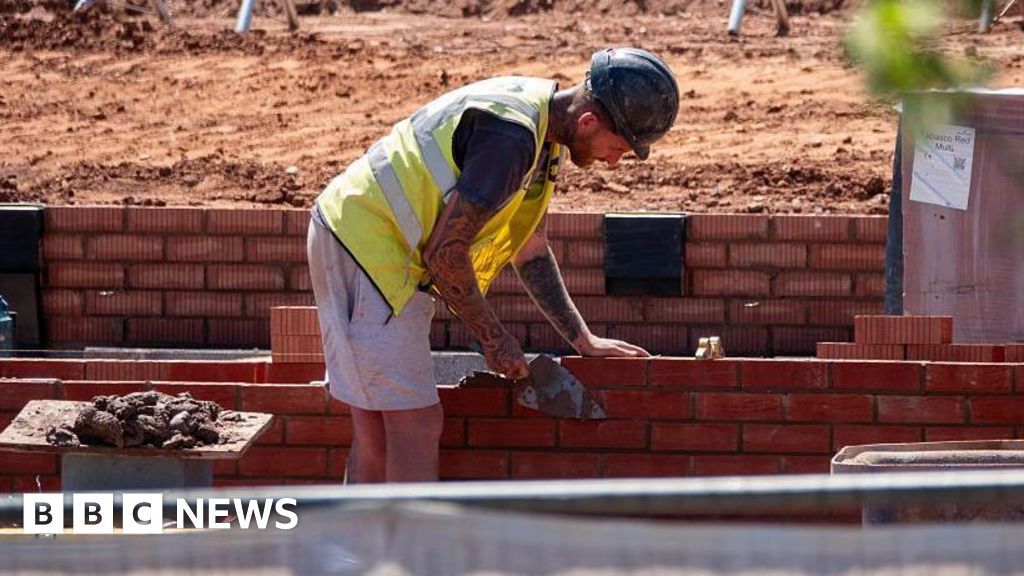
UK cement production has fallen to its lowest level since 1950, putting the government’s house building plan at risk, a trade body has warned.
Cement is the key binding ingredient in concrete, which is the most widely used material in the construction industry, and mortar.
The Mineral Products Association (MPA) said production levels were “increasingly under threat” due to high energy, regulatory and labour costs.
The Department for Business and Trade said it recognised challenges in the sector and its Industrial Strategy was increasing help for energy-intense companies, which include cement manufacturers.
The Labour government has pledged to build 1.5 million new homes in England by 2029 as part of efforts to solve the housing crisis and boost economic growth.
Under a separate investment strategy unveiled in June, Chancellor Rachel Reeves pledged to pour £725bn over the next decade into maintaining existing infrastructure and building new projects.
But the UK made just 7.3 million tonnes of cement in 2024, according to the MPA, which represents manufacturers of products such as asphalt and cement.
The trade body said that was about half of that produced in 1990 and similar to production levels seen when rationing was still in place following the World War Two.
MPA executive director Dr Diana Casey said the decline threatened to derail the government’s ambitions for housing, infrastructure and clean energy projects.
“[You] can’t build houses, bridges or railways without us,” she told the BBC.
“So the fact production has declined so much at a level since 1950 is worrying,” she continued, adding that it “could impact government targets like homes and hospitals and power plants that are due to be built”.
The MPA said a project such as the Sizewell C nuclear power plant could need up to 750,000 tonnes of cement and a new hospital would require nearly 8,000 tonnes.
A traditional four-bedroom home needs between three and five tonnes.
The MPA said production had fallen due to rising costs and changes to carbon taxation, which reduced market competitiveness and was a major concern to the sector.
It also highlighted the growth of cheaper cement import sales nearly tripling over the past 16 years, from 12% in 2008 to 32% in 2024.
Ms Casey said more action was needed to cut electricity prices, which were “disproportionately affecting the industry”.
“[The] UK is uncompetitive because of high costs – energy particularly – and regulatory burden because of carbon, therefore it is cheaper to import cement,” she said.
“We’re calling on the government to help put domestic production on a level playing field so that it can compete fairly with imports.”
In a statement, the Department for Business and Trade said: “We recognise the cement sector faces challenges which is why our modern Industrial Strategy is increasing support for energy-intensive firms through our Supercharger scheme, which will slash energy prices for eligible businesses.”
According to the MPA, about 40% of British cement is manufactured in the Peak District, with the rest of the production spread across the UK.
The trade body fears jobs could be at risk and “disappear in the future” if imports rise.
Rico Wojtulewicz, head of policy and market insights at the National Federation of Builders, said it was getting harder for construction firms, because there were many stalled projects which meant there was a reduced need for locally manufactured cement.
Building costs had also continued to rise, he added, which was pushing smaller builders out of the sector and driving others to find savings.
“They are all looking for better priced materials,” he said.

A United Airlines plane approaches the runway at Denver International Airport on March 23, 2026.
Al Drago | Getty Images
United Airlines slashed its 2026 earnings outlook Tuesday as it grapples with a surge in jet fuel prices due to the Iran war, but CEO Scott Kirby said demand remains strong.
United said it could earn between $7 and $11 a share on an adjusted basis this year, down from its previous forecast of between $12 and $14 a share that it released in January, more than a month before the U.S. and Israel attacked Iran.
Wall Street had already been adjusting its expectations for the year because of higher fuel. Analysts polled by LSEG had forecast that United’s adjusted, full-year earnings would be $9.58 a share.
The carrier, like others, is trimming some of its planned flying this year to reduce costs. Lower capacity can drive up airfare, with fewer seats on the market.
For the second quarter, United forecast adjusted earnings of between $1 and $2 a share. Analysts had expected $2.08 a share for the quarter. United estimated its fuel price would average $4.30 a gallon in the second quarter.
The carrier said it expects its revenue to cover between 40% to 50% of the fuel price increase in the second quarter, as much as 80% in the third and between 85% and 100% by the end of the year.
United reiterated that it is tweaking its schedules to adjust to higher fuel, with capacity in the second half of the year expected to be flat to up about 2% on the year. It grew 3.4% in the first quarter.
Here is what United Airlines reported for the quarter that ended March 31 compared with what Wall Street was expecting, based on estimates compiled by LSEG:
- Earnings per share: $1.19 adjusted vs. $1.07 expected
- Revenue: $14.61 billion vs. $14.37 billion expected
Revenue, profit climb
Revenue overall rose more than 10%, to $14.61 billion, up from the $13.21 billion from a year before.
For the first quarter, United’s net income rose 80% to $699 million, or $2.14 cents a share, compared with net income of $387 million, or $1.16 cents a share, a year earlier. Adjusted for one-time items, United posted earnings per share of $1.19 a share.
Unit revenue was up in every reported segment, including for domestic U.S. flights, where it rose 7.9% to $7.9 billion from a year earlier, signaling strong pricing power in the quarter.
Jet fuel in the U.S. was going for $3.51 a gallon on Monday, down from the high on April 2 of $4.78, but far above the $2.39 on Feb. 27, the day before the first attacks on Iran, according to prices assessed by Platts.
Airline executives have said demand has remained robust even while they have increased fares and checked bag fees as they pass along higher fuel prices to customers.
“Bookings are strong,” Kirby told CNBC’s “Squawk Box” on Wednesday.
United and the rest of the industry have become more reliant on travelers who are willing to shell out more for flights and bigger seats, and who are less affected by price increases.
Alaska Airlines pulled its 2026 forecast on Monday because of higher fuel prices. It has raised fares about $25, CEO Ben Minicucci told analysts Tuesday.
Merger ambitions?
Kirby is likely to face questions on the company’s 10:30 a.m. ET earnings call on Wednesday about his ambitions for a merger with another airline.
Kirby floated a potential merger with American Airlines to a Trump administration official earlier this year, according to a person familiar with the matter, but President Donald Trump said he was against the idea.
“I don’t like having them merge,” he told CNBC’s “Squawk Box” on Tuesday morning. He said he would like someone to buy struggling discount carrier Spirit but he also suggested that the federal government could “help that one out.”
American also rejected the idea of a merger with United last week.
When asked about floating the merger, Kirby declined to confirm the meeting to CNBC’s “Squawk Box” on Wednesday but said: “We want to create a truly global airline.”
Kirby reiterated his view that the U.S. is at a deficit in international air travel as customers fly on international competitors, some of which are state owned.

NI Affairs Committee told even if conflict ends immediately it will take time for supply chains to return to normal.
Source link

The president also said the US will continue to blockade Iran’s ports until peace talks progress.
Source link


US’ Gap & FIT launch programme to mentor fashion students

Nasa unveils new space telescope to probe mysteries of ‘dark energy’

Dubai to build $9.25bn ‘Golden Line’ metro, completion set for 2032

-

 Fashion6 days ago
France’s LVMH Q1 revenue falls 6%, shows resilience amid Iran war
-

 Entertainment7 days ago
Is Claude down? Here’s why users are seeing errors
-

 Sports1 week ago
PSL 11: Peshawar Zalmi win toss, opt to field first against Quetta Gladiators
-

 Tech1 week ago
The Deepfake Nudes Crisis in Schools Is Much Worse Than You Thought
-

 Tech1 week ago
Bremont Is Sending a Watch to the Moon’s Surface
-

 Tech1 week ago
Human-machine teaming dives underwater
-
 Business1 week ago
BP sees ‘exceptional’ oil trading result as Iran war sends crude costs soaring
-
 Business1 week ago
Standard Life buys rival in £2b deal to create savings giant