

Sports
Sources: Knicks to hire Saint Joseph’s Lange

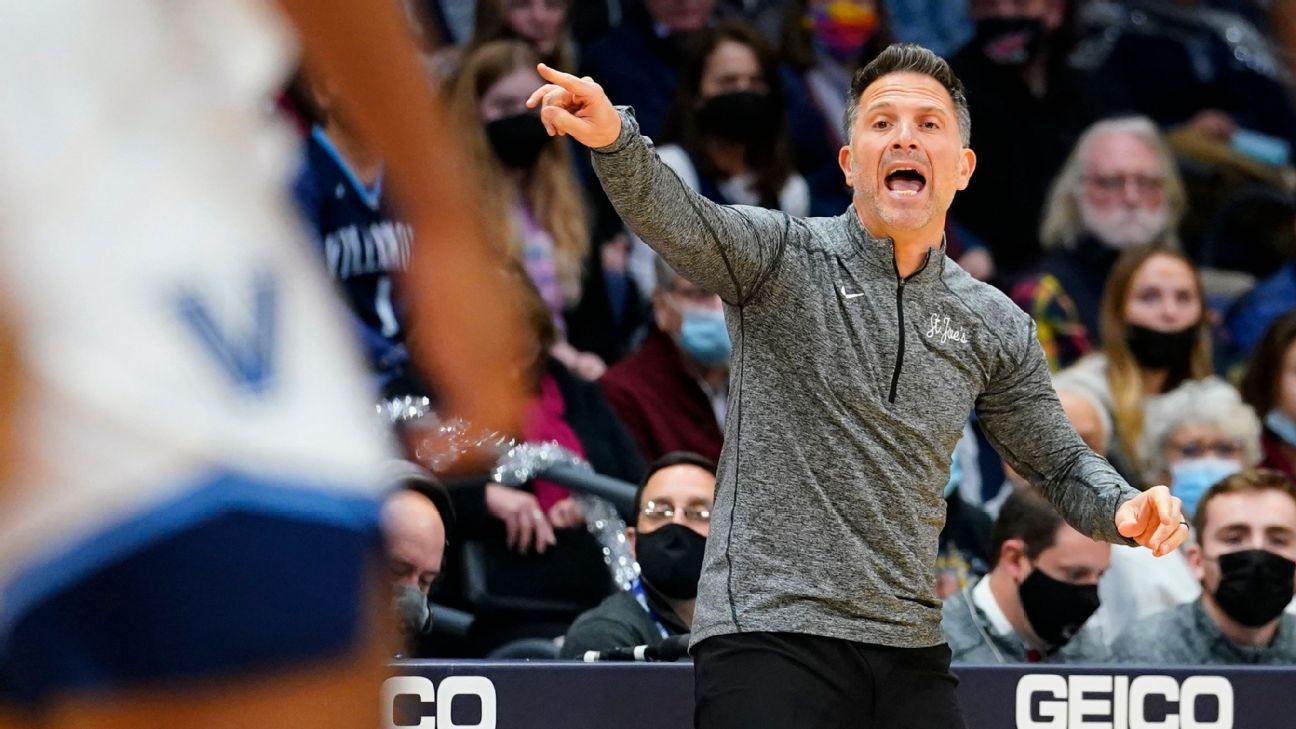
The New York Knicks are expected to hire Saint Joseph’s head coach Billy Lange for a role with the franchise, sources told ESPN.
Lange was set to start his seventh season in charge of the Hawks. He went 81-104 during his time at St. Joe’s but won more than 20 games in each of the past two seasons.
He led the Hawks to the NIT in 2024 and 2025 while also seeing forward Rasheer Fleming become the first Saint Joseph’s player selected in the NBA draft since 2016. Fleming was the first pick of the second round by the Oklahoma City Thunder in June.
Prior to replacing Phil Martelli in 2019, Lange was an assistant coach with the Philadelphia 76ers for six years. He was also the head coach at Navy for seven seasons and spent time as an assistant under Jay Wright at Villanova for five years over two separate stints.
The Knicks fired Tom Thibodeau in June after five seasons, replacing him a month later with two-time NBA Coach of the Year Mike Brown.
Saint Joseph’s announced Wednesday that Steve Donahue, who joined the staff as associate head coach in the spring, will become the program’s next head coach.
The school said Donahue “will lead the Hawks into the 2025-26 season and beyond.”
“Coach Donahue has had an incredible impact on collegiate basketball up and down the East Coast and on the national stage,” athletic director Jill Bodensteiner said. “He is a rare and accomplished coach who is as respected for his basketball acumen as he is for his character.”
Other notable assistant coach hires by the Knicks since Brown took over include former Charlotte Hornets assistant Chris Jent and T.J. Saint, who was the head coach of the G League’s Birmingham Squadron.
NEWYou can now listen to Fox News articles!
What comes to mind when you think of the top men’s FIFA World Cup moments?
It could be Diego Maradona carving through England’s defense for the Goal of the Century. Or, a legend like Pelé or Lionel Messi raising the trophy up high into the sky. Or something more controversial, like Cristiano Ronaldo’s wink after getting Wayne Rooney sent off.
Leading up to this summer, we’re counting down the most iconic, most controversial, most defining moments in tournament history. Check out today’s entry, but keep on reading as we count down to the BEST World Cup moment ever.
JUMP TO: 100-90 | 89-80 | 79-70 | 69-60 | 59-50 | Stay Tuned For More
No. 100: Pure Control, Pure Class, Pure Messi
In 2018, the pressure on Lionel Messi was building. Argentina‘s star captain had gone scoreless through two games, including a 3-0 loss to Croatia. He needed to do something against Nigeria. That’s when the Messi magic appeared.
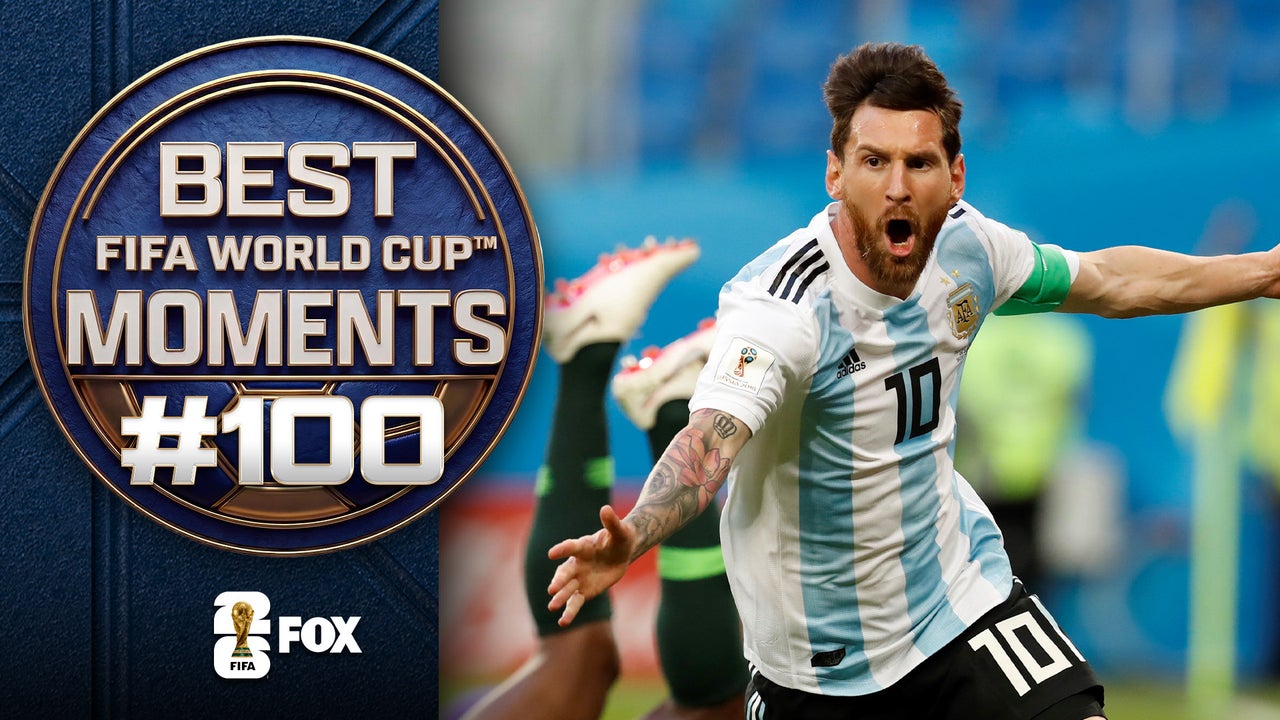

Argentina went on to win the game and advance. An unbelievable first touch from Lionel Messi that saved Argentina. And while La Albiceleste were eliminated by eventual champions France in the round of 16, Messi’s sublime goal was perhaps the best of the tournament.
No. 99: Red Card for … Celebrating?!
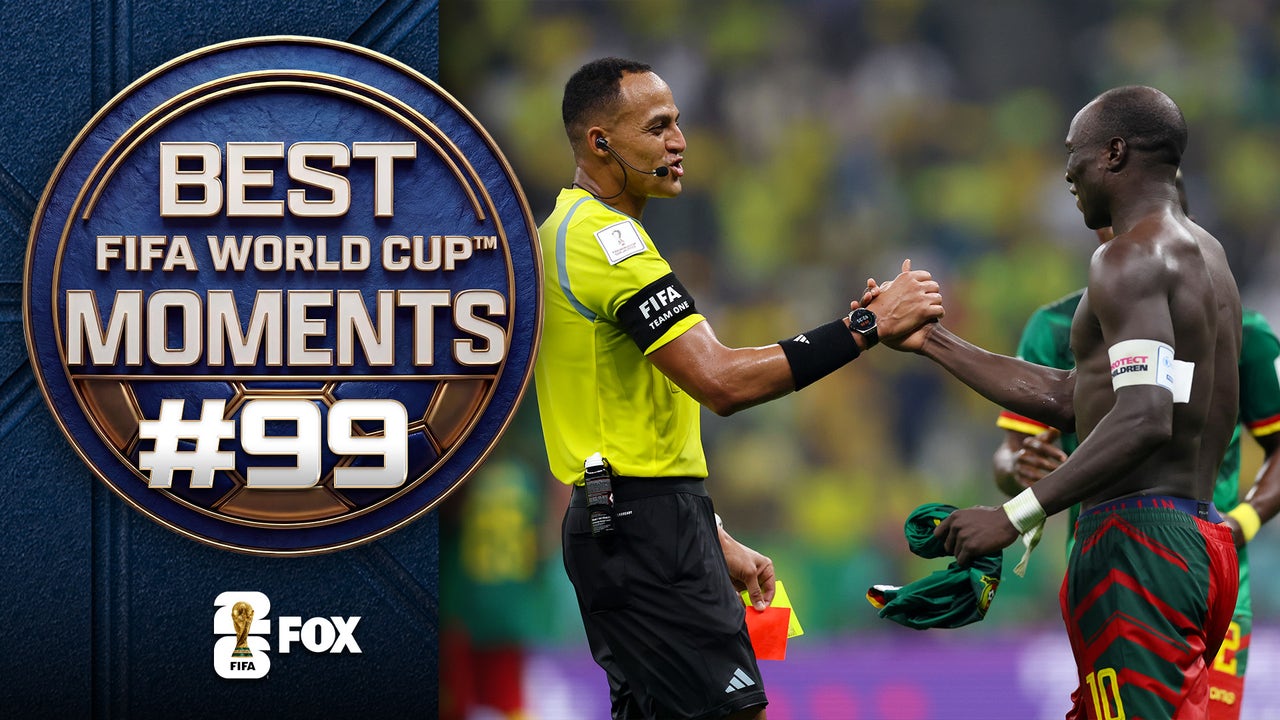
Vincent Aboubakar made history for Cameroon when he scored a game-winning goal against Brazil in 2022, the first time an African country had defeated the five-time champions in a World Cup setting. The problem was that he was then sent off for excessive celebration.
The Indomitable Lions were still eliminated despite the win, with the Brazilians advancing to the knockout rounds. Nonetheless, it was punishment worth the moment of shirtless joy. It even seemed like the referee felt a bit bad for having to hand out that red card.
No. 98: Cuauhtémoc Blanco Leaps Into History
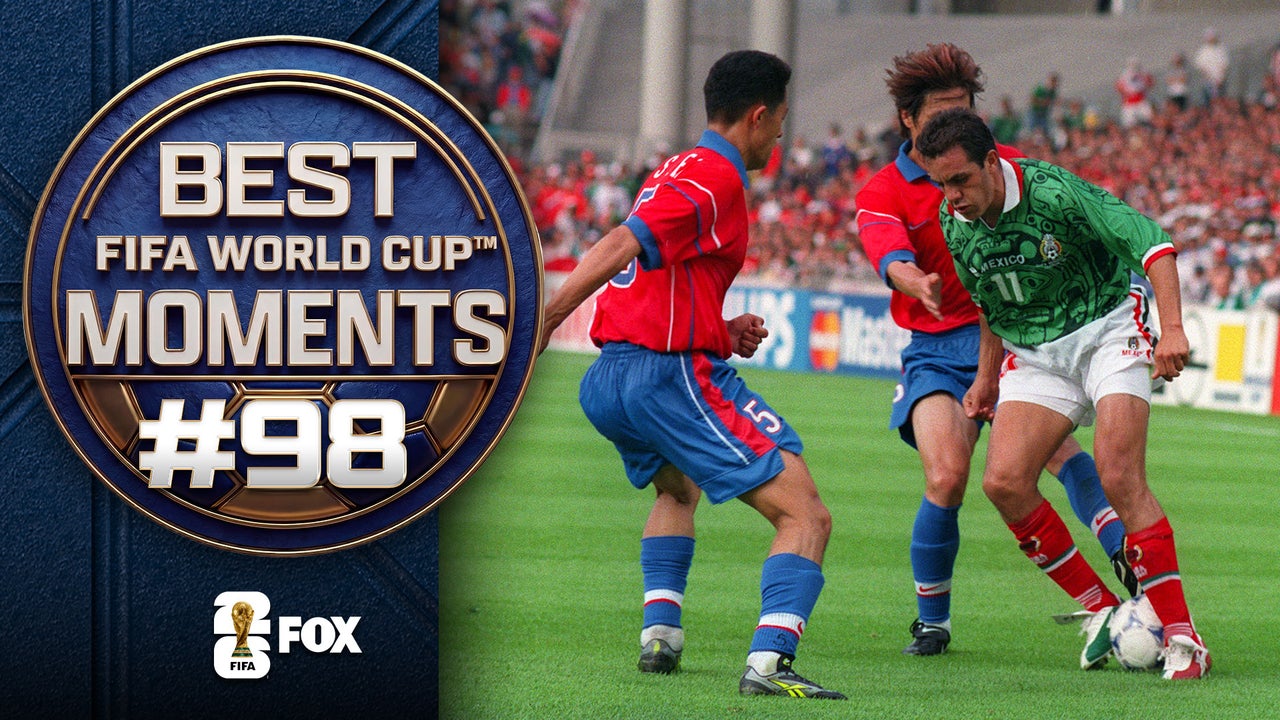
Trying to shake off around two defenders? You should think about trying this trademark move created by one of the greatest Mexican players to ever live. It was so nice, it’s known throughout the world as the “Cuauhtemiña.”
At the 1998 World Cup, Cuauhtémoc Blanco clamped the ball between his feet did his best impression of a kangaroo by hopping between two South Korean defenders. It may not have produced a goal, but the player from el barrio bravo de Tepito produced a move that has immediately leaped into the hearts and minds of soccer fans since.
No. 97: Klinsmann’s Roundhouse Flick
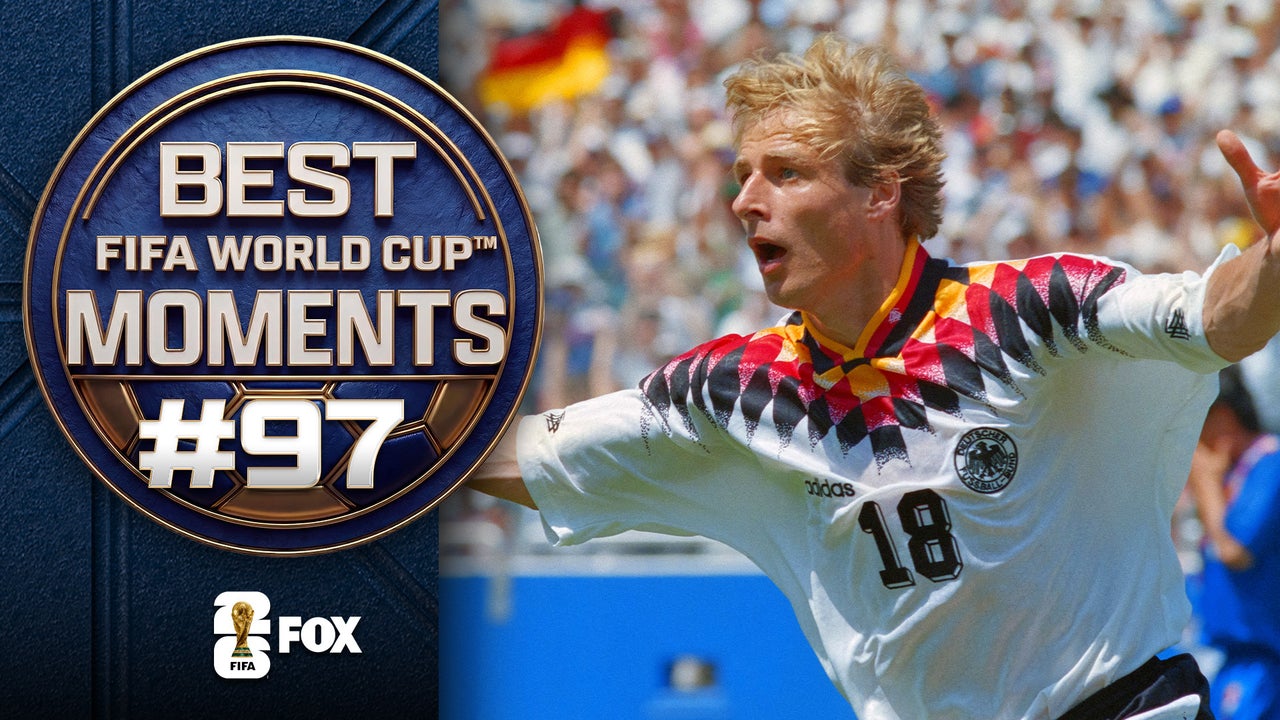
Long before he coached the United States men’s national team at the 2014 World Cup, Jürgen Klinsmann scored a ton of goals for Germany, including this stunner against South Korea.
Klinsmann, who four years earlier had helped his country win the World Cup for the third time, would turn what looked like a routine pass reception with his back to the goal into one of the most memorable goals of USA ‘94 with one swivel of his hips.
No. 96: This Free Kick Changed USA Soccer History
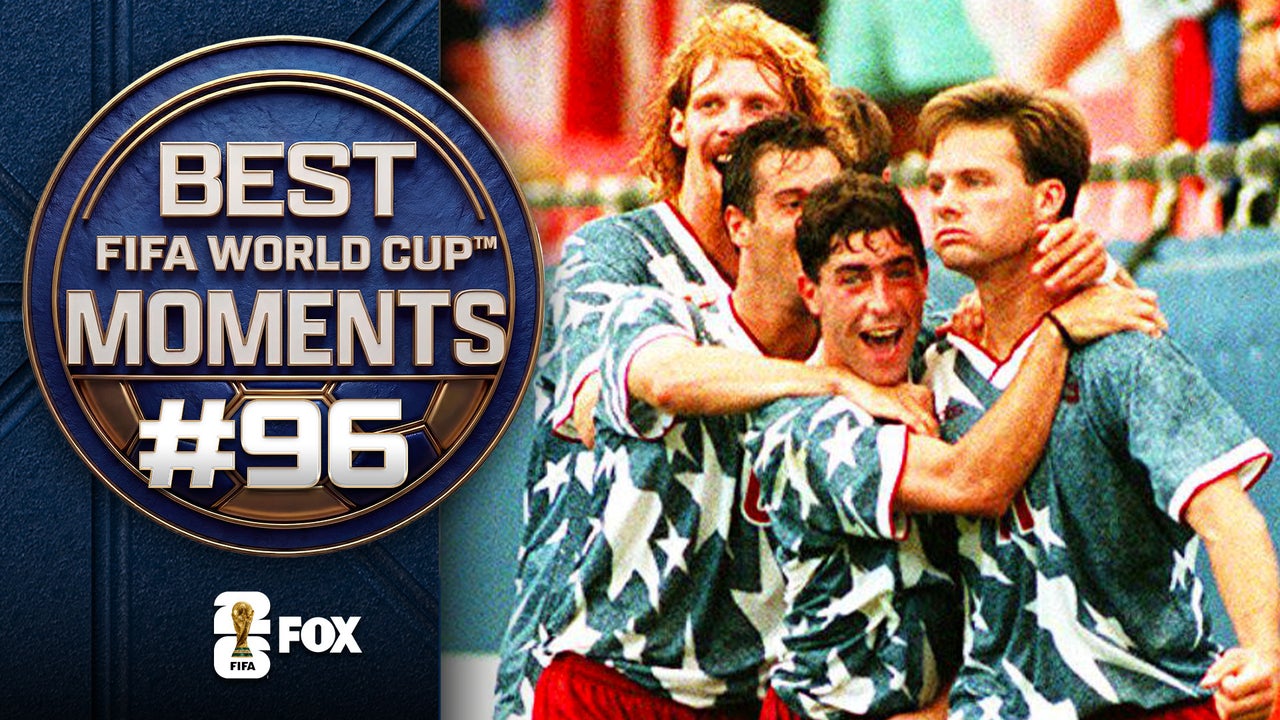
The U.S. men’s national team hadn’t made a splash at the World Cup in decades – but that all changed it the USA hosted the 1994 edition. It was thanks to a wonder-goal against Switzerland by the USA star Eric Wynalda.
Wynalda’s unstoppable, curling free kick just before the teams headed to the dressing rooms nearly blew the roof off the Silverdome in suburban Detroit. The match ended 1-1. That point, plus an upset win over Colombia a few days later, was enough to send the USA to the second round, where they took eventual champ Brazil to extra time before losing 1-0.
No. 95: One Of the Best Opening Goals Ever
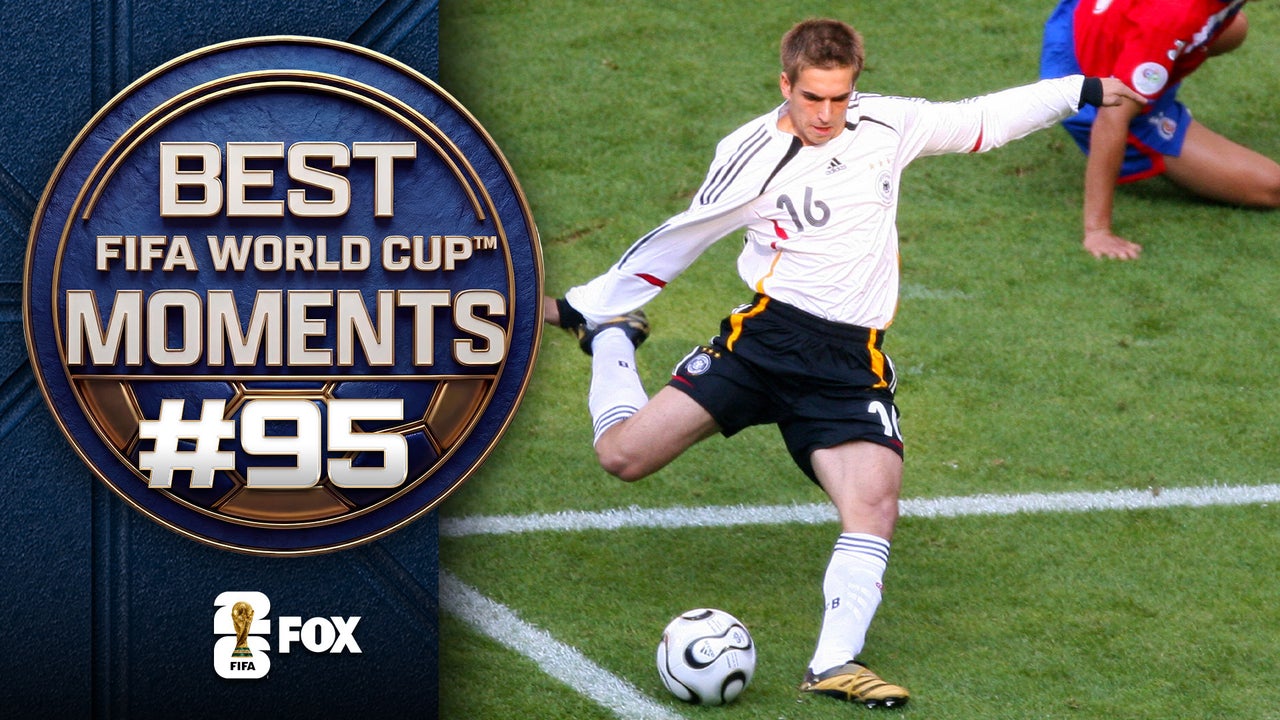
In 2006, Germany legend Philipp Lahm scored one of the best opening goals to a World Cup ever. From a distance, Lahm (wearing a cast on his right arm following a recent injury) curled the ball perfectly into the top corner past Costa Rica keeper José Francisco Porras.
Of course, it was even sweeter as the Germans were hosting the tournament with high hopes of winning it all on home soil. The hosts fell in the semifinals but Lahm’s amazing technique and control on this goal in Munich will be one of the tournament’s highlights.
No. 94: A Volley For The Ages
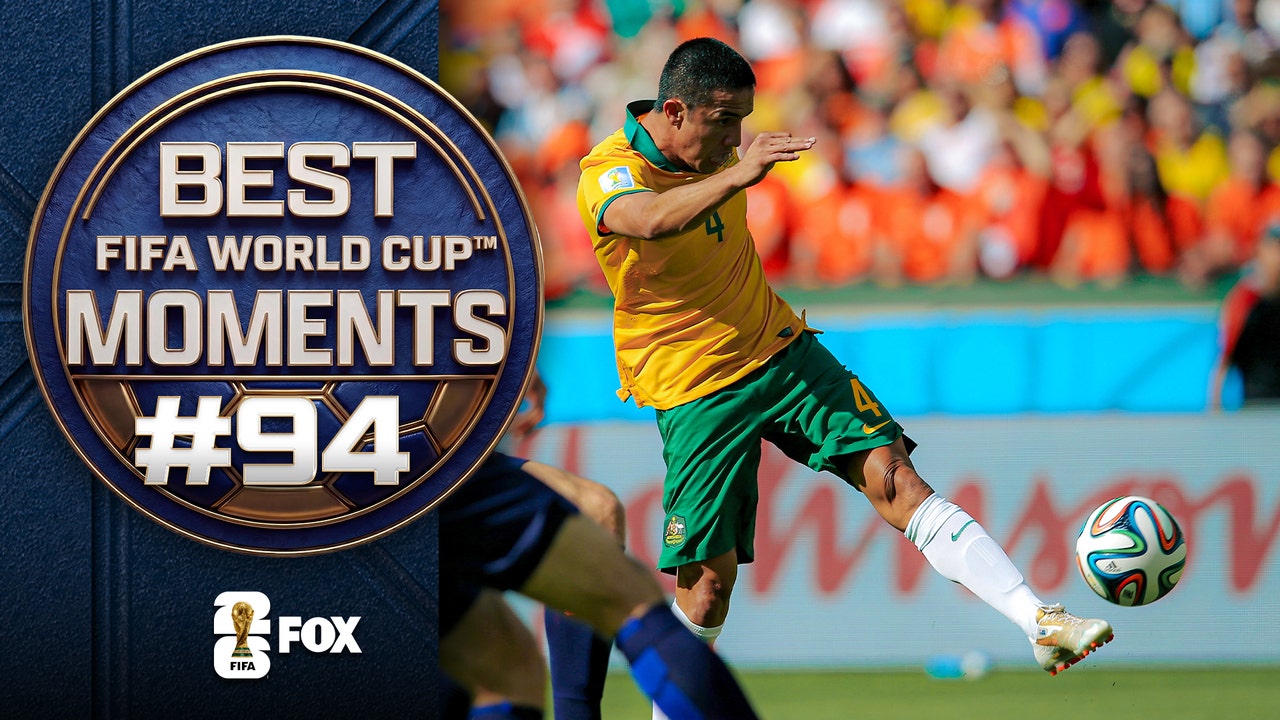
Tim Cahill is arguably Australia’s best men’s soccer player ever and that’s due to his ability to score in big moments at the World Cup. That included this spectacular volley at the 2014 tournament in Brazil, where he showed his technique and ability against the Netherlands.
A looping long pass from one side to the Porto Alegre pitch to the other, Cahill one-timed the shot into the net at the perfect angle as the ball kissed the underside of the bar. A stellar goal followed by his trademark fighting-the-corner-flag celebration.
No. 93: This Rule Proved Too Cruel
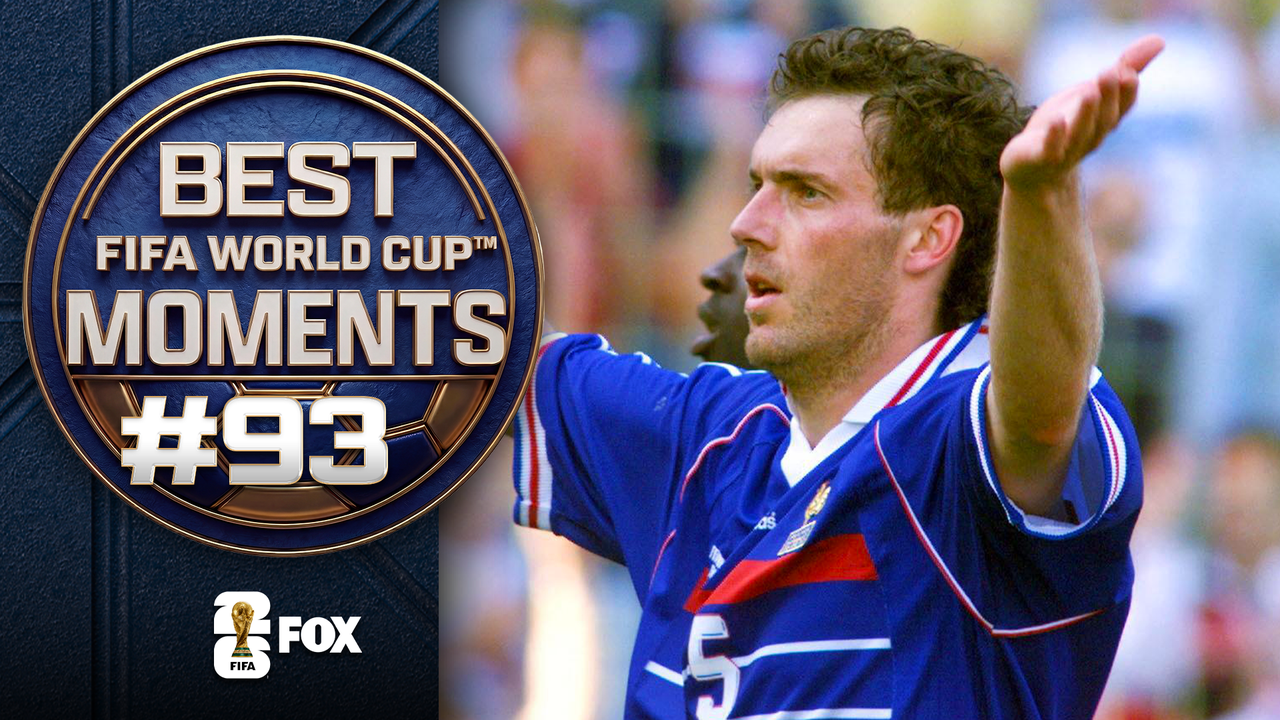
A new rule was introduced in the 1998 World Cup round of 16: Golden Goal. Score in extra time, and it’s over.
Hosts France were deadlocked with Paraguay at 0-0 going into extra time in their round of 16 matchup at Lens. The ball found Laurent Blanc at the edge of the six-yard box, and he buried it to end the match at 1-0. France advanced; Paraguay was eliminated on the spot.
France went on to win it all, but it would be one of the final few countries to benefit from the cruel rule, as it was scrapped altogether six years later.
No. 92: First Back-to-Back Champs

It didn’t take long for the World Cup to have its first dynasty.
After lifting the trophy on home soil at the second-ever World Cup in 1934, Italy did it again at France 1938, stamping its legacy forever.
Italy might not be the most famous repeat World Cup champions of all time, but it will go down in history as the first.
No. 91: A Goal That Deserved A Happier Ending
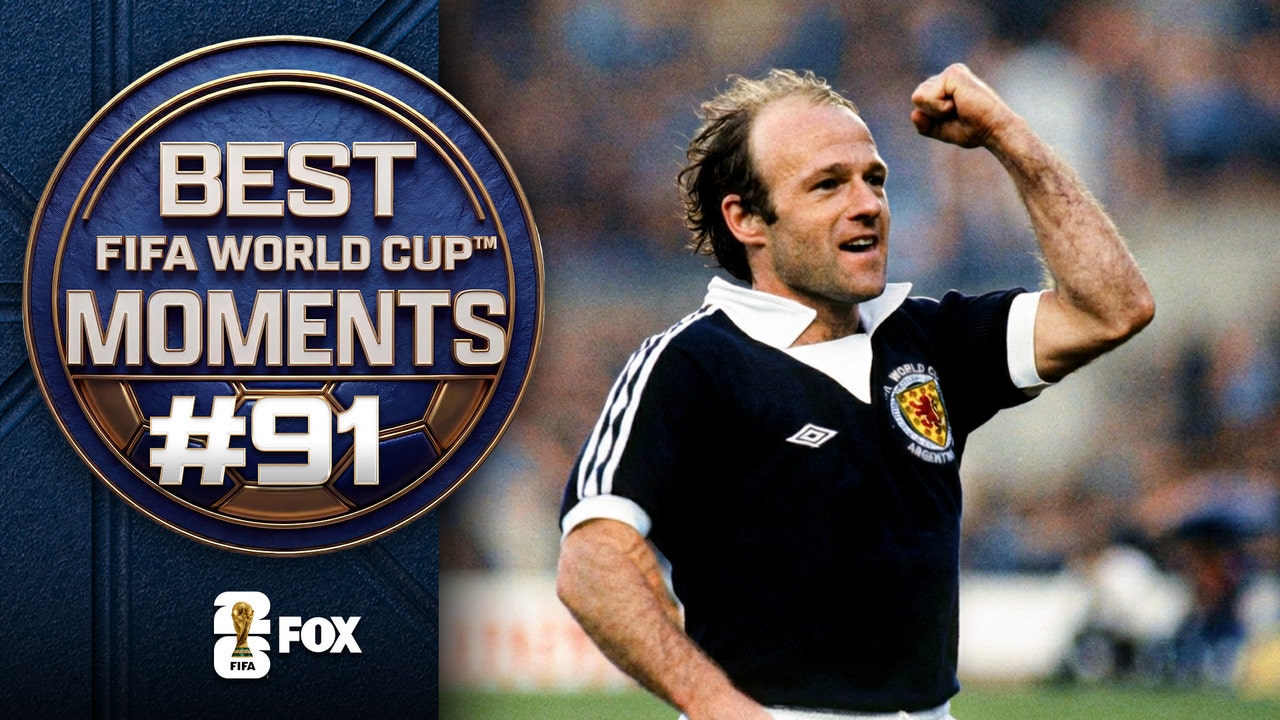
Archie Gemmill’s wonder goal for Scotland in the 1978 FIFA World Cup would have sent them to the knockout stage if they hadn’t fallen short on goal difference against the Netherlands.
Gemmill had Scottish fans dreaming of an upset against one of the world’s best sides. In the 68th minute, the diminutive midfielder danced away from three Dutch defenders before lobbing a left-footed finish over the keeper Jan Jongbloed. With a two-goal lead, it seemed Scotland would advance.
But it was to no avail as the Dutch scored minutes later, leaving the heartbroken Scots wondering what could have been. Instead, the Netherlands advanced on goal-difference and would go on to make a second consecutive World Cup final appearance.
No. 90: The Ultimate Team Goal
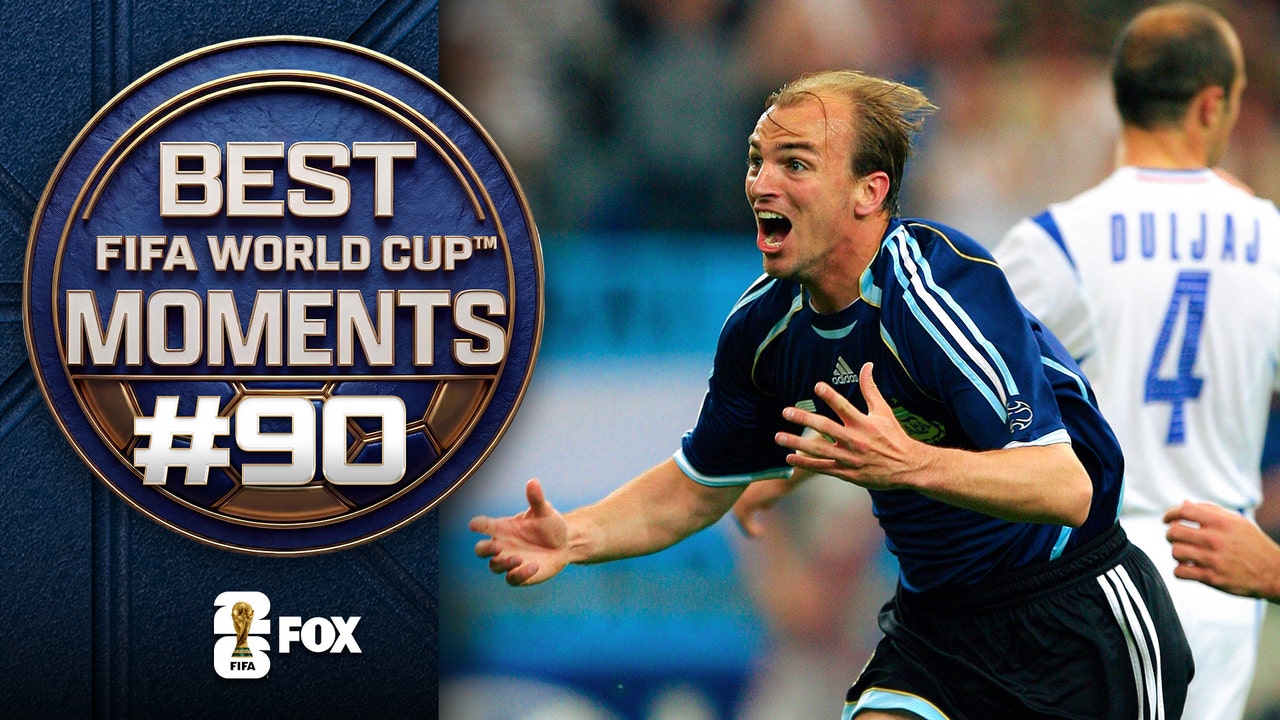
25 passes. Nine players. One iconic goal for Argentina.
At the 2006 World Cup (the first one in which Lionel Messi appeared), Argentina faced a stern test against Serbia in the group stage. It was one of those games where the underdogs knew they would have to be sharp on defense to keep a far more talented Argentina side at bay.
Except it didn’t work that way, and Argentina pounced from the get-go with an early goal in the sixth minute by Maxi Rodriguez. And that’s when the Albiceleste magic took over. In the 31st minute, a patient ballet of teamwork that involved a combination of on-target passes led to Hernán Crespo looping a ball to early-match substitute Esteban Cambiasso. Goal, Argentina.
Four more followed – including Messi’s first ever at a World Cup. But Cambiasso’s strike stood above all that day.
No. 89: A Controversial Goal Affects Three Teams
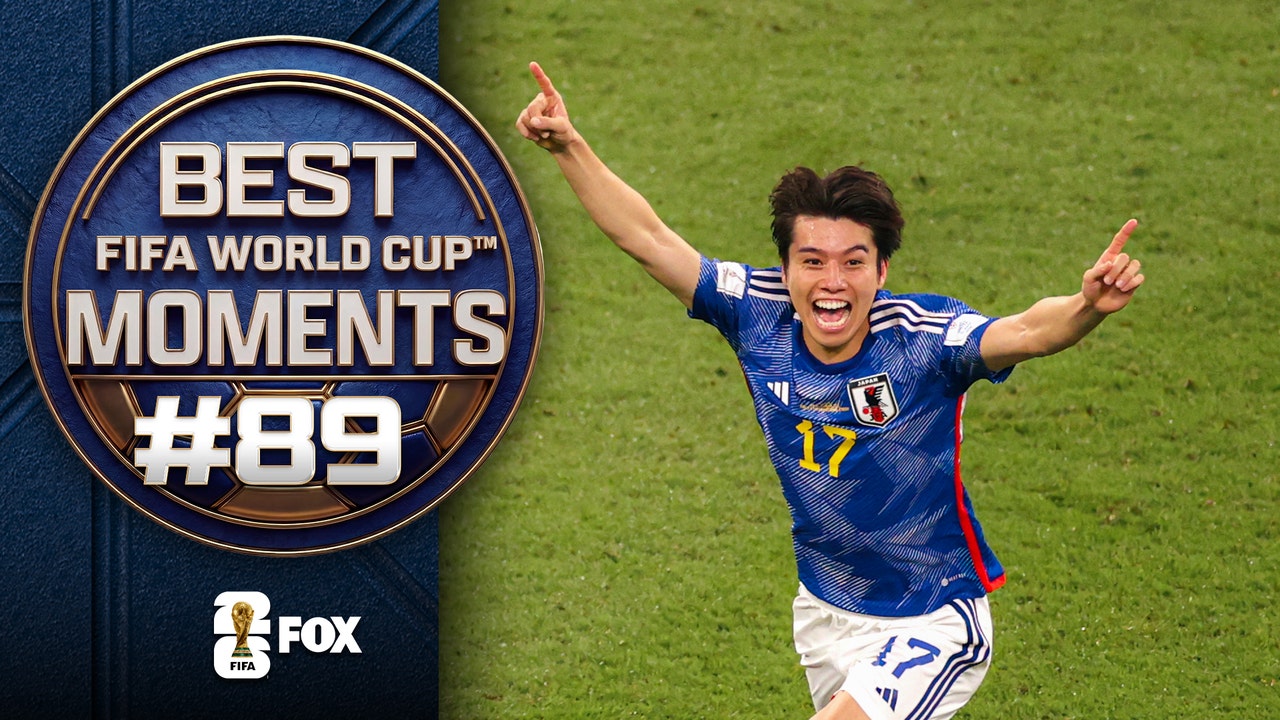
One of the toughest groups at the 2022 World Cup featured Germany (four-time champions), Spain (2010 champions), always talented Japan, and feisty Costa Rica. So you knew that this group was going to have some fireworks.
That happened on the final matchday. Germany facing Costa Rica and Japan taking on Spain with all four teams having hope of advancing.
At halftime of both matches, it seemed like Spain and Germany would advance, while Japan and Costa Rica would go home. But the script was then ripped apart. In the 51st minute of the Japan-Spain game, Kaoru Mitoma chases the ball down — it looks out. But he crosses it to Ao Tanaka, who scores off an improbable angle. VAR says the ball remained in play by the slimmest of margins. The goal stands.
Japan topped the group. Spain also advanced. Germany was eliminated despite beating Costa Rica. Joy and heartbreak all around.
No. 88: Three Yellow Cards And One Red-Faced Referee
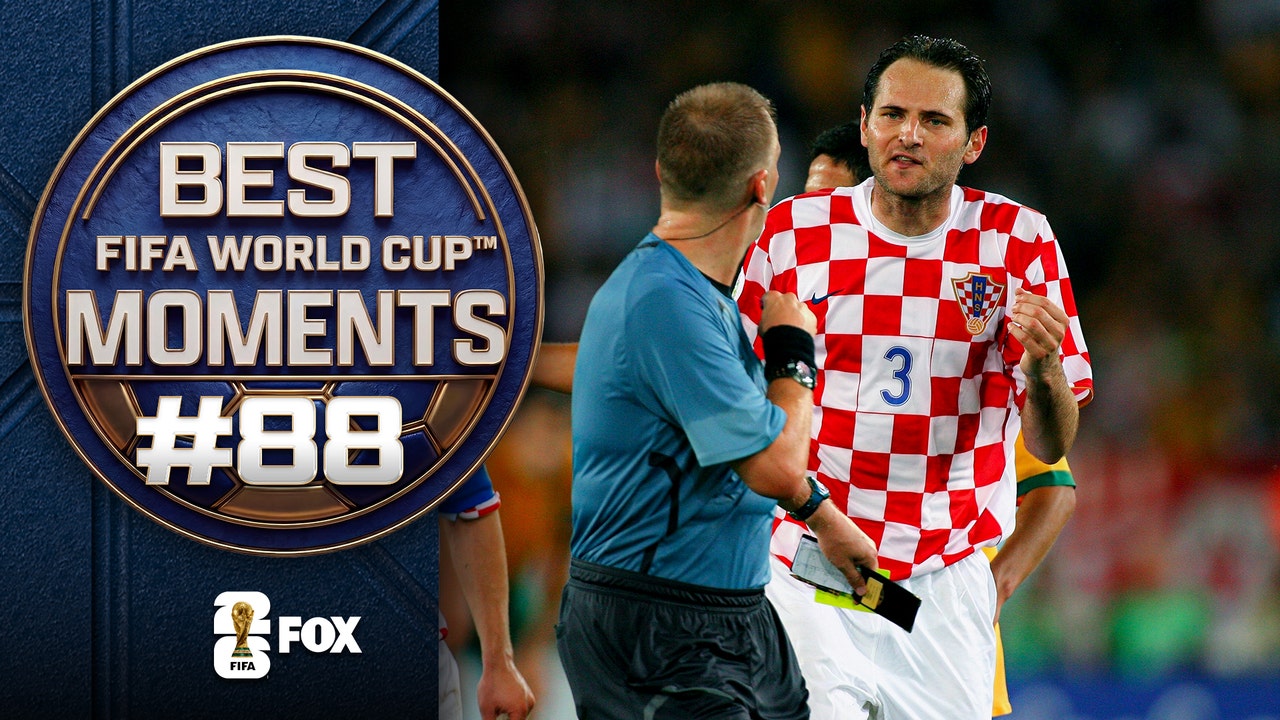
Soccer is known for its simplicity of rules when compared to other major sports. And one of the most well-known rules is that when you get two yellow cards, that equates to a red card and therefore an automatic dismissal from the game.
Which is why an error by England official Graham Poll at the 2006 World Cup was so memorable. Poll had shown Croatia’s Josip Šimunić two yellow cards in the group-stage finale against Australia, but the player inexplicably stayed on. Only until a third card was shown to Šimunić that the defender actually left the pitch.
It was the last World Cup game Poll ever worked as he asked not to be considered for future tournaments on account of his unforgettable mistake.
No. 87: Matador Magic! A Star Rises For Mexico at France ’98
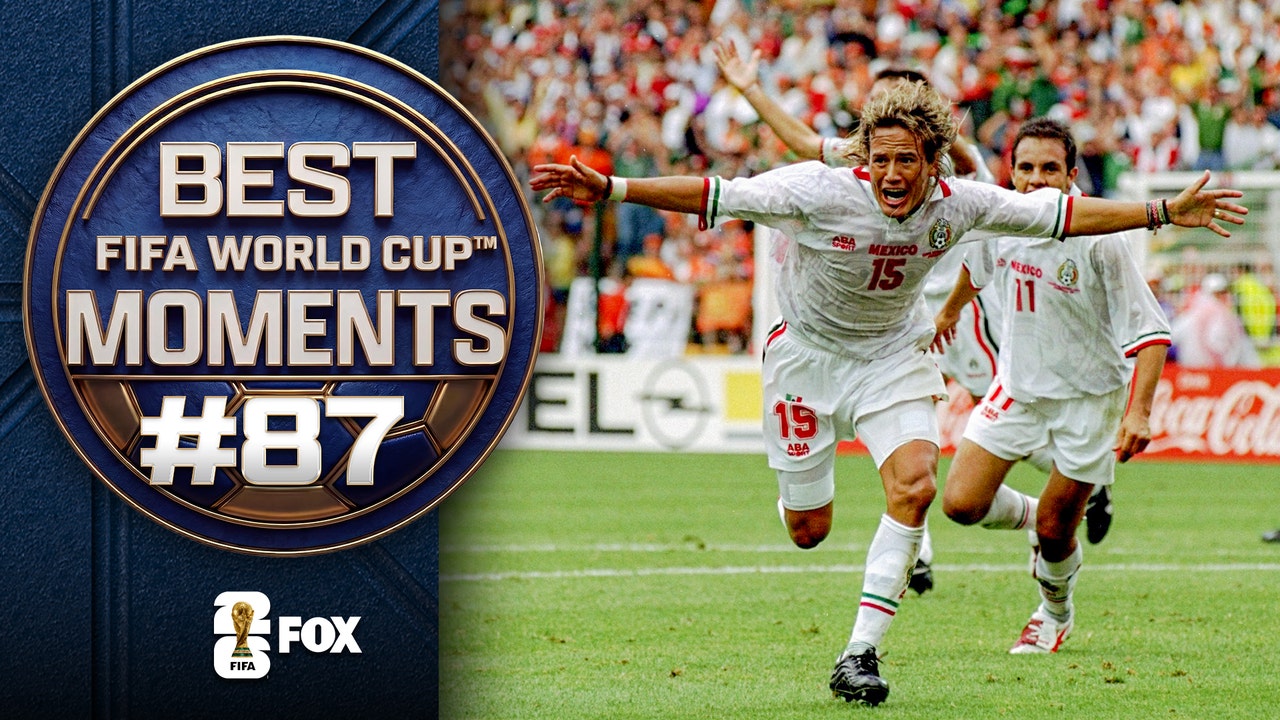
When your nickname is “El Matador,” you better have a killer instinct in front of the net. Luis Hernandez had that and then some as a star striker for Mexico at the 1998 World Cup.
By beating South Korea and tying Belgium in their first two group stage games at France ‘98, Mexico appeared well-positioned to progress to the knockout rounds. Still, advancing was not guaranteed. And with the Netherlands looming in their final first-round match, the nerves of El Tri fans were, understandably, frayed.
They stayed that way until almost the last kick of the ball. Mexico was losing 2-1 to the Dutch as the contest entered stoppage time. In the other Group E finale being played simultaneously, the Koreans and Belgians were tied. If El Tri lost and Belgium managed to score a late winner, they’d advance at Mexico’s expense.
Hernandez, with his trademark flowing blonde hairstyle, wasn’t about to leave anything to chance. Instead of relying on another result, the striker known as “El Matador” pounced on a botched clearance in the box by Dutch center back Jaap Stam and stabbed the ball into the net. The goal pulled Mexico level in the 94th minute. When the final whistle blew moments later, Mexico was en route to the round of 16.
No. 86: Hungary’s Record Scoreline
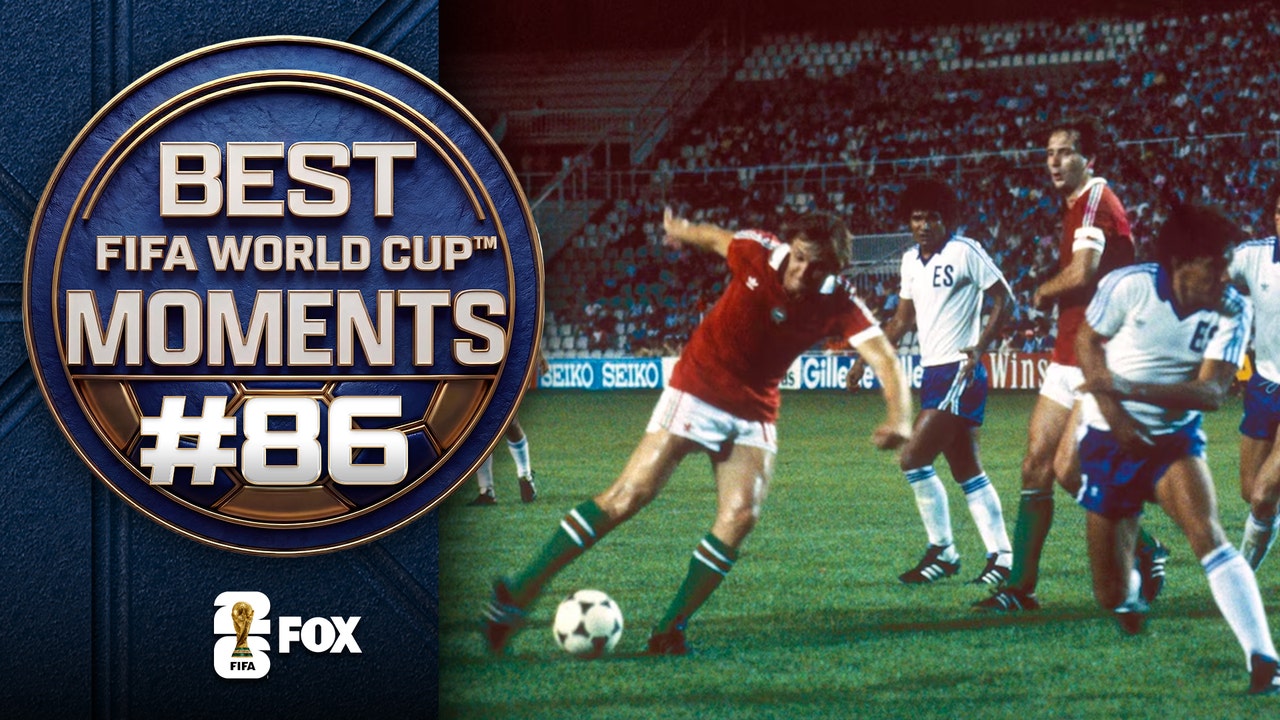
El Salvador was desperate to produce a respectable showing in just its second tournament appearance, having lost all three of their games and failing to score a goal at the 1970 event. But a lack of funding meant they took just 20 players, two short of the roster limit, and were the last team to arrive for competition. Add in an overly aggressive gameplan from young coach Mauricio “Pipo” Rodriguez, and the result was a 10-1 loss to Hungary in their opener. It remains the most lopsided scoreline in World Cup history.
The performance was so humiliating that when ES forward Luis Ramírez Zapata scored to make it 5-1, some of his teammates implored him to tone down his celebration, lest he make the Hungarians angry. Maybe he did; László Kiss came off the bench to score a seven-minute hat trick (also a record) and Hungary added two more goals before the final whistle to complete the rout.
No. 85: Bulgaria’s Superstar Takes Over Summer of ’94
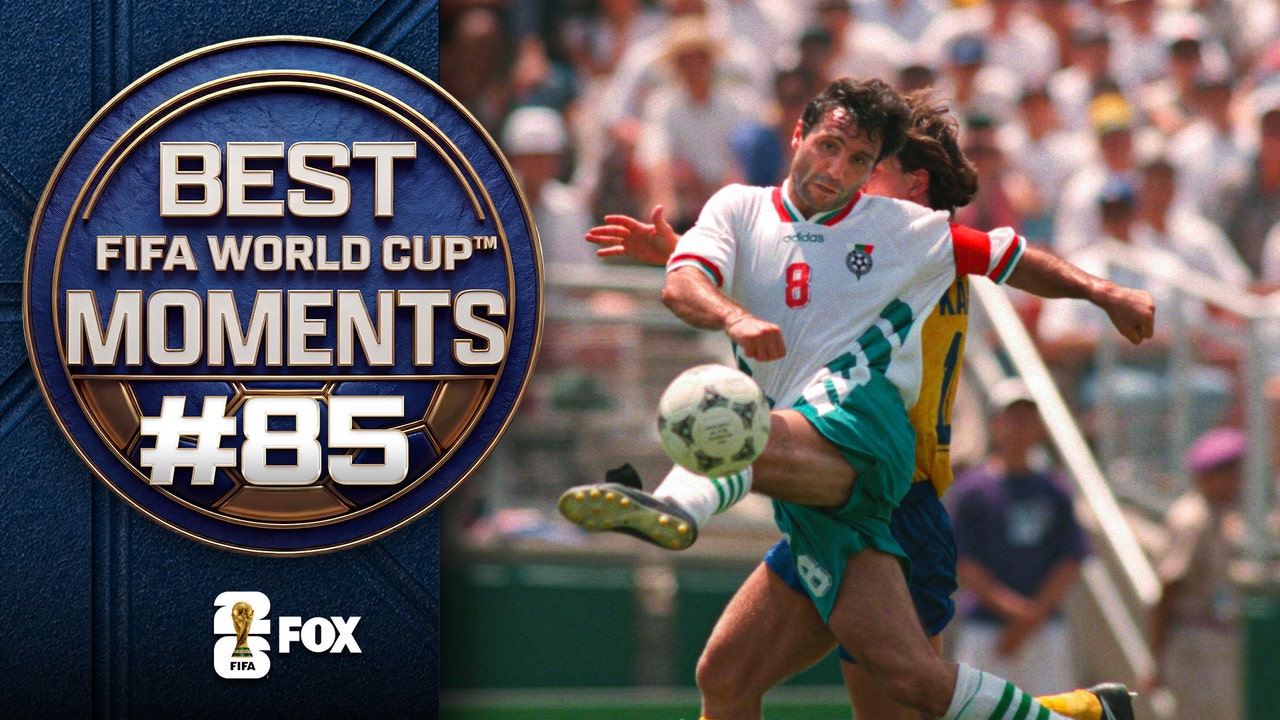
Bulgaria were considered an afterthought. But one man made sure the world remembered them. At the 1994 World Cup, Hristo Stoichkov couldn’t be stopped. After converting two penalties against Greece, the Barcelona legend scored against Argentina to secure a place in the knockout round.
Then, the magic really started. In the Round of 16, Stoichkov bagged a 6th minute goal, as Bulgaria took down Mexico on penalties. Next came defending champions Germany. Trailing 1-0 in the 75th minute, he and Yordan Letchkov scored three minutes apart for the win.
Stoichkov and Bulgaria would ultimately lose in the semifinals, but it was truly an unforgettable run.
No. 84: No Era Penal
Mexico benefited from some good fortune just to make it to Brazil 2014 — if not for a late goal by their archrival United States versus Panama, El Tri would’ve failed to qualify out of CONCACAF — but there they were, just moments away from finally reaching the elusive quinto partido, or fifth game, at a World Cup.
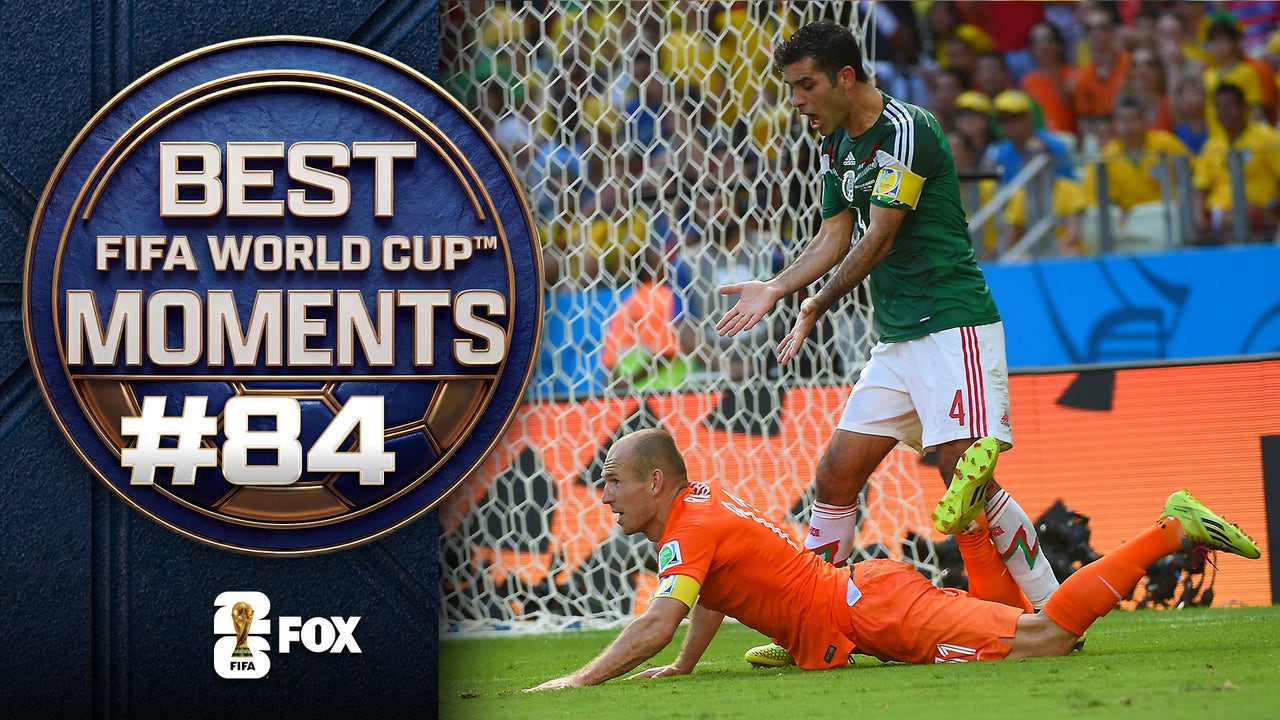
Then their luck ran out. With just two minutes of the 90 to play, the Dutch made it 1-1 through Wesley Sneijder. Mexico captain Rafa Márquez was then whistled for tripping Arjen Robben inside the penalty box deep into second-half stoppage time.
Replays showed that Robben had theatrically embellished the contact, if there was any at all. It wasn’t a penalty.
That didn’t matter. VAR was still four years away from its World Cup debut. Without video review, the call on the field stood, Klaas-Jan Huntelaar scored from the spot, and Mexico were eliminated in the round of 16 for the sixth straight tournament.
No. 83: Sneijder Stands Tall in Dutch Rally
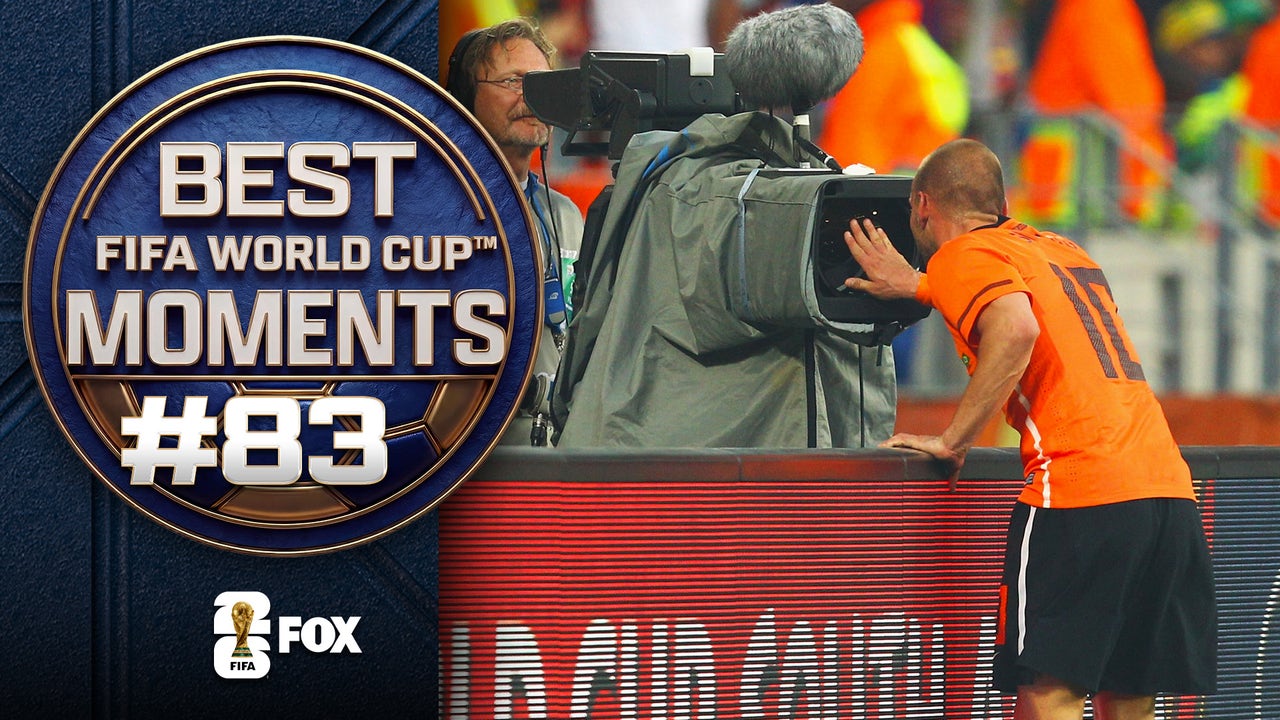
At 5-foot-7, Wesley Sneijder was never an imposing figure for the Netherlands. But he knew how to rise in big moments, such as his standout two-goal performance against Brazil in the 2010 World Cup quarterfinals.
The Brazilians were up early on Robinho’s goal in the quarterfinal match, playing about as sound as anyone else in the tournament. But then the Dutch took over. Sneijder first had a deep wide cross that seemingly floated forever and slipped past Brazil keeper Julio Cesar’s punchout before skimming off Felipe Melo’s head and into the net.
Then it was the diminutive dynamo who scored again to complete the comeback, sneaking through the penalty area and finding space for an improbable header. Even he couldn’t believe it, grasping his forehead in delight. But it’s the win that kept the Netherlands marching on and eventually reaching the final.
No. 82: No Option For Zaire In Loss To Brazil
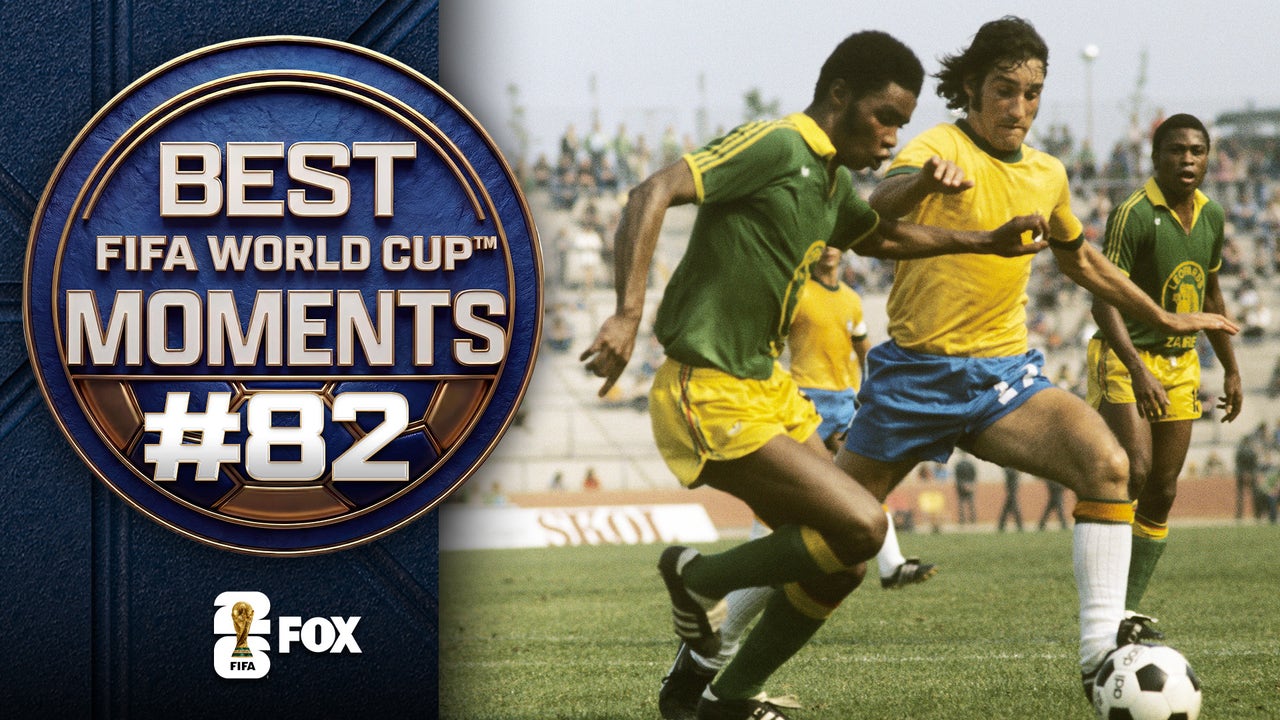
Zaire’s qualification for the 1974 World Cup was a watershed moment for the country. They were the first team from sub-Saharan Africa to make it, and just the third from that continent overall.
But what should have been a joyous tournament for Zaire’s players turned sinister. After losing their opener 2-0 to Scotland, the players were informed that they wouldn’t be paid their World Cup bonuses. They intended to boycott their next match, against Yugoslavia, but relented after threats from the country’s president, dictator Mobutu Sese Seko.
Following a 9-0 loss — tied for the most one-sided scoreline in World Cup history — Mobutu told the team not to bother coming home if they lost to Brazil by more than four goals. So, down three late in the game, Zaire’s Mwepu Ilunga raced from the defensive wall and booted the ball down the field. He was yellow-carded for time-wasting, but it was worth it: Brazil didn’t score again, and the match finished 3-0. A lackluster but perhaps life-saving performance for a country who are now trying to qualify in 2026 – this time with hopes of a better outcome.
No. 81: South Korea Saves Mexico; Germany Hopes Dashed
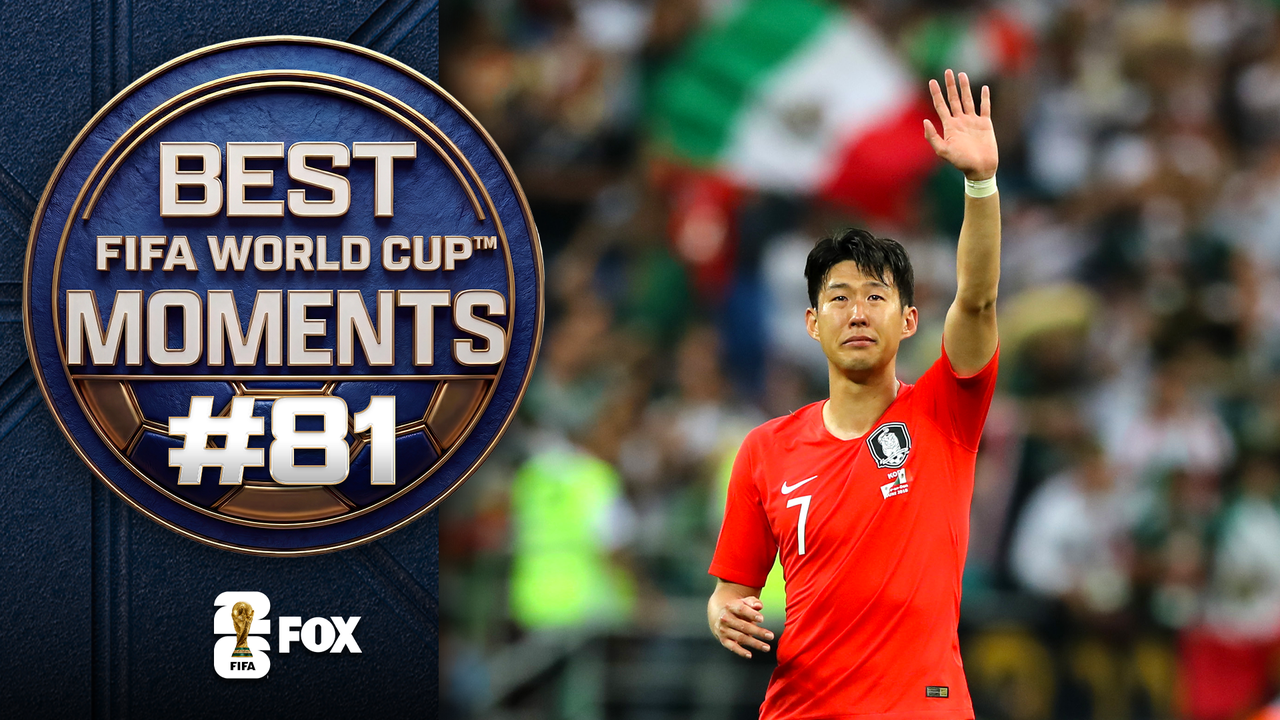
“¡Coreano! Hermano! Ya eres mexicano!”
At the 2018 World Cup, this is how Son Heung-min and South Korea ousted the defending champions and helped out a very grateful Mexico squad.
Despite losing to Mexico in their opening match, 2014 tournament winners Germany liked their odds of reaching the knockout stage at the 2018 edition in Russia. All the Germans had to do was beat South Korea by two goals to guarantee a spot in the business end of the competition.
As expected, Die Mannschaft dominated the Taeguk Warriors through nearly 90 minutes, but the match was still scoreless. Germany was desperate and pushed as many players as possible forward. Then South Korea pounced on the opportunity as Kim Young-gwon first scored. It was then Son who sealed the whole group’s fate with a second goal as time wound down.
That meant Germany was out. Mexico, despite getting pummeled by group winners Sweden, were also advancing. A sigh of relief for El Tri fans, who gratefully serenaded Korean players and fans in Russia – and even held celebrations outside of South Korea’s diplomatic offices across Mexico.
No. 80: Did He Really Mean To Score That Goal?
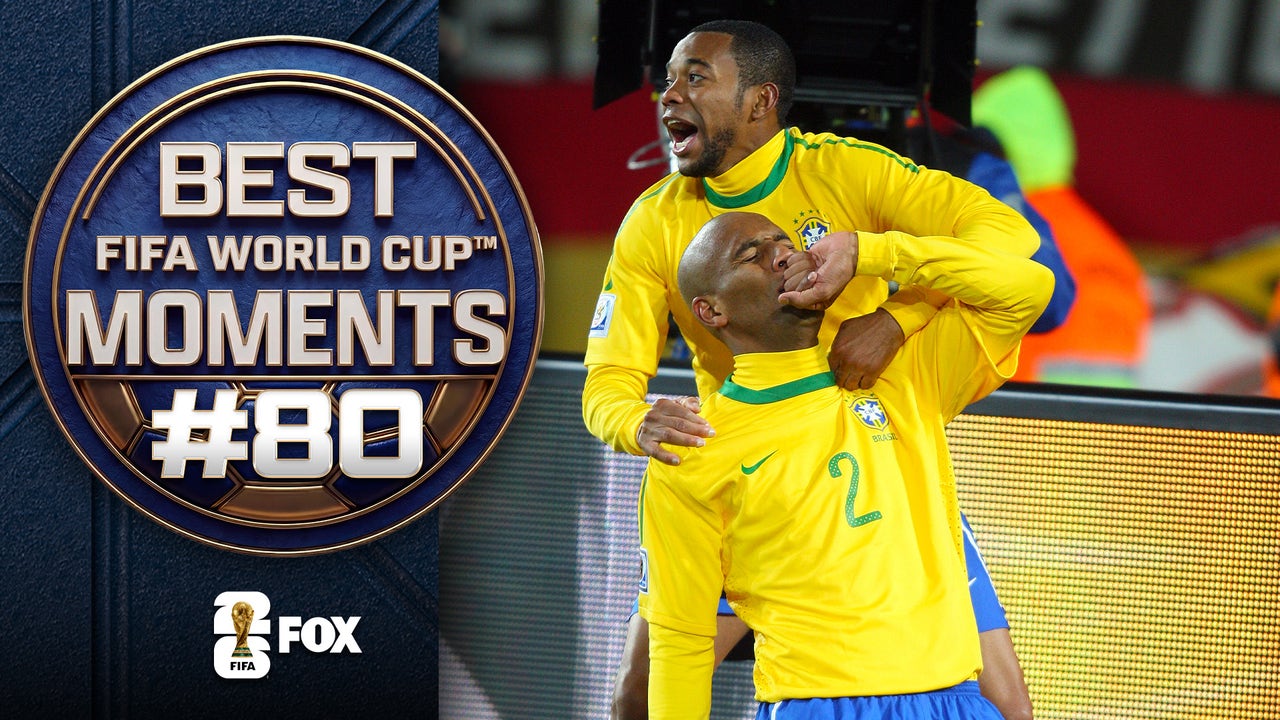
The old saying is that you can make your own luck. And this memorable goal by Maicon, which defied odds and angles, is an example of that.
In the summer of 2010, the Brazilian right-back was at his absolute peak. A Treble-winning elite defender for Inter Milan and a stalwart for his country at the summer’s World Cup. And it was against North Korea that Maicon produced his signature moment continues to be debated.
As Maicon barreled down the flank and into the 18-yard box and caught up to a pinpoint pass by Elano, he powered a shot that whizzed behind keeper Ri Myong-guk and into the net on the tightest of angles. It seemed that Maicon was trying to actually cross to Luis Fabiano, but instead did the job himself. A celebration followed that seemed more relief than joy, and one of the best “Did he mean to do that?” moments in soccer lore was born.
No. 79: USA’s Pulisic Delivers a Winner
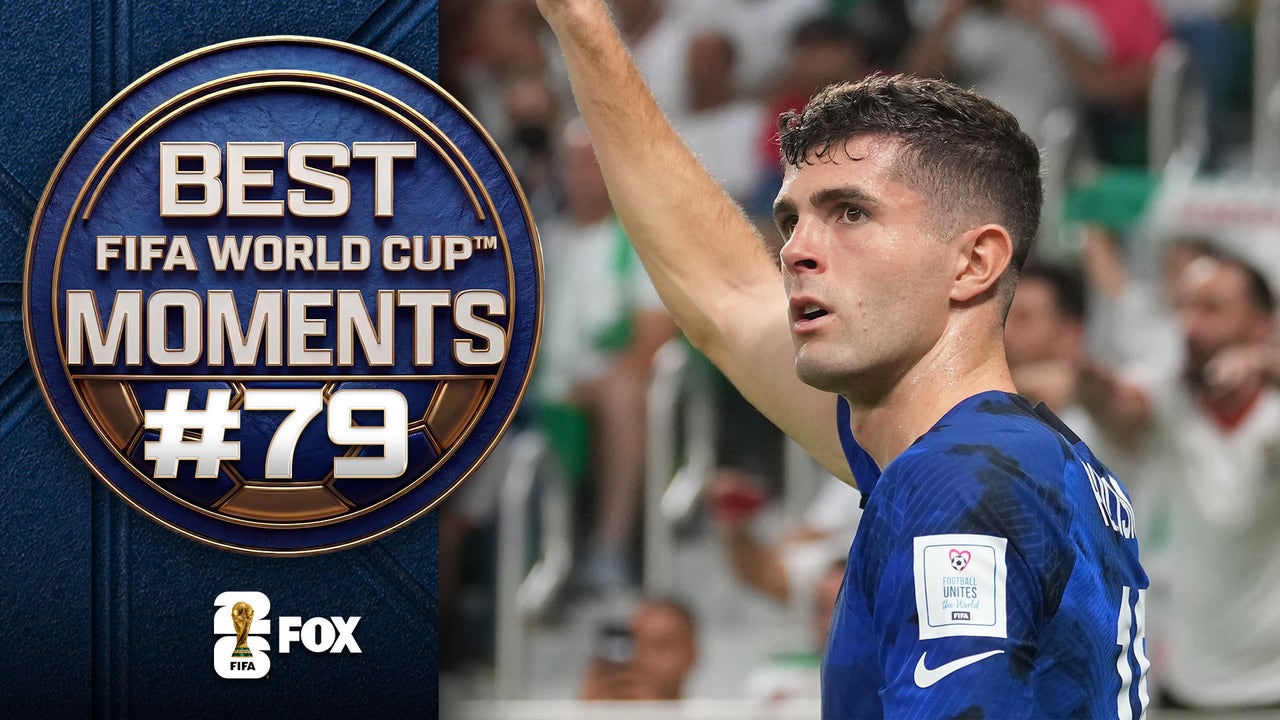
The United States men’s national team faced immense pressure to make it out of a tough Group B at the 2022 FIFA World Cup after failing to qualify for Russia 2018. The problem? It only managed two points after its matchups with Wales and England.
With the U.S. in desperate need of three points in its final group stage match against Iran, Christian Pulisic put his body on the line to get his team on the board, diving in front of a cross to beat the two defenders marking him and colliding with Iran goalkeeper Alireza Beiranvand in the process.
This goal sent the U.S. through — and gave Christian Pulisic his World Cup moment. In the 2022 World Cup Group Stage, the United States needed a win to advance. In the 38th minute, Weston McKennie sent in a cross
Pulisic was forced off as a result of the collision, but his goal ended up being the difference for the U.S. as it advanced to the round of 16 with a 1-0 win and three much-needed points.
No. 78: Richarlison’s Wonder Goal
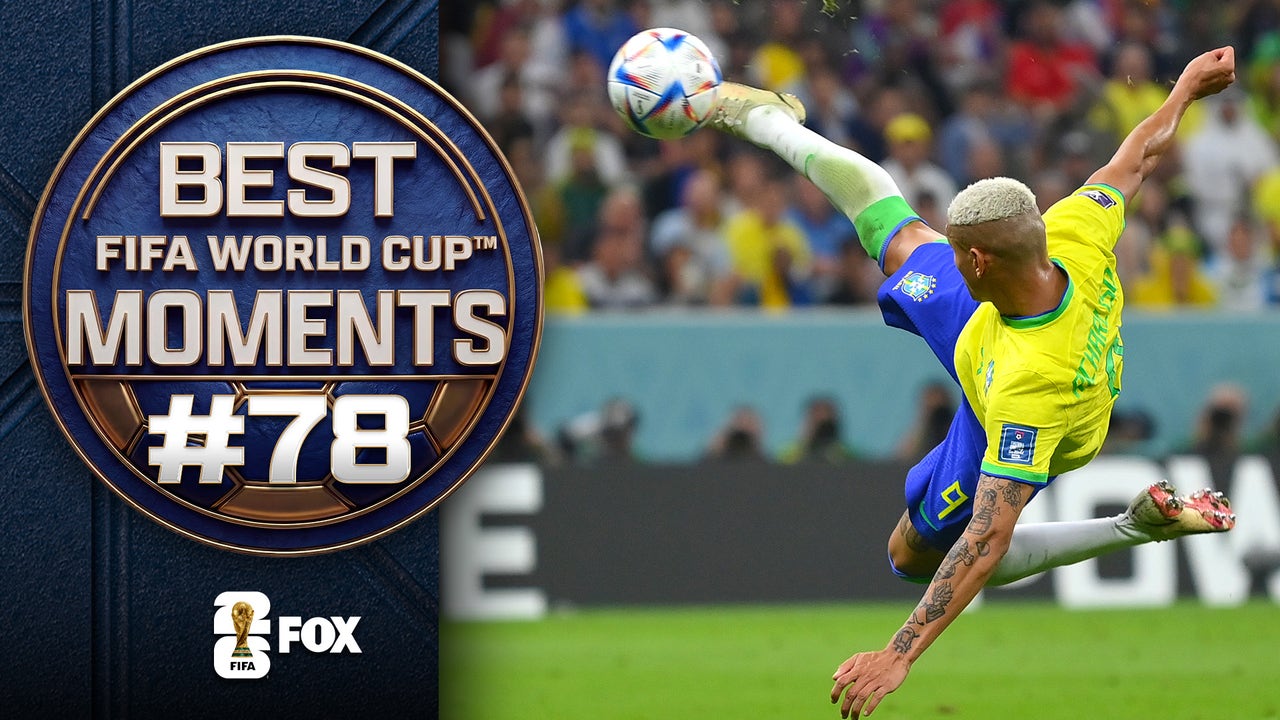
Brazil entered the 2022 FIFA World Cup as one of the favorites to go the distance, and that hype only got louder after Richarlison’s master class in the Seleção’s group stage opener against Serbia.
After failing to score in the first half, Richarlison scored a second-half brace, and his second goal will go down as one of the most skillful goals in World Cup history. Richarlison volleyed a cross from Vinicius Junior in the air to himself and scored with an acrobatic scissor kick.
Brazil would ultimately bow out of the tournament in the quarterfinals, but it made its mark on the tournament thanks to Richarlison.
No. 77: Don’t Count Out Dempsey and the USA
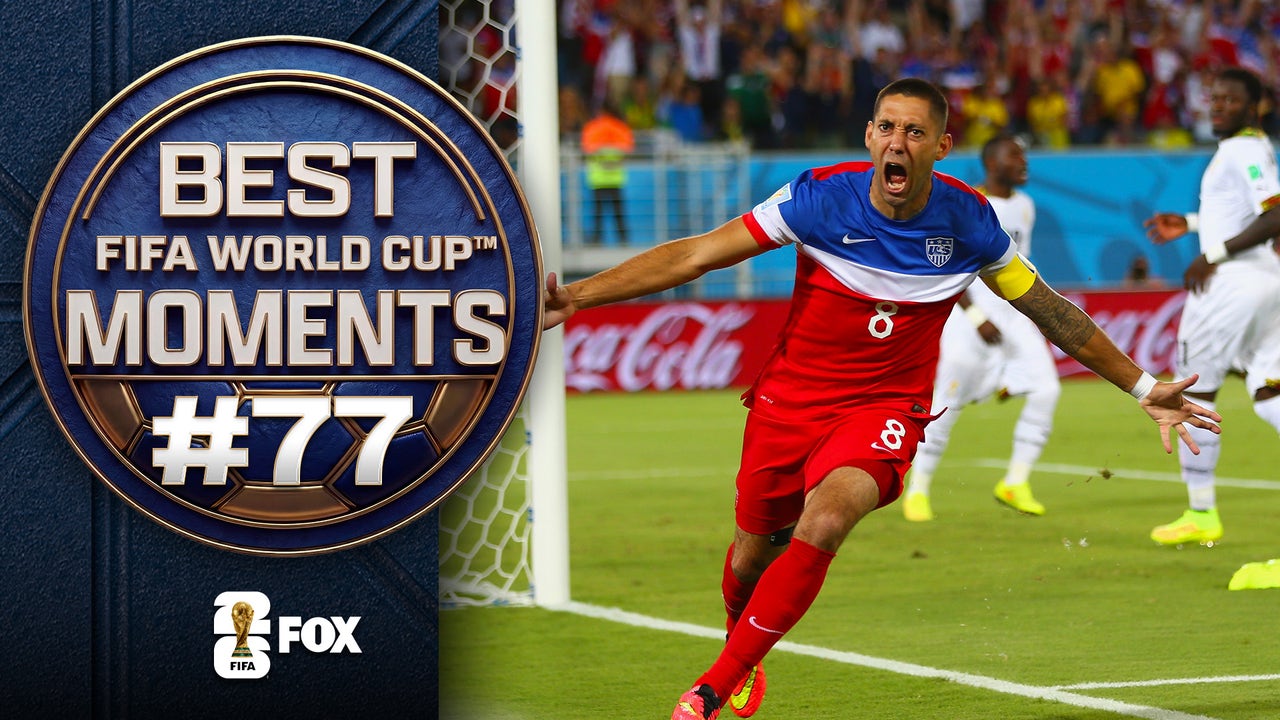
At the 2014 World Cup in Brazil, the soccer gods did the United States no favors. A group stage that included tournament heavyweights Germany, a Cristiano Ronaldo-led Portugal squad, and Ghana (the team that had ousted the USA in two straight World Cups).
Pundits had written off the USA even before the team reached the tournament, thinking there would be no way coach Jurgen Klinnsman’s squad would survive a tough group.
Against Ghana, Clint Dempsey scored the fastest World Cup goal in USA history. Ghana equalized before John Brooks rose to the occasion and netted a header for the dramatic game-winner. Against Portugal, Jermaine Jones smashed a stunner that was mooted after Ronaldo’s last-second equalizer. A loss to Germany still saw the USA advance into the knockout stage thanks to a goal differential over Portugal.
With tough-as-nails playmakers such as Dempsey, Jones and keeper Tim Howard, this USA squad proved a lot of folk wrong.
No. 76: Sunday Oliseh’s screamer vs. Spain
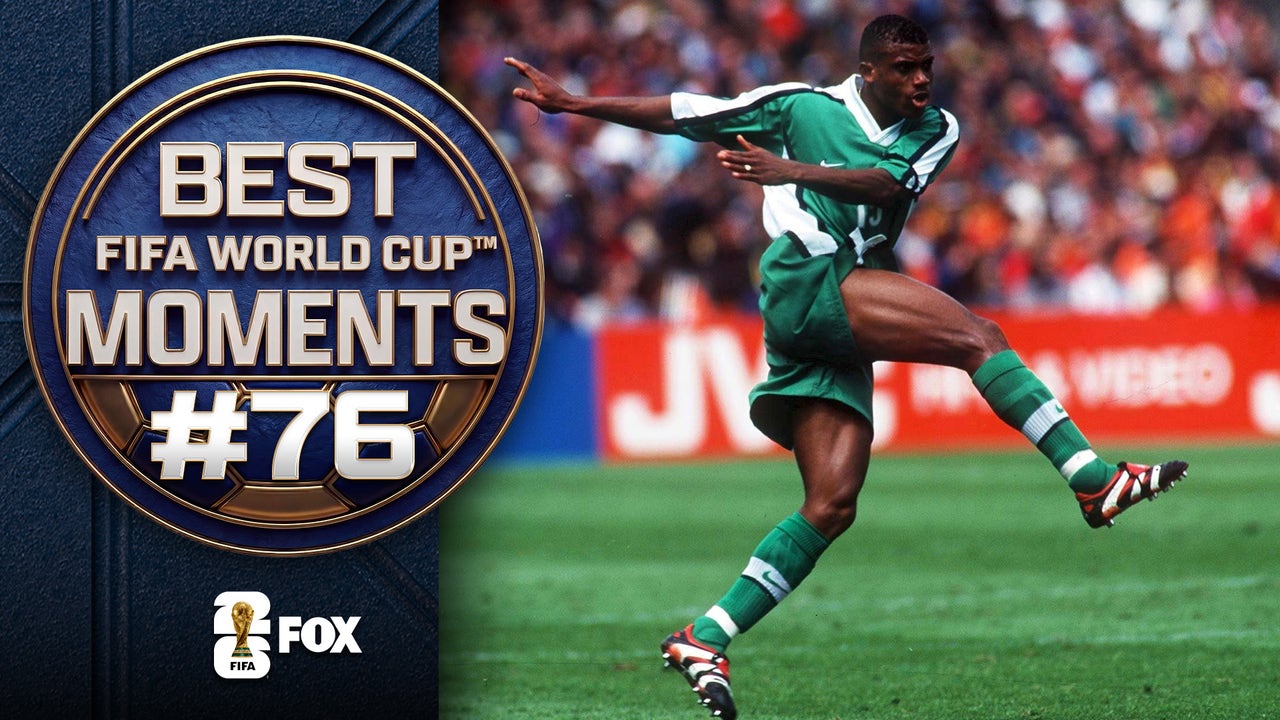
There’s something to be said for sheer power.
Pretty passing sequences and deftly placed shots are nice and all, but sometimes you don’t want to watch the lock get picked — you want to see a ball hit with enough force to blow the entire house down.
That’s what Sunday Oliseh gave us in Nigeria’s first match of the 1998 World Cup. The defensive midfielder wasn’t known for scoring — he managed only one other goal in 53 international appearances — but he knew what to do when a Spain clearance fell to him 30 yards from goal with about 12 minutes remaining in the game.
Fernando Hierro and Raul scored for Spain on either side of halftime, but Nigeria equalized twice. With time running short, Hierro cleared a Super Eagles throw-in deep in his own end. Oliseh caught it on the half-volley and thundered a low strike just inside the post past stunned La Roja backstop Andoni Zubizarreta.
The kick couldn’t have been more ferocious. Not only was it enough to give Nigeria the win, but it also helped propel them to the top of Group D. Spain, meanwhile, failed to survive the group stage.
Talk about a powerful shot.
No. 75: Van Bronckhorst’s Blast
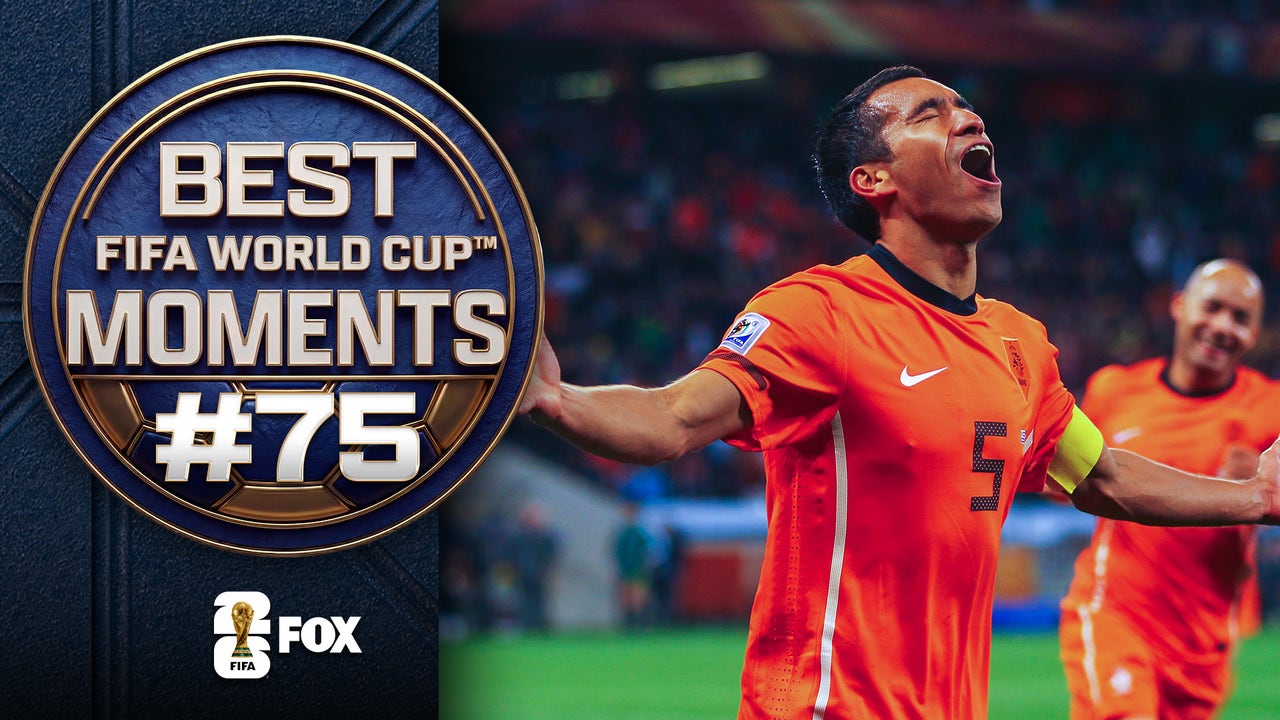
Giovanni van Bronckhorst wasn’t known as a scorer throughout his long and decorated international career for the Netherlands, for good reason.
In 106 appearances with the Oranje, the outside back managed just six goals. And at age 35 in 2010, many wondered if the veteran would even crack Dutch coach Bert van Marwijk’s final 23-man roster for the tournament in South Africa.
Van Bronckhorst didn’t just make it, he was named captain. And in the semifinal against Uruguay, he opened the scoring with an audacious, 40-yard, left-footed strike that grazed diving La Celeste keeper Fernando Muslera’s fingertips and kissed the inside of the far post before settling into the net.
The only World Cup goal Van Bronckhorst ever scored helped send his country to the title match for the third time, and it remains among the most spectacular in tournament history.
No. 74: Five Goals in One Game! Salenko Makes History
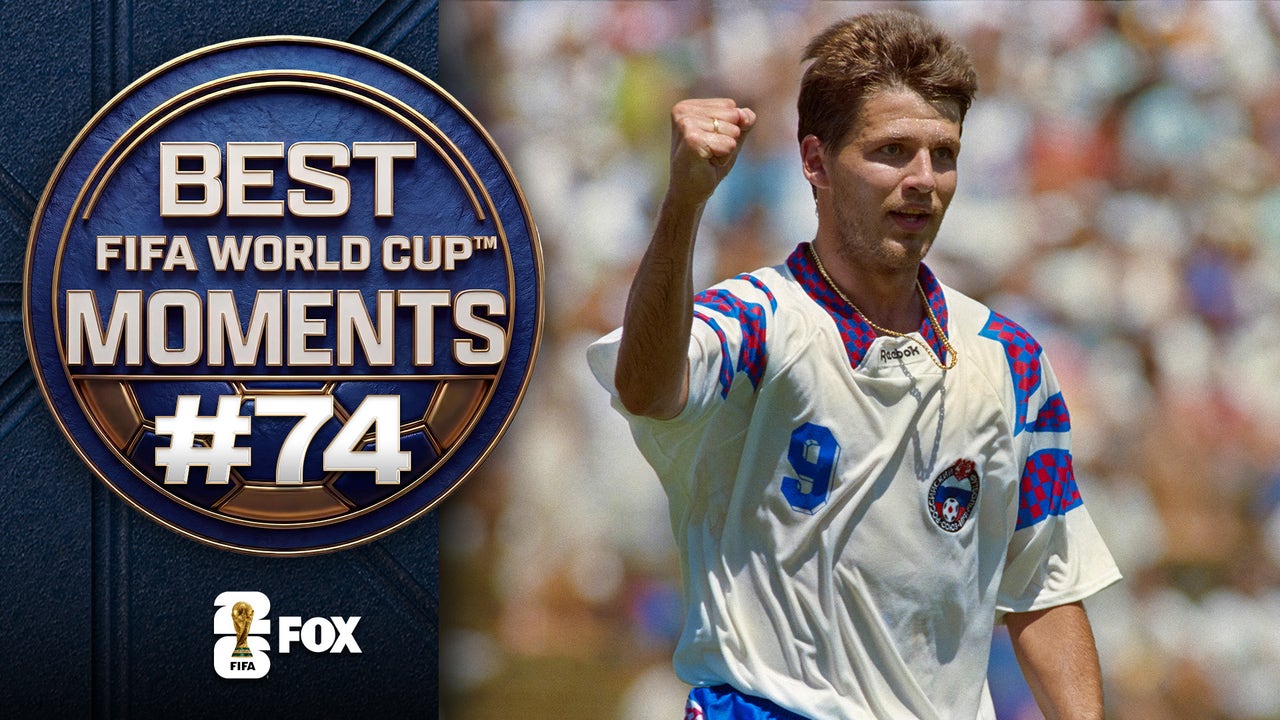
You’ve heard of a hat trick. But what about a Salenko?
When you score five goals in a single game, you’re worthy of having the feat named after you. At the 1994 World Cup, Russian striker Oleg Salenko found the net five times in a 6-1, group stage victory over Cameroon.
The win wasn’t enough to help the Russians reach the knockout stage, but Salenko’s record-setting day did go a long way toward him becoming the only player in World Cup history to win the Golden Boot as top scorer despite only participating in the first round.
Salenko also scored from the penalty spot against Sweden to finish USA ‘94 with six goals, the same number as Bulgarian striker Hristo Stoichkov, with whom he shared the award. Not bad for a guy who played in four fewer matches.
No. 73: Rivaldo’s Oscar-Worthy Diving Performance
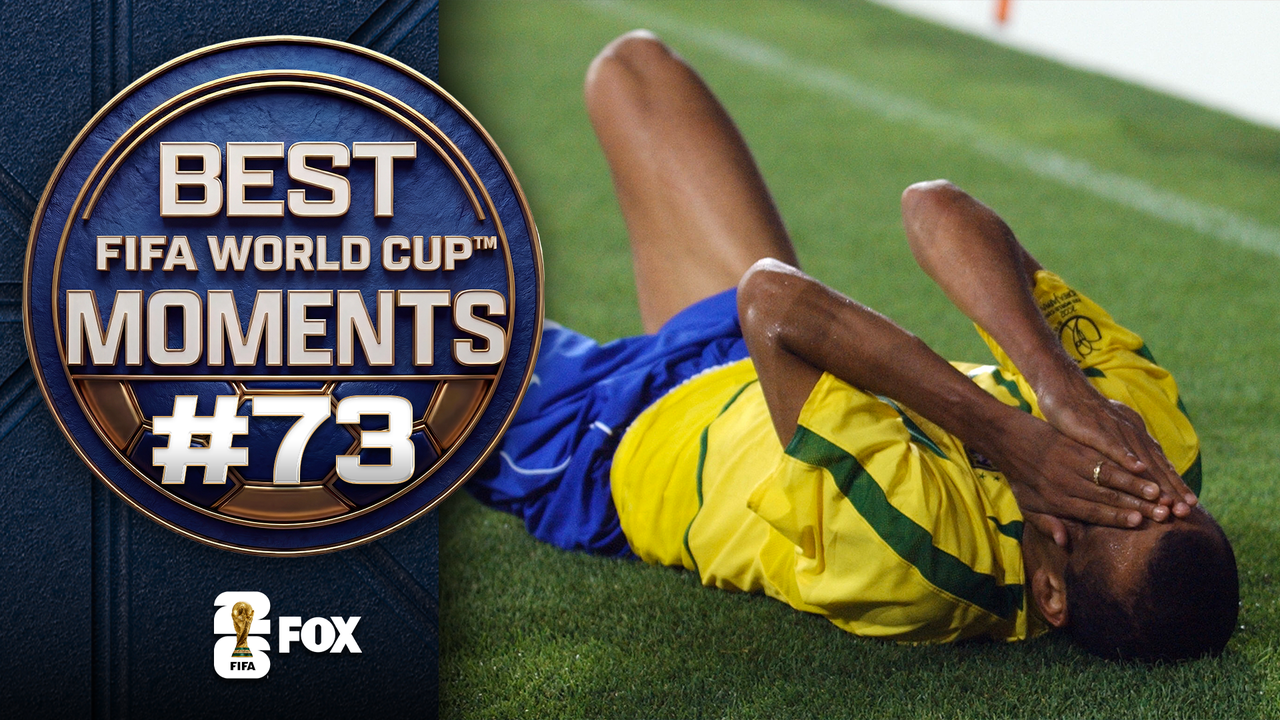
We all know soccer stars have a penchant for the dramatic. But Brazilian legend Rivaldo may take the Oscar for an all-time acting performance for his inexplicable dive at the 2002 World Cup.
During a group stage match, Turkiye’s Hakan Ünsal, annoyed that Rivaldo was taking his sweet time preparing to take a corner kick, booted the ball off the Brazilian’s legs. Rivaldo collapsed and began rolling on the turf holding not his thigh — but his face.
Ünsal was shown a red card and the ridicule against Rivaldo began. In an era before social media, the video went viral and shown over sports and news and late-night shows alike across the globe. Rivaldo was fined (but not suspended) by FIFA but he also got the last laugh — Brazil won its fifth (and its most recent) World Cup title.
No 72: Rooney’s Red and Ronaldo’s Wink
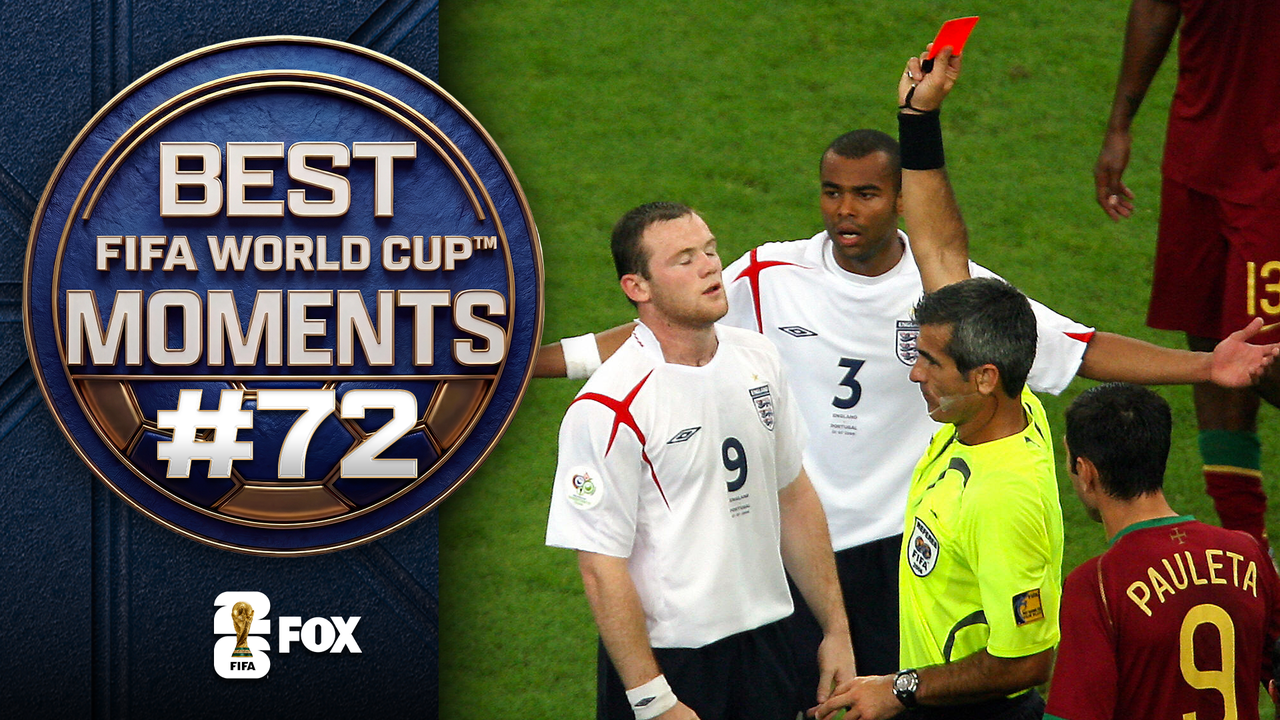
A heated moment at the world’s biggest stage between two World Cup heavyweights involved a pair of Manchester United superstar teammates.
Cristiano Ronaldo and Wayne Rooney were among the faces of global soccer at the 2006 World Cup. So, when England and Portugal were pitted in the quarterfinals, the world knew sparks would fly.
In the second half, Rooney stamped on Portugal’s Ricardo Carvalho and the referee reached for red. Ronaldo had been pleading to the ref that his Man United teammate should be sent off, and that’s when the cameras caught it: a sly, almost celebratory wink toward the Portugal bench right after Rooney’s dismissal.
Portugal would survive on penalties as Ronaldo scores the decider. England’s dream of a World Cup title ends. And that wink — love it or hate it — becomes a defining, unforgettable and controversial moments in World Cup history.
No 71: Kuwait’s Princely Protest
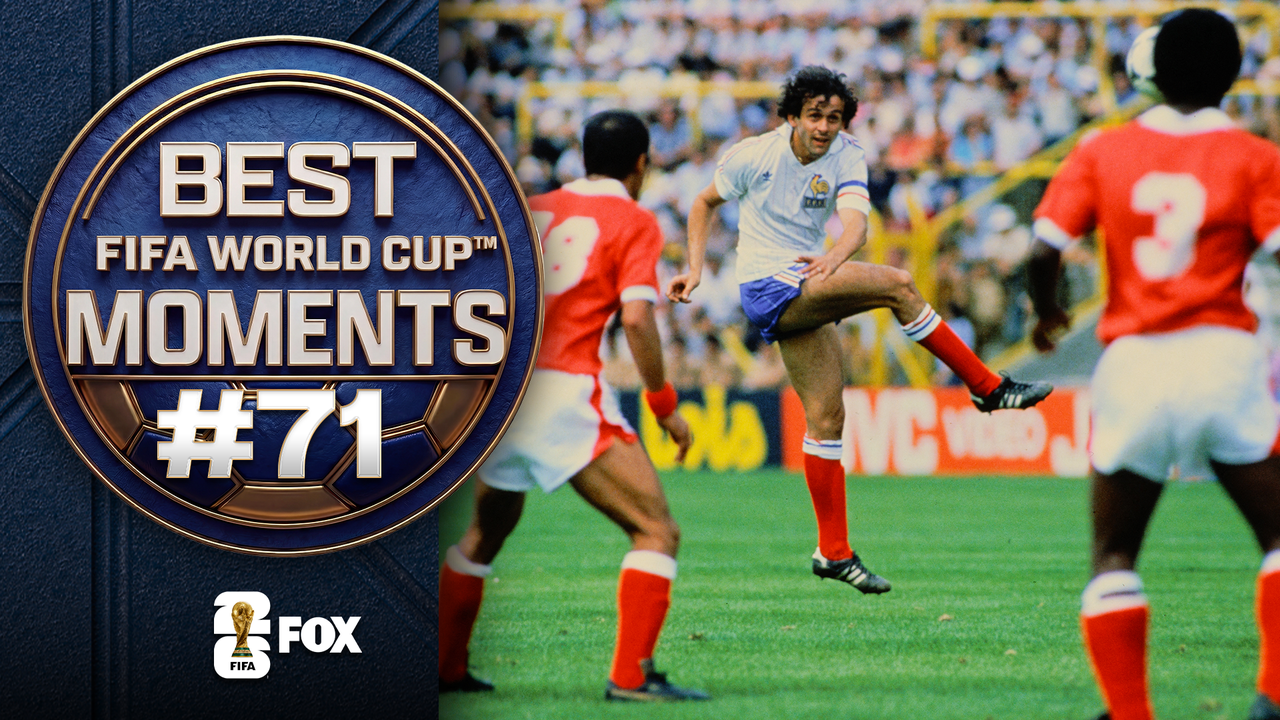
On a list of most bizarre World Cup moments, this would have to be near the top.
At the 1982 event in Spain, first time qualifier Kuwait had just gone 4-1 down to France with 10 minutes left in their group stage match.
Inside the stadium, Kuwaiti Prince Fahad Al-Ahmed Al-Jaber Al-Sabah took exception, contending that a whistle from the crowd sounded before Les Bleus scored their fourth goal, causing Kuwait’s players to stop defending thinking Soviet referee Myroslav Stupar had halted the game.
The Prince strode onto the field and threatened to pull his country’s players off of it if the ref didn’t reverse his decision — which he did! But France scored again anyway to restore the lopsided victory. The Prince was later fined by FIFA, and Stupar never worked a World Cup match again.
Kuwait were eliminated in their final first round match, a 1-0 loss to England. They haven’t been back to a World Cup since.
No. 70: The ‘Saudi Maradona’
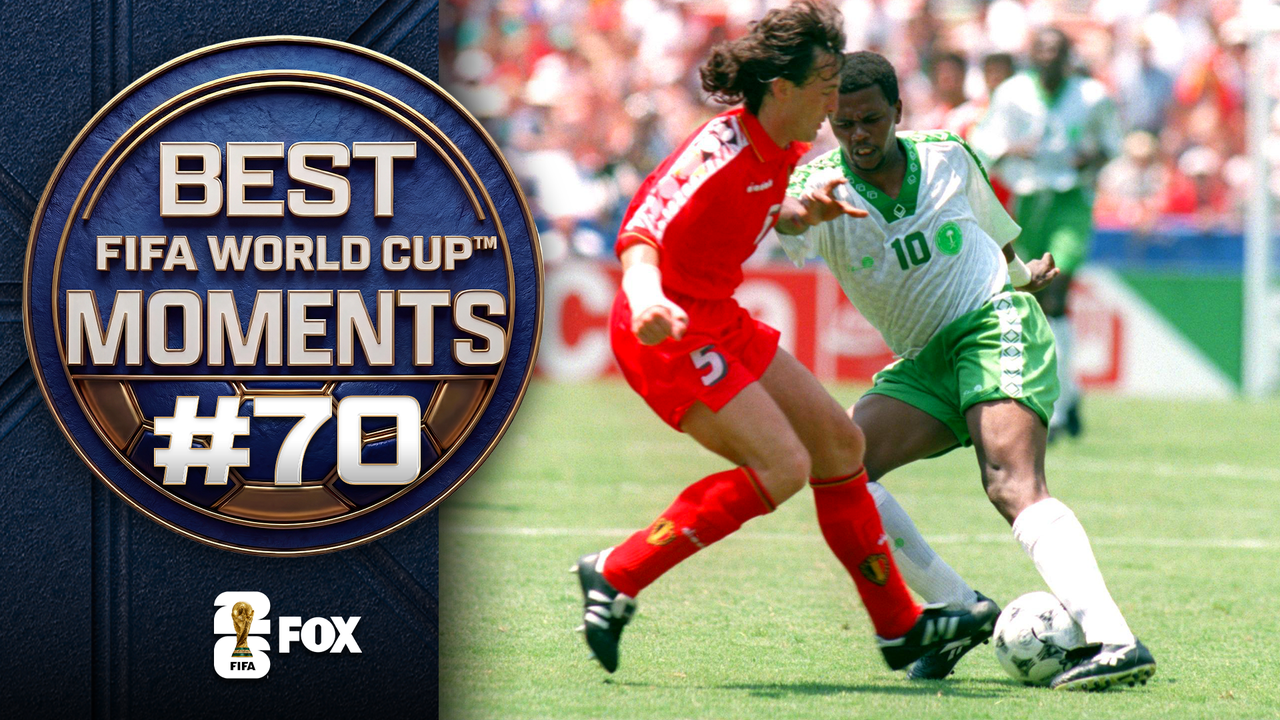
Diego Maradona wasn’t the only player to dribble through an entire team and score at a World Cup. And if we’re being fair, the incredible solo goal Saeed Al-Owairan managed to pull off for Saudi Arabia at USA ‘94 was every bit as pretty.
Al-Owairan’s run and finish didn’t come in the knockout stage, as Maradona’s slalom had eight years earlier. It didn’t come against England or any other former champion. It began deeper in his own half, though, and he beat one more would-be defenders. And while the Argentine legend picked the lock by calmly rolling the ball home after rounding keeper Peter Shilton, Al-Owairan blasted the door down with a ferocious shot past Belgian netminder Michel Preud’homme.
The goal was meaningful, too. Not only did Al-Owairan’s unforgettable strike give Saudi Arabia a 1-0 win, it also sealed their passage to the second round — the only time the country has survived group play.
No. 69: The Goal that Saved Germany
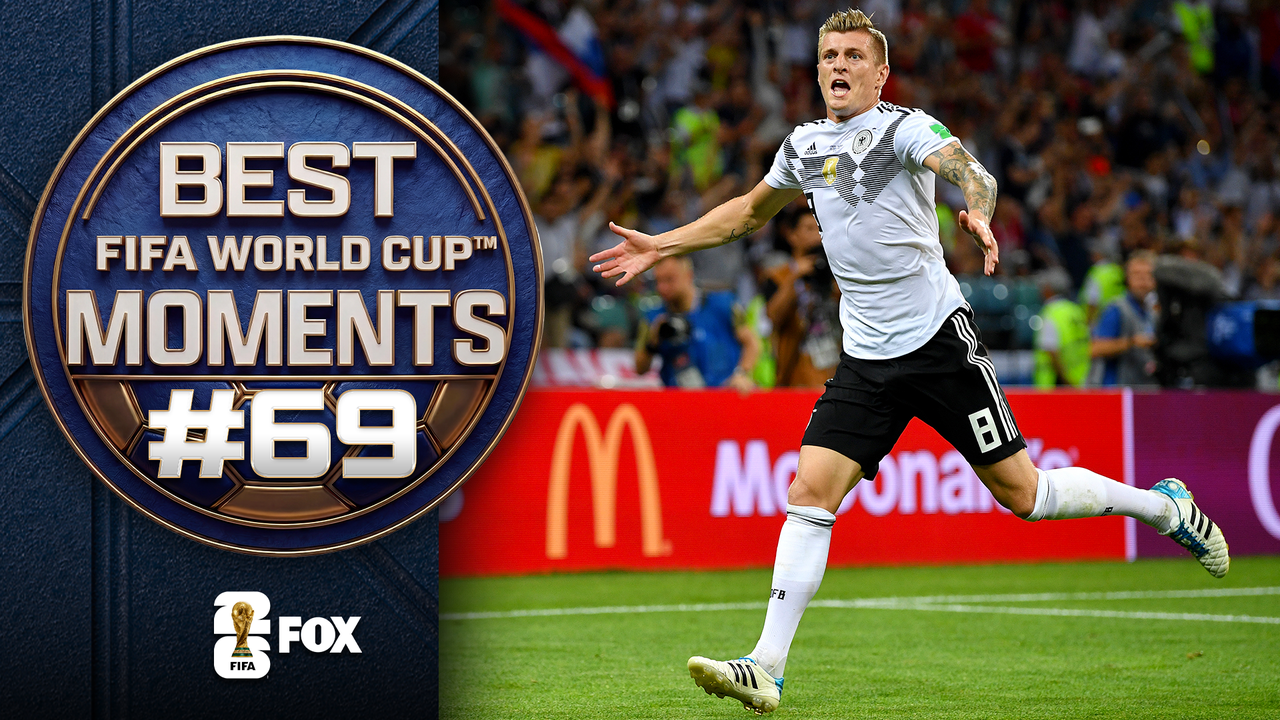
This goal gave Germany hope — at least for one more game.
On the brink of elimination in the group stage at Russia 2018, defending champions Germany were awarded a free kick from just outside the box in the 95th minute. Kroos lined the ball up from a difficult angle and curled the ball into the top left corner of the goal. Germany lives to see another day.
Unfortunately for Germany, it only delayed the inevitable. Days later, Germany lost to South Korea and crashed out of the group. A masterpiece in a World Cup that ultimately slipped away.
No. 68: Soccer in the USA, Changed Forever
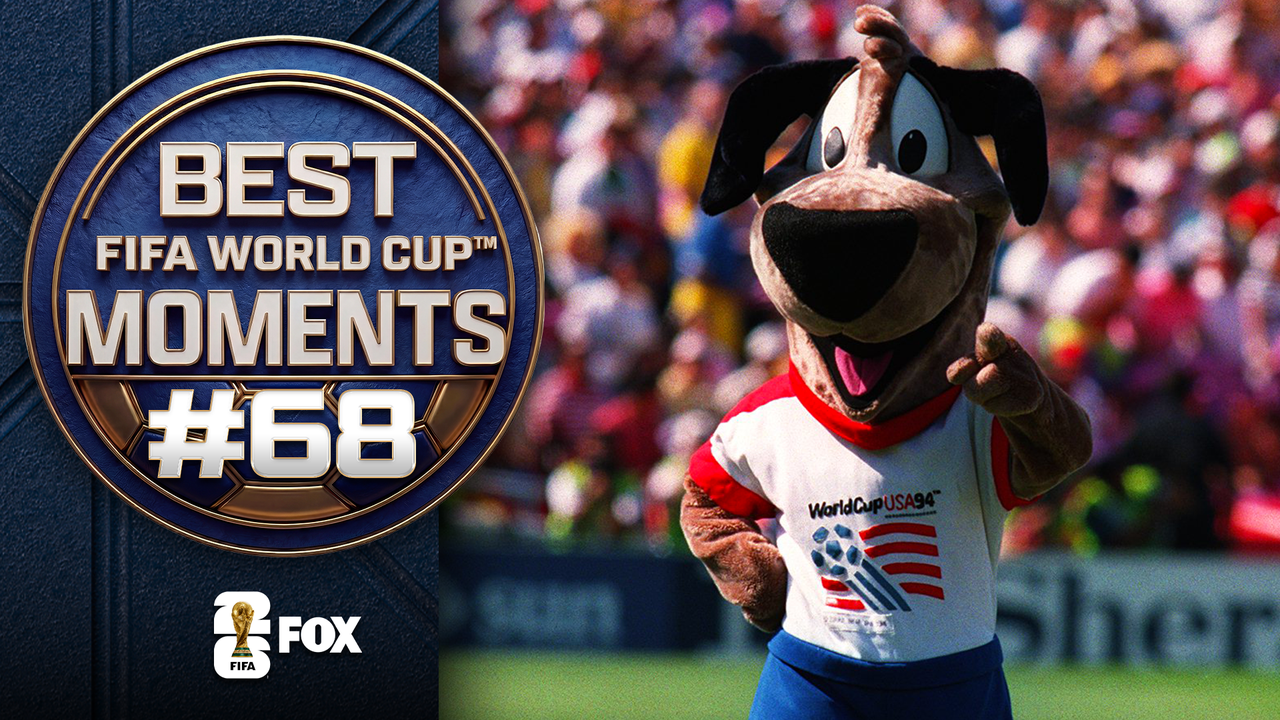
In 1994, the United States hosted the World Cup, marking just the second time ever a North American country had hosted the tournament.
Across stadiums known for Super Bowls and college football games, more than 3.5 million people attended the tournament with an average of nearly 69,000 spectators per match. It’s still the most attended World Cup of all-time.
The USA would lose in the Round of 16 to eventual champion Brazil, but the landscape of American soccer was forever changed.
A new men’s professional league, Major League Soccer, would be founded two years after the tournament. Stateside soccer fans began to wake up early on the weekends and follow the heroics of European teams and leagues. Soccer truly became part of the sports mindset in this country.
Now it’s 2026 and the World Cup is returning to the U.S., co-hosted alongside Mexico and Canada. In many ways, it’s a bookend for the growth of the sport here in the country. But in others, it’s the beginning of a new chapter, with this generation now getting to see up close and personal the greatest sporting event in their own backyard.
No. 67: Argentina Sends Mexico Home TWICE!
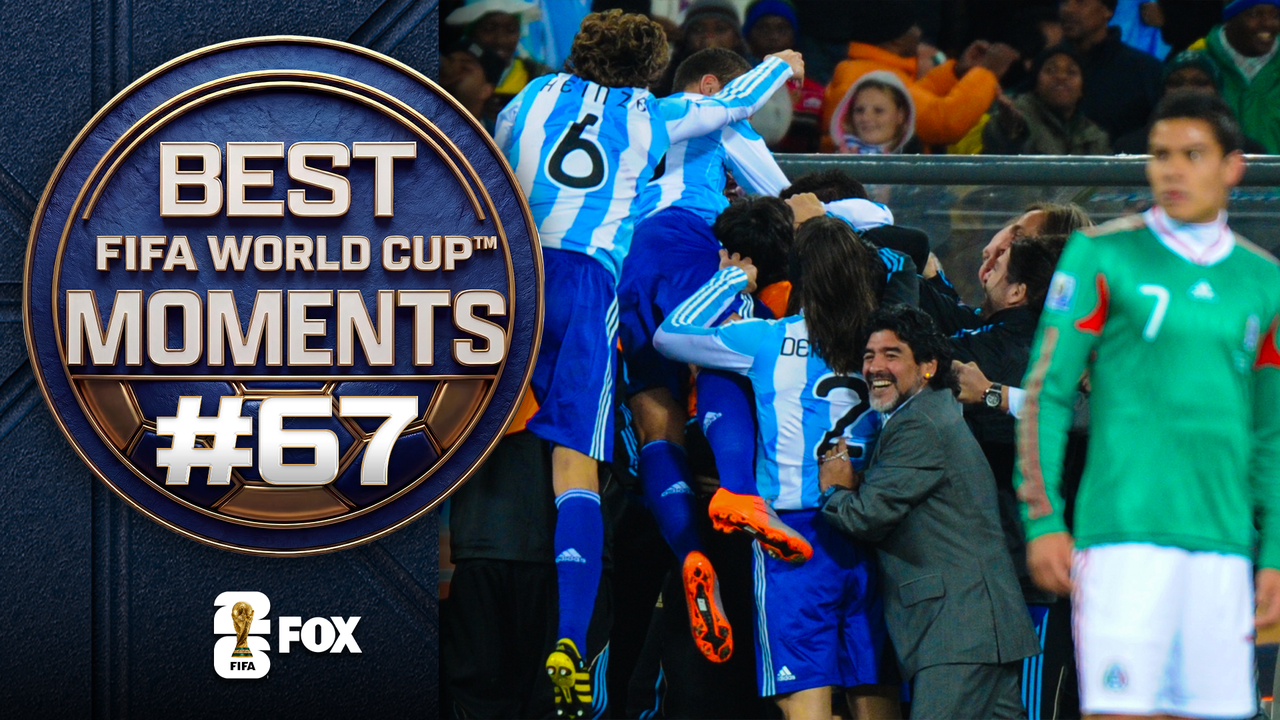
Losing to the same opponent in the same stage in consecutive World Cups can definitely leave fans salty. Which is why a lot of Mexico fans don’t have much love for Argentina.
In 2006, Mexican fans could be forgiven for thinking that maybe this was the year their team would advance to the quarterfinals for the first time away from home soil.
Argentina and Maxi Rodriguez had other ideas. With the game tied 1-1 and halfway through the first additional 15-minute period, Rodriguez volleyed a curling shot past the outstretched glove of goalkeeper Oswaldo Sanchez and into the side netting. The supernaturally beautiful strike was enough to send Argentina into the last eight. To nobody’s surprise, it was also named the goal of the tournament.
Four years later and with the legendary Diego Maradona in charge, Carlos Tevez became the hero (or the culprit) in Argentina’s round-of-16 win over Mexico with a long-range golazo in a 3-1 win in which he scored twice.
Same opponent. Same round. Two unforgettable goals. Mexico’s quest of reaching a quarterfinal at a non-hosted World Cup continues to this day. Will that change this summer?
No. 66: David Villa Fuels Spain’s First World Cup
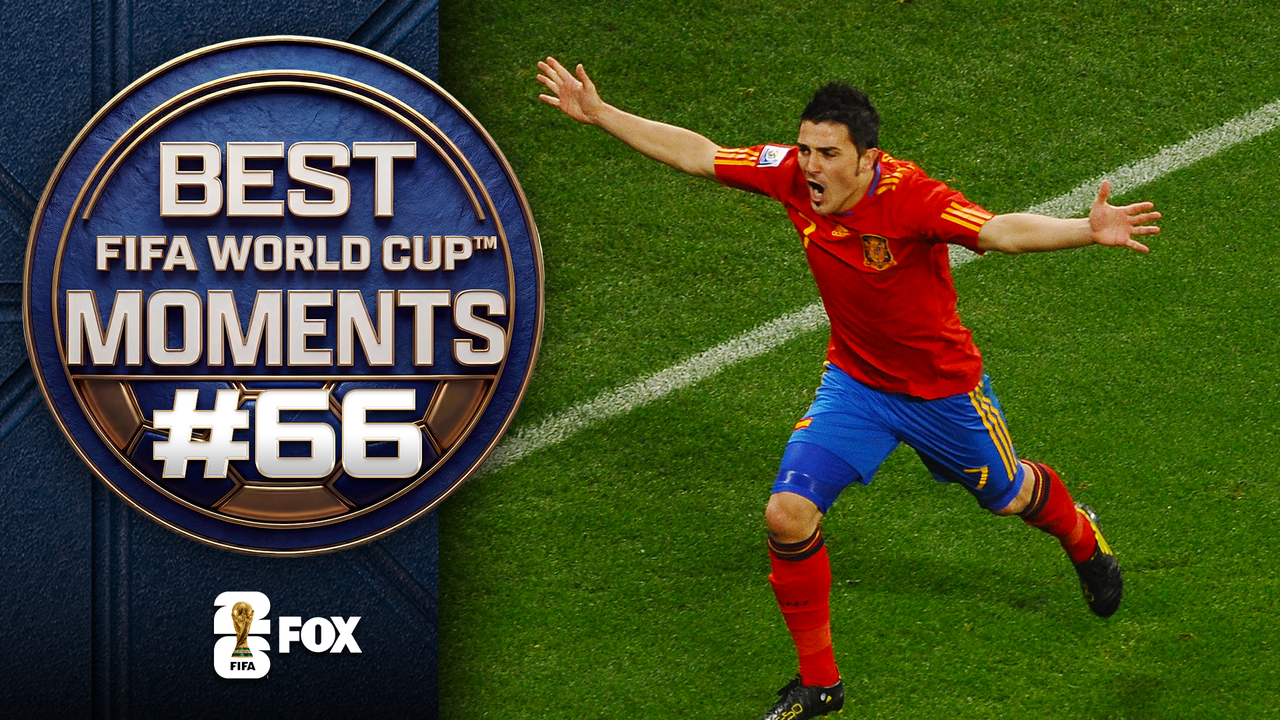
There was a time when Spain memorized the soccer world its midfield mastery, playmaking prowess and incredible chemistry. It led to a golden era for La Roja in which the team won three major titles – the 2008 Euro, the 2010 World Cup, and the 2012 Euro – in a span of four years.
The 2010 squad in South Africa was incredibly special and one man provided the scoring prowess that its trademark possession-based system (often labeled as tiki-taka) to make it all click.
David Villa scored five of Spain’s eight goals at the tournament, and added one assist. He finished as the joint top goalscorer of the tournament along with Thomas Muller, but the German star won the Golden Shoe due to having more assists. No matter. David Villa lifted the hardware that mattered. Villa remains Spain’s top goalscorer.
No. 65: Diego Forlán’s Mastery of the Infamous ‘Jabulani’ Ball
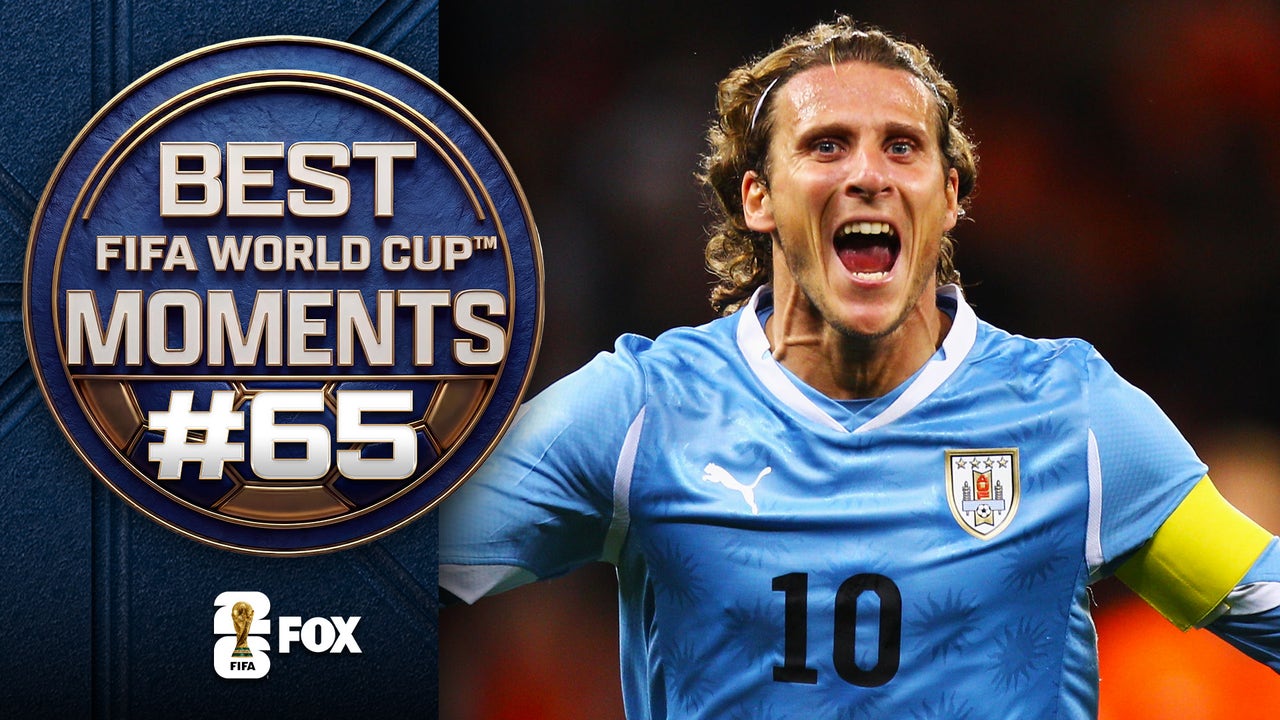
The beauty of each World Cup is how each edition weaves in the traditions and characteristics of the host nations. That’s especially true when the official ball is unveiled.
At the 2010 World Cup in South Africa, the Jabulani ball was noted for some of its aerodynamic quirks when in flight. Decorated with African-inspired designs with the name from a Zulu phrase of “be happy,” it symbolized South Africa’s culture and remains among the most iconic World Cup balls.
It was also hard for some of the players to control it. It floated and dipped and knuckled in all sorts of ways. But one player is arguably synonymous with the ball — Diego Forlán.
The Uruguayan striker helped his team reach the World Cup semifinals, the deepest run they since winning its second title in 1950. And while Uruguay failed to reach the final, it was the third-place match against Germany that Forlán scored the goal of the tournament.
Five goals overall. Golden Ball winner. In a World Cup featuring a unique ball, Diego Forlán mastered the one thing no one else could.
No. 64: The Best Team Ever … To NOT Win a World Cup?
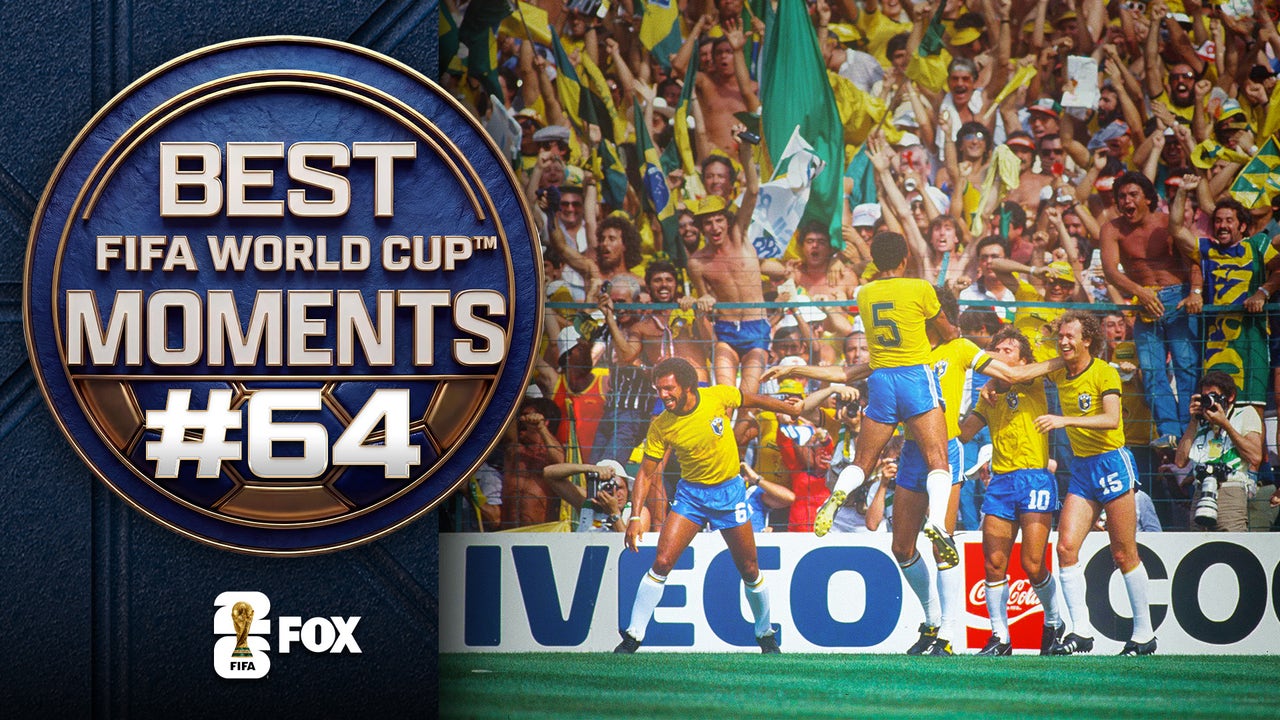
The Brazil national football team of 1982 were absolute artists. Led by the elegance of Zico, the intelligence of Sócrates, and the rhythm of Falcão, this team moved like music — fluid, fearless, and beautiful. Every pass had purpose, every attack felt inevitable.
Nonetheless, the ultimate objective of winning a World Cup (and one without the legendary Pelé) ultimately fell short during that summer in Spain. But this team will be remembered for being as talented – if not more – than teams that have won the whole thing.
Brazil steamrolled its group stage competition against the USSR, Scotland and New Zealand by an aggregate total of 10 goals to 2. In the second phase of the tournament, the Brazilians dominated its fierce rivals Argentina (led by Maradona) before losing an epic 3-2 thriller to eventual champions Italy.
No. 63: The Best Team Ever … To NOT Win a World Cup?
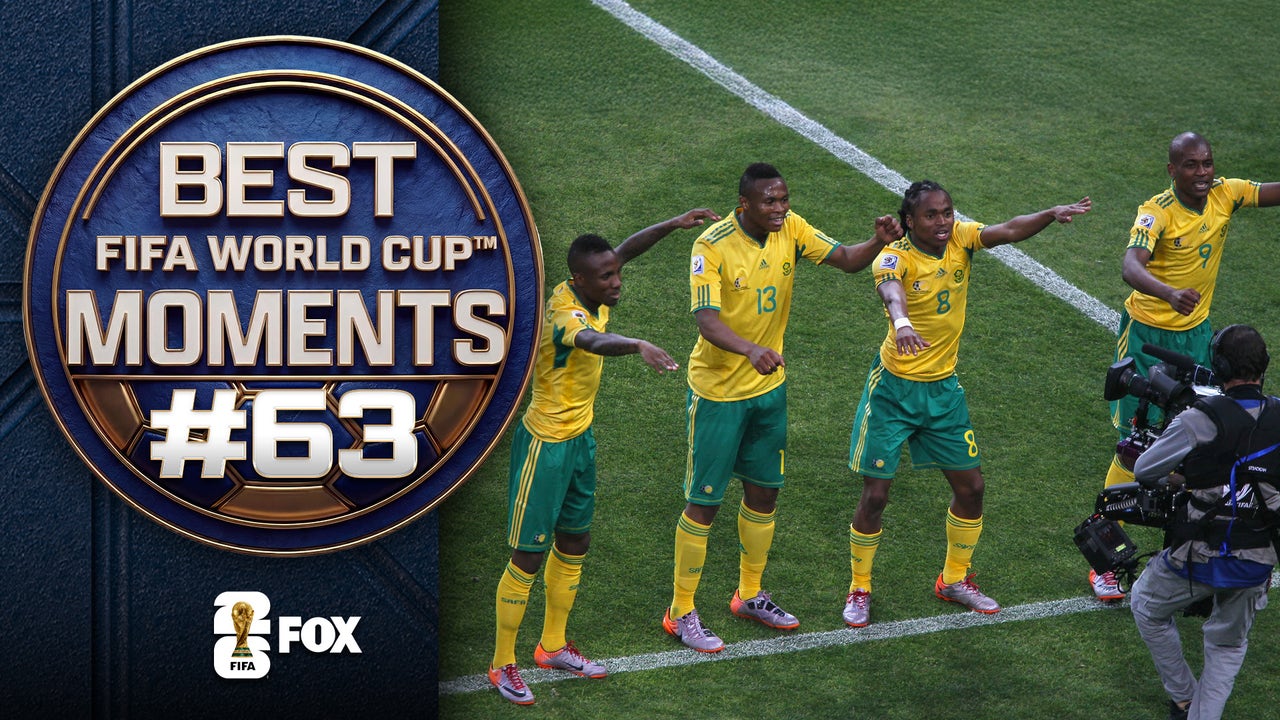
The pressure was on the host nation in the opening match of the 2010 World Cup. South Africa had both the privilege and responsibility of hosting the tournament’s first game on African soil, but fans across the continent feared the worst.
There were questions about whether the team affectionally known as Bafana Bafana — which got an automatic berth as the home team — could compete with the best in the sport. South Africa had won just one of its six outings over its two previous World Cup appearances, in 1998 and 2002, and the country had failed to qualify for the 2006 event. In other words, the pressure was on. So when Siphiwe Tshabalala hit a long-range missile past Mexican goalkeeper Oscar Perez and into the very top corner of the net in front of a packed stadium in Johannesburg, the entire continent erupted.
It turned out to be the high point for the hosts, who conceded a late equalizer to El Tri and eventually became just one of two home sides not to qualify for the knockout stage (Qatar also failed in 2022). But Tshabalala’s effort will forever live on.
No. 62: Beckham Bends It to Save England
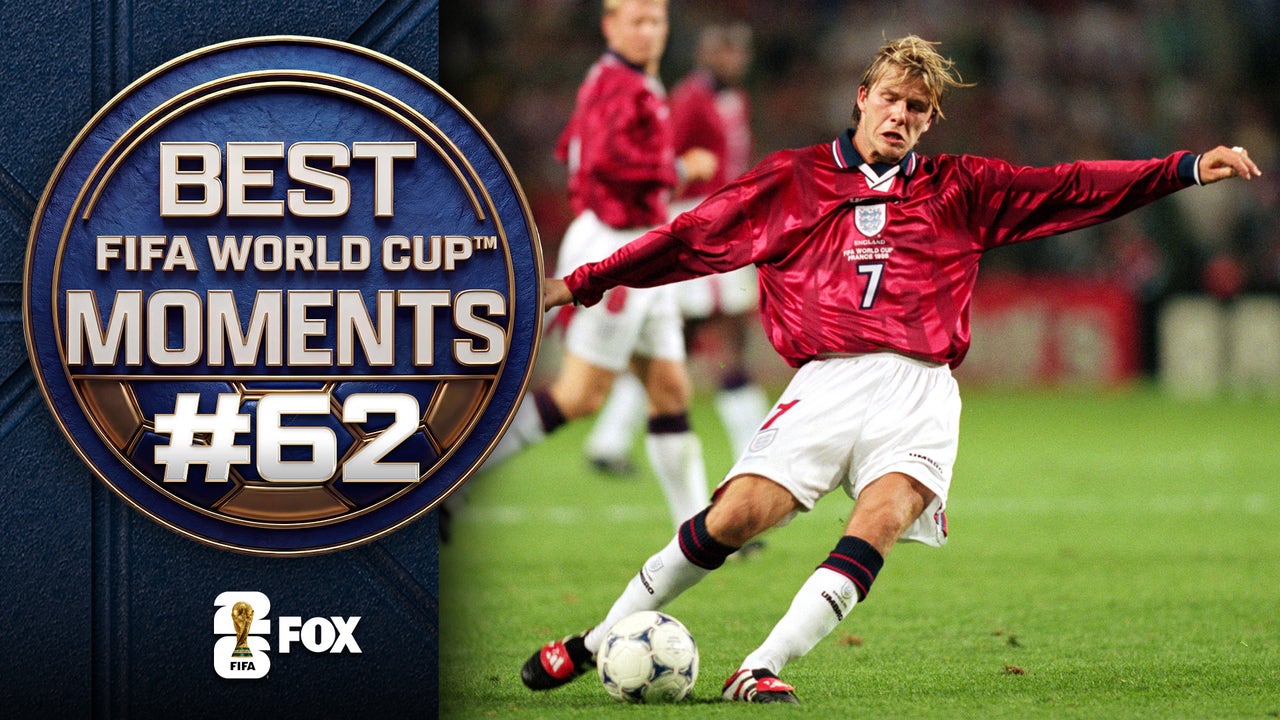
David Beckham’s time at the 1998 FIFA World Cup will forever be overshadowed by the red card he received in England’s Round of 16 matchup with Argentina — so much so that many forget that he was actually the Three Lions’ saving grace in the group stage of the tournament.
In 1998, Beckham was on the cusp of soccer superstardom and just becoming a global icon we now know him for. With England facing elimination in its final group stage match against Colombia, England coach Glenn Hoddle gave into the pressure to play Beckham after sitting his young star in the first two group stage matches.
Beckham proved himself to his skeptic coach by scoring his first international goal for England and doubling England’s lead over Colombia. England went on to win the match 2-0 and advanced as the runner-up in Group G behind Romania. And that ubiquitous term “Bend it like Beckham” began to filtrate across the world.
No. 61: Biggest Robbery Ever? USA Not Awarded A Handball
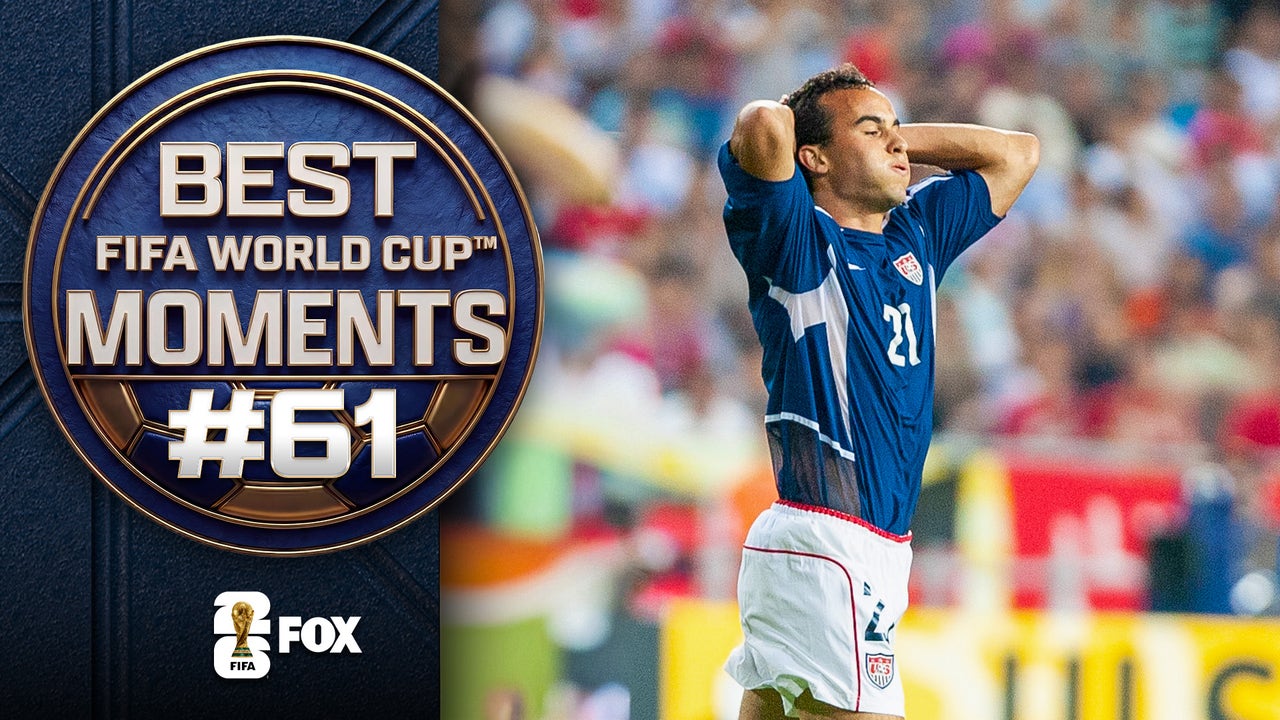
The United States men’s national team could have made the 2002 FIFA World Cup final.
In fact, they should have at least made the semifinals. And yet, they didn’t. Why? An obvious handball that wasn’t called in the quarterfinal against Germany. Arguably the most controversial moment involving the USA at any World Cup tournament.
In 2002, the USA was primed for a run at the tourney co-hosted by South Korea and Japan. Led by a young core that included emerging talented duo Landon Donovan and Brian McBride, the USA defeated Portugal 3-2 and finished runner-up to group winners South Korea.
In the Round of 16, they recorded a 2-0 victory over rivals Mexico behind goals from McBride and Donovan. Next, it was on to the quarterfinal against powerhouse Germany. Michael Ballack got the Germans out to an early 1-0 lead in the 39th minute. The Americans responded with several attacking plays to start the second half.
– What if … the USA had been awarded THAT handball?
But in the 50th minute, everything changed. Off a corner kick by Donovan, the ball landed to a wide-open Gregg Berhalter, who took a shot at goal from just a few yards out. German keeper Oliver Kahn was able to barely save the shot, but the ball would bounce off midfielder Torsten Fring’ arm. Immediately, USA players began clamoring for a handball, and when the replay was shown — it was clear as day.
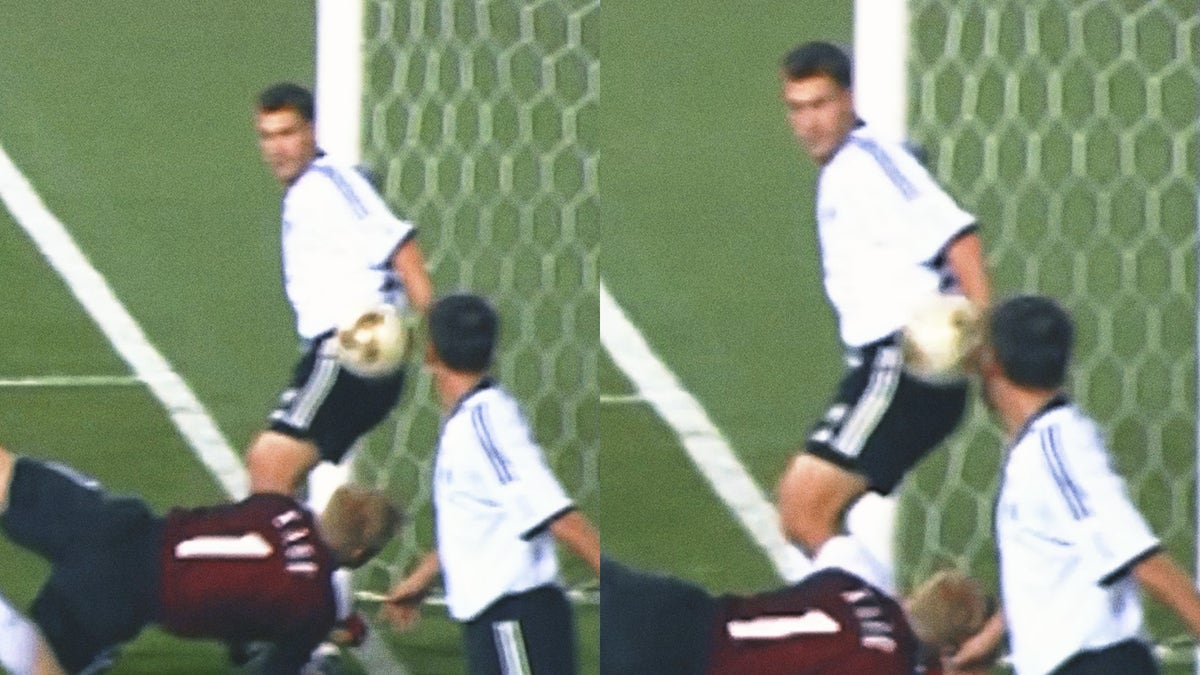
German midfielder Torsten Frings wasn’t called for a handball on this play.
However, referee Hugh Dallas didn’t call it. And with VAR not yet in existence, the call was irreversible. Had it been called, the USA would have been awarded a penalty kick, and Frings would have been sent off, and the Stars and Stripes would have kept the momentum against a 10-man German side.
Germany survived and eventually made it to the final, where they would fall to Brazil. As for the Americans? It remains the biggest “what if” moment in its soccer history.
No. 60: Senegal Roars Into the Limelight
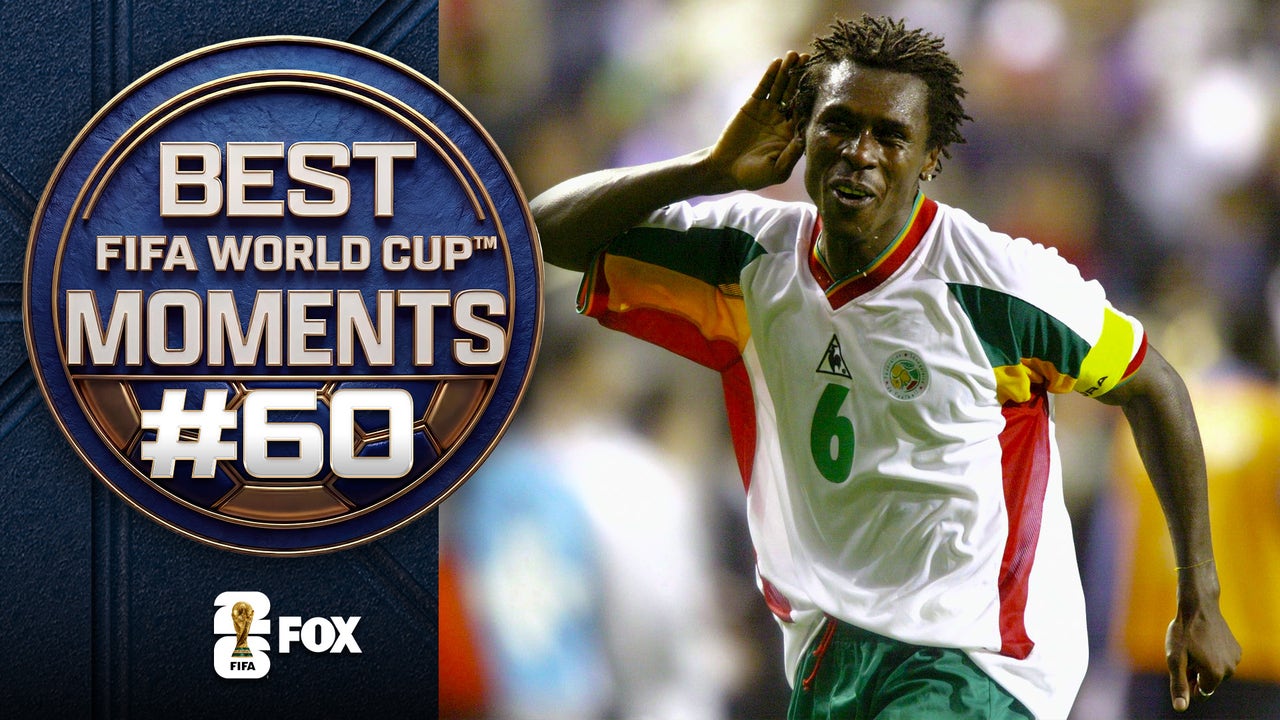
In the 2002 FIFA World Cup, Senegal came with little to no expectations. But, after a shocking win against defending champions France, The Lions of Teranga wrote a Cinderella story like no other.
France, also the reigning European titleholders at the time, probably had a more talented team than the one they fielded during their triumphant run to the trophy four years prior. They were significantly more experienced. Senegal, by contrast, were participating in their first World Cup.
The former French colony took a 30th minute lead on a goal by the wonderfully-named Papa Bouba Diop, who shot the ball while in a seated position. Senegal rode the momentum generated by their tournament-opening victory all the way to the quarterfinals.
As for Les Bleus? Not only did France also fail to win either of their next two games, they exited the competition after the group stage without having managed a single goal.
No. 59: David Luiz Caps Off Goal With Karate-Kick Celebration
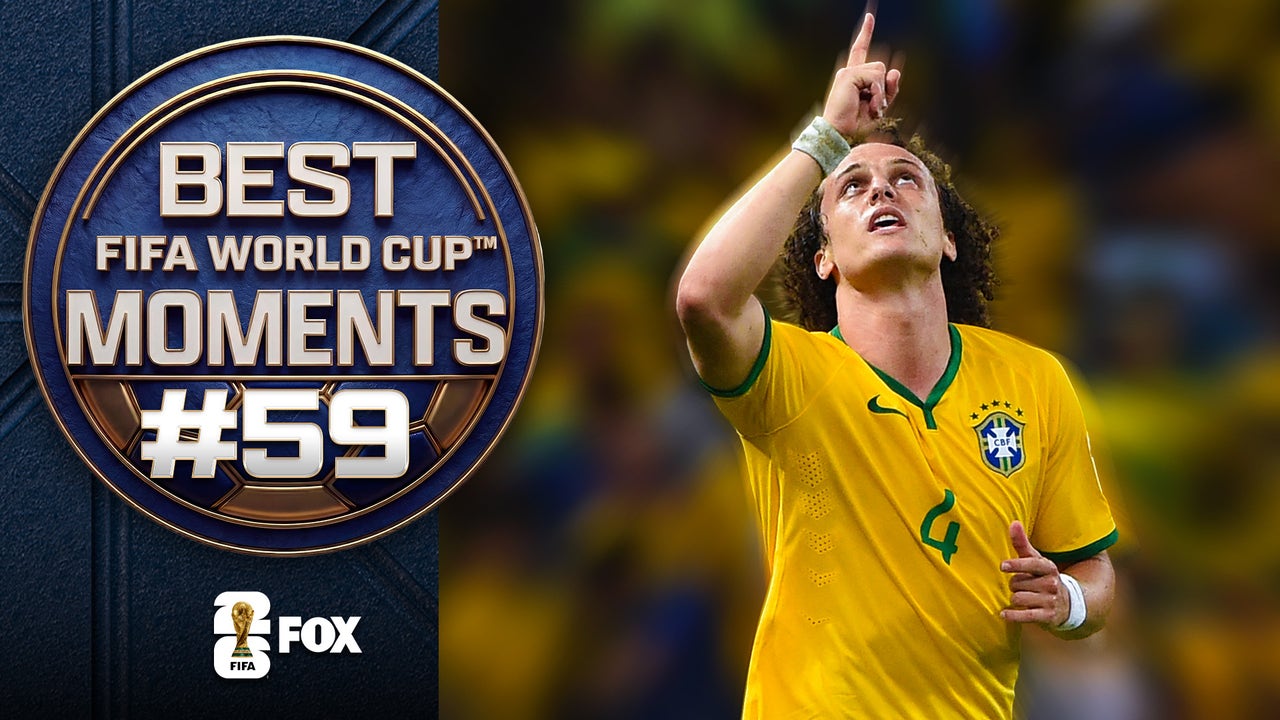
When Brazil hosted the 2014 World Cup, the whole event felt like one never-ending party. And the host team, fully aware of the pressures and expectations on their shoulders, needed to put on a show.
The quarterfinals saw Brazil take on South American rivals Colombia, a squad that became one of the darlings of the tournament behind star midfielder James Rodriguez. But the Brazilians weren’t going to back down. And one of its most vocal leaders, defender David Luiz, ensured they’d keep the run going with a stunning second-half free-kick goal from 40 yards out that effectively sealed the game.
Equally memorable as his knuckle-balling goal that befuddled Colombia keeper David Ospina was Luiz’s celebration, not to mention his signature locks of bouncing curly hair. As the goal sailed into the net, Luiz feverishly ran and karate-kicked the corner flag as his teammates joyously mobbed him.
A moment that felt like Brazil’s last hurrah of the tournament. Captain Thiago Silva would be forced to miss the semifinal match against Germany for yellow card accumulation. Superstar Neymar suffered a devastating back injury that also kept him out of the semifinal. How did that turn out? We’ll get to that soon enough.
No. 58: An Unlikely Hero in France’s 2018 Run
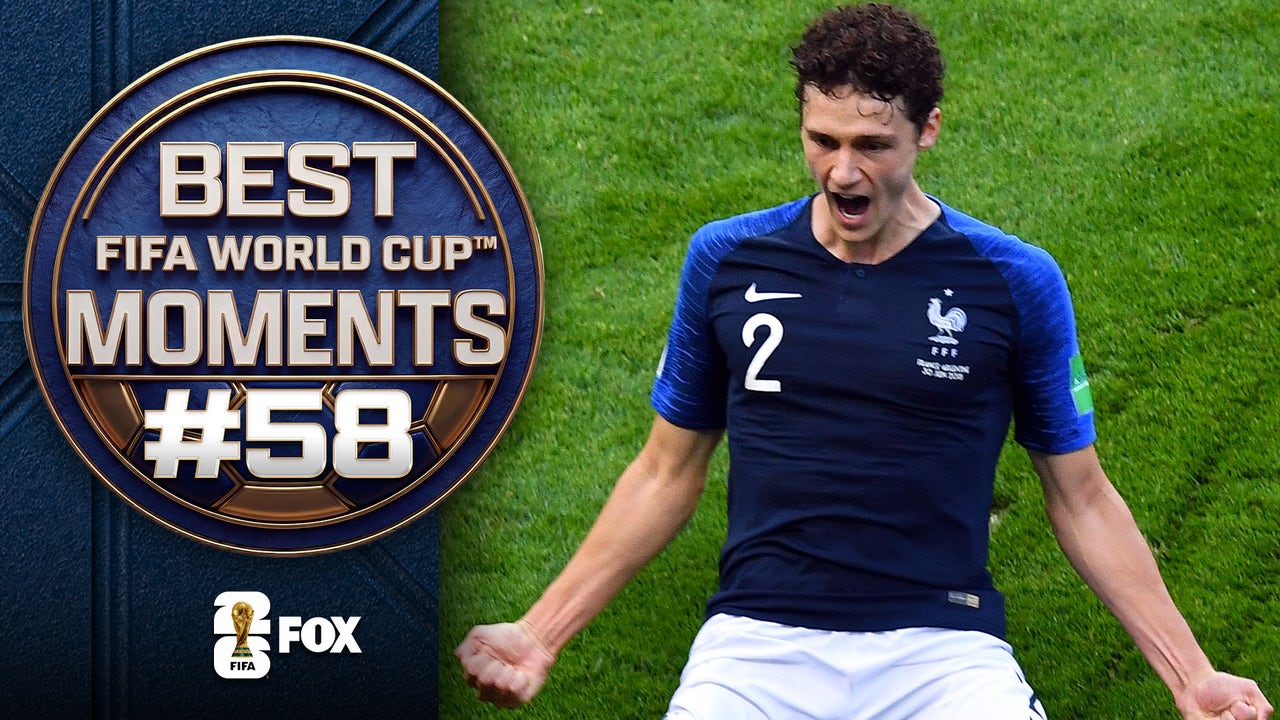
During the 2018 Round of 16, France was trailing Argentina by a goal and were in danger of being eliminated.
After letting an early lead slip away, Les Bleus needed to keep up with La Albiceleste’s firepower and an unassuming hero stepped up.
Just before the hour mark, French defender Lucas Hernandez sent over a cross that took a pair of bounces before landing in front of teammate Benjamin Pavard, who had never scored an international goal up to this point in his career.
Pavard would hit a half-volley with his right foot, which created a top-spin effect that sent the ball swerving into the top-left corner, far beyond reach of Argentinian goalkeeper Franco Armani.
The goal would flip the momentum back on France’s side as a then 19-year-old Kylian Mbappe scored twice in a four-minute span to give his country the lead and eventually a 4-3 victory.
Pavard’s goal would later be voted as the goal of the tournament as France went on to defeat Uruguay, Belgium, and Croatia to lift the nation’s second World Cup Trophy.
No. 57: 16 Yellow Cards and 4 Reds? The ‘Battle of Nuremberg’

No match in World Cup history has seen more cards given out.
Portugal and Netherlands turned this 2006 Round of 16 clash into a record-breaking foul fest. By the time the final whistle blew, referees had shown 16 yellow cards and 4 reds, both World Cup records that still stand today.
A 21-year-old Cristiano Ronaldo left early due to injury in tears. Luis Figo connected with a headbutt. Players argued, pushed, and collided for 90 minutes.
In the midst of all the chaos, Maniche scored the lone goal in the 23rd. Portugal won 1-0 and advanced. But the scoreline was almost an afterthought.
The “Battle of Nuremberg” remains the most ill-tempered match the World Cup has ever seen.
No. 56: Italy Upset By North Korea at 1966 World Cup
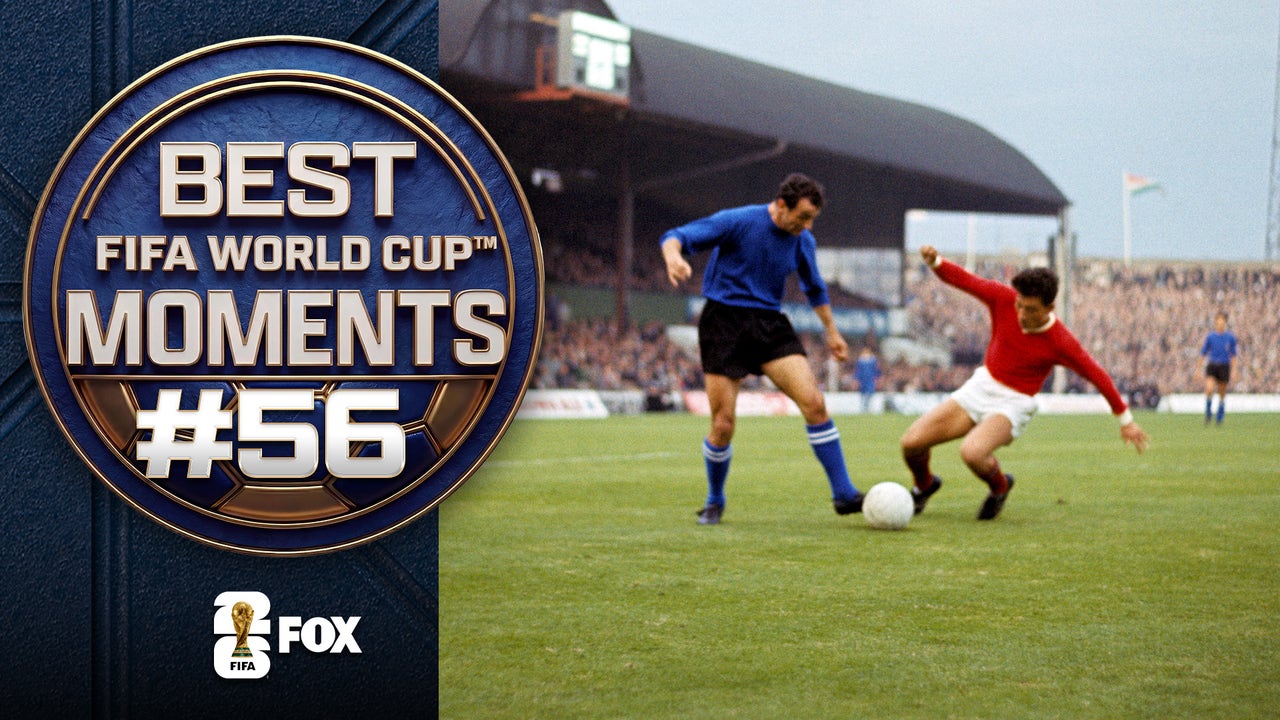
The most unlikely World Cup upset is not Saudi Arabia defeating Argentina in Qatar in 2022.
That honor actually belongs to North Korea, who stunned Italy during the 1966 World Cup in England, the only country other than Brazil with multiple world titles to that point.
The newcomers’ prospects looked grim after a 3-0 loss to the Soviet Union and a 1-1 draw with Chile, leaving them as massive underdogs for their final group match in Middlesbrough.
However, the unthinkable happened when Pak Doo-ik scored just before halftime. North Korea’s defense held firm, securing a 1-0 victory that eliminated the Italians and made North Korea the first Asian team to reach the knockout stage.
They nearly repeated the miracle in the quarterfinals, racing to a 3-0 lead against Portugal before eventually collapsing in a 5-3 loss.
North Korea didn’t qualify again for 44 years and is still chasing its second tournament win.
No. 55: Saudi Arabia’s Upset Over Argentina Stunned the World
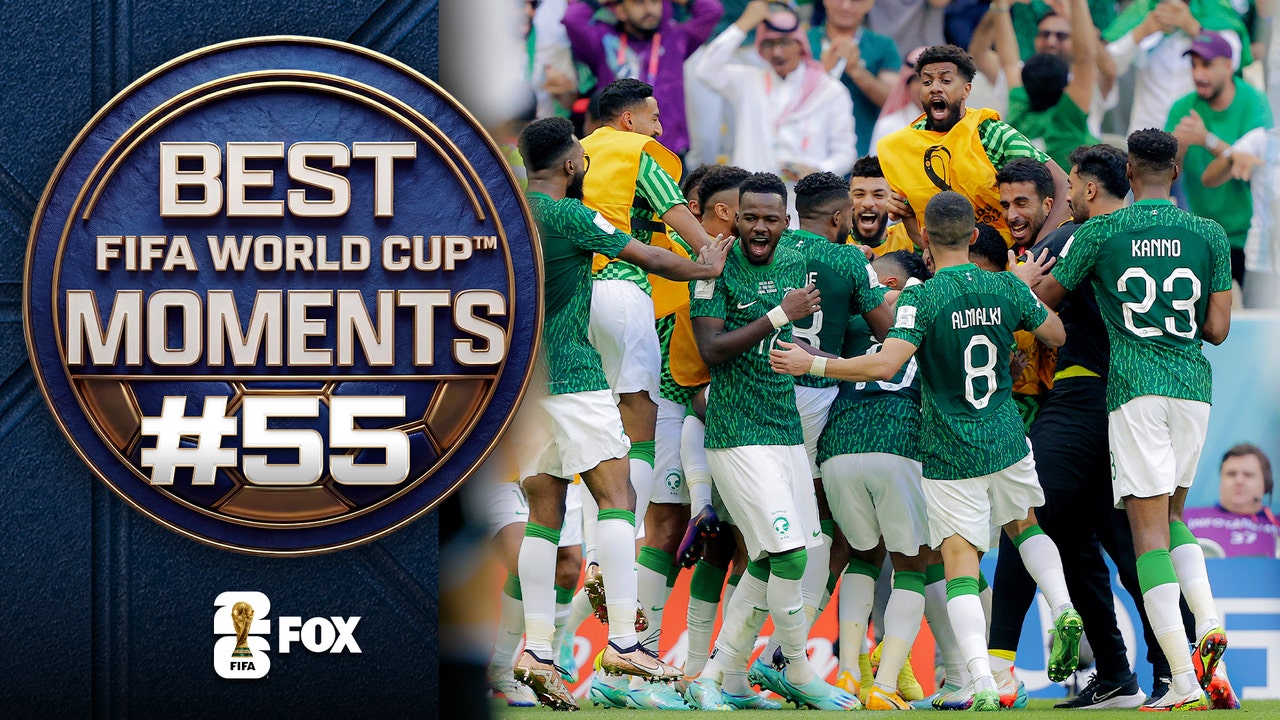
We all remember how the 2022 World Cup ended, with Lionel Messi lifting the trophy for Argentina after the insane win over France in the final at Qatar’s Lusail Stadium.
But do you recall how Argentina’s World Cup campaign started at that very same stadium only weeks before?
What was supposed to be a routine group-stage opener against a less heralded Saudi Arabian side turned into one of the most memorable upsets ever at the World Cup. Messi even had his team up by a goal early thanks to a penalty, but two second-half goals saw the Saudis rally and get the win. Salem Al Dawsari’s eventual game-winner was one of the tournament’s most memorable goals, and included his iconic celebration flip.
The result was a wakeup call for one of the tournament favorites. One that they would bounce back and eventually make their way to the final.
As for the Saudis? They became overnight legends with the country even declaring a holiday for their Green Falcon heroes.
No. 54: Ronaldinho’s Fantastic Free Kick
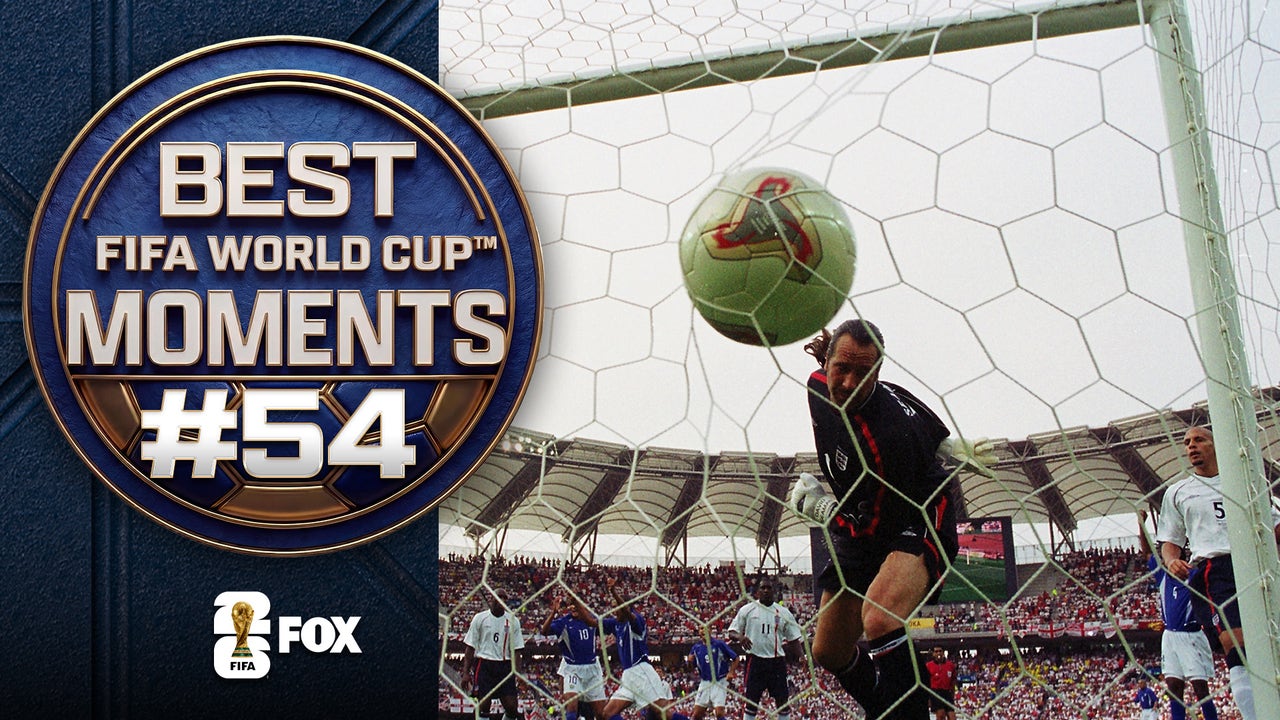
Whether it was a calculated masterpiece or a fortunate fluke, Ronaldinho’s epic 50-yard free kick against England in the 2002 quarterfinals remains one of the World Cup’s best goals in the tournament’s history.
After Michael Owen and Rivaldo traded first-half goals, Brazil earned a set piece deep in midfield five minutes after the break.
Expecting a routine cross, England goalkeeper David Seaman drifted off his line. Instead, Ronaldinho lofted a daring strike that sailed over the backpedaling keeper and tucked neatly under the crossbar.
The goal secured a 2–1 lead that Brazil never relinquished, sending one step closer toward their record fifth world title.
Regardless of whether it was intended to be a shot or cross, the audacity of the strike solidified Ronaldinho’s legend in football history.
No. 53: Never Doubt Cristiano Ronaldo
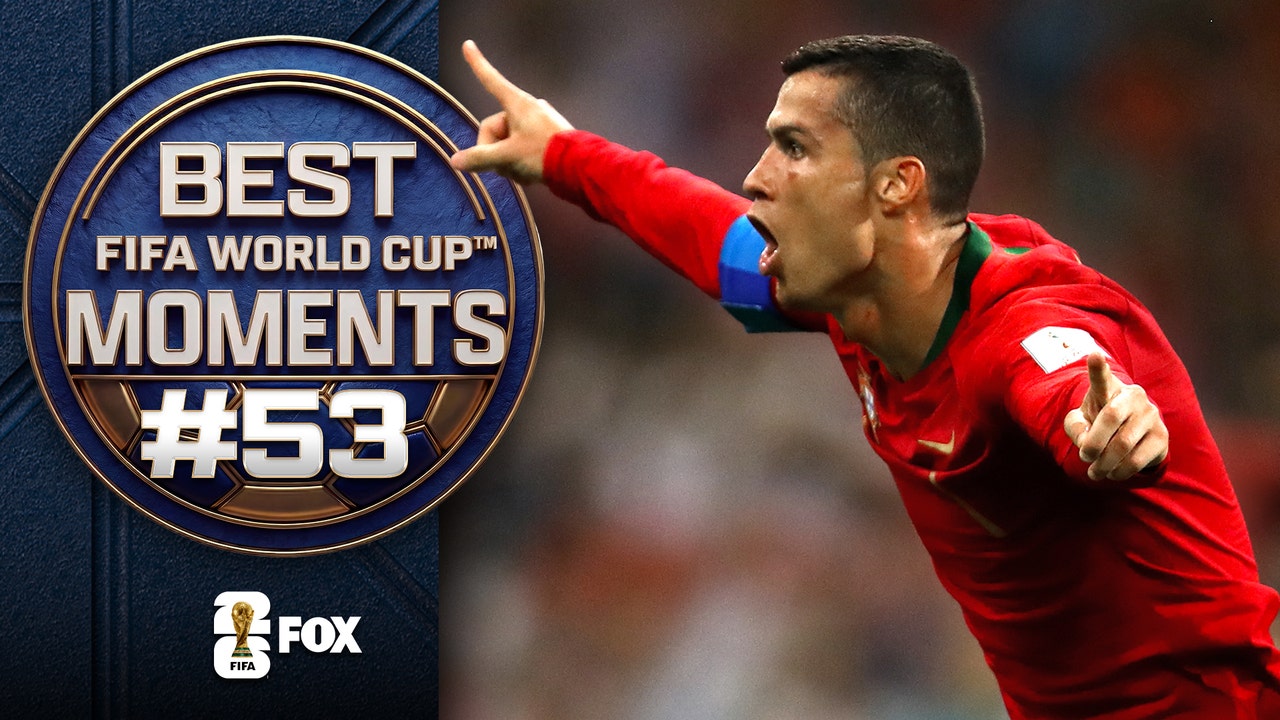
On the second day of the 2018 World Cup, Cristiano Ronaldo delivered a performance for the ages, netting a legendary hat trick to rescue a 3–3 draw against rivals Spain.
This clash of titans became an instant classic, fueled entirely by Ronaldo’s individual brilliance. He opened the scoring early with a composed penalty and restored Portugal’s lead before halftime with a powerful strike that slipped through David de Gea’s grasp.
After Spain surged ahead 3–2, the stage was set for a final act of heroics. In the dying minutes, Portugal earned a free kick at the edge of the box.
With the world watching, Ronaldo curled a sublime, dipping shot around the wall and into the top corner. De Gea didn’t even move.
This stunning equalizer completed his hat trick, making him the oldest player to score three goals in a World Cup match and cementing this masterclass as an all-time tournament highlight.
No. 52: When Ronaldo Became King
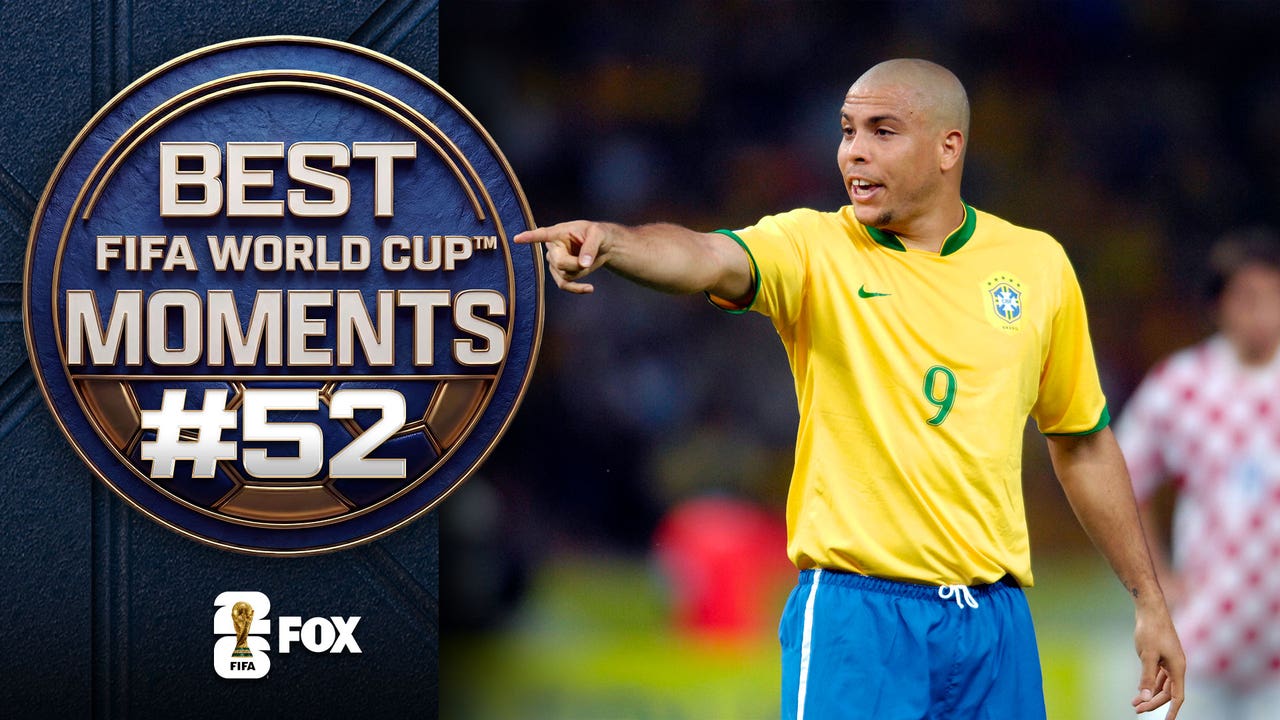
The 2006 World Cup in Germany served as the ultimate stage for Ronaldo Nazário to cement his status as football’s premier “O Fenômeno.”
Entering the tournament just behind the legendary Gerd Müller’s long-standing record of 14 goals, the Brazilian striker carried the weight of historical expectation on his shoulders.
The record-breaking moment arrived in the Round of 16 against Ghana.
In typical R9 fashion, he timed a clinical run to perfection, immobilized the goalkeeper with a signature step-over, and slotted the ball into the net.
This 15th career World Cup goal officially moved him past Müller, establishing a new benchmark that would stand for eight years.
While Miroslav Klose eventually surpassed this total in 2014, Ronaldo’s achievement remains a pinnacle of sporting excellence.
It wasn’t just about the volume of goals, but the artistry and dominance he displayed across three different tournaments cemented his legacy as one of the greatest strikers to ever step foot on the pitch.
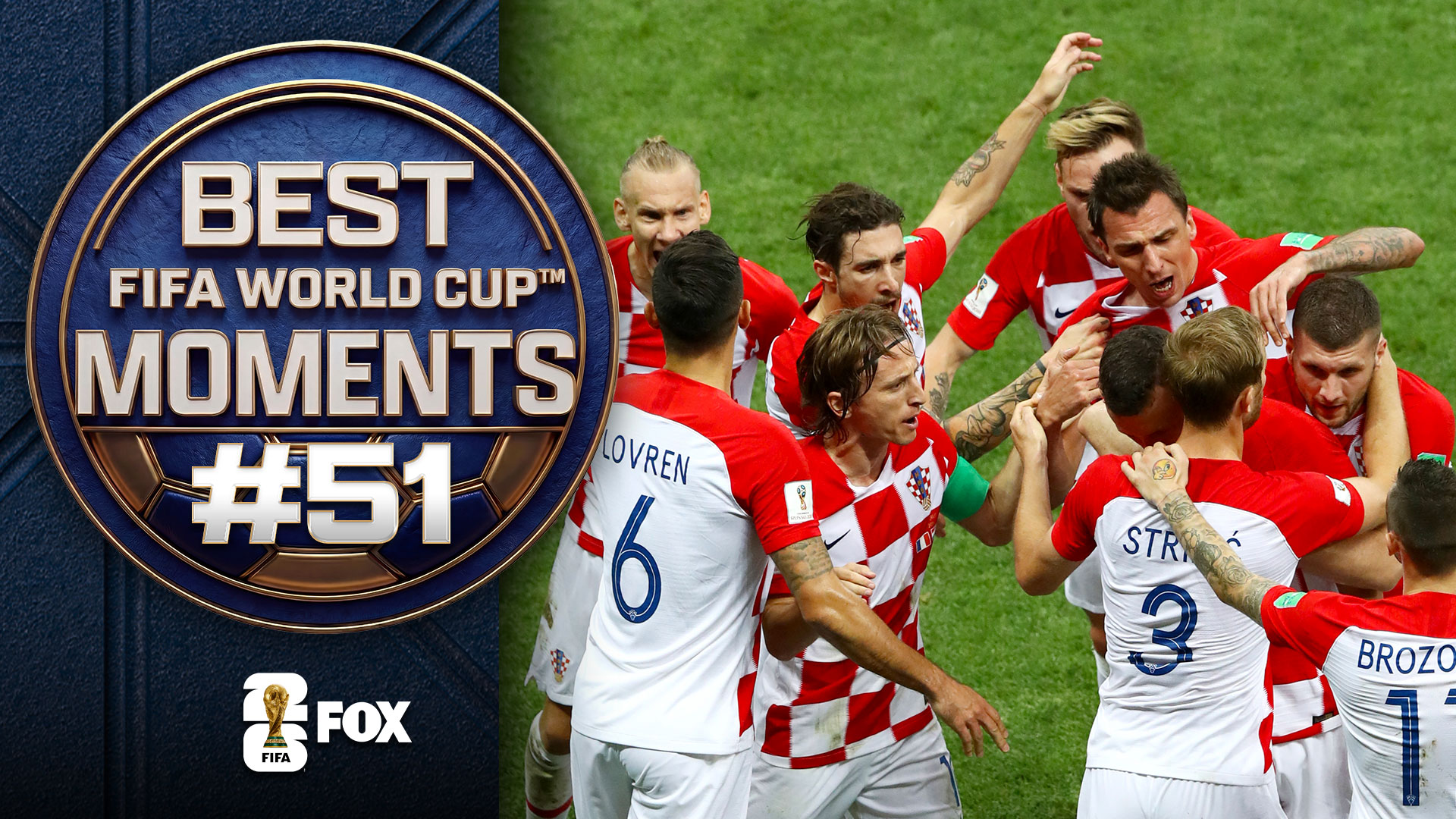
No. 51: Croatia’s Insane Run
For generations, the World Cup final was an exclusive club. Between 1978 and 2014, every championship match featured previous finalists, with no new nation reaching the ultimate stage since 1974.
In 2018, Croatia decided to crash the party.
Led by Luka Modrić, they defied the “usual suspects” narrative to become the second-smallest nation ever to reach the final.
While their path through Denmark, Russia, and England was arguably smoother than France’s gauntlet against powerhouses like Argentina and Belgium, their ascent wasn’t a total fluke as Croatia previously secured a third-place finish in 1998.
Ultimately, France claimed the trophy in a 4-2 thriller, but by ending a 44-year drought for first-time finalists, the “Vatreni” proved that the sports world’s most prestigious stage was no longer reserved solely for the traditional powers.
____
Continue to check back every day for more top moments as we count down to the 2026 FIFA World Cup, starting on June 11.
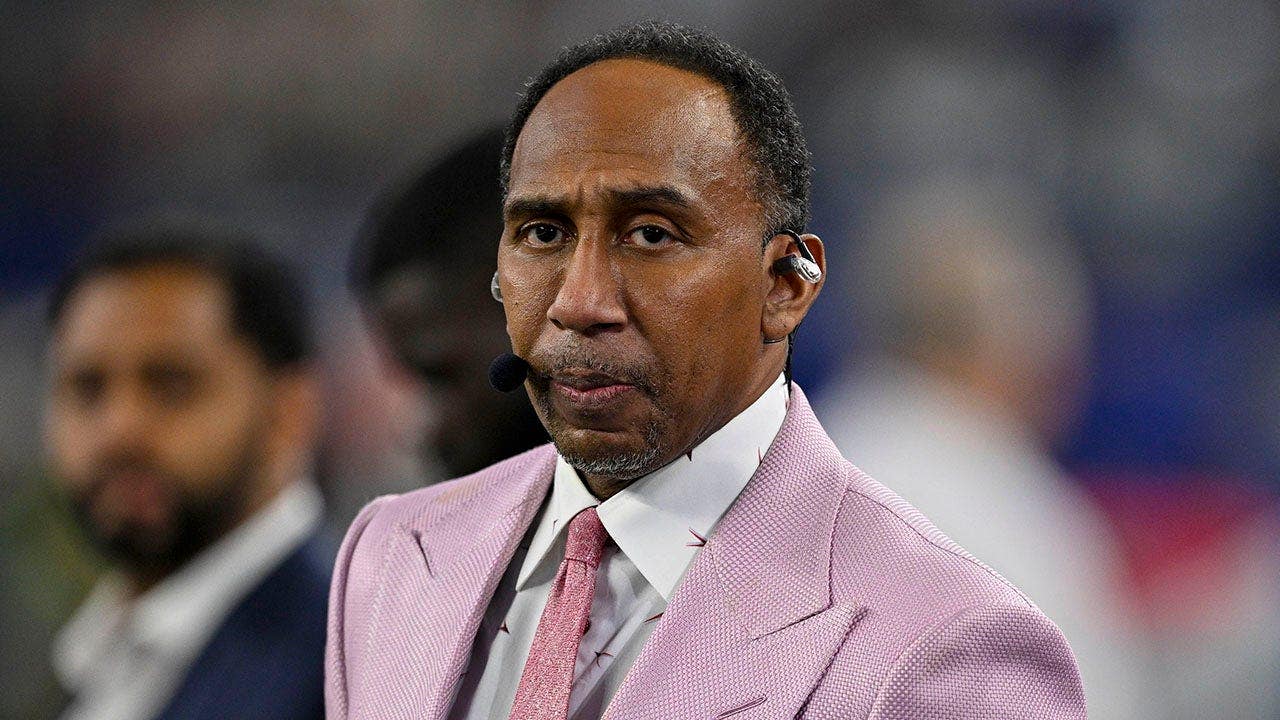
For years, Stephen A. Smith’s many football blunders have been easy enough to explain away.
He’s not an NFL guy (remember when he said the three key players for a game were three guys who weren’t playing in the game?)
Stephen A. Smith falsely claimed the Warriors haven’t made the playoffs since 2022, but Golden State reached the second round in both 2023 and 2025. (Jerome Miron/Imagn Images)
He’s definitely not a college football guy (remember when he called Jalen Milroe Jalen “Milroy” multiple times and then read the wrong stat line after a College Football Playoff game?).
CLICK HERE TO DOWNLOAD THE FOX NEWS APP
ESPN forces him into those conversations because First Take has to talk football, and Smith knows that football is the most popular sport in the country and he needs to be seen as an authority (even though he isn’t).
But Monday’s latest mistake is a lot tougher to excuse, because this time Smith wasn’t talking about the NFL or college football. He was talking about the Golden State Warriors, one of the defining NBA dynasties of the last decade.
In other words, he was talking about the sport and the league that’s supposed to be his bread and butter.
JALEN BRUNSON’S SISTER BLASTS ESPN AFTER STEPHEN A SMITH KNICKS RANT: ‘UTTERLY RIDICULOUS’
While discussing whether Steve Kerr has coached his last game with Golden State, Smith confidently stated the Warriors “haven’t been back to the playoffs since that championship in 2022.”
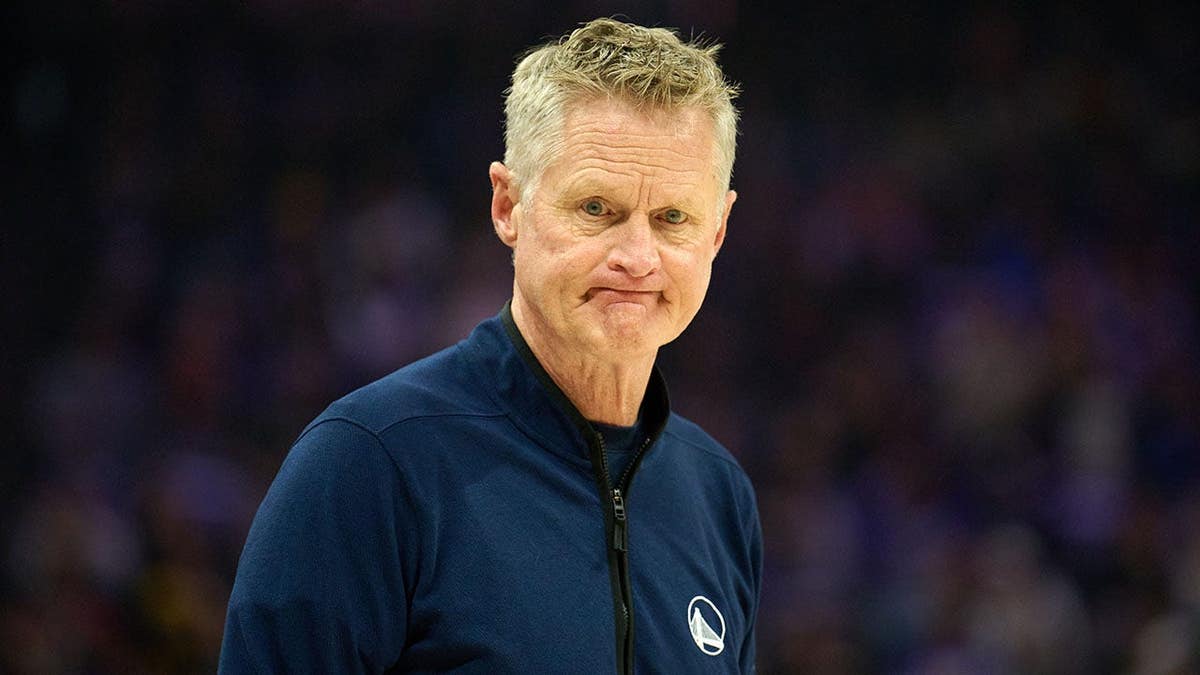
Golden State Warriors head coach Steve Kerr looks on during a game against the Sacramento Kings. (Robert Edwards/Imagn Images)
That’s not even close to true. Not only did Golden State make the playoffs last season, but they also reached the postseason in 2023. Last year, the Warriors made the playoffs, beat the Rockets in seven games and advanced to the second round before losing to the Timberwolves. In 2023, they beat the Sacramento Kings in the first round and before losing to the Lakers in the Western Conference semifinals.
So, Smith wouldn’t even have been right if he said they haven’t won a playoff series since 2022. But he didn’t say that. He said they didn’t make the playoffs in any of the past four years, except they did it twice.
Yikes.
This is not an obscure piece of NBA trivia that Smith could be easily forgiven for not knowing. Perhaps he was too busy playing solitaire on his phone and just missed two of the past three NBA postseasons. That’s a tough look for the guy who fancies himself as the No. 1 NBA analyst in the country.
And it’s a terrible look for ESPN, as they keep selling Smith as one of the faces of their NBA coverage.
Stephen A. Smith made a brutal gaffe while talking Warriors playoff history
If Smith made this kind of mistake while talking about the NFL, nobody would be shocked. At this point, sports fans practically expect him to butcher football analysis. It’s almost endearing that a guy with the ego of Smith can be so consistently wrong while also delivering every “fact” with the utmost confidence. It’s part of the Stephen A. experience.
But this one hits differently because the NBA is where he’s supposed to at least know the basics. This is where Smith prides himself as being an authority figure.
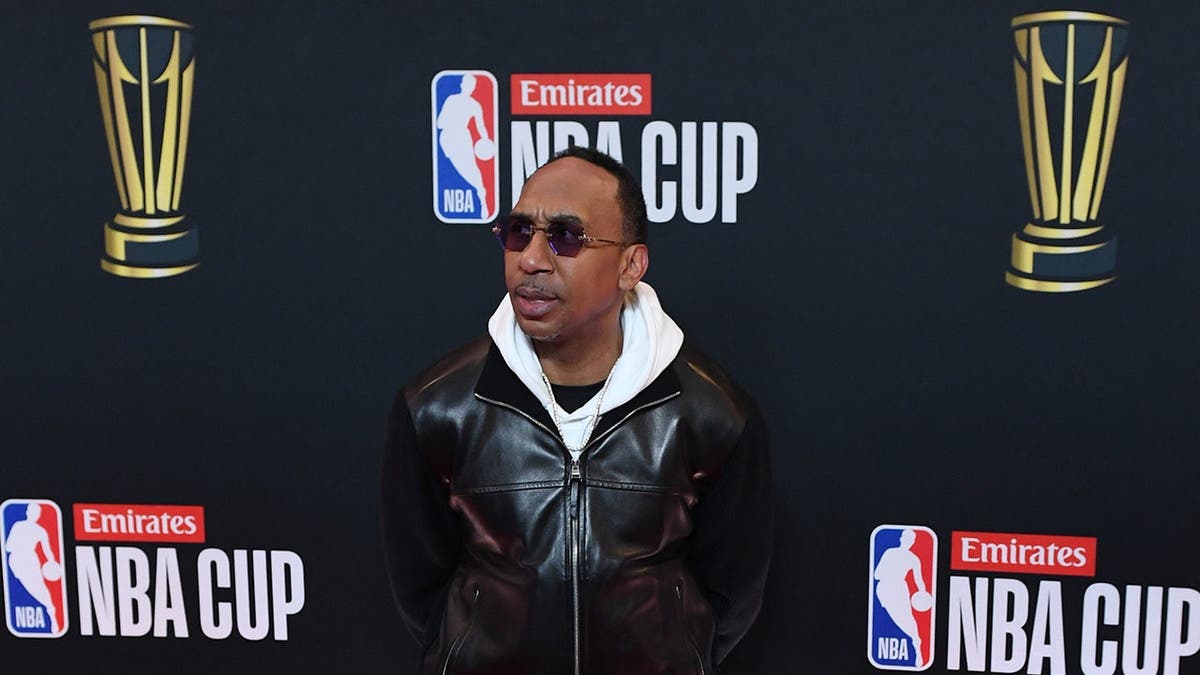
Stephen A. Smith incorrectly stated the Golden State Warriors haven’t made the playoffs since their 2022 championship, despite the team reaching the postseason twice since then. (Candice Ward/Imagn Images)
And yet he couldn’t keep the recent playoff history of the Warriors straight. The team whose head coach is in the news every other week. The team that has won four championships since 2014. Arguably one of the most important franchises in the NBA over the past 15 years.
Yes, Golden State missed the playoffs in 2024 after getting bounced in the Play-In Tournament (although they won 46 games that season). And yes, it fell short again this season. But that’s a lot different from acting like Steve Kerr has spent four years wandering the basketball wilderness since winning that 2022 title.
He hasn’t. In fact, the team is 175-153 in the past four regular seasons.
The Warriors made the second round in 2023. They made the second round again in 2025.
Before burying Steve Kerr on national television, maybe Stephen A. Smith could take 10 seconds to confirm whether the Warriors were actually, you know, in the playoffs.
Sports
Greg Olsen on Travis Kelce returning to Chiefs for 14th season: ‘League is better off with him playing’
NEWYou can now listen to Fox News articles!
Travis Kelce will enter year 14 in the NFL when he steps foot on the gridiron with his beloved Kansas City Chiefs in Week 1, which a close friend and fellow tight end said is a good thing for the league.
After recent seasons, the question of whether Kelce, a future Pro Football Hall of Famer, still wants to play football has come up. Each time, including this offseason, the 11-time Pro Bowler and four-time All-Pro has answered the bell with a resounding yes.
Greg Olsen, whom Kelce works alongside with their Tight End University summit each offseason, spoke to the Chiefs star recently. He told Fox News Digital that he still sees that fire inside Kelce when he talked about strapping the pads on for 2026 – a season in which he will turn 37.
CLICK HERE FOR MORE SPORTS COVERAGE ON FOXNEWS.COM
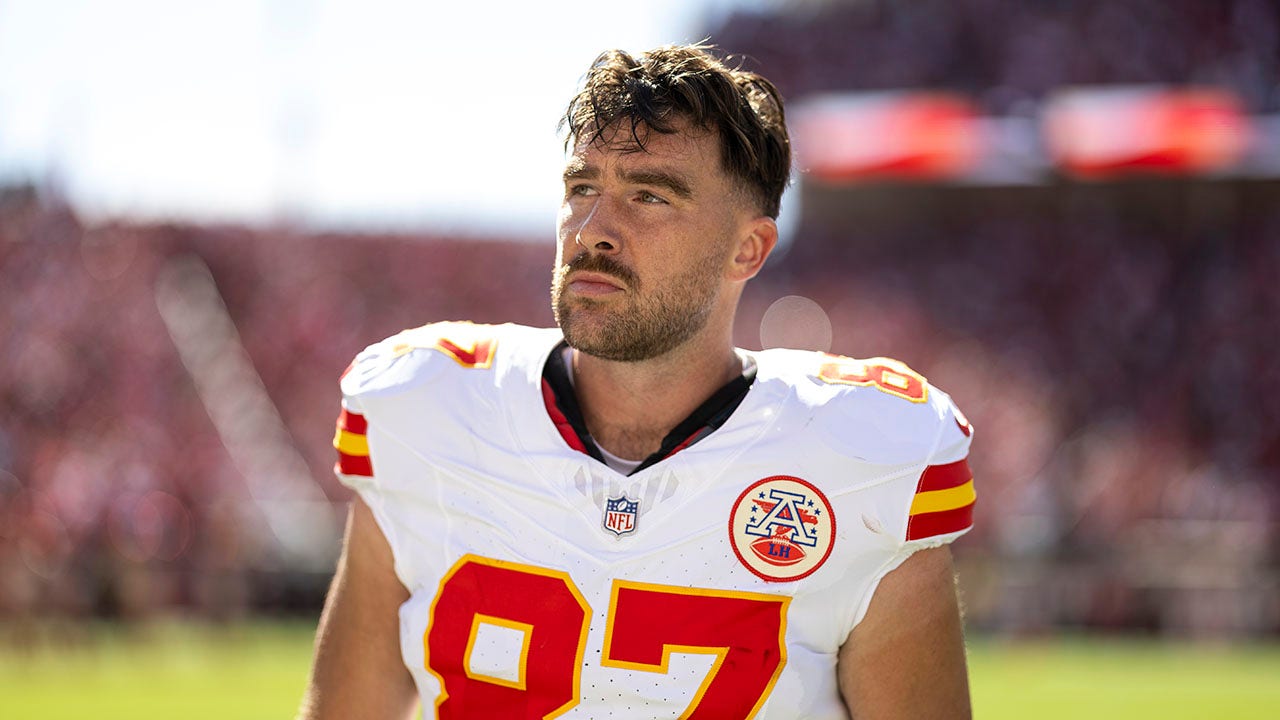
Travis Kelce (87) of the Kansas City looks on during an NFL Football game against the San Francisco 49ers at Levi’s Stadium on Oct. 20, 2024 in Santa Clara, California. (Michael Owens/Getty Images)
“I think just getting to know Travis and just how much he loves playing the game and how much he loves to compete and obviously the career that he’s had as far as first-ballot Hall of Famers – he’s as close to a lock as you’ll find – especially considering the tight end position takes some guys a little bit longer even though they’re super deserving. I think the league is great to have him,” Olsen said. “I think the Chiefs are smart to want him back.
“I got to spend some time with him a couple weeks ago, and he’s super excited for a fresh season, for the team, for himself.”
The Chiefs reached an acceptable deal with Kelce, whose contract was up after this past season. Now that he’s in place for 2026, as well as a reunion with Eric Bieniemy as offensive coordinator, the Chiefs are focused on the health of quarterback Patrick Mahomes, who needed ACL surgery after injuring it during a loss to the Los Angeles Chargers.
GREG OLSEN’S ADVICE FOR NFL DRAFT FIRST-ROUND PICKS ON HANDLING HIGH EXPECTATIONS
“It’s one of the best tight end-quarterback combinations of all time,” Olsen added, acknowledging one of the league’s best duos in recent memory. “So, I’m happy for [Kelce] just as a friend, as a fan of football.”
While it may be a nuisance for Kelce to continuously hear about retirement, Olsen also understands that Kelce has had the opportunity not many can say they do during a grueling football career – walking away on your own terms.
Olsen wants that for his friend in the end, whenever that may be.
“I’d love to see him go out when he wants to be done,” Olsen explained. “Very few guys are able to earn that right throughout their NFL career to say, ‘You know what? I’m done when I say I’m done.’ That’s not typically how it goes. Very few guys have that swan song, perfect ending, walking off under the confetti and the Super Bowl. That’s a dream scenario everyone hopes will be them.
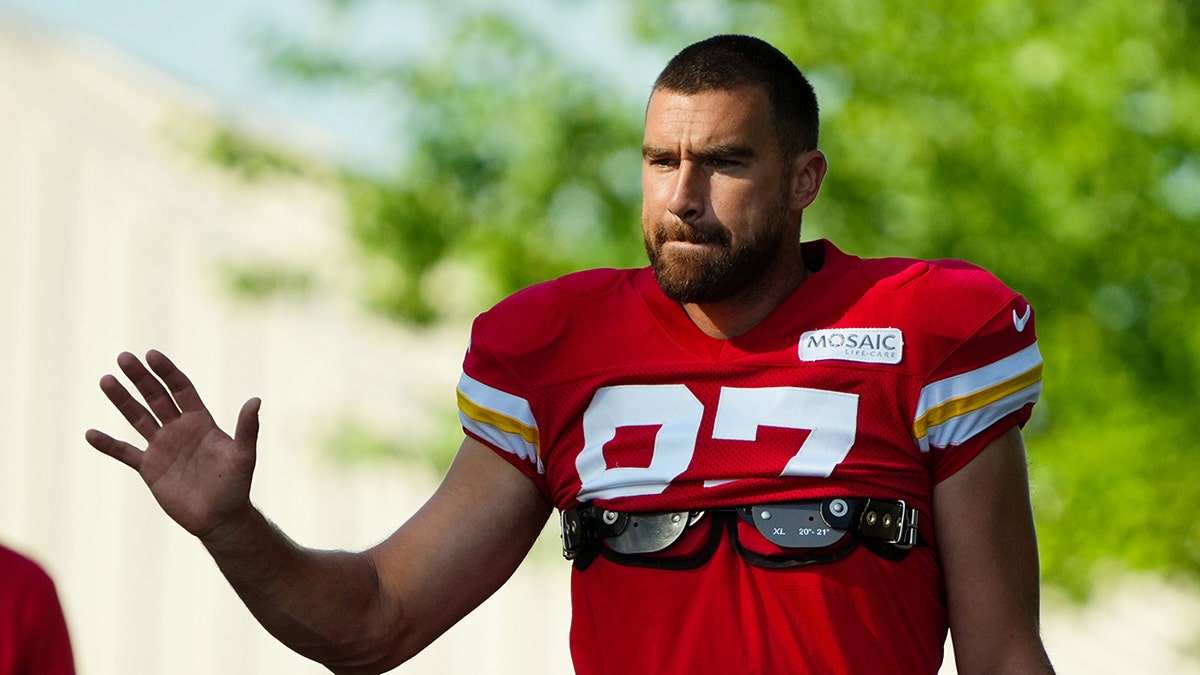
Kansas City Chiefs tight end Travis Kelce (87) greets fans as he arrives prior to training camp at Missouri Western State University on July 28, 2023 in St. Joseph, Missouri. (Jay Biggerstaff/USA TODAY Sports)
“But if there is a guy who deserves his career to end the right way because of everything he’s stood for, everything he’s done, how hard he’s worked, the success he’s had, individually and collectively, Trav’s at the top of that list.”
Olsen, who serves as an NFL analyst for Fox Sports, is excited for the prospect of covering more games featuring Kelce and the Chiefs, as he wants to enjoy the remainder of his career.
And that’s a career defined by three Super Bowl titles, and more than enough accolades to end up with a bronze bust in Canton one day.
“I never thought I’d see a day where people started saying, ‘Is anyone better than Tony Gonzalez?’ Then, Gronk comes along and that conversation. When it’s all said and done, Travis might be at the top of that list, which 10 years ago sounded crazy that anyone would surpass some of those guys. His career is second to none, and the league is better off with him playing,” Olsen ended.
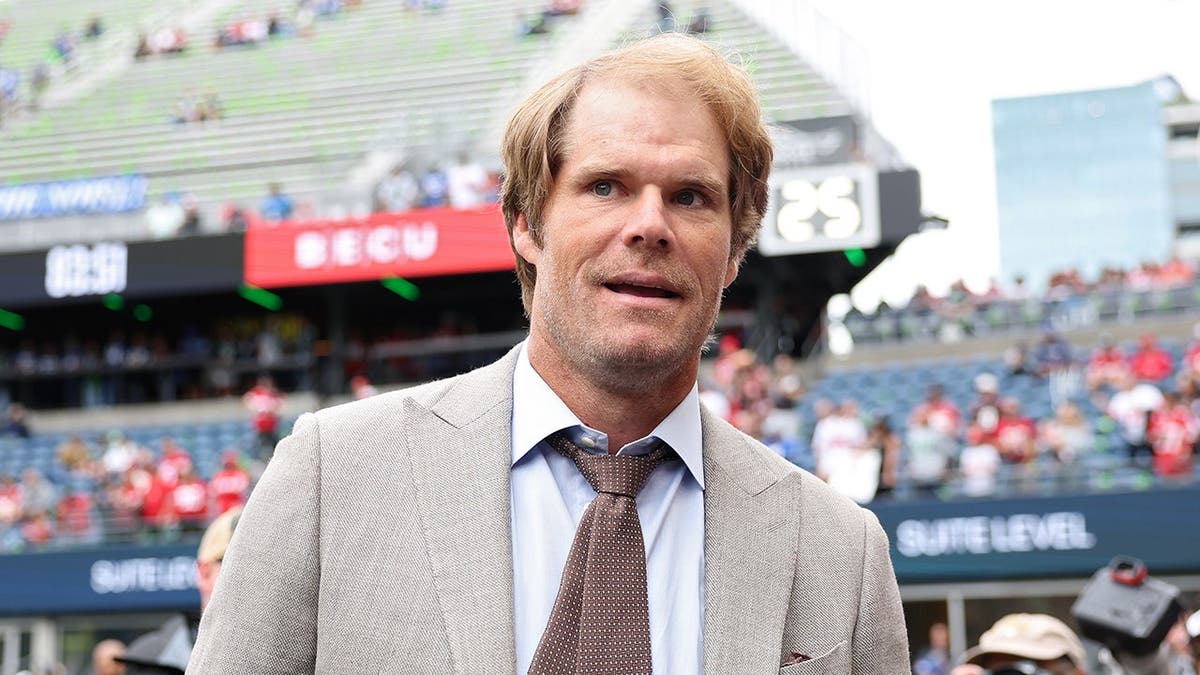
Broadcaster Greg Olsen looks on before the game between the Seattle Seahawks and the San Francisco 49ers at Lumen Field in Seattle, Washington, on Sept. 7, 2025. (Steph Chambers/Getty Images)
INSIDE THE FRONT OFFICE MIND
While Olsen enjoyed 14 years in the NFL, his next chapter of the game is providing keen analysis for FOX Sports broadcasts during the year.
To help him do that in the offseason while looking at the NFL Draft and free agency pickups by each franchise, Olsen has been using NFL IQ, the new interactive hub created by the league and Amazon Web Services powered by Amazon Quick.
Ahead of the draft, NFL IQ transformed raw data from the NFL Combine and team needs, free agency moves made and more for this hub that provides fans access to key insights and puts them in the shoes of front office decision makers. Whether it’s the casual fan or a top analyst like Olsen, NFL IQ is an easy-to-use way to deepen football knowledge, especially at a crucial roster-building time like the draft is.
“This is the most educated fan base in NFL history, and I think that’s a good thing,” Olsen said.
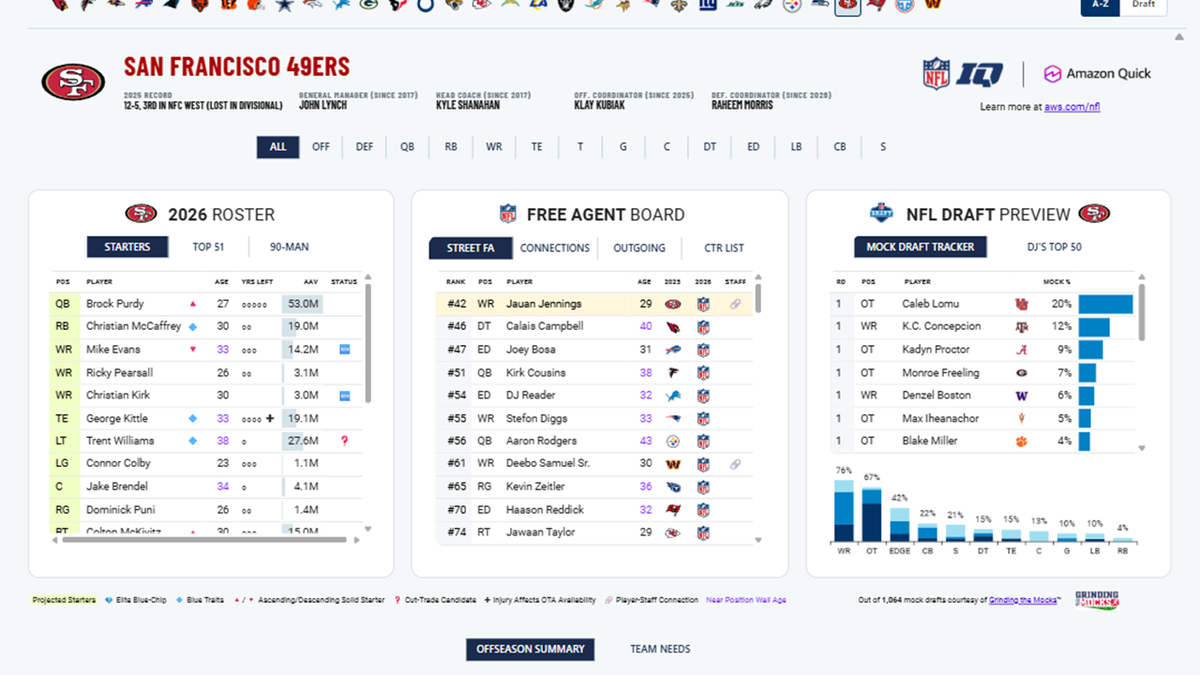
General shot of NFL IQ, the new interactive hub from the league and Amazon Web Services, powered by Amazon Quick. (NFL IQ)
CLICK HERE TO DOWNLOAD THE FOX NEWS APP
“Fans actually have a way to access the exact same data, the exact same information that the teams and everyone are using for their own interest, whether it’s something casual or for people who really want to dive into the nitty gritty.
“I think it’s a really fun set of tools for the wide array of people who touch the NFL space. I know firsthand as a fan, and now a professional in the industry, it’s a huge part of my interaction of the game.”
Follow Fox News Digital’s sports coverage on X and subscribe to the Fox News Sports Huddle newsletter.


War-linked energy shock pushing inflation higher in Europe: IMF expert

Scam messages offering ships safe transit through Hormuz, warns security firm

Billions to be paid! US starts refund process for Trump tariffs: Can Indian exporters claim? – The Times of India

-

 Fashion5 days ago
France’s LVMH Q1 revenue falls 6%, shows resilience amid Iran war
-

 Sports1 week ago
The case for Man United’s Fernandes as Premier League’s best
-

 Entertainment1 week ago
Palace left in shock as Prince William cancels grand ceremony
-
 Business1 week ago
UK could adopt EU single market rules under new legislation
-

 Entertainment6 days ago
Is Claude down? Here’s why users are seeing errors
-

 Fashion1 week ago
Energy emerges as biggest cost driver in textile margins
-
 Business1 week ago
Delta Air Lines unveils first new Delta One suite in premium cabin arms race
-

 Tech1 week ago
A Lot of Shops Won’t Fix Electric Bikes. Here’s Why