

Business
Farmers are being squeezed – it’s testing their loyalty to Trump

Luke MintzBBC News and
Anna JonesPresenter of Corn Belt People
 BBC
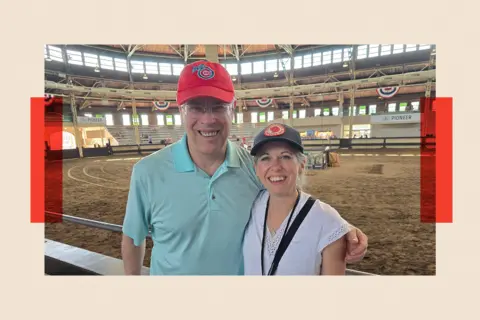
BBCOn a scorchingly hot day in the American Midwest, Tim Maxwell is voicing his fears about the future of farming.
The 65-year-old has worked the fields since he was a teenager. He now owns a grain and hog farm near Moscow, Iowa – but he’s unsure about its prospects.
“I’m in a little bit of a worried place,” says Mr Maxwell, who wears a baseball cap bearing the logo of a corn company.
He is concerned that American farmers aren’t able to sell their crops to international markets in the way they could in previous years, in part because of the fallout from President Trump’s tariffs.
“Our yields, crops and weather are pretty good – but our [interest from] markets right now is on a low,” he says. “It’s going to put stress on some farmers.”

 Bloomberg via Getty Images
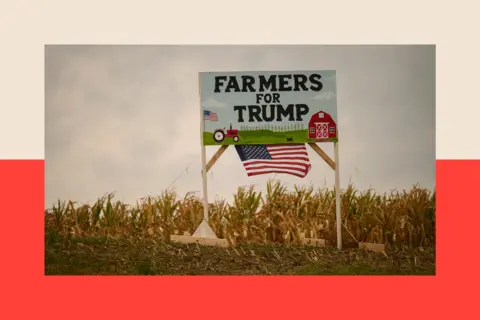
His fears are not unique. US agricultural groups warn that American farmers are facing widespread difficulty this year, mostly due to economic tensions with China. Since April, the two countries have been locked in a trade war, causing a sharp fall in the number of Chinese orders for American crops.
American farmers are wounded as a result, economists say. The number of small business bankruptcies filed by farmers has reached a five-year high, according to data compiled by Bloomberg in July.
With all this economic pain, rural areas could well have turned against Trump. But that doesn’t seem to be happening.
Rural Americans were one of the president’s most loyal voting blocs in last year’s election, when he won the group by 40 percentage points over Kamala Harris, beating his own margins in 2020 and 2016, according to Pew Research analysis.
Polling experts say that in the countryside, he is still broadly popular.
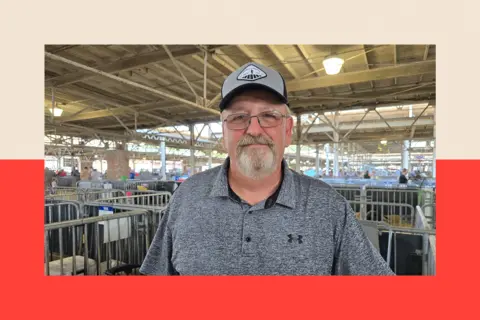
Mr Maxwell says he is sticking with Trump, despite his own financial worries. “Our president told us it was going to take time to get all these tariffs in place,” he says.
“I am going to be patient. I believe in our president.”
So why do so many farmers and other rural Americans broadly continue to back Trump even while feeling an economic squeeze that is driven in part by tariffs – the president’s signature policy?
Farmers on a ‘trade and financial precipice’
If you want a window into rural America, the Iowa State Fair is a good start. The agricultural show attracts more than one million visitors over 10 days.
There is candy floss; deep-fried hot dogs on a stick for $7 (£5) – known as “corn dogs”; an antique tractor show; a competition for the biggest boar.
But when the BBC visited last month, there was another topic of conversation: tariffs.

“A lot of people say he’s just using tariffs as a bargaining chip, as a bluff,” says Gil Gullickson, who owns a farm in South Dakota and edits an agriculture magazine.
“But I can say: history proves that tariffs don’t end well.”
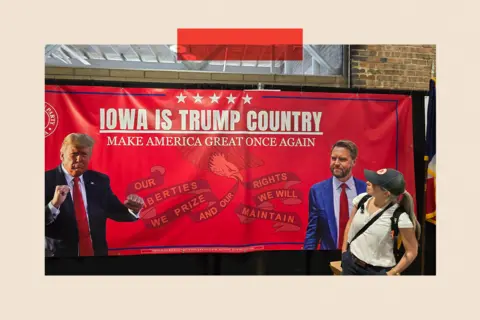
In April, what he termed “liberation day”, Trump imposed sweeping tariffs on most of the world, including a 145% tariff on China.
In response, China put a retaliatory 125% tariff on American goods – a blow to farmers in the American Midwest, sometimes known as the “corn belt”, many of whom sell crops to China.
Last year Chinese companies bought $12.7bn (£9.4bn) worth of soybeans from America, mostly to feed their livestock.
September is harvest season, and the American Soybean Association (ASA) has warned that soybean orders from China are way below where they should be at this point in the year.

Tariffs have fluctuated dramatically since they were introduced – and the uncertainty is proving tough for farmers, says Christopher Wolf, a professor of agricultural economics at Cornell University.
“China is just so big that when they buy things, it matters – and when they don’t, it matters.”
The cost of fertiliser has rocketed, too – partly because of trade disputes with Canada, which has raised the cost of potash, a salt imported from Canada by American farmers and used in fertiliser.
Jon Tester, a former Democrat Senator of Montana, who is a third-generation farmer, told a US news station earlier this month: “With all these tariffs the president’s put on, it’s interrupted our supply chain… it’s increased the cost of new equipment… and because of the trade and tariffs, a lot of customers have said to heck with the United States…
“The people who are new to agriculture, those young farmers who haven’t saved money for times like this, they’re going to be in trouble and a lot of those folks are going to go broke.
“And if this continues, a lot of folks like me are going to go broke too.”
American farmers already suffer from high levels of stress. They are more than three times more likely than average to die by suicide, according to a paper by a charity, the National Rural Health Association, which analysed a period before Trump’s presidency.
In a letter to the White House, Caleb Ragland, president of the ASA, warned of a tipping point: “US soybean farmers are standing at a trade and financial precipice.”
Trump: ‘Our farmers are going to have a field day’
Supporters of President Trump say that his tariffs will help American farmers in the long run, by forcing countries like China to come to the negotiating table and agree new deals with the US over agriculture.
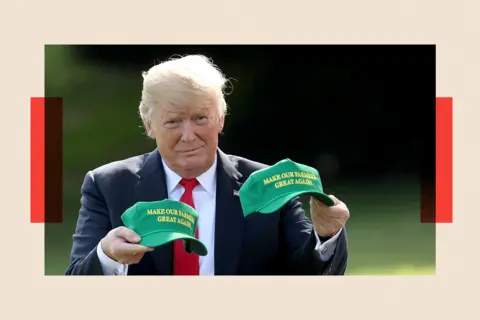
And they point to other ways this White House has helped farmers. Over the summer, as part of Trump’s tax and spend bill, his administration expanded federal subsidies for farmers by $60bn (£44bn), and boosted funding for federal crop insurance.
In his annual speech to Congress in March, Trump warned farmers of a “little bit of an adjustment period” following the tariffs, adding: “Our farmers are going to have a field day… to our farmers, have a lot of fun, I love you.”
 Getty Images
Sid Miller, commissioner of the Texas Department of Agriculture, is among those who have praised Trump for his “vital support”.
“We finally have an administration that is prioritising farmers and ranchers,” he wrote in a statement earlier this year. “They advocate for farmers, challenge China … and ensure America’s producers are receiving fair treatment.”
And it is possible the president’s tariff strategy could eventually work, according to Michael Langemeier, a professor of agricultural economics at Purdue University.
But he also worries that uncertainty is inflicting long-term damage. “Your trading partner doesn’t know exactly what your position’s going to be next year, because it seems like we’re changing the goalposts.
“That is a problem.”
Tariffs will make us great again
There’s an old adage in American politics that says people “vote with their pocketbooks” – and turn against politicians if they appear to harm their finances.
Yet despite financial pressures, the rural Americans we spoke to are firmly sticking with Trump.
Experts say they haven’t seen any evidence of meaningful change in support among rural voters since last year. A survey by Pew last month found that 53% of rural Americans approve of the job Trump is doing, far higher than the 38% figure for the country as a whole.
Though a survey by ActiVote earlier this month did find a small decline in Trump’s approval among rural voters from 59% in August to 54% in September. Analysts warn not to pay too much attention to those shifts, however, because the number of rural voters included in those polls is so small.
“The data I’ve seen suggests Trump is still heavily supported in rural communities,” says Michael Shepherd, a political science professor at the University of Michigan who focuses on rural politics.
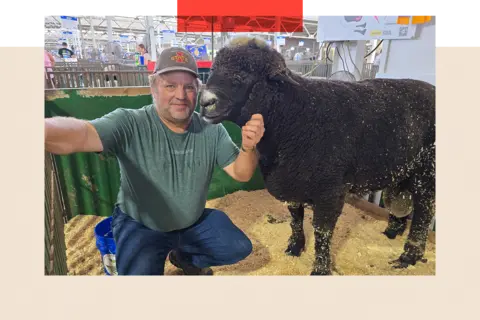
For some farmers at the state fair, the explanation is simple: they believe the US president when he tells them that tariffs will help them in the long run.
“We think the tariffs eventually will make us great again,” says John Maxwell, a dairy farmer and cheese producer from Iowa.
“We were giving China a lot, and [previously] we paid tariffs when we sold to them. Let’s make it fair. What’s good for the goose is good for the other goose.”
Some may also hold onto hope that the president will bail farmers out. During Trump’s first term he gave farmers a $28bn (£20.7bn) grant amid a tariff dispute with China.
A case of selective blame attribution?
For Nicholas Jacobs, a politics professor at Colby College and author of The Rural Voter, there’s a deeper reason at play.
“It’s easy for an outsider to ask, ‘Why the hell are you still with this guy?'” he says. “But you have to understand that across rural America, the move towards Republicans long predates Donald Trump.”
Starting in the 1980s, he says, rural Americans started to feel alienated and left behind while cities benefited from globalisation and technological change.
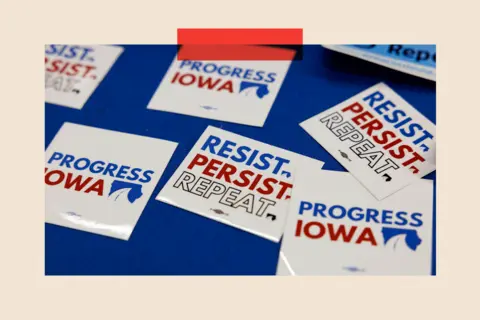
What he calls a “rural identity” formed, based on a shared grievance and an opposition to urban liberals. The Republicans seemed like their natural champion, while he says the Democrats became “the party of the elite, technocrats, the well-educated, the urbane”.
 Bloomberg via Getty Images
Some repeat that sentiment at the state fair. Joan Maxwell, a dairy farmer from Davenport in Iowa, says that her area is too often viewed as “flyover country”.
“We are not looked at very positively for the most part from the media,” she says. “We’ve been called deplorables, uneducated,” – a reference to Hillary Clinton’s description of half of Trump’s supporters as a “basket of deplorables”.
Ms Maxwell added: “A lot of times they ignore us or make fun of us.”
Prof Shepherd, of Michigan University, believes there’s another factor: in his view, America has become so polarised – with voters from both sides entrenched in their camps – that many are willing to forgive much more than they would previously, as long as it’s a policy implemented by their own side.
He calls this “selective blame attribution… they might be really angry about some things that are happening, but they’re reticent to blame Trump for them.”
‘We’re giving him a chance – there’d better be results’
Mr Wolf has his own view on the “best case scenario” from here. “What I hope happens is that he [Trump] just declares victory and leaves it [tariffs] alone.”
But he warns that even if the policy is dropped, the damage to American farmers could be long-term due to the shake-up to supply chains. Some Chinese firms are now buying their soybeans from Brazil rather than America, he says; they may not quickly return.
Many of the analysts we spoke to believe that rural America’s support for Trump is not a blank cheque, despite their current support.
Mr Shepherd points to the Great Depression and rural “Dustbowl” of the 1930s, which forced millions of farmers to migrate to American cities, causing a long-term realignment in politics – though nobody expects it to get anywhere near that bad this time. The farm crisis of the 1980s also saw thousands of farms go under.
Back at the state fair, Ms Maxwell, the Iowan dairy farmer, makes this point clear.
“We’re giving him the chance to follow through with the tariffs, but there had better be results. I think we need to be seeing something in 18 months or less.
“We understand risk – and it had better pay off.”
Additional reporting: Florence Freeman
BBC InDepth is the new home on the website and app for the best analysis and expertise from our top journalists. Under a distinctive new brand, we’ll bring you fresh perspectives that challenge assumptions, and deep reporting on the biggest issues to help you make sense of a complex world. And we’ll be showcasing thought-provoking content from across BBC Sounds and iPlayer too. We’re starting small but thinking big, and we want to know what you think – you can send us your feedback by clicking on the button below.

Experts say Mythos potentially has an unprecedented ability to identify and exploit cybersecurity weaknesses.
Source link
Business
Anthropic’s new AI model exposes fresh risks, flaws for cybersecurity, IT services – The Times of India
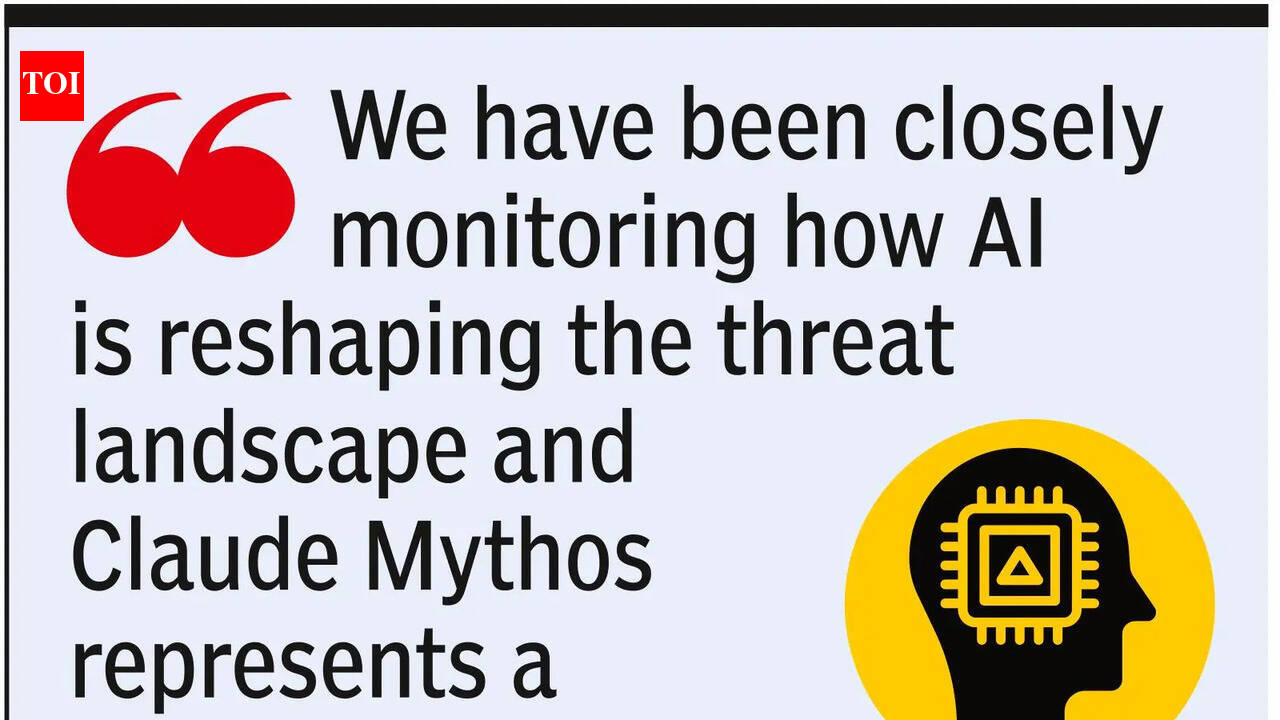
New Delhi: A powerful new AI model is forcing govts, banks, and technology firms to rethink the rules of cybersecurity – and in India, the stakes may be even higher.Claude Mythos, developed by Anthropic, has demonstrated the ability to autonomously detect and exploit software vulnerabilities, including flaws that have persisted for decades. Early tests revealed that the model could identify long-standing weaknesses and simulate complex, multi-step cyberattacks, prompting the company to restrict its wider release. Anthropic CEO Dario Amodei highlighted the shift, noting that AI systems are now capable of finding vulnerabilities “that humans have missed”, a signal of how quickly the cybersecurity landscape is changing.US Treasury Secretary Scott Bessent reportedly convened a meeting with top bank executives – including leaders from JPMorgan Chase, Goldman Sachs, Citigroup, BoA, and Morgan Stanley – to assess the risks posed by such advanced AI systems.That concern is not theoretical. According to Jaydeep Singh, GM for India at Kaspersky, the emergence of such systems represents a turning point not just for security professionals, but for everyday users. “We have been closely monitoring how AI is reshaping the threat landscape, and Claude Mythos represents a moment that every user, not just the cybersecurity industry, needs to understand,” Singh said.The dual-use nature of AI is at the heart of the concern. The same capability that strengthens defences can just as easily be weaponised. “The same capability that finds a 27-year-old vulnerability in hardened infrastructure is the capability that, in the wrong hands, turns every unpatched system into an open door,” Singh added.Cybersecurity firm Check Point Software Technologies echoed the warning. Sundar Balasubramanian, MD, India and South Asia, for Check Point, says, AI is “dramatically lowering the barrier to entry for cyber attackers,” enabling even less-skilled actors to identify and exploit vulnerabilities. He added that defensive tools can be repurposed offensively, compressing the traditional gap between attackers and defenders. Jayant Saran, partner, Deloitte India, described this as a “changed reality,” where organisations must prepare for risks that were previously invisible. He called AI a “double-edged sword…that cannot be reversed,” highlighting an accelerating race between those securing systems and those attempting to break them.In India, the risks are amplified by scale. From UPI to banking and govt platforms, millions depend on digital infrastructure – much of it built on legacy systems. These systems are often slower to patch, harder to monitor, and lack continuous threat intelligence, creating what Saran called an “asymmetric risk exposure.” Singh pointed out that this gap is especially critical in India, where legacy infrastructure serves hundreds of millions.Beyond cybersecurity, ripple effects could reach financial markets. Analysts say models like Mythos could automate parts of software development, testing, and security – core functions of IT services industry. While disruption may be gradual, labour-intensive outsourcing models could face pressure, while firms embracing AI may benefit.

Firms say digital twins make staff more productive, but are they a potential legal minefield?
Source link


Italy’s apparel export-import plunge after positive trend in 2025
Finance ministers and top bankers raise serious concerns about Mythos AI model
Anthropic’s new AI model exposes fresh risks, flaws for cybersecurity, IT services – The Times of India

-

 Entertainment1 week ago
Queen Elizabeth II emotional message for Archie, Lilibet sparks speculation
-

 Tech1 week ago
Azure customers up in arms over ‘full’ UK South region | Computer Weekly
-

 Tech1 week ago
As the Strait of Hormuz Reopens, Global Shipping Will Take Months to Recover
-

 Fashion1 week ago
CII submits 20-pt agenda to Indian govt to back firms hit by Iran war
-

 Tech1 week ago
This AI Button Wearable From Ex-Apple Engineers Looks Like an iPod Shuffle
-

 Politics7 days ago
Indian airlines hit hardest after Dubai limits foreign flights until May 31
-

 Entertainment4 days ago
Palace left in shock as Prince William cancels grand ceremony
-
Uncategorized1 week ago
[CinePlex360] Please moderate: “Trump considers