

Sports
Real Madrid thrash Levante as Mbappe hits brace | The Express Tribune

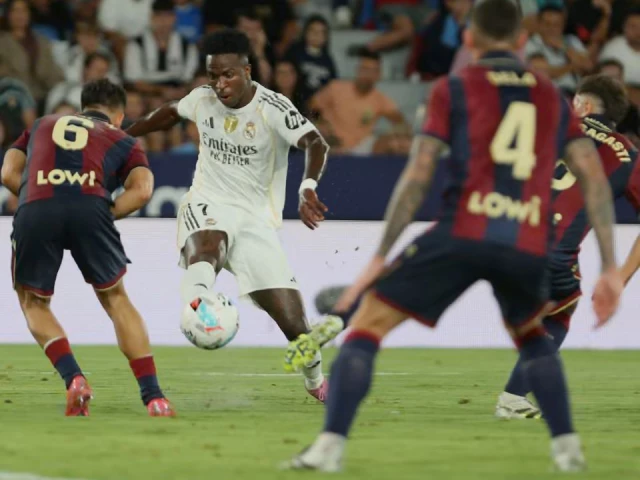
SPAIN:
Real Madrid extended their winning start to La Liga with a comfortable 4-1 triumph at Levante on Tuesday.
Kylian Mbappe scored twice to reach seven league goals in six matches as Xabi Alonso’s side maintained their 100 percent record.
Vinicius Junior opened the scoring with a superb finish and Franco Mastantuono was also on target for the league leaders.
Second-placed Barcelona visit Real Oviedo on Thursday, with the Spanish champions trailing Madrid by five points.
“It was a very good game, from the start, we were really committed in defence and the first goal was fundamental, to go ahead and give us confidence,” said Alonso.
Vinicius was unhappy to be taken off by Alonso during the win over Espanyol on Saturday but the Brazilian winger started on the left flank and delivered.
Since coming second to Manchester City’s Rodri in last year’s Ballon d’Or rankings Vinicius has struggled for consistency.
However, he found his rhythm at the Ciutat de Valencia stadium and opened the scoring after 28 minutes, following a bright start to the game.
“Vini had a very complete, very good game and I am very happy for him,” said Alonso.
Valencia goalkeeper Mathew Ryan made a good save to deny Vinicius and Mastantuono hit the bar from the rebound as Los Blancos threatened in the opening stages.
Then fed by Fede Valverde on the right of the box, Vinicius used the outside of his right boot to bend a sumptuous effort in at the far post.
Ivan Romero and Adrian de la Fuente came close early for Levante but they were forced back and Madrid found their second when Vinicius set up Mastantuono, who rifled into the top corner.
It was the promising 18-year-old attacker’s first goal for the club since his summer switch from River Plate.
Ryan denied Vinicius with a good stop from close range before half-time.
Levante striker Karl Etta Eyong, in fine form himself at the start of the season, nodded home his fourth goal from close range after Romero’s cross was deflected and looped into the air.
It offered Levante a brief glimmer of hope but that was quickly quashed by Mbappe.
Unai Elgezabal clumsily brought down the French superstar in the box and Mbappe cheekily dinked the resulting penalty down the middle for the third.
Then two minutes later the forward, released by Arda Guler, rounded Ryan and tapped home his second of the night.
‘A good path’
Mbappe struggled in his first few months at Madrid after joining from Paris Saint-Germain in the summer of 2024, but hit top form in the second half of the season.
The striker has carried that into the new campaign and has nine goals in seven games across all competitions, helping Madrid start the campaign in ideal fashion.
“There are still things we can do better, but we’re on a good path and we have to continue along it,” said Alonso, with Los Blancos facing city rivals Atletico on Saturday.
“We’re in a construction phase… there’s still a lot we have to do.
“We’re building a solid base, and in the team many players feel connected and important.”
Villarreal earned a late 2-1 win at Sevilla to rise to third in the table, above fourth-placed Espanyol who drew 2-2 with Valencia.
Bottom side Girona earned a creditable 1-1 draw at Athletic Bilbao, fifth.






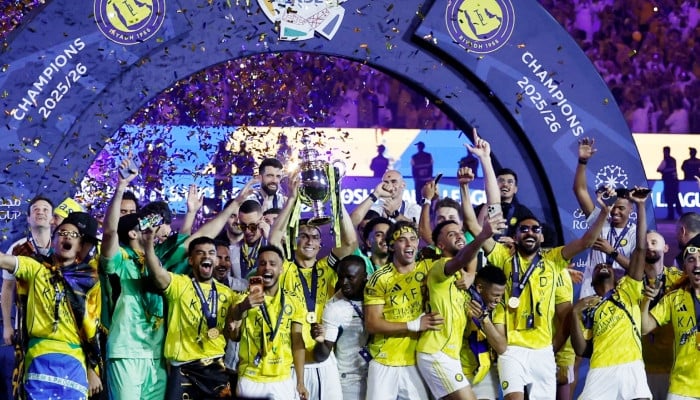
Cristiano Ronaldo scored twice as Al Nassr clinched the Saudi Pro League title with a 4-1 win over Damac on Thursday, ending his long wait for domestic silverware.
A trademark free-kick and a close-range finish, both in the final half-hour, sealed the win Al Nassr needed on the last night of the season, with Al Hilal finishing just two points behind.
Ronaldo, 41, who was without a major club trophy since winning Serie A with Juventus in 2020, arrived in the kingdom to great acclaim in 2023, wept as he watched the final minutes from the bench.
He adds the Saudi championship to his English, Spanish and Italian titles and five Champions League medals.
Al Nassr took a 2-0 lead but were back to 2-1 before Ronaldo’s free-kick on 63 minutes evaded the goalkeeper and a forest of legs to find the far corner.
He struck again nine minutes from time, receiving a cut-back on the edge of the six-yard box and smashing high into the net.
Next up for the all-time leading men’s international goalscorer, with 143 goals, is a sixth crack at the World Cup after he was named in Portugal’s squad this week.
Desert trailblazer
Ronaldo opened the door to a series of big-money Saudi signings when he joined Al Nassr in January 2023 following an unhappy second spell at Manchester United.
Neymar and Karim Benzema were among those to follow after Ronaldo inked a two-and-a-half-year deal estimated at 200 million euros, extended for two years in June 2025.
The stated aim was to turn the Pro League into one of the world’s top five football competitions measured by the quality of players, stadium attendances, and commercial success. International interest has been muted, however.
In December 2024, Saudi Arabia was confirmed as host of the 2034 World Cup, a coup as it pushes to decouple its economy from oil and attract business and tourists, partly via the buzz of sports.
With a record 664 million Instagram followers, Ronaldo has been a highly visible ambassador as Saudi Arabia tries to turn the page on the ultra-conservative image that has defined it for decades.
The world’s biggest oil exporter and home of Islam has been accused of “sportswashing” — using sport to deflect human rights criticism — as it has invested in Formula 1, golf, boxing, and tennis alongside football.
Some of the more outlandish spending on economic diversification, including sprawling tourist developments and NEOM, a futuristic city in the desert, is being reined in.
This month, Saudi Arabia’s Public Investment Fund said it was exiting the breakaway LIV Golf tour, after reportedly ploughing more than $5 billion into a venture that split the sport.
Expensive football signings have also waned with the stream of big-money transfers slowing to a trickle.
Tears and a protest
Ronaldo was the Pro League’s top scorer in his first two seasons, with his career tally now at 973 — tantalisingly close to the 1,000-goals milestone.
His Saudi stint has not always been smooth. In 2024, he was left in floods of tears when Al Nassr lost the King’s Cup final to Al Hilal on penalties, denying him his first Saudi title.
This season, he disappeared from Al Nassr’s line-up for three games in an apparent protest at Benzema´s transfer to rival team Al Hilal.
Al Hilal and Al Nassr were among the stable of Saudi teams owned by the Public Investment Fund, the country’s $900 billion sovereign wealth fund.
Before Thursday, Ronaldo’s only silverware with Al Nassr was the 2023 Arab Club Champions Cup. He was also disappointed on Saturday, when Al Nassr lost to Gamba Osaka in the AFC Champions League Two final.
Sports
Knicks crush Cavaliers in Game 2, take commanding 2-0 lead in series behind Josh Hart’s career night
NEWYou can now listen to Fox News articles!
The New York Knicks didn’t need a historic comeback to take Game 2 of the Eastern Conference Finals from the Cleveland Cavaliers on Thursday.
Instead, it was a dominant victory in regulation, 109-93, as the Knicks take a commanding 2-0 lead in the best-of-seven series to Cleveland this weekend.
There was no hangover for the Cavaliers to begin the game, as they owned a 27-24 lead at the end of the first quarter. But the Knicks found their way into the lead by halftime.
CLICK HERE FOR MORE SPORTS COVERAGE ON FOXNEWS.COM
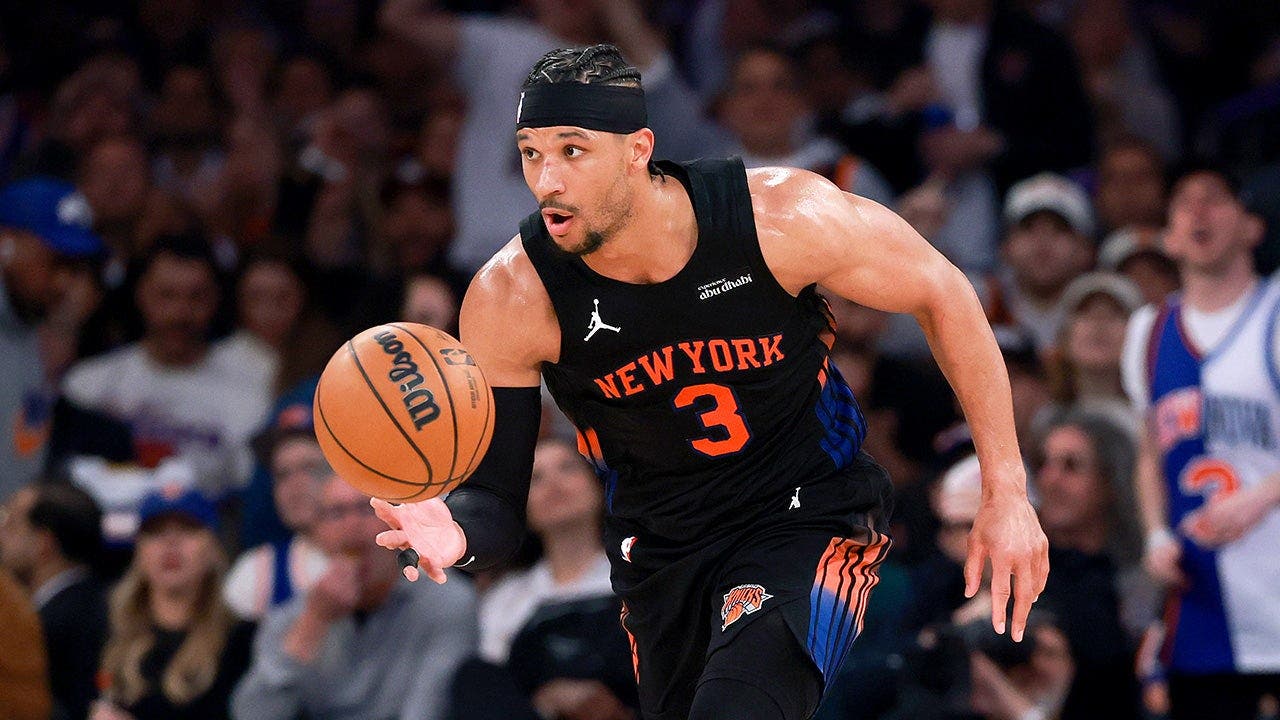
Josh Hart of the New York Knicks dribbles the ball against the Cleveland Cavaliers during the third quarter in Game Two of the NBA Eastern Conference Finals at Madison Square Garden in New York City on May 21, 2026. (Sarah Stier/Getty Images)
It was the third quarter where New York started to pull away, getting the lead up to 18 points as the Madison Square Garden crowd went ballistic. The Knicks went on an 18-0 run at one point as well, which was reminiscent of Game 1’s fourth-quarter comeback.
However, Cleveland wasn’t letting off the gas despite the deficit. The Cavaliers cut the 18-point lead in half with around 8:30 left in the fourth quarter, as New York struggled to buy a basket.
KNICKS STORM BACK TO SHOCK CAVS IN GAME 1 AS JAMES HARDEN’S DEFENSIVE PLAY COMES UNDER SCRUTINY
But once OG Anunoby knocked down a three-pointer from the left wing, things were back to normal for the Knicks crowd.
Mikal Bridges, who had a stellar night on both ends of the floor, hit a wide-open three with 6:12 remaining in the fourth that got the lead back up to 13 for the Knicks, and they would coast from there.
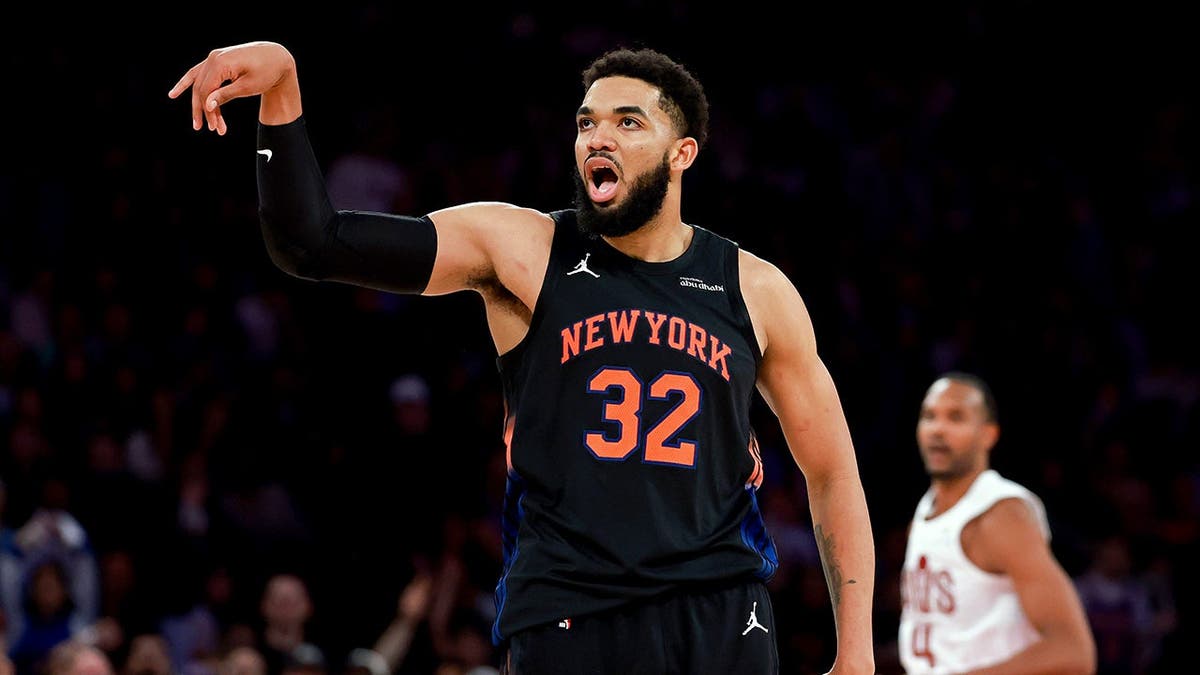
Karl-Anthony Towns of the New York Knicks celebrates after making a basket against the Cleveland Cavaliers during the third quarter in Game Two of the NBA Eastern Conference Finals at Madison Square Garden in New York City on May 21, 2026. (Sarah Stier/Getty Images)
Jalen Brunson, the team’s All-Star point guard, was phenomenal in the comeback on Tuesday night, dropping 38 points. But Cleveland made their game plan known right away in this matchup, putting pressure on him to the point where he’d be giving up the rock in double-teams.
As a result, the Cavaliers were fine with Josh Hart taking shots instead. While the plan seemed to work in the first half a bit, Hart found his groove in the second and set a new career high with a team-high 26 points on 10-of-21 shooting, including 5-of-11 from three-point range. He also got on the board with seven assists, four rebounds and two steals.
Meanwhile, Brunson tallied 19 points and dished out a playoff career-high 14 assists for New York. And once again, Karl-Anthony Towns recorded a double-double with 18 points and 13 rebounds, playing efficiently for Mike Brown’s Knicks.
With the lead back up to 18 for the Knicks, all starters were pulled with under two minutes to play, as the crowd gave their squad a standing ovation for a job well done.
The Knicks shot 52% from the field and only saw 14 foul shots all game long, but they held the Cavaliers to just 39% shooting as a team. Cleveland also failed to capitalize on key free throws late in the game, as they were in the bonus with over nine minutes to play. As a team, they shot just 69% (22-of-32) from the charity stripe.
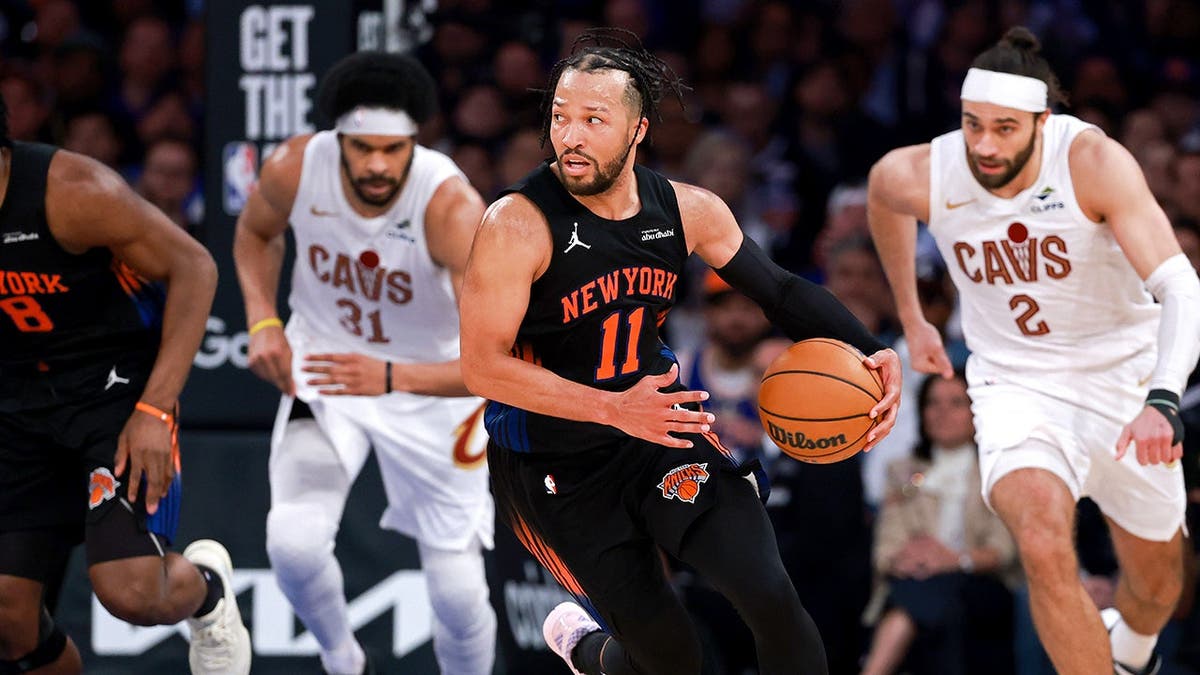
Jalen Brunson of the New York Knicks dribbles against the Cleveland Cavaliers during the third quarter in Game Two of the NBA Eastern Conference Finals at Madison Square Garden in New York City on May 21, 2026. (Sarah Stier/Getty Images)
CLICK HERE TO DOWNLOAD THE FOX NEWS APP
Evan Mobley also had 14 points in the first half, but he curiously didn’t take a single shot in the second half for Cleveland. Donovan Mitchell matched Hart’s 26 points, though he shot 8-of-18. James Harden also went 6-of-15 for 18 points.
With the win, the Knicks have now won nine straight playoff games.
Follow Fox News Digital’s sports coverage on X and subscribe to the Fox News Sports Huddle newsletter.
NEWYou can now listen to Fox News articles!
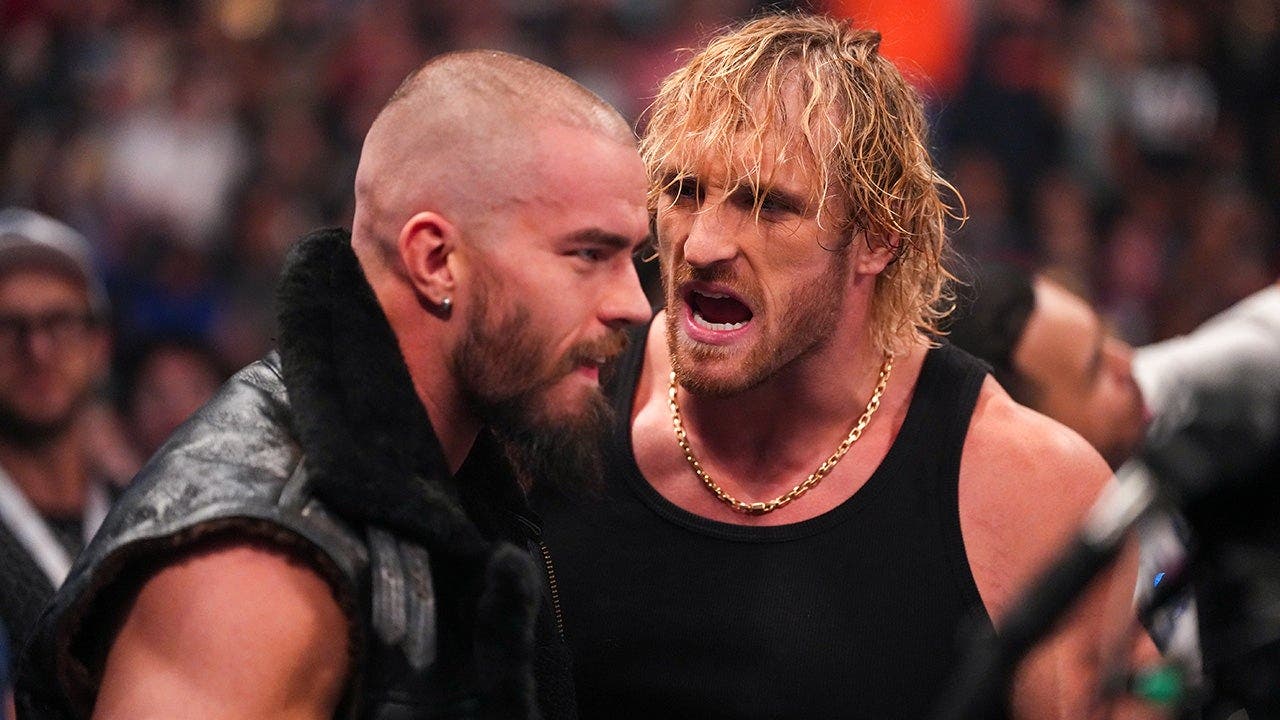
Austin Theory and Logan Paul have one of their biggest tests as world tag team champions this weekend as they defend their titles against The Street Profits at Saturday Night’s Main Event.
Theory and Paul are members of The Vision – the top faction on “Monday Night Raw” featuring the future of the WWE. Bron Breakker may be the in-ring leader of the group as he made a thunderous return to the roster at WrestleMania 42 and then defeated Seth Rollins at Backlash. Theory and Paul are the ones with the gold while Paul Heyman is the mouthpiece for the next generation of superstars.
With the tag team title around his waist, Paul has now held gold twice in WWE since making his debut with the company in 2021. Paul has the tools that any pro wrestler dreams of – the athletic prowess in the ring coupled with immense heat from the crowd along with his skills on the mic.
Theory told Fox News Digital that Paul’s rise in the WWE has made it tougher for any outsider to come in and have success, suggesting the YouTube sensation has set the bar enormously high.
Austin Theory and Logan Paul speak during WWE Backlash at Benchmark International Arena in Tampa, Fla., on May 9, 2026. (Michael Owens/WWE)
LOGAN PAUL’S JAW-DROPPING SPRINGBOARD MOONSAULT WOW FANS AT WWE MONEY IN THE BANK
“I say with Logan Paul, with his athletic ability and his skills in wrestling and how he’s been able to just develop it so quick,” he said. “It’s impressive to me – somebody who’s wanted to be in WWE since I was eight, started training at 18, signed with the WWE at 22 and took that longer path. But I have to give Logan his respect. This is a dude, as a young kid, started with YouTube and streaming and pretty much – dude created YouTube. He put it on the map, his whole streaming thing.
“Kind of both of us building our dreams in different ways and kind of meeting in the middle. I just think he kinda just messed it up for everybody on the outside that wants to come into WWE and thinks like, ‘Oh wow, this is easy. Like, I can pick up a mic and talk trash and I can do these cool moves off the ropes like Logan Paul,’ but you can’t. There’s an art to it. Logan Paul is exceptional on the mic. In the ring, he does things even highflyers we have in WWE couldn’t even do. He’s just a phenomenal athlete. When it comes to me and Logan Paul, we’re freaks of nature. That’s why I say we’re gonna motivate everybody this Saturday at Saturday Night’s Main Event in Fort Wayne.”
The Vision, which also includes an injured Bronson Reed, is under the tutelage of Heyman, who has been a “wiseman” and an “advocate” for many young talents in WWE.
ZERO BS. JUST DAKICH. TAKE THE DON’T @ ME PODCAST ON THE ROAD. DOWNLOAD NOW!
Theory had the utmost confidence that Heyman was sending him and his stablemates in the right direction.
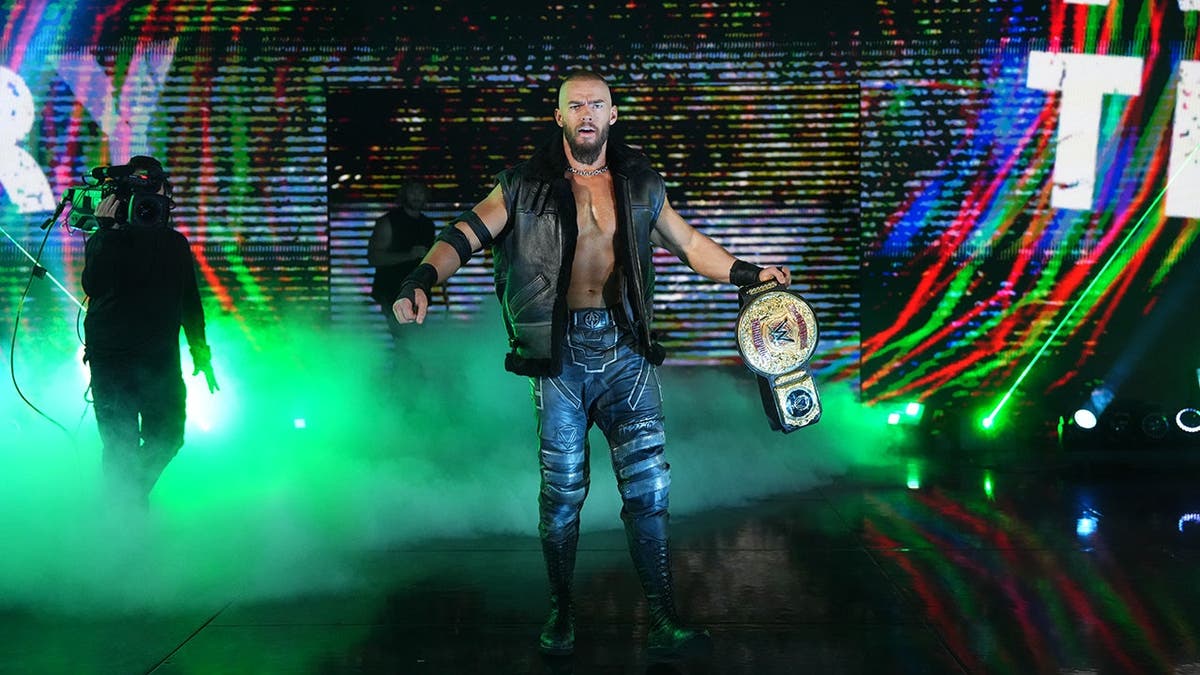
World Tag Team Champion Austin Theory enters the arena during Monday Night RAW at Greensboro Coliseum Complex in Greensboro, N.C., on May 18, 2026. (Michael Owens/WWE)
“With Paul Heyman, you know, this history with him having Brock Lesnar, having Roman Reigns, CM Punk, Seth Rollins – you know, before he realized he was a loser,” he said. “Paul Heyman, man, he’s the ‘wiseman.’ I think anything that comes out of his mouth is gold and especially kind of molding The Vision and sending us in the right direction. I couldn’t ask for more. It’s just sitting under the knowledge tree of history. He’s from back in the 80s to present day. The dude’s done it all. I’m very grateful for the wiseman, Paul Heyman.”
Montez Ford and Angelo Dawkins will challenge for the tag titles. The two returned to “Monday Night Raw” after WrestleMania 42 after a prolonged absence.
Theory gave them credit where credit is due. They are three-time WWE tag champions and won the tag titles at NXT and Evolve. However, Theory made clear that Ford and Dawkins are running into “the greatest tag team champions of the world.”
“Well, the Street Profits. They’ve been in the WWE a very long time,” he said. “Feels like too long, like 60 years. I do realize every time I have a title, they’re around, which makes sense because they’re irrelevant and I’m relevant. But not to push them too low down, they’re very athletic, they have a great resume. But it’s just that comparison to Austin Theory and Logan Paul – The Vision. The greatest tag team champions of the world, of the universe. You can’t really compare.
CLICK HERE FOR MORE SPORTS COVERAGE ON FOXNEWS.COM
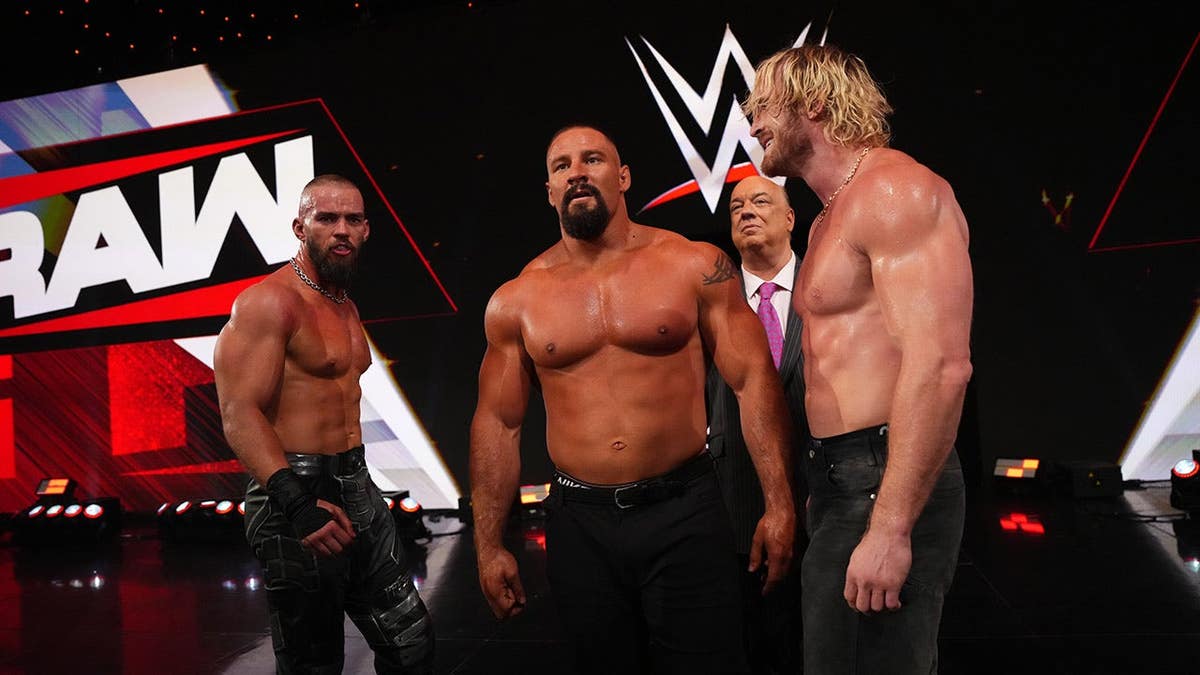
World Tag Team Champions Austin Theory and Logan Paul stand alongside Bron Breakker and Paul Heyman during Monday Night RAW at Greensboro Coliseum Complex in Greensboro, N.C., on May 18, 2026. (Michael Owens/WWE)
“Unfortunately, yes, I said unfortunately, the show is in Fort Wayne, Indiana. I look at this match as more of a big motivational moment for those people because they’re gonna see two guys that don’t look like anybody from Fort Wayne. We look like freaking superheroes. We’re really there to inspire everybody and then after the match, get the hell out of there.”
Saturday Night’s Main Event will take place Saturday in Fort Wayne, Indiana, much to Theory’s chagrin. And, it’s a loaded card.
CLICK HERE TO DOWNLOAD THE FOX NEWS APP
Aside from the tag team title match, read below for how the rest of the card looks.
- Paige and Brie Bella (c) vs. Nia Jax and Lash Legend for the WWE Women’s Tag Team Championship.
- Becky Lynch vs. Sol Ruca.
- Rhea Ripley, Charlotte Flair and Alexa Bliss vs. Jade Cargill, Michin and B-Fab.
- Penta (c) vs. Ethan Page for the Intercontinental Championship.


Vietnam, US to finalise reciprocal trade agreement soon

Cloudways vs Hostinger, tested by a tech expert

US’ Tapestry’s Q3 revenue jumps 21% on Coach strength

-

 Fashion1 week ago
Italy’s Zegna Group’s Q1 growth boosted by strong organic performance
-

 Entertainment6 days ago
Where Pete Davidson, Elsie Hewitt stand after breakup: Details revealed
-

 Entertainment1 week ago
Emilia Clarke recalls near-death incident while filming ‘Game of Thrones’
-
 Business1 week ago
Jersey Election 2026: Cost of living concern in St Helier Central
-

 Fashion1 week ago
Global cotton production, stocks to fall; consumption to rise: WASDE
-

 Fashion1 week ago
US’ Kontoor Brands’ posts strong Q1, plans Lee divestiture
-

 Politics6 days ago
Rising diesel costs from Iran war strain US school budgets
-

 Politics1 week ago
UK’s Starmer faces survival battle as potential rivals circle