

Business
Ask Dhirendra: “How do I decide how much to save and invest when my income is just about enough?” – The Times of India


“How do I decide how much to save and invest when my income is just about enough?”This is one of those questions that sounds technical, but is actually very emotional.On paper, it’s simple: income comes in, expenses go out, and whatever is left is “savings. In real life, income comes in, rent, EMIs, school fees, petrol, Swiggy, Zomato, sale on Myntra, birthday gifts, one sudden expense… and at the end of the month, you look at your balance and say, “I’ll start investing from next month. Pakka.”Next month looks surprisingly similar.So let’s start with an honest admission: for most people, the problem is not which fund to choose. It’s how much they can realistically save when it feels like the money is just about enough.At Value Research, whenever we look at this, we don’t begin with a number like “you must save 30%”. We start with a different idea: savings are not what is left after spending. Savings are what you decide first; spending adjusts after that if you flip this order, the maths – and your behaviour – changes completely.A good rule of thumb for many middle-class households is to allocate 20–30% of their take-home income to savings and investments. However, I also know that for many people today, 30% sounds like a bad joke. So instead of fighting over the “ideal” number, let’s work with two simpler questions:
- What can you save today without breaking your life?
- How can you make that number grow every year?
To answer the first question, you need to know where your money is actually going, not where you think it is going. For one or two months, track your expenses honestly – not for Instagram, for yourself. You don’t need an app; even a simple notebook or spreadsheet works.
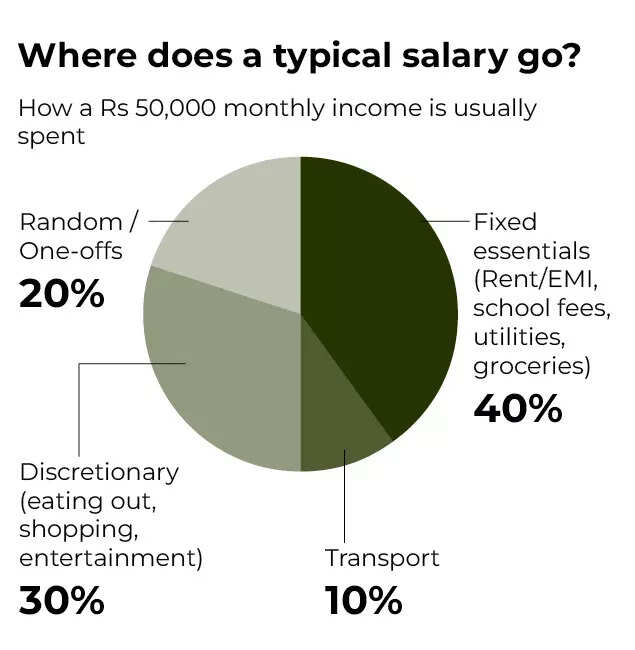
Where does a typical salary go?
Once you see your own pie chart, three things usually stand out:
- Some expenses are non-negotiable (rent, basic food, fees).
- Some are negotiable but important (a modest phone, occasional eating out).
- Some are pure leakage (unused subscriptions, impulsive orders, “I don’t even remember what this was”).
Your first “investment” might simply be plugging two or three leaks. Even if that frees up only ₹2,000–₹3,000 a month, that is your starting SIP.Now let’s look at how “small” that really is.
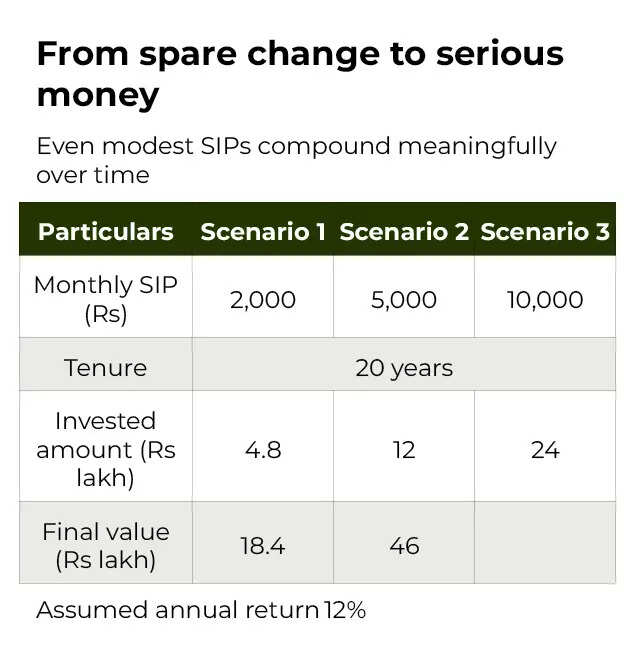
From spare change to serious money
When we run these numbers at Value Research in our retirement and goal calculators, the results are always the same: the gap between zero and small is far bigger than the gap between small and perfect.But what if your income truly is at the survival stage? There are people for whom even ₹2,000 is a luxury some months. If that’s your reality, you have two parallel jobs. One is to create a tiny habit – even ₹500 or ₹1,000 a month into a recurring deposit or a conservative fund. The absolute amount is less important than the mental switch from “I’ll save if anything is left” to “I will save something, and then I will live on the rest.”The second job is to make sure that as your income grows, your lifestyle doesn’t expand at the same speed. This is where a lot of middle-class Indians quietly sabotage themselves. Every salary increase automatically becomes a better phone, nicer meals out, upgraded gadgets, and bigger car loans. The percentage saved stays the same, or sometimes even falls.A very powerful habit – one we often build into plans at Value Research – is the “step-up”. Each year, when your salary goes up, you increase your SIPs and savings before you upgrade anything else.
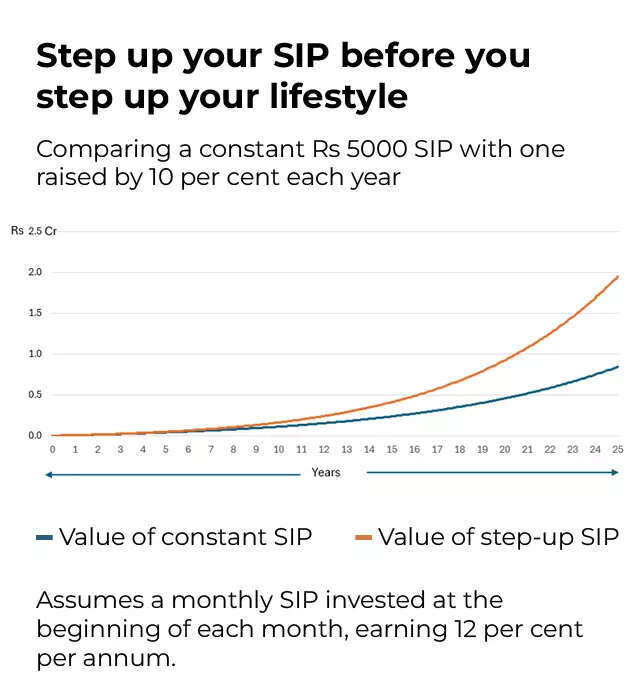
Step up your SIP before you step up your lifestyle
In many examples we’ve run, the step-up strategy leads to a dramatically higher corpus at the end, without you ever feeling an acute “sacrifice” in any single year. You just avoid letting every pay hike leak out into lifestyle.Now, how do you decide your own number?Here’s a simple approach:
- First, add up your genuine essentials: rent/EMI, groceries, utilities, fees, basic transport.
- Next, be realistic and add a modest amount for discretionary spending that you know you’ll do anyway – because you are human, not a robot.
- See what is left. From that leftover, commit to a percentage – even 10% of your take-home income – as a non-negotiable
saving and investing amount. Set up automatic transfers and SIPs for that right after your salary date.
If that number feels tight, start a little lower and promise yourself one thing: every time your income goes up, your savings rate will go up faster than your spending.At Value Research, when we build long-term plans, we don’t assume people will suddenly start saving 40% from next month. We assume they will start somewhere realistic, and then we design step-ups. The rigour is in the process, not in some magical starting number.One last point. Many people postpone investing because they are embarrassed by how small their starting amount looks. Please don’t underestimate the psychological power of seeing a small, growing pile that you started and maintained. It changes how you think about yourself: from “I can’t save” to “I am someone who always saves something.” That identity is worth more than one extra dinner out.So how much should you save and invest when your income feels just about enough? The honest answer is: start with whatever you can without lying to yourself, protect that amount like you protect your rent, and then make sure it rises every time your income increases. The “right” number is not what a formula says; it’s the number you will actually stick to for the next 20 years.The perfect percentage can wait. The first rupee cannot.If you have any queries for Dhirendra Kumar you can drop us an email at: toi.business@timesinternet.in(Dhirendra Kumar is Founder and CEO of Value Research)






Heineken has announced a substantial investment exceeding £44 million into hundreds of its pubs across the UK, a move expected to create approximately 850 jobs.
The Dutch brewing giant’s Star Pubs operation, which manages 2,350 sites nationwide, is undertaking this significant financial commitment despite a challenging period for the pub sector.
The industry has faced considerable pressure over the past year, grappling with escalating labour costs and increases in national insurance contributions.
Concurrently, consumer spending has been constrained by concerns over inflation and rising unemployment, further impacting pub revenues. However, pubs did receive additional business rates support from the government last month, aimed at alleviating some of these financial burdens.
Lawson Mountstevens, managing director of Star Pubs, indicated that the investment strategy is partly designed to bolster revenues and help the group navigate the recent “sustained increases in running costs”.
This year, £44.5 million will be allocated to upgrades for 647 pubs. A notable 108 of these venues are earmarked for particularly significant cash injections, with each transformation costing at least £145,000.
Heineken clarified that while the majority of its pubs are group-owned, they are independently operated by local licensees. A key focus for this investment, particularly in the lead-up to the 2026 football World Cup, will be on sports-focused venues.
The pub firm and brewer has a history of significant investment in British pubs, having pumped £328 million into the sector since 2018. Work has already commenced at 52 locations, including eight projects dedicated to reopening boarded-up pubs that have endured lengthy closures.
Mr Mountstevens also urged the government to reduce the tax burden on pubs, arguing it would ease cost pressures and foster further job creation within the industry.
He stated: “We can only do so much; the root-and-branch reform of business rates that the industry has been calling for over many years is urgently required, as well as a lowering of the burden of taxation on pubs, including VAT and beer duty.”
He concluded with a direct appeal: “We are calling on the Government to support us in bringing out the best in the Great British pub.”

GameStop’s boss Ryan Cohen says he sees potential to make eBay a much bigger rival to Amazon.
Source link

It comes as the US said on Monday it will begin to help “guide” vessels out of the Strait of Hormuz.
Source link


Tarik Skubal to undergo elbow surgery, sidelining Tigers ace for months ahead of free agency

Jake Paul breaks silence after Olivia Rodrigo’s savage SNL joke

UAE says air defences engage Iranian missiles, drones as flights diverted

-

 Tech1 week ago
A Brain Implant for Depression Is About to Be Tested in Humans
-

 Tech1 week ago
Almost 90% of women leave tech industry within 10 years | Computer Weekly
-
 Business7 days ago
‘I had £20,000 stolen and had to fight a 13-month fraud reporting rule to get it back’
-
 Business1 week ago
Pakistan’s oil market is fuelling the crisis | The Express Tribune
-

 Sports6 days ago
Pro wrestling star Steph De Lander reveals how colleague’s advice helped lead her to title triumph at ACW
-

 Tech7 days ago
This Ambitious Laptop Doesn’t Leave Much Room for Your Hands
-

 Entertainment1 week ago
Norway joins Type 26 Frigate Programme to boost NATO naval power
-

 Entertainment1 week ago
Melania Trump says ABC should ‘take a stand’ on late-night host Kimmel