

Business
Auto surplus drives export urgency | The Express Tribune

KARACHI:
Pakistan has long advocated a shift towards private investment over public spending, in line with International Monetary Fund (IMF)-backed reforms since 1988. However, the country remains caught in a persistent cycle, as the private sector continues to demand key prerequisites, including security, a simplified regulatory framework and a lower cost of doing business, conditions that Pakistan has struggled to provide.
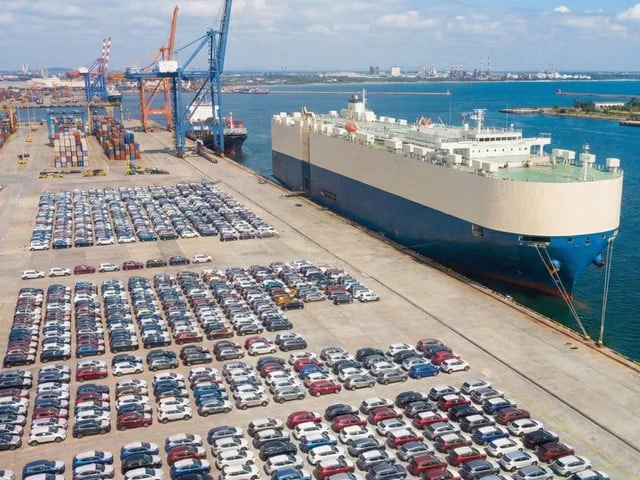
Despite this, in a rare development, the automobile sector is showing signs of capacity expansion, with installed capacity nearing 500,000 units, almost double the size of domestic demand. While this creates an opportunity to tap export markets, industry stakeholders warn that deep-rooted structural weaknesses continue to undermine competitiveness, raising concerns about the sustainability of this growth.
Commenting on the current market scenario in a conversation with The Express Tribune, Toyota Indus Motor Chief Executive Officer Ali Asghar Jamali said, “We have the will and the capacity to manufacture vehicles that meet the standards of export markets, but achieving this requires a policy environment that encourages the development of raw material industries.”
Trade barriers remain the biggest constraint on export prospects, as many potential destinations impose tariffs ranging from 10% to nearly 40%, putting Pakistani vehicles at a price disadvantage from the outset. Meanwhile, regional competitors such as China, India and Thailand benefit from inclusive trade blocs and free trade arrangements that significantly reduce export costs.
Pakistan’s automotive sector is entering a phase of structural imbalance, where installed production capacity is expanding faster than demand, exposing underlying inefficiencies. The country’s auto manufacturing capacity has approached 500,000 units annually, driven by new entrants and expansion by existing assemblers. However, domestic demand is expected to remain in the range of 250,000 to 300,000 units, leaving a large portion of capacity underutilised and forcing manufacturers to increasingly look towards export markets for growth.
Recent data from the Pakistan Automotive Manufacturers Association (PAMA) indicates a short-term recovery in the sector, as passenger car sales rose 51% year-on-year in February 2026 to 13,388 units, reflecting a rebound in consumer demand after a prolonged slowdown caused by high interest rates and import curbs. Similarly, SUVs, jeeps and light commercial vehicles posted strong annual gains, with production increasing 24% and sales rising 36%. However, a month-on-month decline due to seasonal factors highlights the fragile nature of the recovery and suggests that demand remains uneven.
Industry leaders caution that the rebound is temporary and does not resolve deeper structural challenges. While Pakistan has the capability to assemble vehicles that meet international standards, it lacks the industrial ecosystem needed to support sustainable, export-oriented growth. A major constraint is the limited development of upstream industries, which forces manufacturers to rely heavily on imported raw materials, Jamali said.
The continued closure of Pakistan Steel Mills (PSM) has significantly weakened the domestic supply chain, increasing dependence on imported steel, plastics and rubber. This reliance exposes manufacturers to global price volatility and supply disruptions, while also raising production costs. Freight charges alone add 10-12% to raw material costs, with container shipping from China ranging between $2,000 and $3,300, pointed out Abdul Rehman Aizaz, former chairman of the Pakistan Association of Automotive Parts & Accessories Manufacturers (PAAPAM).
“Even when we are allowed to import the raw material and intermediary goods at zero rate, additional costs, including L/C charges, a 2% Federal Excise Duty, and other levies, further increase the financial burden, pushing total costs higher by at least 5%,” he said.
Consequently, locally produced or processed inputs remain 15-18% more expensive than in competing markets such as China, India, Vietnam and Thailand.
“We could not even establish a naphtha cracker for petrochemical production, a basic requirement for the vast majority of industries,” he said.
This further undermines competitiveness, as domestic suppliers often charge above international rates, eroding any cost advantage.
Logistical inefficiencies also pose a significant challenge. Pakistan’s supply chain is frequently disrupted by road blockages, protests and strikes. A recent 20-day truckers’ strike disrupted connectivity between Karachi and upcountry markets, halting the movement of goods. For an industry reliant on just-in-time production, such disruptions can bring assembly lines to a standstill, undermining reliability for both domestic operations and potential exports.
Port inefficiencies add to the problem, with delays in container handling often extending for weeks, particularly during peak periods. This unpredictability discourages international buyers, who require consistent and timely delivery schedules.
In addition to operational challenges, Pakistan faces a perception issue in global markets. Concerns over political and economic stability make foreign buyers hesitant, limiting opportunities for export expansion. Unlike textiles, which benefit from established relationships and diaspora demand, the automotive sector must compete purely on price, quality and reliability, Aizaz said.
The project was part of a package of tech investment promising the UK could become an AI superpower.
Source link

People gather at the Magic Kingdom theme park before the “Festival of Fantasy” parade at Walt Disney World in Orlando, Florida, U.S. July 30, 2022.
Octavio Jones | Reuters
Disney is planning to begin its next phase of cost cutting, which will include as many as 1,000 layoffs, according to a person familiar with the matter.
The cost-cutting initiative comes shortly after Josh D’Amaro took the helm as CEO in mid-March.
The layoffs are expected to mostly affect Disney’s marketing department, according to the person, who requested to speak anonymously because the moves had not yet been made public. That department was recently consolidated under Asad Ayaz, who was named chief marketing and brand officer in January.
Ayaz, who reports directly to D’Amaro and Dana Walden, Disney’s president and chief creative officer, oversees marketing for all of Disney’s divisions — entertainment, experiences and sports — in the newly created role. It’s the first time that Disney brought all of its units under one marketing chief.
Disney’s stock was slightly down in afternoon trading on Thursday. The layoffs were first reported by The Wall Street Journal.
The changes to the marketing department structure occurred in January, when Bob Iger was still CEO of the company. Disney announced shortly after that that D’Amaro would take take over the top job — a long-awaited decision for the company.
D’Amaro, who previously was chairman of Disney Experiences, succeeded Iger after a period of uncertainty for the media and theme park giant — which had included a succession race and recent reorganization and turnaround of the business.
Iger reclaimed the Disney CEO role in late 2022, about two years after his initial departure. He was immediately tasked with a turnaround of the business as its stock price had fallen and earnings began to miss expectations.
By February 2023, Disney had announced sweeping plans that reorganized the structure of the company, cut $5.5 billion in costs and eliminated 7,000 jobs from its workforce.
On D’Amaro’s first official day as CEO in March, he noted the work Iger had done to get the company past one of its most difficult periods.
“When Bob returned to the company a few years ago, his goal was to fortify our business and lay the groundwork for long-term growth, by reigniting creativity and improving performance at our studios, building a robust and profitable streaming business, transforming ESPN for a digital future, and turbocharging our parks and experiences,” D’Amaro said on stage at the company’s investor day.
“We’ve accomplished all of those things, and we’re operating from a place of strength, with ample opportunity for growth.”

The British perfume designer and Zara are being sued by Estée Lauder over a collaboration.
Source link

[CinePlex360] Please moderate: “US fleet is mov

Trump administration dismantling US Forest Service: Here’s what it means

China Is Cracking Down on Scams. Just Not the Ones Hitting Americans

-
 Business1 week ago
Jaguar Land Rover sees sales recover after cyber attack
-
Uncategorized1 week ago
[CinePlex360] Please moderate: “Trump signals p
-

 Entertainment6 days ago
Joe Jonas shares candid glimpse into parenthood with Sophie Turner
-

 Tech6 days ago
Our Favorite iPad Is $50 Off
-
 Fashion1 week ago
China’s Anta Sports posts record $11.62 bn revenue in 2025
-

 Politics6 days ago
Iran can sustain Strait of Hormuz closure for years, will cut US military logistics: Official
-

 Sports6 days ago
UConn Final Four run could trigger a $50M furniture giveaway for Massachusetts-based Jordan’s Furniture
-
 Business7 days ago
Gold prices in Pakistan Today – April 3, 2026 | The Express Tribune