

Business
Balochistan turns to tech for water security | The Express Tribune


Province rolls out satellite-backed monitoring system, new dams and irrigation upgrades backed by ADB
KARACHI:
Balochistan, Pakistan’s largest and driest province, is racing to modernise its water management systems amid groundwater depletion, erratic rainfall and rising climate stress. With 75% of its population living in rural areas and dependent on agriculture, chronic water scarcity now threatens livelihoods and long-term socioeconomic stability.
Arid conditions dominate the province, where only 7.2% of land is cultivated and most districts rely almost entirely on groundwater. Years of over-extraction, deterioration of traditional karez systems and limited surface water storage have worsened the crisis. Climate variability, prolonged droughts, flash floods and unpredictable rainfall have further strained an already fragile system.
To address these challenges, the provincial government, with financing from the Asian Development Bank (ADB), the Japan Fund for Poverty Reduction and the High-Level Technology Fund, has launched the Balochistan Water Resources Development Project. The initiative blends new infrastructure with digital technologies to support climate-smart, data-driven water governance.
Central to the reforms is the Balochistan Water Resources Information System (BWRIS), a satellite-supported platform in Quetta. The system integrates hydrological, meteorological and remote-sensing data into a secure GIS platform that provides real-time information on groundwater, surface water and climate conditions. Officials say the platform is designed to support evidence-based decision-making, improve irrigation scheduling, and strengthen drought risk assessments across the province.
Speaking to The Express Tribune, Dr Muhammad Arshad, Deputy Country Representative of IWMI in Quetta, said groundwater depletion remains the most urgent challenge. Except for Nasirabad and Jafarabad, the rest of the province depends entirely on groundwater, making recharge essential. The rapid spread of subsidised solar panels has unintentionally intensified extraction. “People now pump water for 12 hours a day. Previously, load shedding limited extraction to three or four hours. With no regulation and no implementation, the problem is worsening,” he said. He said 10 of 18 river basins face severe decline, driven by severe water-intensive practices such as flood irrigation. He recommended precise water-flow measurement, soil moisture sensors at farm level and a strong digital regulatory framework to monitor depletion and forecast needs.
A crucial step toward improved governance is the Balochistan Integrated Water Resource Management Policy 2024, which aims to shift the province toward a low-water economy. The forthcoming Balochistan Water Act, developed with the FAO and World Bank, has been approved by the provincial cabinet and is expected to introduce a regulatory framework for equitable allocation and responsible use of water.
Experts say improved groundwater recharge is critical. Managed Aquifer Recharge (MAR) techniques could help harvest floodwater through infiltration wells, riverbed interception structures, and recharge ditches. Although more than 300 Delay Action Dams constructed in past decades suffered from sedimentation issues, specialists argue that modified designs combined with catchment-specific watershed management can revive their utility. Research has identified high MAR potential in basins such as Poralai and Hingol.
Balochistan’s harsh climate complicates recovery. With annual rainfall around 250mm and evaporation above 1,500mm, losses far exceed replenishment. Dr Arshad said small underground structures often outperform large surface dams, which quickly fill with sediment. Meanwhile, rapid depletion has created space for a thriving tanker water market, especially in Quetta, where prices range from Rs1,500 to Rs3,000 per tanker and rise to Rs5,000 in summer. The lack of rainfall since 2023 has worsened shortages and accelerated migration to urban areas, further straining civic systems.
Under the ADB-supported project, Automatic Weather Stations (AWS) have strengthened BWRIS, feeding real-time data on temperature, humidity, rainfall and wind. This information helps farmers plan planting and supports government decisions.




Business
Top stocks to buy today: Stock recommendations for April 17, 2026 – check list – The Times of India

Stock market recommendations: Reliance Industries, and Varun Beverages are the top stock recommendations by Bajaj Broking Research for April 17, 2026.Reliance IndustriesBuy in the range of ₹ 1330.00-1350.00
Reliance Industries stock has undergone a corrective phase over the past three months and is currently consolidating near a crucial support zone of ₹1270–₹1300. This technical setup offers a favorable risk-reward profile, positioning the stock for a potential bullish reversal and the next leg of uptrend.This ₹1270–₹1300 range serves as a crucial support area, reinforced by the convergence of multiple technical factors: (a) 61.8% retracement of the previous April 2025-January 2026 up move (1115-1611) (b) 200 weeks EMA placed around 1292, which has historically acted as strong demand area for the stockThe ongoing corrective phase appears to be nearing exhaustion, with price action indicating the potential for a fresh bullish reversal. We anticipate the stock to resume its uptrend and head towards ₹ 1474 levels in the coming quarters being the high of February 2026 and the 61.8% retracement of the recent decline of the last 3 months ₹ 1611-1290.Varun BeveragesBuy in the range of 455-465
The share price of Varun Beverages has generated a breakout above the falling channel containing last 3 months decline signaling strength and offers fresh entry opportunity.The stock has also formed a higher high and higher low signaling resumption of up move after recent corrective decline.We expect the stock to head higher towards 503 levels in the coming weeks being the 80% retracement of the previous decline from 534 to 381.(Disclaimer: Recommendations and views on the stock market, other asset classes or personal finance management tips given by experts are their own. These opinions do not represent the views of The Times of India)

Experts say Mythos potentially has an unprecedented ability to identify and exploit cybersecurity weaknesses.
Source link
Business
Anthropic’s new AI model exposes fresh risks, flaws for cybersecurity, IT services – The Times of India
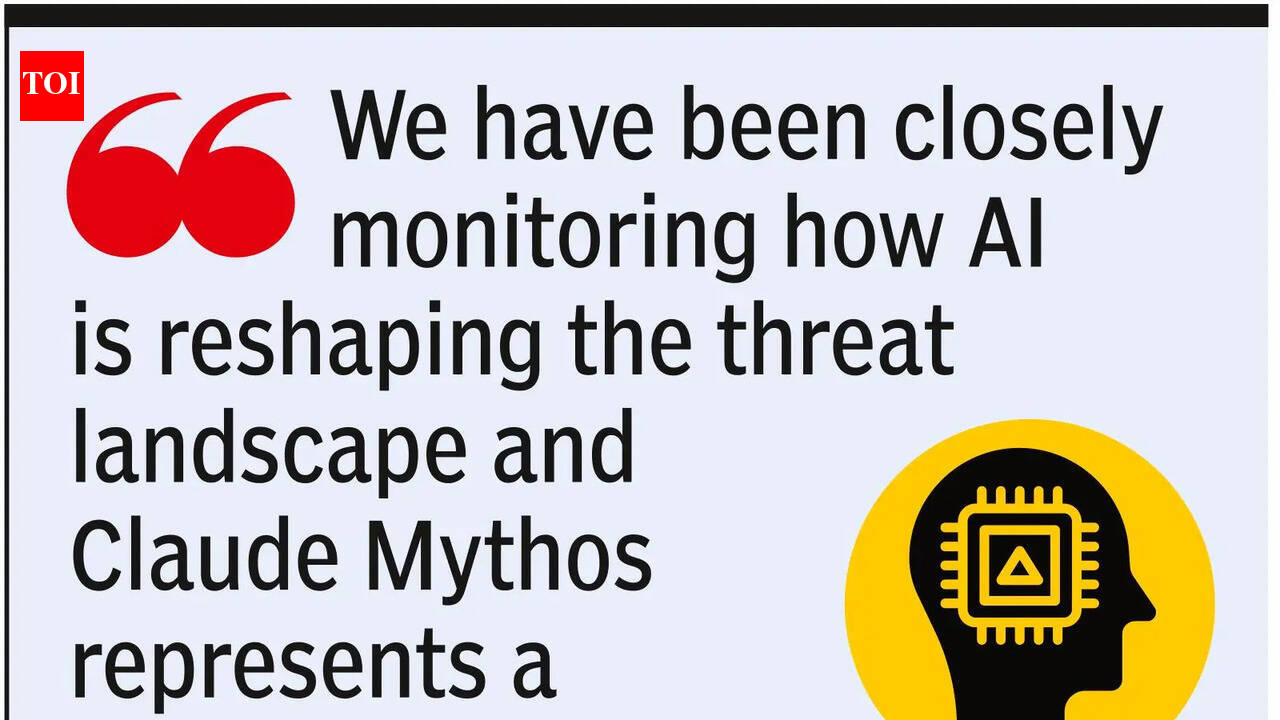
New Delhi: A powerful new AI model is forcing govts, banks, and technology firms to rethink the rules of cybersecurity – and in India, the stakes may be even higher.Claude Mythos, developed by Anthropic, has demonstrated the ability to autonomously detect and exploit software vulnerabilities, including flaws that have persisted for decades. Early tests revealed that the model could identify long-standing weaknesses and simulate complex, multi-step cyberattacks, prompting the company to restrict its wider release. Anthropic CEO Dario Amodei highlighted the shift, noting that AI systems are now capable of finding vulnerabilities “that humans have missed”, a signal of how quickly the cybersecurity landscape is changing.US Treasury Secretary Scott Bessent reportedly convened a meeting with top bank executives – including leaders from JPMorgan Chase, Goldman Sachs, Citigroup, BoA, and Morgan Stanley – to assess the risks posed by such advanced AI systems.That concern is not theoretical. According to Jaydeep Singh, GM for India at Kaspersky, the emergence of such systems represents a turning point not just for security professionals, but for everyday users. “We have been closely monitoring how AI is reshaping the threat landscape, and Claude Mythos represents a moment that every user, not just the cybersecurity industry, needs to understand,” Singh said.The dual-use nature of AI is at the heart of the concern. The same capability that strengthens defences can just as easily be weaponised. “The same capability that finds a 27-year-old vulnerability in hardened infrastructure is the capability that, in the wrong hands, turns every unpatched system into an open door,” Singh added.Cybersecurity firm Check Point Software Technologies echoed the warning. Sundar Balasubramanian, MD, India and South Asia, for Check Point, says, AI is “dramatically lowering the barrier to entry for cyber attackers,” enabling even less-skilled actors to identify and exploit vulnerabilities. He added that defensive tools can be repurposed offensively, compressing the traditional gap between attackers and defenders. Jayant Saran, partner, Deloitte India, described this as a “changed reality,” where organisations must prepare for risks that were previously invisible. He called AI a “double-edged sword…that cannot be reversed,” highlighting an accelerating race between those securing systems and those attempting to break them.In India, the risks are amplified by scale. From UPI to banking and govt platforms, millions depend on digital infrastructure – much of it built on legacy systems. These systems are often slower to patch, harder to monitor, and lack continuous threat intelligence, creating what Saran called an “asymmetric risk exposure.” Singh pointed out that this gap is especially critical in India, where legacy infrastructure serves hundreds of millions.Beyond cybersecurity, ripple effects could reach financial markets. Analysts say models like Mythos could automate parts of software development, testing, and security – core functions of IT services industry. While disruption may be gradual, labour-intensive outsourcing models could face pressure, while firms embracing AI may benefit.


Wings stifle questions about Azzi Fudd-Paige Bueckers relationship

China’s industrial output grows 6.1% in Q1 2026

Italy’s apparel export-import plunge after positive trend in 2025

-

 Entertainment1 week ago
Queen Elizabeth II emotional message for Archie, Lilibet sparks speculation
-

 Tech1 week ago
Azure customers up in arms over ‘full’ UK South region | Computer Weekly
-

 Tech1 week ago
As the Strait of Hormuz Reopens, Global Shipping Will Take Months to Recover
-

 Fashion1 week ago
CII submits 20-pt agenda to Indian govt to back firms hit by Iran war
-

 Tech1 week ago
This AI Button Wearable From Ex-Apple Engineers Looks Like an iPod Shuffle
-

 Politics7 days ago
Indian airlines hit hardest after Dubai limits foreign flights until May 31
-
Uncategorized1 week ago
[CinePlex360] Please moderate: “Trump considers
-

 Entertainment4 days ago
Palace left in shock as Prince William cancels grand ceremony