Connect with us

Politics

Big-box stores could help slash emissions and save millions by installing solar panels on their roofs. So why aren’t more of them doing it?

Published

on

Big-box stores could help slash emissions and save millions by installing solar panels on their roofs. So why aren’t more of them doing it?


CNN
 — 

As the US attempts to wean itself off its heavy reliance on fossil fuels and shift to cleaner energy sources, many experts are eyeing a promising solution: your neighborhood big-box stores and shopping malls.

The rooftops and parking lot space available at retail giants like Walmart, Target and Costco is massive. And these largely empty spaces are being touted as untapped potential for solar power that could help the US reduce its dependency on foreign energy, slash planet-warming emissions and save companies millions of dollars in the process.

At the IKEA store in Baltimore, installing solar panels on the roof and over the store’s parking lot cut the amount of energy it needed to purchase by 84%, slashing its costs by 57% from September to December of 2020, according to the company. (The panels also provide some beneficial shade to keep customers’ cars cool on hot, sunny days.)

As of February 2021, IKEA had 54 solar arrays installed across 90% of its US locations.

Big-box stores and shopping centers have enough roof space to produce half of their annual electricity needs from solar, according to a report from nonprofit Environment America and research firm Frontier Group.

Leveraging the full rooftop solar potential of these superstores would generate enough electricity to power nearly 8 million average homes, the report concluded, and would cut the same amount of planet-warming emissions as pulling 11.3 million gas-powered cars off the road.

The average Walmart store, for example, has 180,000 square feet of rooftop, according to the report. That’s roughly the size of three football fields and enough space to support solar energy that could power the equivalent of 200 homes, the report said.

“Every rooftop in America that isn’t producing solar energy is a rooftop wasted as we work to break our dependence on fossil fuels and the geopolitical conflicts that come with them,” Johanna Neumann, senior director for Environment America’s campaign for 100% Renewable, told CNN. “Now is the time to lean into local renewable energy production, and there’s no better place than the roofs of America’s big-box superstores.”
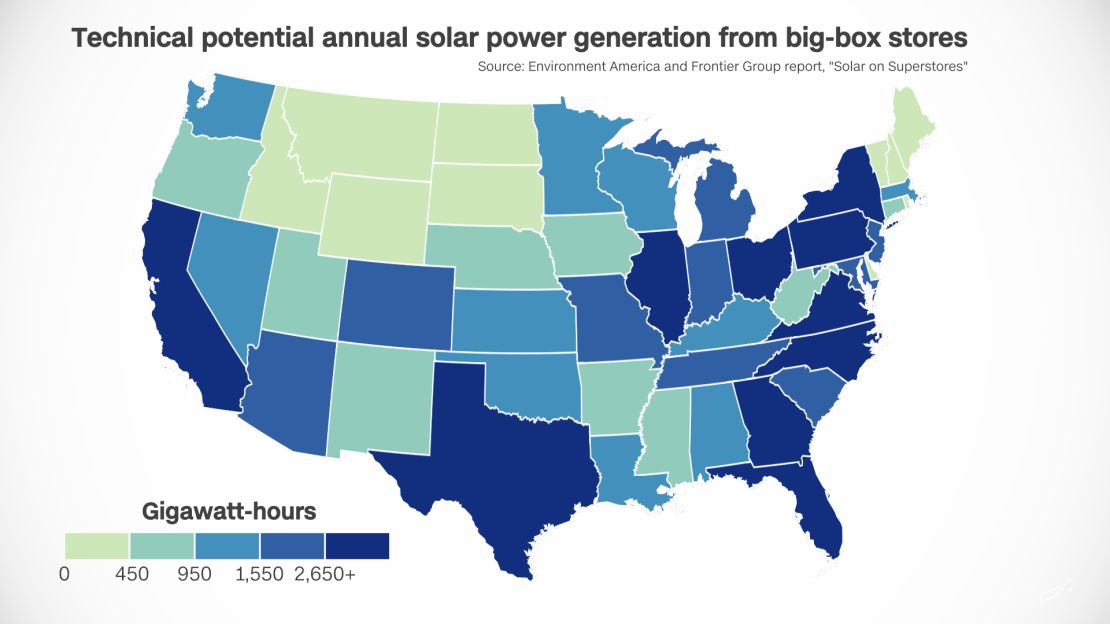
MAP big box rooftop solar climate

Advocates involved in clean energy worker-training programs tell CNN that a solar revolution in big-box retail would also be a significant windfall for local communities, spurring economic growth while tackling the climate crisis, which has inflicted disproportionate harm on marginalized communities.

Yet only a fraction of big-box stores in the US have solar on their rooftops or solar canopies in parking lots, the report’s authors told CNN.

CNN reached out to five of the top US retailers — Walmart, Kroger, Home Depot, Costco and Target — to ask: Why not invest in more rooftop solar?

Many renewable energy experts point to solar as a relatively simple solution to cut down on costs and help rein in fossil fuel emissions, but the companies point to several roadblocks — regulations, labor costs and structural integrity of the rooftops themselves — that are preventing more widespread adoption.

The need for these kinds of clean energy initiatives is becoming “unquestionably urgent” as the climate crisis accelerates, said Edwin Cowen, professor of civil and environmental engineering at Cornell University.

“We are behind the eight ball, to put it mildly,” Cowen told CNN. “I would have loved to see policy help incentivize rooftop solar 15 years ago instead of five years ago in the commercial space. There’s still a tremendous amount of work to do.”

Neumann said Walmart, the nation’s largest retailer, possesses by far the largest solar potential. Walmart has around 5,000 stores in the US and more than 783 million square feet of rooftop space — an area larger than Manhattan — and more than 8,974 gigawatt hours of annual rooftop solar potential, according to the report.

It’s enough electricity to power more than 842,000 homes, the report said.

Walmart spokesperson Mariel Messier told CNN the company is involved in renewable energy projects around the world, but many of them are not rooftop solar installations. The company has reported having completed on- and off-site wind and solar projects or had others under development with a capacity to produce more than 2.3 gigawatts of renewable energy.

Neumann said Environment America has met with Walmart a few times, urging the retailer to commit to installing solar panels on roofs and in parking lots. The company has said it’s aiming to source 100% of its energy through renewable projects by 2035.

“Of all the retailers in America, Walmart stands to make the biggest impact if they put rooftop solar on all of their stores,” Neumann told CNN. “And for us, this report just underscores just how much of an impact they could make if they make that decision.”

According to Environment America, Walmart had installed almost 194 megawatts of solar capacity on its US facilities as of the end of the 2021 fiscal year and additional capacity in off-site solar farms. The company’s installations in California were expected to provide between 20% to 30% of each location’s electricity needs.
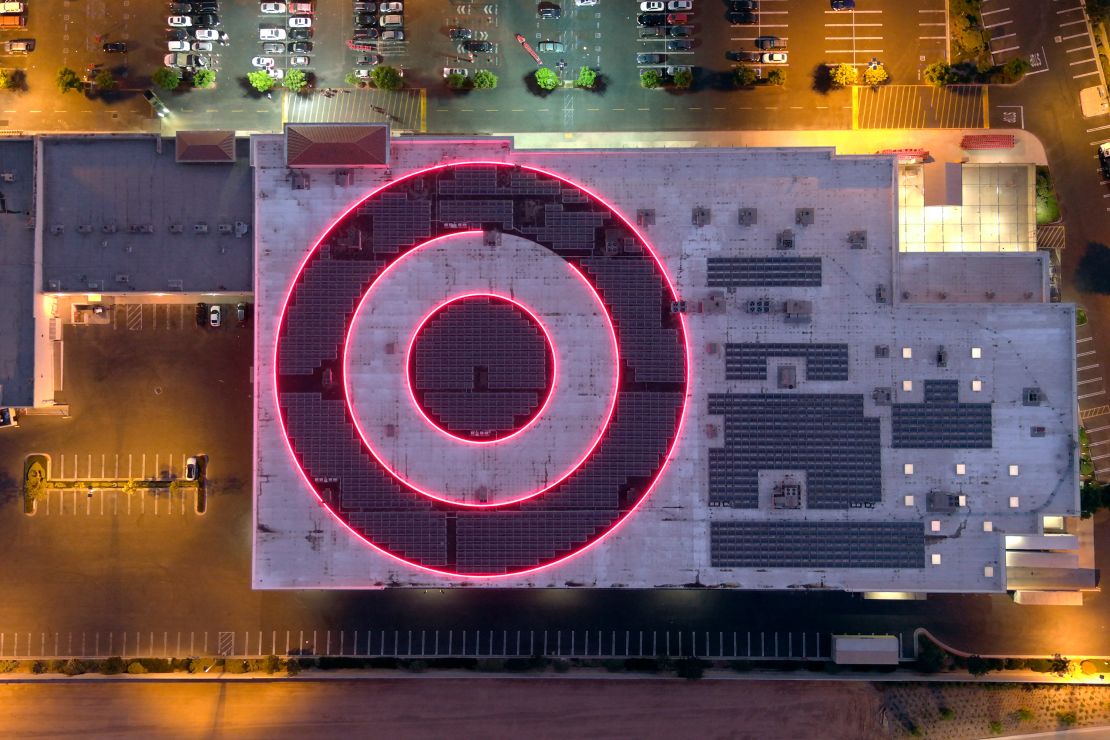
Solar panels on the roof of a Target store in Inglewood, California, in 2020. Target ranked No. 1 for on-site solar capacity in 2019, according to the Solar Energy Industries Association.

Target ranked No. 1 for on-site solar capacity in 2019, according to industry trade group Solar Energy Industries Association’s most recent report. It currently has 542 locations with rooftop solar — around a quarter of the company’s stores — a Target spokesperson told CNN. Rooftop solar generates enough energy to meet 15% to 40% of Target properties’ energy needs, the spokesperson said.

Richard Galanti, the chief financial officer at Costco, said the company has 121 stores with rooftop solar around the world, 95 of which are in the US.

Walmart, Target and Costco did not share with CNN what their biggest barriers are to adding rooftop or parking lot solar panels to more stores.

Approximate number of households companies could power with rooftop solar

  • Walmart — 842,700
  • Target — 259,900
  • Home Depot — 256,600
  • Kroger — 192,500
  • Costco — 87,500
  • Source: Environment America, Frontier Group report, “Solar on Superstores”
  • “My suspicion is that they want an even stronger business case for deviating from business-as-usual,” Neumann said. “Historically, all those roofs have done is cover their stores, and rethinking how [they] use their buildings and thinking of them as energy generators, not just protection from rain, requires a small change in their business model.”

    Home Depot, which has around 2,300 stores, currently has 75 completed rooftop solar projects, 12 in construction and more than 30 planned for future development, said Craig D’Arcy, the company’s director of energy management. Solar power generates around half of these stores’ energy needs on average, he said.

    Aging rooftops at stores are a “huge impediment” to solar installation, D’Arcy added. If a roof needs to be replaced in the next 15 to 20 years or sooner, it doesn’t make financial sense for Home Depot to add solar systems today, he said.

    “We have a goal of implementing solar rooftop where the economics are attractive,” D’Arcy told CNN.

    CNN also reached out to Kroger, which owns about 2,800 stores across the US. Kristal Howard, a Kroger spokesperson, said the company currently has 15 properties — stores, distribution centers and manufacturing plants — with solar installations. One of the “multiple factors affecting the viability of a solar installation” was the stores’ ability to support a solar installation on the roofs, Howard said.
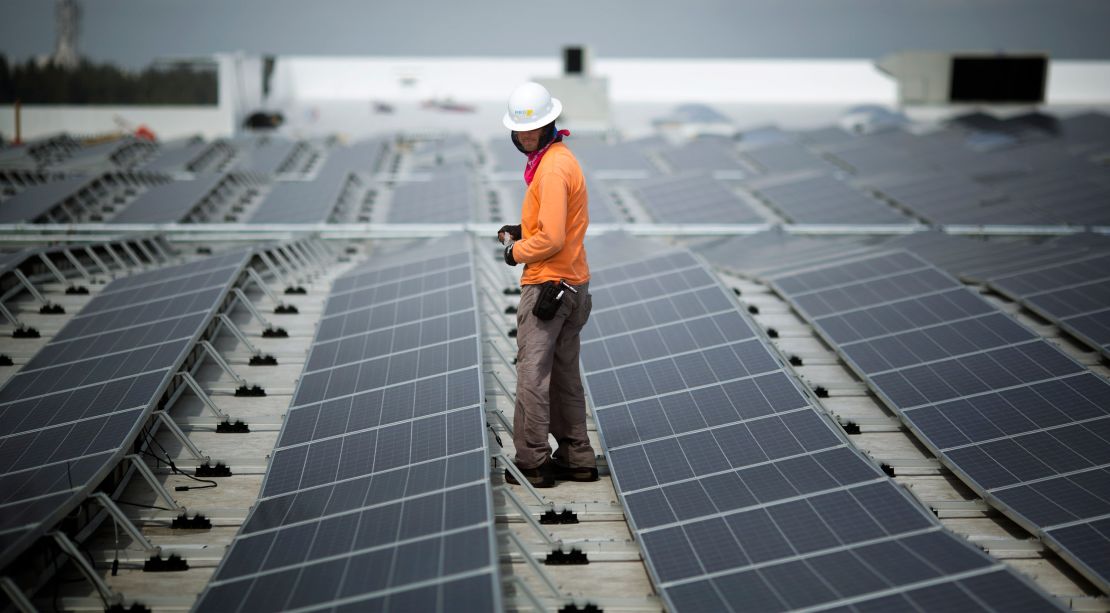
    A worker walks among solar panels being installed on the roof of an IKEA in Miami in 2014. As of February, IKEA had solar installed at 90% of its US locations.

    Cowen, the engineering professor at Cornell, said solar is already attractive, but that labor costs, incentives and the different layers of regulation likely pose some financial challenges in solar installations.

    “For them, this means usually hiring a local site firm that can do that installation that also knows local policy,” Cowen said. “It’s just another layer of complexity that I think is beginning to make sense because the costs have come down enough, but it needs kind of reopening that door of getting into an existing building.”

    Rep. Sean Casten of Illinois, who co-chairs the power sector task force in the House, said the US has “failed to provide the incentives to people who have the expertise to go in and build these things.” The reason both retail companies and the power sector have not made much progress on solar is because “our system is so disjointed” and has a complex regulation structure, Casten said.

    “Why aren’t we doing something that makes economic sense? The answer is this horribly disjointed federal policy where we massively subsidize fossil energy extraction, and we penalize clean energy production,” Casten told CNN. “For a long, long time, if you wanted to build a solar panel on the rooftop of Walmart, your biggest enemy was going to be your local utility because they didn’t want to lose the load.

    “We could have done this decades ago,” Casten added. “And had we done it, we would not be in this dire position with the climate, but we’d also have a lot more money in our pocket.”

    For Charles Callaway, director of organizing at the nonprofit group WE ACT for Environmental Justice, strengthening the rooftop solar capacity in big box retail stores is a no-brainer, especially if companies allow the local community to reap benefits either through installation jobs or sharing the electricity produced later.

    Either way, it would put a massive dent in curbing the climate crisis and help usher in an equitable transition away from fossil fuels — and it’s doable, Callaway told CNN.
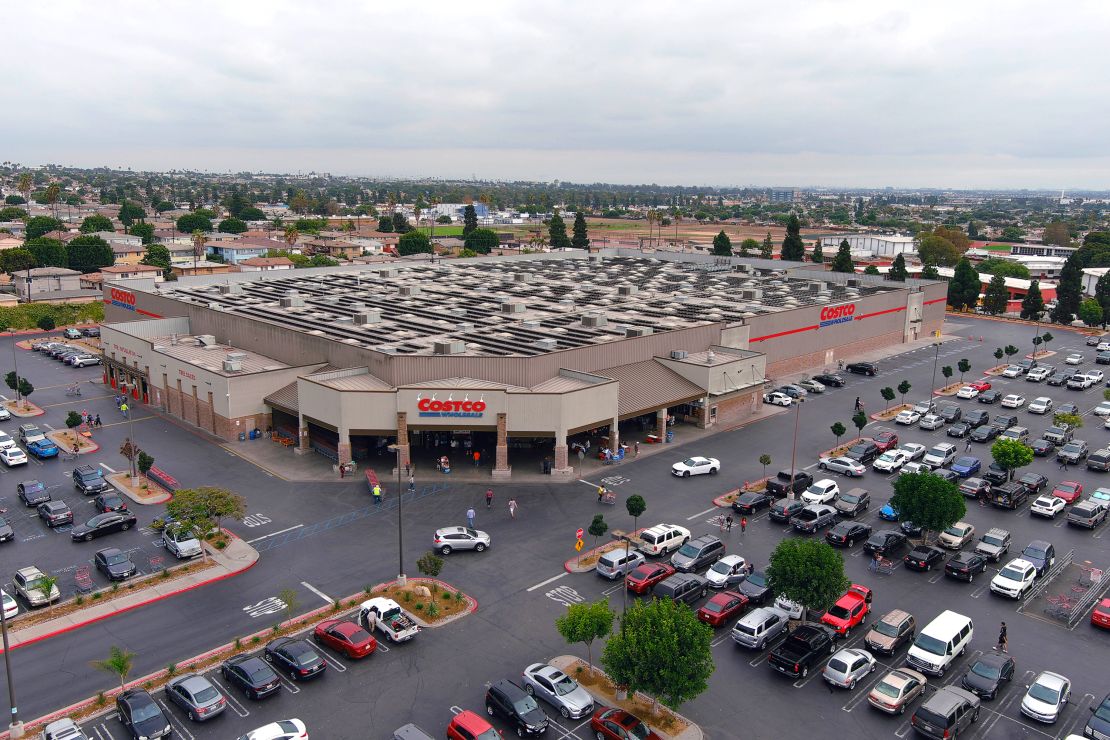
    Solar panels on the roof of a Costco store in Ingelwood, California, in 2021. Costco told CNN 95 stores in the US have rooftop solar installations.

    The New York City resident led a worker training program that helped train more than 100 local community members, mostly people of color, to become solar installers. He also formed a solar workers cooperative to ensure many of the participants of the training program get jobs in a tough market.

    In the last two years, Callaway said his group has not only installed solar panels on roofs of affordable housing units, but also equipment capable of producing 2 megawatts of solar energy on shopping malls up in upstate New York. He emphasized that hiring locally would be most beneficial since local installers know the community and local regulations best.

    “One of my huge concerns is social equity,” Cowen said. “Access to renewable energy is a fairly privileged position these days, and we’ve got to figure out ways to make that not true.”

    Jasmine Graham, WE ACT’s energy justice policy manager, said the potential of building rooftop solar on big box superstores is encouraging, only “if these projects use local labor, if they are paying prevailing wages, and if this solar is being used in a manner such as community solar, which would allow [utility] bill discounts for folks that live in the same utility zone.”

    Pressure is mounting for global leaders to act urgently on the climate crisis after a UN report in late February warned the window for action is rapidly closing.

    Neumann believes the US can meet its energy demand with renewables. All it takes, she said, is the political will to make that switch, and the inclusion of the local community so no one gets left behind in the transition.

    “The sooner we make that transition, the sooner we’ll have cleaner air, the sooner we’ll have a more protected environment and better health and the sooner we’ll have a more livable future for our kids,” Neumann said. “And even if that requires investment, it is an investment worth making.”
    Source link

    Continue Reading
    Click to comment

    Leave a Reply

    Your email address will not be published. Required fields are marked *

    Politics

    US Senate backs Trump’s Iran war, shuts down Democratic push to stop conflict

    Published

    on

    US Senate backs Trump’s Iran war, shuts down Democratic push to stop conflict


    Members of US House of Representatives gather for fourth round of voting for new House Speaker on second day of 118th Congress at US Capitol in Washington, US, January 4, 2023. — Reuters
    Members of US House of Representatives gather for fourth round of voting for new House Speaker on second day of 118th Congress at US Capitol in Washington, US, January 4, 2023. — Reuters
    • Senate Republicans have blocked war powers measures four times.
    • Almost all Republicans remain firmly behind Trump.
    • Democrats warn conflict could escalate.

    A majority of the US Senate backed President Donald Trump’s military campaign against Iran on Wednesday, voting to block a Democratic-led resolution aiming to stop the war until hostilities are authorised by Congress.

    The Senate voted 52-47 not to advance the war powers resolution, underscoring his party’s continuing support for the Republican president’s war policy more than six weeks after the US and Israel launched airstrikes on Iran.

    Trump said in an interview with Fox Business Network conducted on Tuesday and aired on Wednesday that the war was close to over. Also on Wednesday, the army chief of mediator Pakistan arrived in Tehran to try to prevent a renewal of the conflict, after weekend peace negotiations ended without an agreement.

    It was the fourth time Democrats have forced Senate votes on war powers measures since the war began. All of them have failed in the face of opposition from every Senate Republican except Rand Paul of Kentucky.

    The libertarian-leaning Paul, who often advocates against excessive military spending and for a strict interpretation of the Constitution, was the only Republican vote in favour of the resolution in the latest vote. The only Democratic “no” came from Pennsylvania Senator John Fetterman. Republican Senator Jim Justice of West Virginia did not vote.

    Although the US Constitution says that Congress, not the president, can declare war, presidents from both parties have long held that the restriction does not apply to short-term operations or if the country is under immediate threat.

    ‘Nobody is coming to help you, Iran’

    The White House, and almost all of Trump’s fellow Republicans in Congress, say Trump’s actions are legal and within his rights as commander-in-chief to protect the US by ordering limited ⁠military operations.

    Opinion polls show the war is broadly unpopular, although views differ along partisan lines. A Reuters/Ipsos poll published on March 31 found that 60% of Americans opposed US military strikes on Iran, with 74% of Republicans supporting the action, compared with 7% of Democrats.

    Senator Jim Risch of Idaho, the Republican chairman of the Foreign Relations Committee, accused backers of the war powers resolution of supporting Iran in a speech before the vote.

    “Nobody is coming to help you, Iran, except for the 47 people over here,” he said, referring to senators who back the resolution.

    Democrats said they wanted Congress to retake its constitutionally mandated power to declare war, and pull the country back from what they warned could become a long conflict.

    “I urge my colleagues … to choose the path of peace before President Trump’s war becomes irreversible,” Senator Jack Reed of Rhode Island, the top Democrat on the Armed Services Committee, said in a speech urging support for the vote.

    Democratic Party leaders have vowed to keep bringing war powers resolutions until the conflict ends or Congress authorises continued fighting.

    The House of Representatives is expected to consider a similar measure later this week.


    Source link

    Continue Reading

    Politics

    Law firms helping migrants pose as gay to get asylum in UK: report

    Published

    on

    Law firms helping migrants pose as gay to get asylum in UK: report


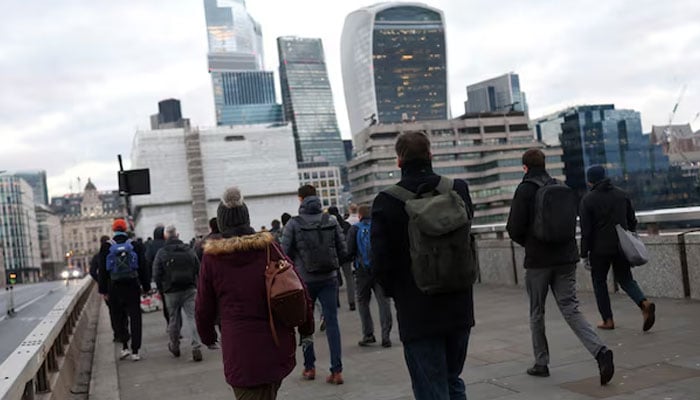
    This representational image shows commuters cross London Bridge, in London, Britain, January 13, 2025. — Reuters
    This representational image shows commuters cross London Bridge, in London, Britain, January 13, 2025. — Reuters 

    LONDON: A BBC undercover investigation has alleged that a network of immigration advisers, paralegals and associated intermediaries has been helping migrants fabricate asylum claims in the UK by falsely presenting themselves as gay, charging thousands of pounds for false narratives, staged evidence and interview coaching.

    At least three law firms – one of these owned by Pakistanis – have been accused by the BBC of fabricating the asylum claims through illegal means.

    The law firms include Law and Justice Solicitors and Connaught Law. Law and Justice is owned by Michael Oluyemi Makinde and Connaught Law is owned by Nauman Javid, Sheryar Khan, Zehra Tamkan and Awais Javed.

    According to the BBC investigation, the abuse centres on migrants, particularly from Pakistan and Bangladesh, whose student, work or tourist visas are close to expiring and who are then allegedly advised to seek asylum on the basis of sexual orientation, as being gay or lesbian.

    Using undercover reporters posing as international students from Pakistan and Bangladesh, the BBC said it tested whether immigration advisers would encourage false sexuality-based asylum claims.

    It reported finding multiple individuals willing to discuss fake claims, suggest supporting evidence and quote fees for handling such cases. Among the findings were allegations that Connaught Law firm quoted up to £7,000 for a fabricated claim and described the chances of refusal as “very low”, while another adviser allegedly offered to arrange fake supporting letters, photographs and even a supposed sexual partner to back up an asylum application.

    The BBC undercover reporter made an appointment with Aqeel Abbasi, a senior legal adviser at Connaught Law, which has its offices in Central London on Gray’s Inn Road.

    Abbasi told the BBC reporter that he could help him stay in the country and appeared to be willing to direct him on how to fabricate evidence for a fake claim. He promised that the chance of refusal by the Home Office was “very low”.

    He said his fee would be £7,000 and, once that had been paid, his office would contact the undercover reporter to guide them through the process and the kind of evidence required.

    This would include advising him on “where to go or what specific actions to take”.

    The legal adviser also suggested the undercover reporter would need to find someone willing to pretend to be his male/gay partner. When the reporter said he had a wife in Pakistan, Abbasi was quick to suggest a cover story to explain this, by saying that things were “more open” in the UK than in Pakistan and that he now had a male partner.

    “We will prepare a statement for you, and once you read it, you will understand exactly how it is,” said Abbasi.

    A significant part of the investigation focused on Worcester LGBT, a support organisation for gay and lesbian asylum seekers, which holds monthly meetings attended by large numbers of migrants from across the country.

    The BBC traced the undercover reporter’s route to the group through Mazedul Hasan Shakil, a paralegal at Law and Justice Solicitors, an immigration firm based in Birmingham and London, who is also described as founder and chairman of Worcester LGBT.

    The reporter received a call from a woman identified as Tanisa (Shakil’s associate), who, in Urdu, allegedly became much more direct about using a “gay case” as the only realistic route to stay in Britain.

    When told the reporter was not gay, Tanisa replied: “There is nobody who is real. There is only one way out in order to live here now and that is the very method everyone is adopting.” The BBC identified her as Tanisa Khan, an adviser linked to Worcester LGBT.

    The broadcaster then described an initial meeting in Forest Gate, east London, which took place in Tanisa’s home.

    According to the report, she laid out a plan to fabricate an asylum claim on the grounds of same-sex orientation, warning that the applicant would have to memorise a false story convincingly for Home Office interviews. The report said she offered to obtain a letter from someone claiming to have had sexual relations with the applicant and said she would fully prepare him for the Home Office process.

    She charged £2,500, with additional costs if the claim failed and went to appeal. The BBC also said she suggested that if the reporter later brought his wife from Pakistan to Britain, she too could make a false asylum claim by pretending to be lesbian.

    The BBC showed its footage to immigration lawyer Ana Gonzalez, who has 30 years of experience. She said Tanisa appeared to be “committing fraud by manufacturing a claim” and warned that such conduct makes life harder for genuine asylum seekers, especially LGBT claimants whose cases are often difficult to prove objectively.

    The report said precise figures for fabricated claims are impossible to establish, but Home Office data suggests a disproportionate number of sexuality-based asylum claims come from Pakistani nationals.

    In 2023, there were 3,430 initial decisions on LGBT asylum claims and nearly 1,400 new claims based on sexual orientation. Of these, 42% were lodged by Pakistani nationals, who also accounted for the highest number in each of the previous five years. The article noted that Pakistanis were only the fourth most common nationality across all asylum applications and made up just 6% of total claims overall.

    Nearly two-thirds of asylum seekers claiming persecution on grounds of sexual orientation had their claims granted at initial decision stage in 2023.

    The Home Office told the BBC that making an asylum claim through deception is a criminal offence and that anyone convicted can face prison and deportation.

    It said misuse of protections designed for people fleeing genuine persecution because of their sexuality was deplorable, but insisted that the asylum system includes safeguards and that claims are rigorously assessed.

    The department added that abuse is actively investigated and procedures are continually reviewed.


    Source link

    Continue Reading

    Politics

    Iran says to host Pakistani delegation as exchanges continue with US

    Published

    on

    Iran says to host Pakistani delegation as exchanges continue with US


    Iran will be hosting a high-ranking political and security delegation from Pakistan on Wednesday, as indirect exchanges of messages between Tehran and Washington continue, the Iranian Foreign Ministry spokesman announced.

    Esmail Baghaei, speaking in response to a question from IRNA, confirmed that Tehran is expected to receive the Pakistani delegation today.

    “Today, we are most likely hosting a delegation from Pakistan,” Baghaei said.

    “Following the talks that took place in Islamabad, and also the discussions that the Pakistani side has had with the United States, our views have been conveyed and heard,” he said.

    He added, “Naturally, during this visit, the two sides are expected to discuss their viewpoints in detail.”

    Meanwhile, informed sources in Pakistan confirmed that a high-level security-political delegation, comprising prominent Pakistani figures, left Islamabad for Tehran a short while ago, IRIB news reported.

    According to the sources, the delegation is carrying a new message from Washington for Tehran.

    The delegation is scheduled to meet with Iranian officials to discuss future negotiations, the sources said.

    The development comes as a two-week ceasefire between Iran and the United States will expire on April 22.

    The United States and Israel launched their unprovoked war of aggression against Iran on February 28, assassinating the Leader of the Islamic Revolution and striking nuclear facilities, schools, hospitals and civilian infrastructure.


    Source link

    Continue Reading

    Trending