

Tech
Boots or Trail Runners? Depends if You Want Speed, Durability, or Ankle Support

When I started hiking, big leather boots were the only real option. They were burly, stiff, and difficult to break in, but one pair would last you decades. Technology has mercifully caught up, however. If you head to the trails today, most hikers and backpackers are opting for more lightweight, low-cut options. While an influx of new shoes from brands like Hoka, Merrell, Danner, and Salomon has transformed the footwear industry, that doesn’t mean the hiking boot has had its day. It just depends on what you’re looking to do and when you’re doing it.
Which shoes should you pick to go out for the day? I tested countless pairs of great hiking boots, trail runners, and hiking shoes across a variety of terrain, from forest trails and coastal paths to high alpine terrain. To get a better understanding of the differences between the many options available—and which is right for you—I grilled Ingrid Johnson, a leading footwear product specialist at REI. (For what it’s worth, Johnson’s personal recommendation is the Salomon XA Pro).
When you’ve chosen your next pair of trail running shoes (or hiking boots), be sure to check out more of WIRED’s outdoor guides, like the Best Gravel Running Shoes, the Best Merino Wool T-Shirts, and the Best Electric Bikes.
Update March 2026: We added links to recent coverage, added the On Running Cloudrock Low, and updated links and prices.
Jump to Section
Here’s When You Need Boots
If you’re carrying a heavy pack over rough terrain, or if it’s wet or snowy, you need hiking boots. They tend to be higher at the ankle, with stiff midsoles and protective toe caps, and they are generally made from very durable materials like leather and tough synthetic fabrics like Cordura. Hiking boots prioritize stability, protection, and durability.
Boots generally have thick, deep lugs, tougher soles, stronger toe guards, and sturdier ankle support. They protect you from rock impact, uneven ground, moisture, and often colder conditions. The high-cut designs also offer more ankle support, something I found reassuring when coming back from a recent injury.
But don’t think that hiking boot brands are stuck in the dark ages. Borrowing lightweight features and materials from trail running, brands are able to offer technical boots with cushioning, grip, and stability. They’re still heavy, but featherweight compared to a traditional leather boot. Hoka’s Kaha 3 GTX ($240) is one of the best boots available, blending soft nubuck leather, Vibram Megagrip sole, and bags of cushioning. Here are a few other picks:
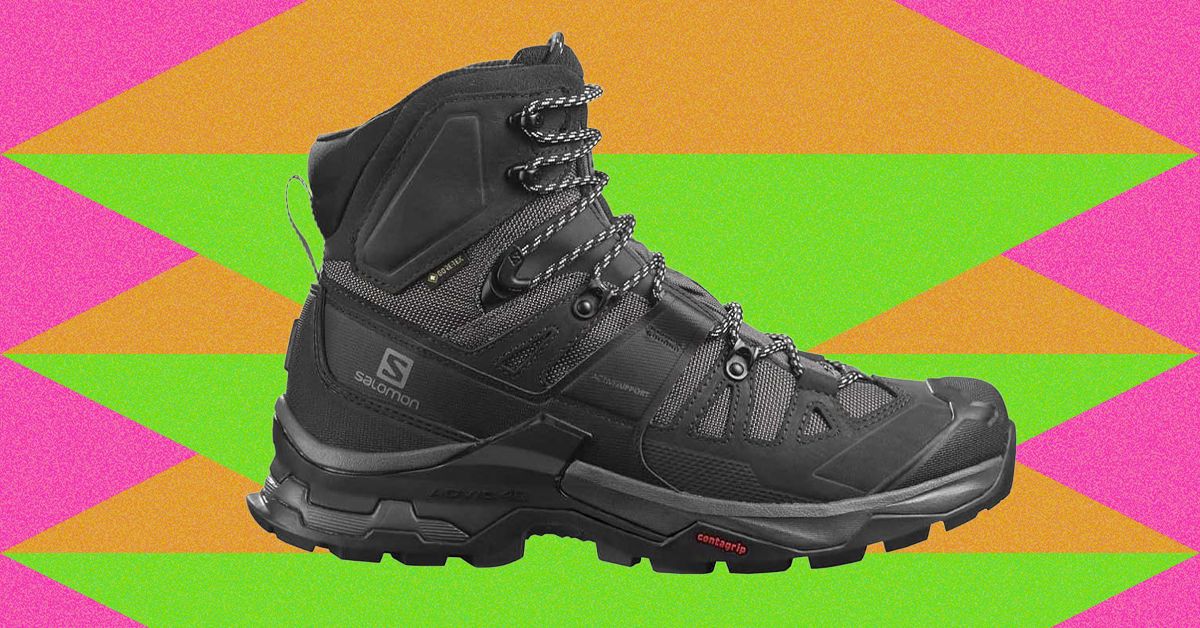
Perennially popular for good reason, these Salomons boast superb levels of comfort and support without the bulk typically associated with traditional walking boots. They feel like ski boots, but that’s not a criticism; the height and support is most welcome when walking all day carrying a full pack.













President Donald Trump’s negotiators face the arduous task of trying to convince the president that a deal he previously rejected is their best option in Iran.
Last month, Trump initially gave his blessing for a so-called “cash for uranium” deal, under which the US would release around $20 billion in frozen funds in exchange for Iran handing over its stockpile of highly enriched uranium, sources familiar with the matter tell WIRED.
Trump’s negotiators, vice president JD Vance, special envoy Steve Witkoff and Jared Kushner, Trump’s son in law, received repeated approvals from the president while they were in Islamabad, giving them confidence a deal was close.
But the deal unraveled, in part because Trump was warned by his team that there was a risk he could be seen as giving Iran “pallets of cash”—an echo of his own oft-stated criticism of Barack Obama’s Iran deal—and he pulled the plug, the sources said.
Except now, that’s once again the cornerstone of the current proposal.
The current negotiations for a memorandum of understanding that could guide talks on a nuclear deal center on Iran handing over its stockpile of highly enriched uranium, and a moratorium on further uranium enrichment for somewhere around 12 to 15 years, Axios earlier reported.
In exchange, the US would offer a combination of billions in sanctions relief and the gradual release of frozen funds after gaining control of the enriched uranium, in order to destroy it or blend it down so it cannot be used for a nuclear weapon.
While a memorandum of understanding might get Iran to the table, that framework is not materially different from what was discussed previously in Islamabad and rejected by Trump, who has repeatedly told advisers in recent weeks he is against sending money to Iran, sources tell WIRED.
Some of Trump’s advisers say the decision of whether Trump ultimately blesses the framework is likely to come down to how badly he wants a deal. There are few options to incentivize Iran, they add, and financial aid has been the most compelling.
“They are going to have to do something like that, and it’s better than the Obama deal, so he should take it,” one Trump adviser said on the condition of anonymity, referring to the Joint Comprehensive Plan of Action. Trump has long criticized that deal for having provisions similar to ones currently under discussion, like a sunset clause on nuclear enrichment and the US lifting some sanctions.
For all the machinations in the West Wing, it has not gone unnoticed by Trump’s orbit that some of his top players have been conspicuous in their absence on Iran, according to two administration officials familiar with the matter.
Marco Rubio, the secretary of state and national security adviser, has been part of the group advising Trump on Iran and, physically speaking, spends most of his time in his West Wing office overlooking West Executive Avenue instead of at the State Department.
Rubio was happy to brief reporters on Tuesday, but he only did so at the request of the White House, a person familiar with the matter said, with his advisers wary of him getting involved in Iran negotiations that could as easily unravel as succeed.
In fact, given the downside risk, Rubioworld has been saying they were surprised that Vance asked to be a part of the Iran talks—a contention denied by people close to the vice president, who said he was ordered to by Trump.
Rubio instead has been more focused on Cuba, and on Venezuela, where assistant secretary of state Caleb Orr has been involved in overseeing new private equity investment to rebuild the country’s oil infrastructure.
Mexico City is one of the fastest sinking cities in the world. Now, a powerful satellite from the US National Aeronautics and Space Administration (NASA) confirms the accelerated advance of this silent threat that puts nearly 20 million people at risk.
The satellite designed by NASA and the Indian Space Research Organization (ISRO), known as NISAR (NASA-ISRO Synthetic Aperture Radar), was able to capture with unprecedented precision the magnitude and evolution of this phenomenon in different areas of the Mexican capital. The analysis is based on preliminary measurements taken from space between October 2025 and January of this year, during the dry season in Mexico City.
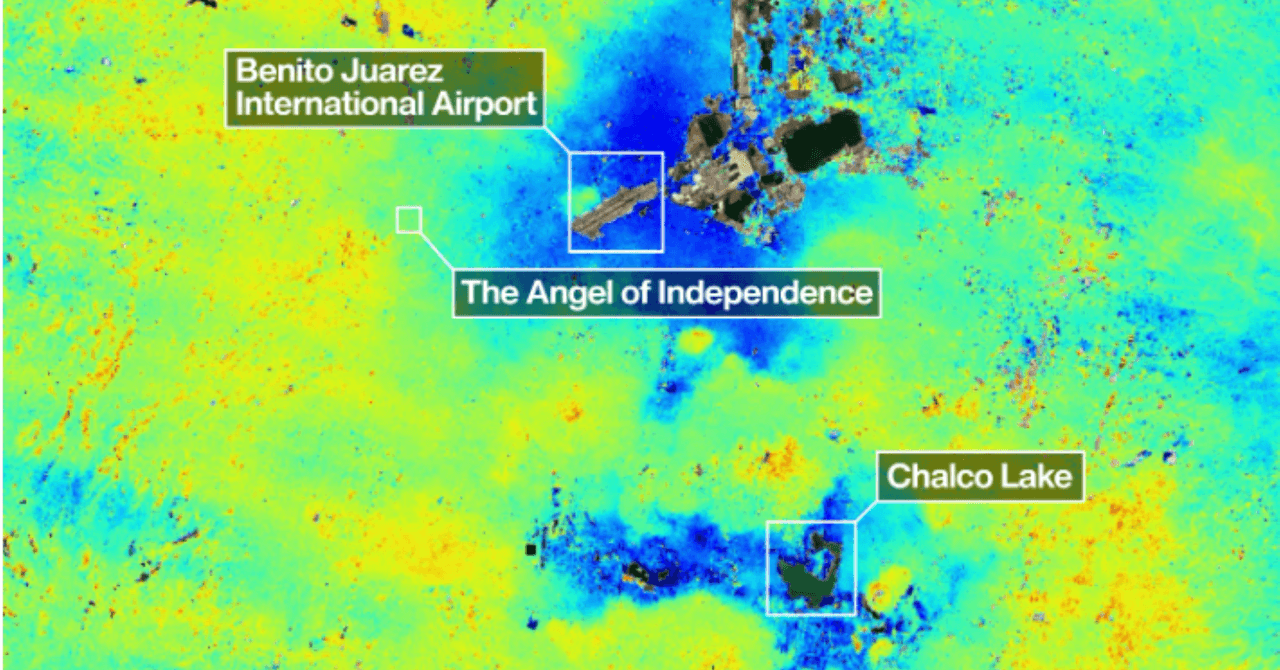
Their findings were captured in a map that shows how the subsurface of the metropolis is shifting. In the map, NASA identified areas with subsidence greater than 2 centimeters per month (marked in dark blue). The agency specifies that the areas marked in yellow and red could correspond to background signals (or noise) that are expected to diminish as the satellite instrument collects more data.
The image also highlights the location of Benito Juarez International Airport, located near Lake Nabor Carrillo, which operates in the middle of an area with accelerated subsidence. “Images like this confirm that the NISAR measurements are in line with expectations,” said Craig Ferguson, deputy director of the project.
Mexico City sits atop the clay and lake bed of ancient Lake Texcoco. NASA explains that this process is a consequence of intense groundwater pumping and the increasing weight associated with urban development. Both factors have caused the compaction of the ancient lake soil for more than a century.
The phenomenon was first documented in 1925 by engineer Roberto Gayol. Between the 1900s and 2000s, some areas experienced a drop of nearly 35 centimeters per year, causing damage to infrastructure such as the Metro, one of the largest mass transit systems in the Americas.
A study conducted in 2024 by Dario Solano-Rojas, a remote-sensing specialist at the National Autonomous University of Mexico, found that subsidence is not uniform. After analyzing changes in the city’s elevation between 2011 and 2020, the researcher and his team concluded that subsidence rates are highly variable: While some areas register up to 50 centimeters per year, in others the phenomenon is almost imperceptible.
This creates “differential subsidence,” where the ground sinks unevenly not only across square kilometers or city blocks, but even on a meter scale. When a street, railway, or building sinks differently at one end compared to the other, its stability is compromised.
I’m looking at Volume 1,536 of the Epstein files, page 311. It’s an early 2016 email thread between Jeffrey Epstein and a woman whose name is redacted by the Department of Justice.
In the thread, Epstein asks the unidentified woman for a “naughty selfie” and later sends her a camera. In late February, he replies with a different ask: “Do you have any friends that might want to work for me?…I will give you money if you find someone willing to travel, 22-25, educated. Personable.”
The exchange carries extra resonance when you consider that Epstein is accused of sex trafficking minors, with the Department of Justice estimating that he had more than 1,200 potential victims. But I just happen to flip to it randomly during my recent visit to the newly opened Donald J. Trump and Jeffrey Epstein Memorial Reading Room.
Photograph: Anna Maria Lopez/Courtesy of BPI Group
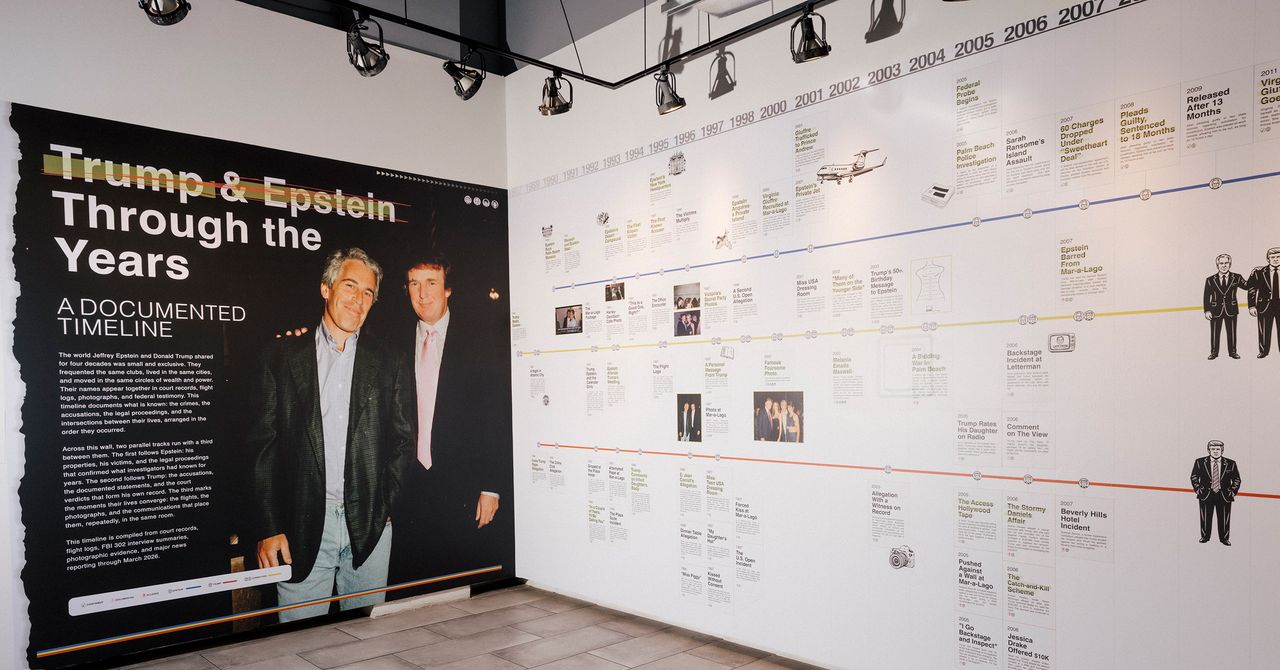
Tucked away in a nondescript gallery in New York City’s Tribeca neighborhood, the reading room is a massive library of all 3.5 million pages of Epstein-related records released by the Department of Justice earlier this year, compiled into more than 3,700 individual volumes. From May 8 to 21, the reading room will be open to the public by appointment only.
The library—essentially, the Epstein files in analog—is intended to represent the staggering scale of Epstein’s crimes, as well as the impunity with which he carried them out. More than 17,000 pounds of evidence is on display at the library, says David Garrett, the main organizer of the exhibit at the Institute for Primary Facts, a nonprofit intended to promote transparency and accountability in the US government.
“The evidence in this room is evidence of one of the most horrific crimes in American history,” Garrett says. “When people come through this room, I hope they realize that in America, we have the rule of law, and if they stand up they can take action and demand accountability for the crimes that were committed.”
Epstein, who died in prison in 2019, is now synonymous with systemic corruption and abuse, particularly in light of his ties to President Donald Trump. The installation features a detailed timeline of Epstein’s relationship with Trump, from their purported initial meeting in Palm Beach in 1987 to Epstein’s 1993 attendance at Trump’s wedding to Marla Maples to the end of Epstein’s membership at Mar-a-Lago in 2007, when Trump allegedly witnessed him behaving inappropriately toward the teenage daughter of another member. The shelves are organized around an exhibit in support of Epstein’s survivors, with candles laid out on the ground to represent the more than 1,200 victims. In response to a request for comment, White House spokesperson Abigail Jackson said Trump has “been totally exonerated on anything relating to Epstein,” claiming that he “has done more for Epstein’s victims than anyone.”


Trump’s Team Wants Him to Accept an Iran Deal He’s Already Rejected

Kyle Loftis, founder of 1320Video, defining voice in street car culture, dies

Airlines spent 56.4% more on jet fuel in month after Iran war started, U.S. government says

-

 Sports1 week ago
Pro wrestling star Steph De Lander reveals how colleague’s advice helped lead her to title triumph at ACW
-
 Business1 week ago
‘I had £20,000 stolen and had to fight a 13-month fraud reporting rule to get it back’
-
 Business7 days ago
PSX plunges over 4,800 points | The Express Tribune
-
 Tech1 week ago
This Ambitious Laptop Doesn’t Leave Much Room for Your Hands
-

 Tech6 days ago
Almost half of UK businesses hit by cyber attacks | Computer Weekly
-

 Sports1 week ago
Match officials announced for HBL PSL 11 qualifier – SUCH TV
-

 Tech5 days ago
This Indigenous Language Survived Russian Occupation. Can It Survive YouTube?
-

 Tech6 days ago
Musk v. Altman Kicks Off, DOJ Guts Voting Rights Unit, and Is the AI Job Apocalypse Overhyped?