

Sports
Browns to hold open QB competition between Shedeur Sanders and Deshaun Watson, GM says

NEWYou can now listen to Fox News articles!
The Cleveland Browns entered last season with one of the NFL’s more crowded quarterback rooms.
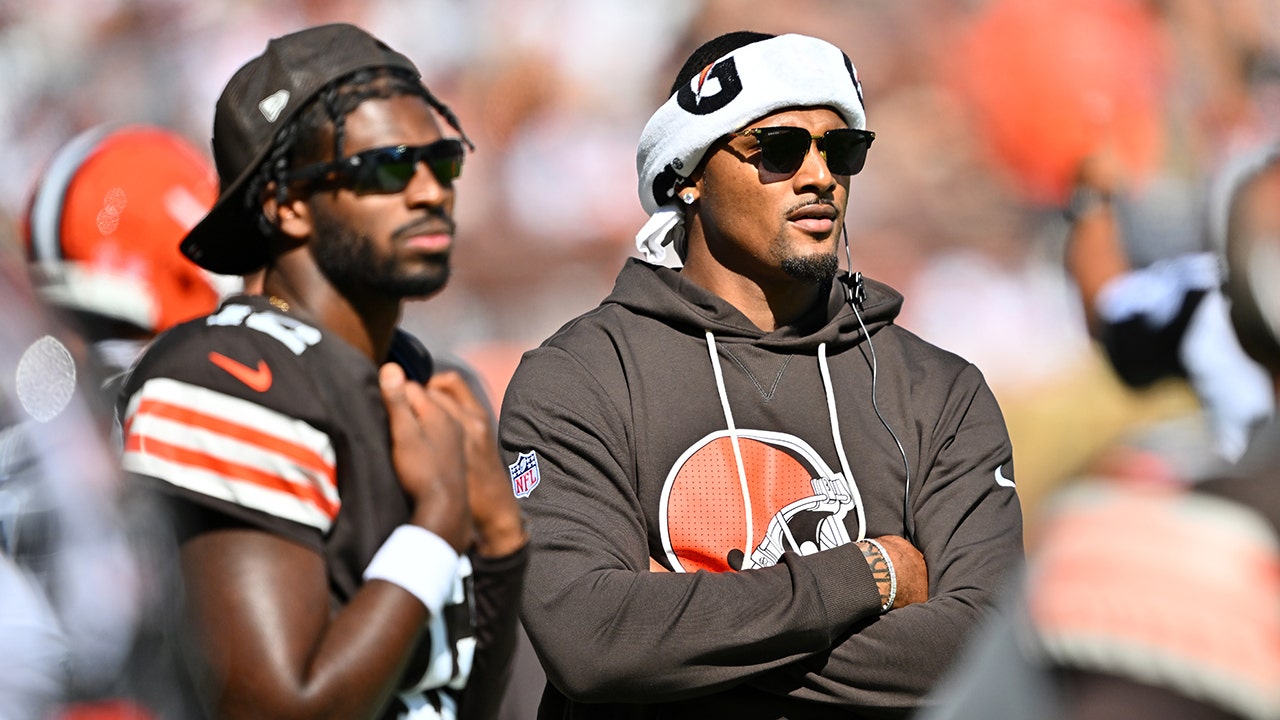
Sheduer Sanders took over the starting quarterback duties in Week 12 last season, and after two more starts, he was named the starter for the remainder of the season. Dillon Gabriel moved to a backup role as Deshaun Watson stayed on the physically unable to perform list, even after the team opened his 21-day practice window in December. Watson is still recovering from his latest Achilles injury.
Speaking at the 2026 NFL Scouting Combine in Indianapolis Tuesday, Brown general manager Andrew Berry left the door open for Watson to compete with Sanders for the starting job next season.
CLICK HERE FOR MORE SPORTS COVERAGE ON FOXNEWS.COM
Cleveland Browns Executive vice president, football operations & general manager Andrew Berry looks on during OTA offseason workouts at CrossCountry Mortgage Campus on June 04, 2025 in Berea, Ohio. (Nick Cammett/Diamond Images via Getty Images)
Berry cautioned that there’s no rush to decide on who will QB1 when next season kicks off.
“We don’t have to make that decision anytime soon,” he said. “I think any player that we have in that room we would expect to compete to earn a role. Those two would be no different.”
While Gabriel could be among the group competing for the starting spot, Berry has previously indicated that the team could look to add an experienced quarterback to the roster at some point this offseason.
Sanders took snaps with the designated second-team for the majority of the Browns’ minicamp and training camp last year. He went 3-4 as a starter in 2025. Berry is optimistic Sanders can continue to improve.
“I think the biggest thing that we want to see from Shedeur is just continued growth,” Berry said. “I think he grew a lot from Start 1 to Start 7. I think certainly playing more efficiently, not putting the ball in harm’s way as much would be important while maintaining the ability to produce out of structure and generate explosive plays.”
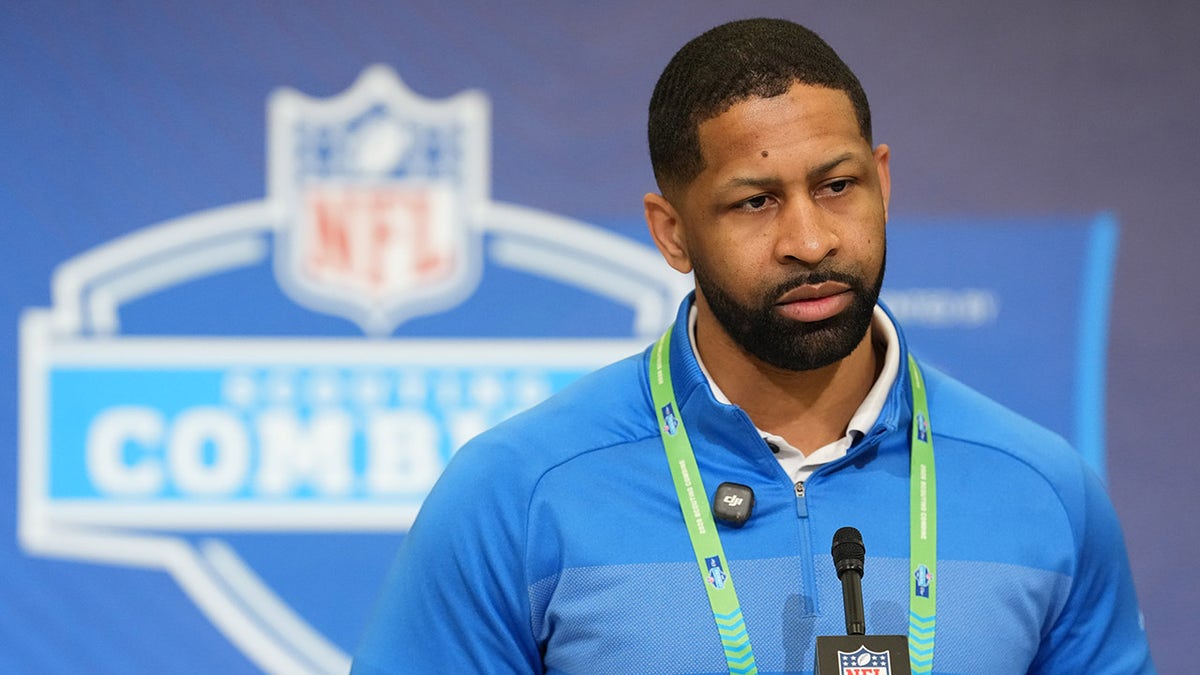
Cleveland Browns general manager Andrew Berry speaks at the NFL Scouting Combine at the Indiana Convention Center on Feb. 24, 2026 in Indianapolis, Indiana. (Kirby Lee/Imagn Images)
The Browns dismissed Kevin Stefanski in January and brought in Todd Monken, and Berry said he wants Sanders to acclimate to the new system.
“You’re not going to see all of that in the upcoming months because we’re not on the field. So the biggest thing that he can do is learn the new offense, get in with the coaching staff once our offseason program starts, continue to work on his body physically and then make strides when we actually get on the grass.”
Watson has appeared in just 19 games in the three years since he inked an unprecedented fully guaranteed $230 million contract with the Browns. Watson is reportedly owed $46 million next season and carries the largest salary cap hit in the league in 2026.
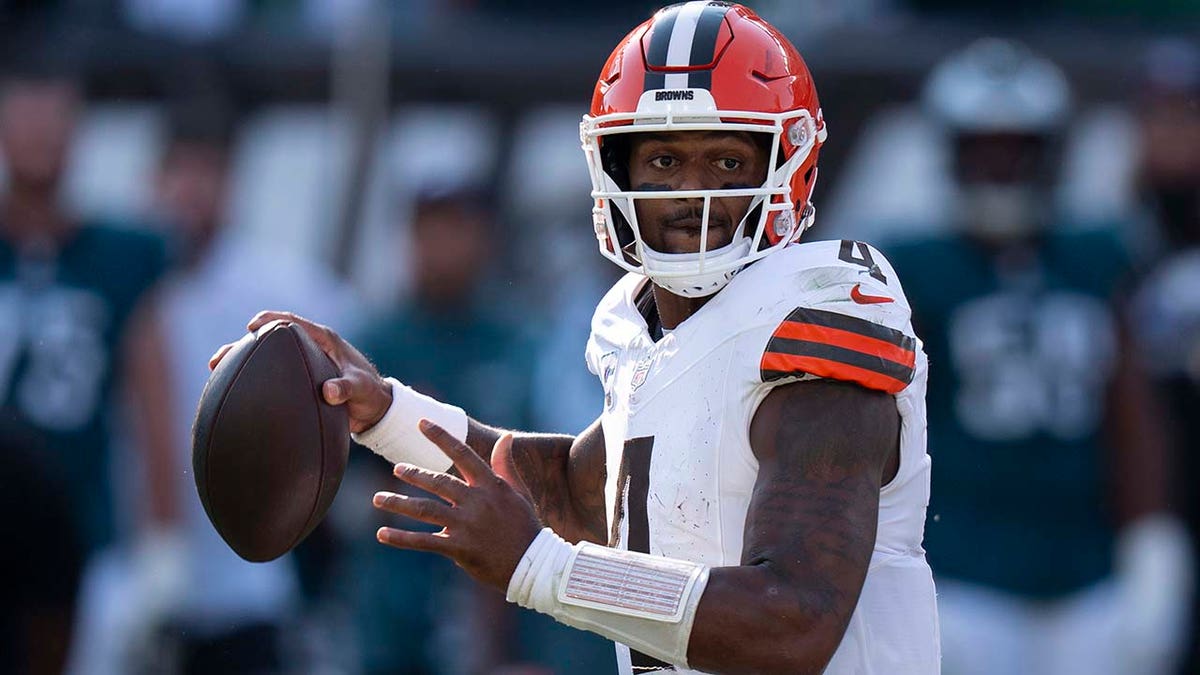
Cleveland Browns quarterback Deshaun Watson in action during the NFL football game against the Philadelphia Eagles on Oct. 13, 2024, in Philadelphia, Pennsylvania. (AP Photo/Chris Szagola, File)
Berry confirmed Watson continues to work through the rehab process. “Deshaun’s been working really hard, he’s been working his tail off,” he said. “And like I said, we’re excited to go in mid-April with all of our players across the roster.”
CLICK HERE TO GET THE FOX NEWS APP
The Browns went 5-12 last season.
Follow Fox News Digital’s sports coverage on X, and subscribe to the Fox News Sports Huddle newsletter.
Related Article










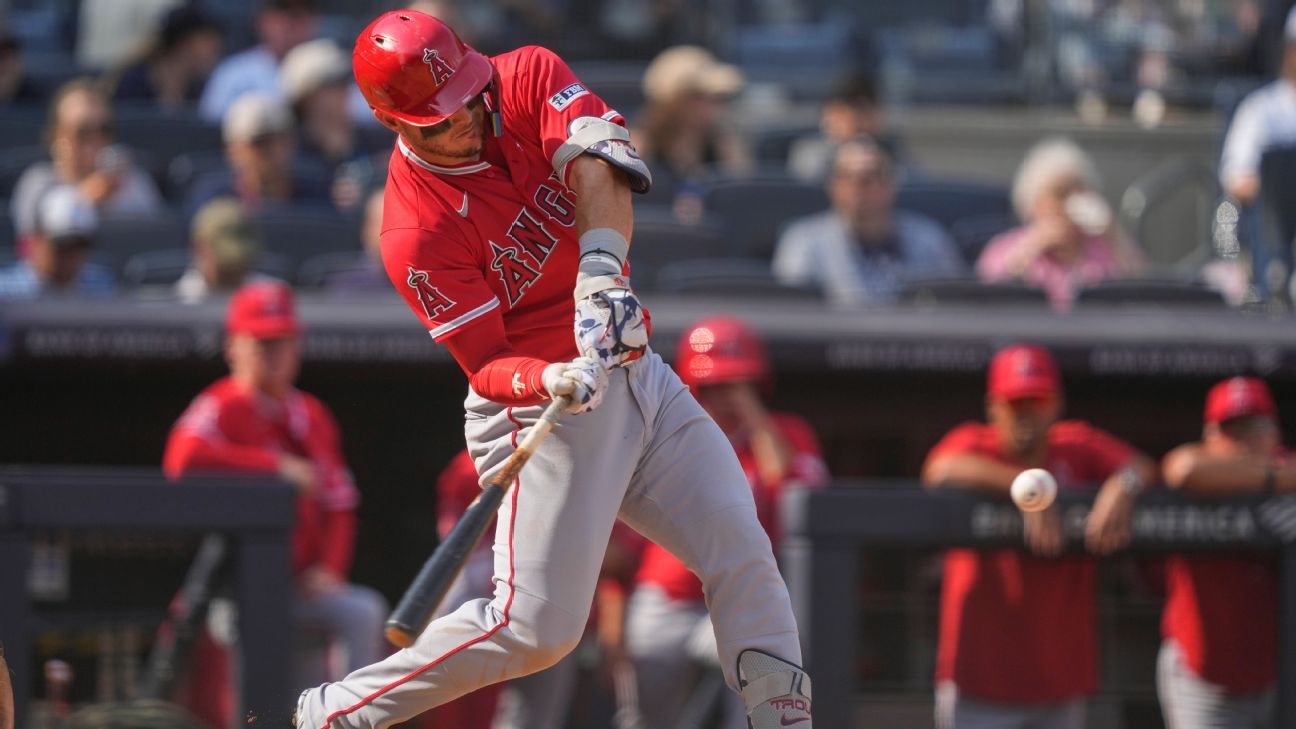
NEW YORK — Mike Trout‘s latest homer against the New York Yankees put him in rare company, and going deep again made history at Yankee Stadium.
Trout homered for the fifth time during a four-game series Thursday, crushing a 446-foot drive in the seventh inning for the Los Angeles Angels in an 11-4 victory.
A three-time MVP, Trout joined Jimmie Foxx (1933), Darrell Evans (1985) and George Bell (1990) as the only players with five homers in a series against the Yankees, according to MLB researcher Sarah Langs.
Trout homered twice Monday before going deep again in the following two games. In the series finale Thursday, Trout drove a 2-2 slider from reliever Angel Chivilli about halfway up the left-field bleachers to give the Angels a 7-4 lead. That shot made Trout the first player to hit five homers in a series in the Bronx.
“I heard that after the game,” Trout said. “It’s pretty surreal. All the great players that came through here, so it’s pretty cool.”
“Honestly, not surprising,” Los Angeles manager Kurt Suzuki said. “When you’re with Mike every day, there’s nothing that you believe that he can’t do.”
Trout also became the first visiting player to homer in four consecutive days at the current Yankee Stadium, which opened in 2009.
Trout went 6-for-16 with five homers and nine RBIs in the series. He also has homered in his past five games at Yankee Stadium and drew an intentional walk in his next plate appearance before Jo Adell hit a grand slam.
“At this point it’s vintage Mike Trout,” Adell said. “When he’s healthy and feeling good, there’s nothing like it. It’s special. It’s one of a kind. So for all of us to experience it, it’s special.”
“He’s unbelievable,” Suzuki said. “He really is. It’s been an amazing week for him.”
Trout is hitting .246 with seven homers and 16 RBIs. He is 9-for-27 (.333) with five homers and 13 RBIs on the Angels’ road trip, which coincides with him making a mechanical tweak.
Trout’s career-high homer streak is seven games, achieved Sept. 4-12, 2022. He has homered in four straight games for the fourth time in his career.
Trout’s homer was part of a four-game series that featured four homers from Yankees’ slugger Aaron Judge. Judge homered twice Monday, again Wednesday and went deep in the first inning in the series finale.
“He’s unreal,” designated hitter Giancarlo Stanton said after the Yankees lost for the seventh time in nine games. “Cool showing from him and Judgie all series. Obviously, you don’t want that against us, but you got to acknowledge the greatness.”
According to the Elias Sports Bureau, it was the first time opposing players who owned multiple MVPs hit at least three homers in the same series.
“It was an impressive show by those two,” Suzuki said.
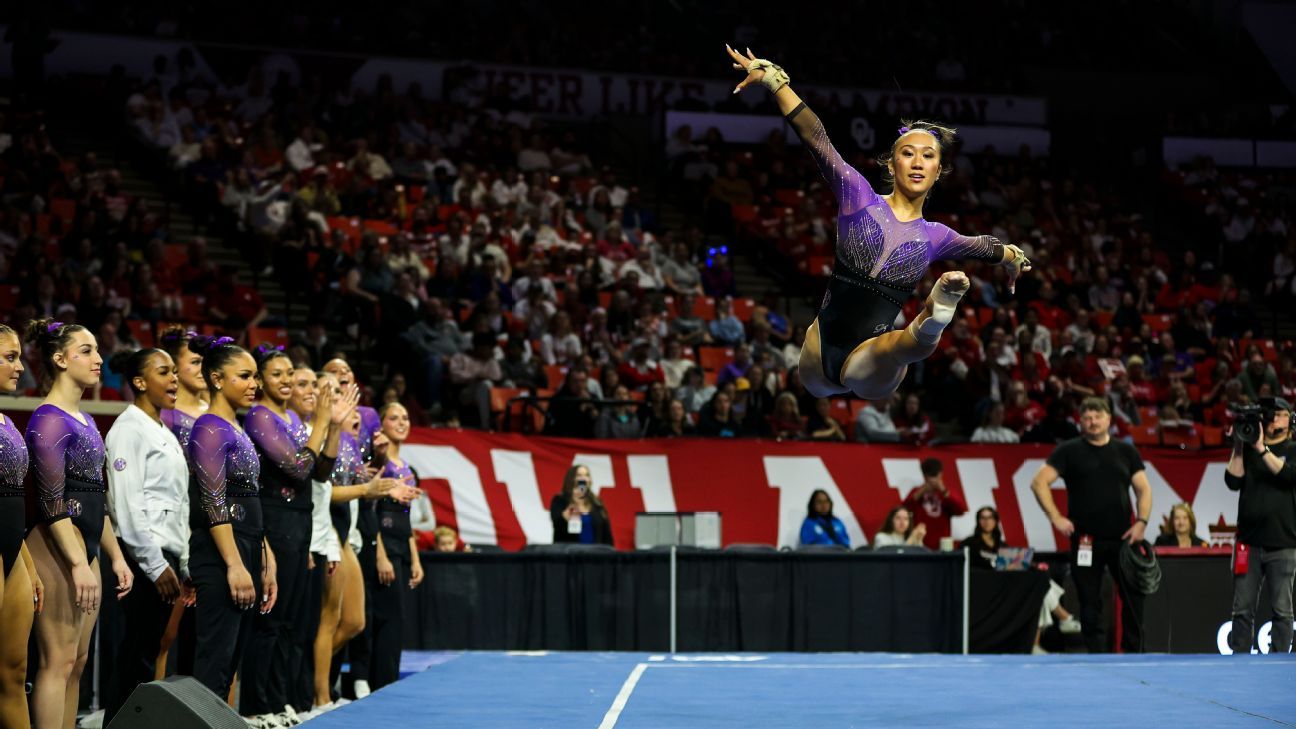
FORT WORTH, Texas — The first semifinal session of the NCAA gymnastics championships included LSU, Florida, Georgia and Stanford — with Florida and LSU advancing to Saturday’s final (4 p.m. ET; ABC).
Next up, Oklahoma, UCLA, Arkansas and Minnesota will compete in Semifinal II, beginning at 9 pm ET (ESPN2). Once again, the top two teams will move on.
Individual event titles and an all-around winner will also be awarded today — but not until both semifinal sessions are complete.
Who will make it to the next round? Will an upset surprise us all? We’ll have you covered with all the action here.
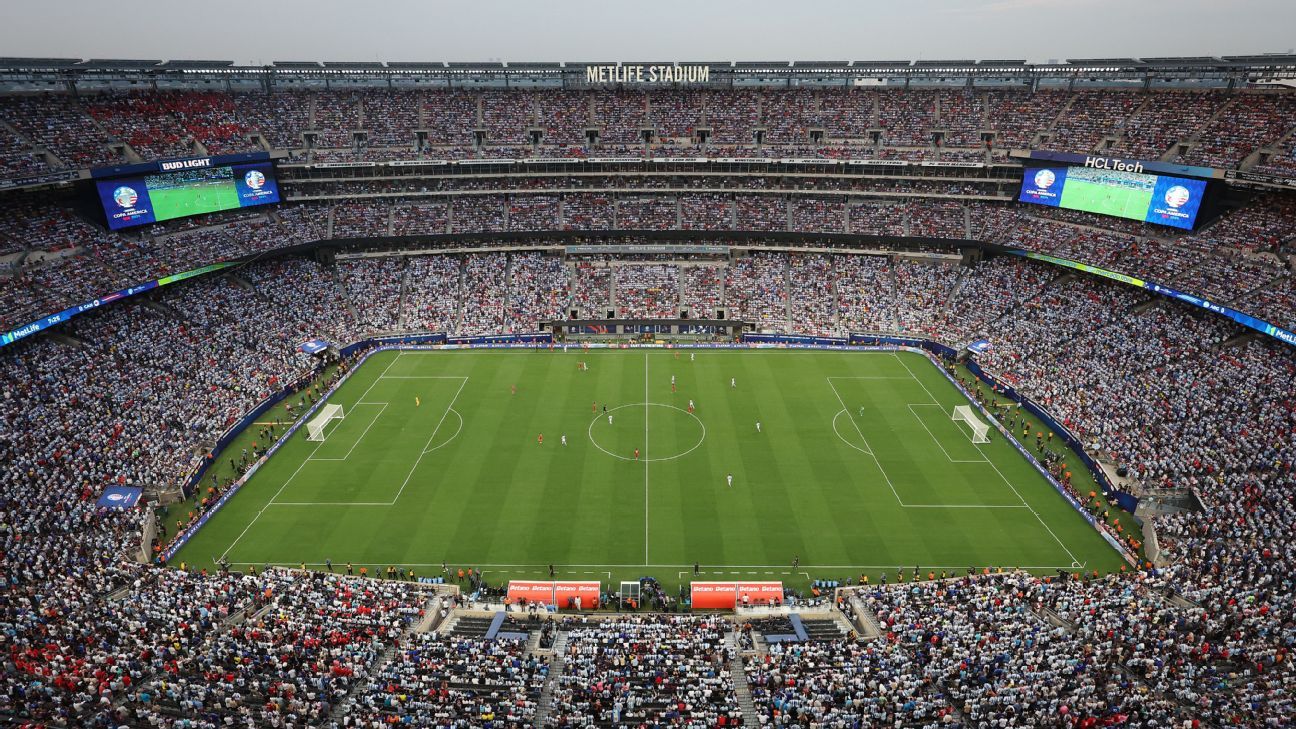
New Jersey Gov. Mikie Sherrill on Wednesday joined U.S. Senator Chuck Schumer in calling on FIFA to contribute toward World Cup transit security costs.
MetLife Stadium will host eight World Cup games, including the tournament final. The Athletic reported earlier this week that NJ Transit is considering charging $100 for train tickets to shuttle fans between New York Penn Station and the stadium. Standard fare is $12.90.
Parking will be restricted at the Meadowlands stadium complex compared to NFL games — making public transport one of the only options to attend World Cup matches, which get underway June 11.
“We inherited an agreement where FIFA is providing $0 for transportation to the World Cup,” Sherrill said on X. “And while NJ TRANSIT is stuck with a $48 million bill to safely get fans to and from games, FIFA is making $11 billion. I’m not going to stick New Jersey commuters with that tab for years to come.
“FIFA should pay for the rides. But if they don’t — I’m not going to let New Jersey get taken for one.”
Speaking on WNYC on Wednesday, Sherrill said she would approve the fare increase if FIFA doesn’t step in.
“I will, if that’s what it takes, because I’m not putting this on the back of New Jerseyans,” she said.
On Wednesday, NJ Transit’s board of directors unanimously approved a resolution to set transport prices to “cover any and all costs” to transport fans and comply with Sherrill’s directive.
NJ Transit CEO Kris Kolluri on Wednesday said he supported Sherrill’s plea to FIFA and confirmed that commuters would not pay extra costs, according to NJ.com.
“The governor said whatever the fare will be, it will not be cross subsidized by our regular commuters. I’d think every NJ Transit customer would stand behind that,” Kolluri told NJ.com. “It will cost us $48 million. We will charge FIFA fans for those tickets, and it will not be subsidized by our commuters.”
Schumer on Monday said FIFA should be helping pay for World Cup transit security costs.
“FIFA is set to reap nearly $11 billion from this summer’s World Cup, yet New York area commuters and residents are being handed the bill,” Schumer wrote on X. “The least FIFA can do is ensure New York residents can go to the stadium without being gouged at the turnstile. I am demanding FIFA step up.”
We inherited an agreement where FIFA is providing $0 for transportation to the World Cup.
And while NJ TRANSIT is stuck with a $48 million bill to safely get fans to and from games, FIFA is making $11 billion.
I’m not going to stick New Jersey commuters with that tab for years… pic.twitter.com/pugU8davkW
— Governor Mikie Sherrill (@GovSherrillNJ) April 15, 2026
Earlier this month, New Jersey’s host travel committee released a detailed plan for transport and parking during the matches, outlining a park-and-ride plan with specific parking lots and shuttle buses that will run to and from the stadium.
“While rideshare and limited premium parking options will be available, the FIFA World Cup at NYNJ Stadium will be a public transportation first event, largely relying on NJ Transit rail and Host Committee bus shuttles,” Natalie Hamilton, a host committee spokesperson, told NJ.com.
“We are strongly encouraging all ticket holders to utilize expanded NJ Transit rail service and the Host Committee’s Stadium Shuttle.”
A FIFA spokesperson insisted the host city had previously agreed to provide free or at-cost transportation to fans at all matches.
“We are quite surprised by the NJ governor’s approach on fan transportation,” FIFA said in a statement Wednesday.
“The original FIFA World Cup 2026 host city agreements signed in 2018 required free transportation for fans to all matches. Recognizing the financial strain this placed on the host cities, back in 2023 FIFA adjusted the host agreement requirements across all host cities as follows: All match ticket holders and accredited individuals shall be able to access transport [public or additionally planned transport] at cost to allow travel to stadiums on match days.
“Moreover, FIFA has worked for years with host cities on their transportation and mobility plans, including advocating for millions of dollars in federal funding to support host cities for transportation.
“The FIFA World Cup will bring millions of fans to North America along with the related economic impact. Many of these fans will travel to NYNJ to enjoy the eight matches scheduled, including the FIFA World Cup final.
“FIFA is not aware of any other major event previously held at NYNJ Stadium, including other major sports, global concert tours, etc, where organizers were required to pay for fan transportation.”
During the last World Cup in Qatar in 2022, ticket holders enjoyed free transport on the city’s Metro system, funded by the country’s government.
UEFA bore the cost of ticket holders using German public transport in host cities on match days during Euro 2024.
Kansas City, where England’s training camp will be based, will offer free bus travel for fans from the airport close to the Fan Festival in the city center, and daily, weekly and tournament passes for unlimited regional travel costing $5.25 and $50, respectively.
Ticket holders will also be able to use a Stadium Direct service, which connects four park and ride locations as well as the Fan Festival to the Arrowhead Stadium for $15 per person, the host city committee said.
Meanwhile, a spokesperson for the Southeastern Pennsylvania Transportation Authority (SEPTA) said that there will be no fare increases connected to the staging of World Cup matches in Philadelphia.
The spokesperson said most if not all of the added operating costs of running the services during the World Cup would be covered by a recently awarded federal grant.
Information from Press Association and The Associated Press was used in this report.


Mike Trout crushes fifth Yankee Stadium HR in four games

AI version of Val Kilmer to star in new movie after his death

2026 NCAA gymnastics championships: Live updates from semifinals

-

 Entertainment1 week ago
Queen Elizabeth II emotional message for Archie, Lilibet sparks speculation
-

 Tech1 week ago
Azure customers up in arms over ‘full’ UK South region | Computer Weekly
-

 Tech1 week ago
As the Strait of Hormuz Reopens, Global Shipping Will Take Months to Recover
-

 Fashion1 week ago
CII submits 20-pt agenda to Indian govt to back firms hit by Iran war
-

 Tech1 week ago
This AI Button Wearable From Ex-Apple Engineers Looks Like an iPod Shuffle
-

 Politics7 days ago
Indian airlines hit hardest after Dubai limits foreign flights until May 31
-

 Entertainment4 days ago
Palace left in shock as Prince William cancels grand ceremony
-

 Politics7 days ago
Chinese, Taiwanese will unite, Xi tells Taiwan opposition leader