

Business
Building of three new towns will start before election, Labour pledges


The construction of three new towns will begin before the next general election, Labour has pledged.
A taskforce has recommended 12 locations in England for development, with three areas – Tempsford in Bedfordshire, Leeds South Bank, and Crews Hill in north London – identified as the most promising sites.
Housing Secretary Steve Reed is expected to announce the plans in a speech on the opening day of Labour’s annual party conference.
Labour has put housebuilding at the centre of its vision of how to get the economy growing, promising to build 1.5 million new homes by 2029.
Tempsford is home to 600 people and currently has around 300 houses. Its parish council chairman David Sutton said residents had been kept in the dark about the potential plans, including how many new homes could be built.
“The biggest problem we’ve got at the moment is that even today, as an announcement’s being made, we’ve been given no idea whatsoever of the scale of what we’re being asked to live amongst,” he told the PA news agency.
“Nobody’s come to talk to us at all.”
The promise of a “new generation of new towns” was included in Labour’s election manifesto last year.
The 12 proposed developments range from large-scale standalone new communities, to expansions of existing towns and regeneration schemes within cities.
Sites in Cheshire, South Gloucestershire, East Devon, Plymouth and Manchester are among those which have been recommended for development.
The chosen sites will be subject to environmental assessments and consultation, with the government confirming the final locations and funding next spring.
Labour said each new town would have at least 10,000 homes and they could collectively result in 300,000 homes being built across England over the coming decades.
The government has welcomed a recommendation from the New Towns Taskforce that at least 40% of these new homes should be classed as affordable housing.
A New Towns Unit will be tasked with bringing in millions of pounds of public and private sector funding to invest in GP surgeries, schools, green spaces, libraries and transport for the new developments.
The taskforce has recommended new towns are delivered by development corporations, which could have special planning powers to compulsory purchase land, invest in local services, and grant planning permission.
This follows the model of the regeneration of Stratford in east London during and after the 2012 Olympic and Paralympic Games.
Prime Minister Sir Keir Starmer said: “For so many families, homeownership is a distant dream.
“My Labour government will sweep aside the blockers to get homes built, building the next generation of new towns.”
In his speech, the housing secretary will promise to “build baby build”, while “taking lessons from the post-war Labour government housing boom”.
“This party built new towns after the war to meet our promise of homes fit for heroes. Now, with the worst economic inheritance since that war, we will once again build cutting-edge communities to provide homes fit for families of all shapes and sizes,” Reed is expected to say.
After World War Two Clement Attlee’s government planned the first wave of new towns, including in Stevenage, Crawley and Welwyn Garden City, to relocate people from poor or bombed-out housing, with development corporations assigned responsibility for building them.
The announcement comes as Labour members gather in Liverpool for the party’s annual conference.
It will be Reed’s first major speech since he took over from Angela Rayner as housing secretary, after she resigned for failing to pay enough tax on a flat purchase.
It has been a bruising few weeks for Sir Keir, who is facing questions over his leadership and the direction of his party.
With Labour trailing behind Reform UK in the polls, the prime minister has stepped up his attacks on Nigel Farage’s party.
Arriving in Liverpool on Saturday, he warned Reform would “tear this country apart” and said the conference would be an opportunity to set out his alternative to the “toxic divide and decline” offered by the party.
Business
Top stocks to buy today: Stock recommendations for April 17, 2026 – check list – The Times of India

Stock market recommendations: Reliance Industries, and Varun Beverages are the top stock recommendations by Bajaj Broking Research for April 17, 2026.Reliance IndustriesBuy in the range of ₹ 1330.00-1350.00
Reliance Industries stock has undergone a corrective phase over the past three months and is currently consolidating near a crucial support zone of ₹1270–₹1300. This technical setup offers a favorable risk-reward profile, positioning the stock for a potential bullish reversal and the next leg of uptrend.This ₹1270–₹1300 range serves as a crucial support area, reinforced by the convergence of multiple technical factors: (a) 61.8% retracement of the previous April 2025-January 2026 up move (1115-1611) (b) 200 weeks EMA placed around 1292, which has historically acted as strong demand area for the stockThe ongoing corrective phase appears to be nearing exhaustion, with price action indicating the potential for a fresh bullish reversal. We anticipate the stock to resume its uptrend and head towards ₹ 1474 levels in the coming quarters being the high of February 2026 and the 61.8% retracement of the recent decline of the last 3 months ₹ 1611-1290.Varun BeveragesBuy in the range of 455-465
The share price of Varun Beverages has generated a breakout above the falling channel containing last 3 months decline signaling strength and offers fresh entry opportunity.The stock has also formed a higher high and higher low signaling resumption of up move after recent corrective decline.We expect the stock to head higher towards 503 levels in the coming weeks being the 80% retracement of the previous decline from 534 to 381.(Disclaimer: Recommendations and views on the stock market, other asset classes or personal finance management tips given by experts are their own. These opinions do not represent the views of The Times of India)

Experts say Mythos potentially has an unprecedented ability to identify and exploit cybersecurity weaknesses.
Source link
Business
Anthropic’s new AI model exposes fresh risks, flaws for cybersecurity, IT services – The Times of India
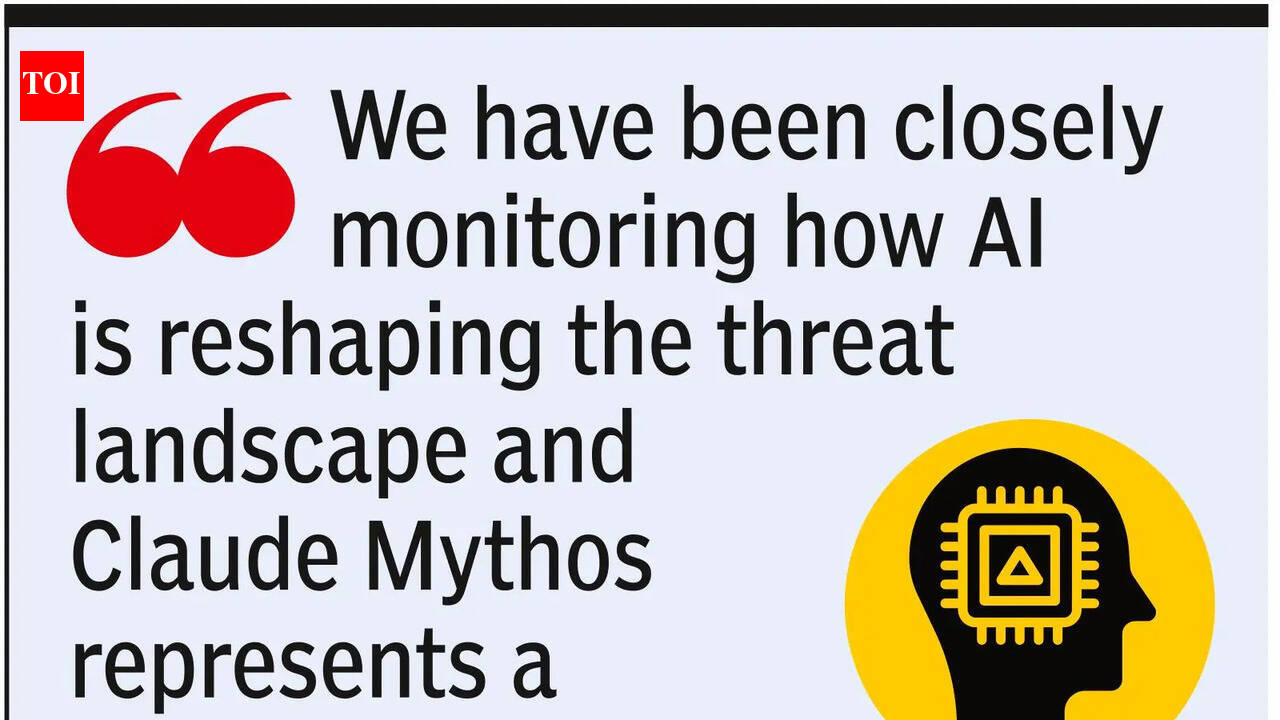
New Delhi: A powerful new AI model is forcing govts, banks, and technology firms to rethink the rules of cybersecurity – and in India, the stakes may be even higher.Claude Mythos, developed by Anthropic, has demonstrated the ability to autonomously detect and exploit software vulnerabilities, including flaws that have persisted for decades. Early tests revealed that the model could identify long-standing weaknesses and simulate complex, multi-step cyberattacks, prompting the company to restrict its wider release. Anthropic CEO Dario Amodei highlighted the shift, noting that AI systems are now capable of finding vulnerabilities “that humans have missed”, a signal of how quickly the cybersecurity landscape is changing.US Treasury Secretary Scott Bessent reportedly convened a meeting with top bank executives – including leaders from JPMorgan Chase, Goldman Sachs, Citigroup, BoA, and Morgan Stanley – to assess the risks posed by such advanced AI systems.That concern is not theoretical. According to Jaydeep Singh, GM for India at Kaspersky, the emergence of such systems represents a turning point not just for security professionals, but for everyday users. “We have been closely monitoring how AI is reshaping the threat landscape, and Claude Mythos represents a moment that every user, not just the cybersecurity industry, needs to understand,” Singh said.The dual-use nature of AI is at the heart of the concern. The same capability that strengthens defences can just as easily be weaponised. “The same capability that finds a 27-year-old vulnerability in hardened infrastructure is the capability that, in the wrong hands, turns every unpatched system into an open door,” Singh added.Cybersecurity firm Check Point Software Technologies echoed the warning. Sundar Balasubramanian, MD, India and South Asia, for Check Point, says, AI is “dramatically lowering the barrier to entry for cyber attackers,” enabling even less-skilled actors to identify and exploit vulnerabilities. He added that defensive tools can be repurposed offensively, compressing the traditional gap between attackers and defenders. Jayant Saran, partner, Deloitte India, described this as a “changed reality,” where organisations must prepare for risks that were previously invisible. He called AI a “double-edged sword…that cannot be reversed,” highlighting an accelerating race between those securing systems and those attempting to break them.In India, the risks are amplified by scale. From UPI to banking and govt platforms, millions depend on digital infrastructure – much of it built on legacy systems. These systems are often slower to patch, harder to monitor, and lack continuous threat intelligence, creating what Saran called an “asymmetric risk exposure.” Singh pointed out that this gap is especially critical in India, where legacy infrastructure serves hundreds of millions.Beyond cybersecurity, ripple effects could reach financial markets. Analysts say models like Mythos could automate parts of software development, testing, and security – core functions of IT services industry. While disruption may be gradual, labour-intensive outsourcing models could face pressure, while firms embracing AI may benefit.


Indonesia helicopter crash kills 8

USDA releases payments under 2026 Pima Cotton and Wool Trust Funds

Wings stifle questions about Azzi Fudd-Paige Bueckers relationship

-

 Entertainment1 week ago
Queen Elizabeth II emotional message for Archie, Lilibet sparks speculation
-

 Tech1 week ago
Azure customers up in arms over ‘full’ UK South region | Computer Weekly
-

 Tech1 week ago
As the Strait of Hormuz Reopens, Global Shipping Will Take Months to Recover
-

 Fashion1 week ago
CII submits 20-pt agenda to Indian govt to back firms hit by Iran war
-

 Tech1 week ago
This AI Button Wearable From Ex-Apple Engineers Looks Like an iPod Shuffle
-

 Politics7 days ago
Indian airlines hit hardest after Dubai limits foreign flights until May 31
-
Uncategorized1 week ago
[CinePlex360] Please moderate: “Trump considers
-

 Entertainment4 days ago
Palace left in shock as Prince William cancels grand ceremony