Connect with us

Politics

Cash-strapped Taliban look to airspace for windfall

Published

on

Cash-strapped Taliban look to airspace for windfall
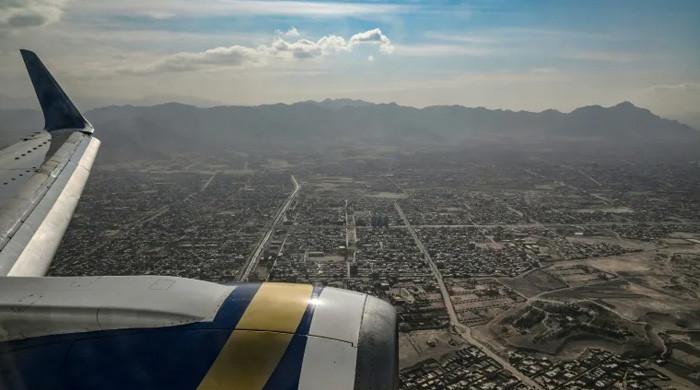

A view from inside a commercial plane flying over Kabul city in November 2021, after the Taliban takeover in August of that year. — AFP

Far above Kabul, the cash-strapped Taliban government has located a potentially lucrative revenue stream: Afghanistan’s airspace.

As Israel and Iran’s exchange of missiles threw flight paths into disarray this year, the skies above Afghanistan offered carriers a less turbulent and faster route to ply — for a flat $700 overflight fee, according to industry insiders.

The US aviation authority eased restrictions on the country’s airspace and paved the way for commercial flyovers in 2023, two years after the Taliban takeover.

Airspace that had long been avoided — as the country endured four decades of war and shifting powerbrokers — suddenly became a viable option, allowing carriers to abbreviate routes and save on fuel costs.

But it was not until the 12-day war between Iran and Israel in June that the route really gained traction, allowing the Taliban government to potentially rake in millions.

Faced with shuttered airspace over Iran and Iraq, and unpredictable openings and closures across the Middle East, airlines saw reason to divert course and found refuge over Afghanistan.

While missiles clogged the neighbouring airspace, “the risk of flying over Afghanistan (was) virtually zero”, said France-based aerospace and defence consultant Xavier Tytelman.

“It’s like flying over the sea.”

May’s average of 50 planes cutting through Afghanistan each day skyrocketed to around 280 after June 13, when war erupted in the neighbourhood, data from tracking website Flightradar24 showed.

Since then, in any given day, more than 200 planes often traverse Afghanistan — equivalent to roughly $4.2 million a month, though this figure is difficult to verify as the authorities do not publish budgets and have declined to comment.


Source link

Continue Reading
Click to comment

Leave a Reply

Your email address will not be published. Required fields are marked *

Politics

Global oil, gas shipping costs surge as Iran vows to close Strait of Hormuz

Published

on

Global oil, gas shipping costs surge as Iran vows to close Strait of Hormuz


An aerial view of the Iranian shores and the island of Qeshm in the strait of Hormuz, December 10, 2023. — Reuters

SINGAPORE: Global oil and gas shipping rates soared, with supertanker costs in the Middle East hitting all-time highs, as the US-Iran conflict intensified after Tehran targeted ships passing through the Strait of Hormuz, according to shipping data and industry sources on Tuesday.

Shipping through the Strait of Hormuz between Iran and Oman, which carries around one-fifth of oil consumed globally as well as large quantities of liquefied natural gas, has ground to a near halt after vessels in the area were hit as Iran retaliated to US and Israeli strikes.

The disruption and fears of prolonged closure have caused oil and European natural gas prices to jump, with Brent crude futures up nearly 10% this week as the conflict triggered multiple oil and gas shutdowns in the ⁠Middle East.

The benchmark freight rate for the very large crude carriers (VLCCs) used to ship 2 million barrels of oil from the Middle East to China, also known as TD3, rose to an all-time high of W419 on the Worldscale industry measure used to calculate freight rates, on Monday, or $423,736 per day, LSEG data showed.

Mideast to Asia oil shipping cost hit all-time high amid US-Iran conflict. — Reuters

The rate doubled from Friday, extending gains from a six-year high last week, after the US and Israel attacked Iran and killed its Supreme Leader Ayatollah Khamenei on Saturday.

In retaliation, Iran has struck Gulf countries, prompting precautionary shutdowns at oil and gas facilities across the Middle East.

An Iranian Revolutionary Guards senior official said on Monday that the Strait of Hormuz is closed and Iran will fire on any ship trying to pass, Iranian media reported.

The US military’s Central Command said the Strait is not closed despite the Iranian statements, Fox News reported.

LNG shipping rates jump

Still, daily freight rates for LNG tankers jumped more than 40% on Monday after Qatar halted ⁠its production.

Oil tankers pass through the Strait of Hormuz, December 21, 2018. — Reuters

Atlantic rates rose to $61,500 per day on Monday, up 43%, or $18,750, from Friday, according to Spark Commodities, a pricing assessment agency for LNG shipping. Pacific rates rose to $41,000 per day, up 45%, or $12,750, from Friday.

Fraser Carson, principal analyst for global LNG at energy consultancy Wood Mackenzie, said spot daily LNG shipping rates could rise above $100,000 this week on tight supply.

“Vessel availability for the rest of March is considered weak as cargo operators try to work through the backlog created by weather ⁠disruptions during February,” he said.

“There will be very strong competition for any available vessels,” he added.

Until safe passage through the Strait of Hormuz can be assured, shipping will remain idle, Carson said.

Tankers staying away from Strait of Hormuz amid Iran conflict. — Reuters

An oil shipbroker who declined to be named due to company policy said it is very difficult to assess shipping rates in the Gulf as several shipowners have ⁠suspended operations indefinitely.

South Korean shipping firm Hyundai Glovis said on Tuesday it is preparing contingency plans including securing alternative routes and ports in response to the Middle East conflict.

South Korea’s maritime ministry has issued a notice to South Korean shippers with vessels sailing in the Middle East, asking them to refrain ⁠from business operations in the region, an official told Reuters on Tuesday.

The ministry is holding a meeting to discuss further safety measures following Iran’s threat to attack any ship passing through the Strait of Hormuz, the official added.


Source link

Continue Reading

Politics

US Embassy in Riyadh damaged Trump warns of ‘big wave’ of attacks

Published

on


According to the US State Department, the Embassy in Riyadh was hit by two unmanned aerial vehicles (UAVs). “Embassy Riyadh has been struck by two UAVs that hit the roof and the perimeter of the chancery. Post is sheltering in place and reported no injuries.” the State Department said.

The attack by two drones early Tuesday on the US embassy in Riyadh sparked a fire, a Saudi defence ministry spokesman said in a statement, while Iran pressed on with retaliatory strikes across the Gulf.

The growing war began on Saturday after joint US-Israeli strikes on Iran that Tehran said killed dozens of civilians and the country’s supreme leader.

“The US Embassy in Riyadh was attacked by two drones, according to initial assessments. The attack resulted in a limited fire and minor material damage to the building,” the statement said.

Two witnesses told AFP they saw fire engines around the embassy.

Earlier, witnesses said they had seen smoke over the building housing the US mission and heard loud explosions in the diplomatic quarter, home to foreign embassies in the Saudi capital.

 A source close to the Saudi army, speaking on condition of anonymity to discuss the sensitive issue, told AFP that Saudi air defences intercepted four drones targeting Riyadh’s diplomatic quarter in the attack.

In the aftermath, the US embassy issued shelter in place notifications for Jeddah, Riyadh and Dhahran and limited non-essential travel to any military installations in the region.

Later on Tuesday, the Saudi defence ministry said it had intercepted more than half a dozen drones near capital Riyadh and the city of Al-Kharj. “Eight drones were intercepted and destroyed near the cities of Riyadh and Al-Kharj,” said defence ministry spokesman Major General Turki al-Malki on X.

The attacks in Saudi coincided with a wave of missiles and drones launched at Gulf states with the UAE defence ministry saying it was dealing with a barrage of ballistic missiles coming from Iran.

In Qatar, the military intercepted two ballistic missiles early Tuesday morning, the country’s defence ministry said in a statement.

Iran’s salvos have hit ports, airports, residential buildings and hotels along with military sites across the wealthy region of oil giants.

On Monday smoke poured out of Kuwait City’s US embassy, an AFP correspondent saw. Later, a Kuwait-based diplomat and a Western diplomat, speaking on condition of anonymity, told AFP the embassy had been damaged by several drones, while a second Kuwait-based diplomat said the building had been struck directly.

 Trump warns of longer war

US President Donald Trump warned that his attack on Iran could extend longer than a month, as the war spread Tuesday with Israel bombarding Lebanon and Tehran targeting US allies in the Gulf.

Shortly after the United States urged Americans to flee all Middle Eastern nations from Egypt eastward, smoke rose above the US embassy in Riyadh after it was hit by two drones, a Saudi defence spokesman said, although there were no immediate reports of injuries.

New powerful explosions also shook windows in Tehran as fighter jets flew over the Iranian capital, AFP journalists witnessed, as the Pentagon boasted that it had achieved air superiority over the country ruled since 1979 by Islamic clerics virulently opposed to the United States.

Trump said that the war, which began Saturday with a strike that killed Iran’s supreme leader, Ayatollah Ali Khamenei, was going “substantially” ahead of schedule but that the United States was equipped for a prolonged conflict.

“From the beginning we projected four to five weeks, but we have capability to go far longer than that,” Trump said at the White House.

He also for the first time laid out objectives — destroying Iran’s missiles, navy and nuclear programme and stopping its support for armed groups across the region. The goals notably did not include toppling the Islamic republic, even though on Saturday Trump had urged the people of Iran to rise up and overthrow their government.

Secretary of State Marco Rubio presented a strikingly new narrative of how the conflict started, saying that the United States, which built up its military to levels not seen since the 2003 Iraq invasion, attacked only after learning that ally Israel was set to strike Iran.

Iran had been ready to strike US forces in the region in response to Israel, so Trump decided to intervene “pre-emptively” alongside Israel, Rubio asserted.

“The imminent threat was that we knew that if Iran was attacked — and we believed they would be attacked — that they would immediately come after us,” Rubio told reporters before briefing lawmakers.

Rival Democrats voiced disbelief, with Senator Mark Warner saying it was “unchartered territory” for the United States to be triggered into action by Israel’s perception of a threat.

 Iran has responded to the attack by unleashing missiles and drones across the Middle East, threatening explicitly to drive up energy costs, which could wreak havoc on the global economy.

“We will burn any ship that tries to pass through the Strait of Hormuz,” Revolutionary Guards General Sardar Jabbari said of the strategic waterway to the Gulf through which about 20 percent of global seaborne oil travels.

European natural gas prices surged more than 39 percent after Qatar’s state-run energy firm said it had halted liquefied natural gas production following Iranian attacks.

Qatar, which had comparatively good relations with Iran before the war, said it shot down two Iranian bombers, the first time a Gulf Arab country has hit planes from their giant neighbour.

US doesn’t rule out troops

Trump warned that the United States had more firepower in store, saying, “The big wave hasn’t even happened.”

In an interview with the New York Post, Trump — who campaigned on promises to end US involvement in wars — refused to rule out deploying US ground troops to Iran “if they were necessary.”

Defense Secretary Pete Hegseth also signaled Monday that deploying troops inside Iran had not been ruled out.

In a combative public appearance, he rejected “stupid rules of engagement” that would constrain the United States and said, “We’ll go as far as we need to go.”

Ali Larijani, the head of Iran’s Supreme National Security Council, vowed that Iran would defend itself “regardless of the costs and will make the enemies sorry for their miscalculation.”

Tehran had the air of a ghost town on Monday, and many residents seemed to have left. Some, suitcases and luggage in hand, were preparing to do the same, AFP journalists saw.

Many residents were torn between fear of the bombings and hope that the government’s days might now be numbered.

“Every time we hear the noises, we get scared for just a second. But we experience some joy and excitement every time we hear a hit,” a 45-year-old lawyer said in a voice message to Europe.

Israel responds to latest missile strikes

Just after midnight local time Tuesday, Israel’s military said it was working to intercept a large wave of missiles launched from Iran targeting multiple locations, including Jerusalem.

“A short while ago, the IDF identified missiles launched from Iran toward the territory of the State of Israel. Defensive systems are operating to intercept the threat,” the military said.

Netanyahu: no ‘endless war’

Israeli Prime Minister Benjamin Netanyahu said in a Fox News interview Monday that the US-Israeli operation against Iran would be “a quick and decisive action,” later adding: “It may take some time, but it’s not going to take years.

New Israel strikes on Hezbollah

Israel’s military said Tuesday that it had launched strikes on Hezbollah targets including “command centres and weapons storage facilities” in Lebanon’s capital Beirut, after warning it would press ahead with its campaign against the Iran-backed group.

The Lebanese militant group said just after midnight that its rocket and drone attack on Israel was a “defensive act” after more than a year of Israeli strikes despite a ceasefire.

US warns citizens in Middle East to ‘depart now’

The US State Department urged Americans to leave much of the Middle East, including Egypt and Gulf states, due to the US-Israeli war on Iran.

The State Department “urges Americans to DEPART NOW from the countries below using available commercial transportation, due to serious safety risks,” wrote Mora Namdar, the assistant secretary of state for consular affairs, in a social media post.

The countries or territories included in the warning were Bahrain, Egypt, Iran, Iraq, Israel and the Palestinian territories, Jordan, Kuwait, Lebanon, Oman, Qatar, Saudi Arabia, Syria, the United Arab Emirates and Yemen.

Iran state broadcaster headquarters ‘struck and dismantled’

Israel’s military claimed it had “struck and dismantled” the headquarters of Iran’s state radio and television broadcaster, the Islamic Republic of Iran Broadcasting (IRIB), saying it had “called for the destruction of the State of Israel and for the use of nuclear weapons.”

The IRIB wrote on Telegram there had been explosions near its headquarters in Tehran but that there was no disruption to its operations.

NGO new Iran death toll

The US-based Human Rights Activists News Agency (HRANA) on Tuesday said there were 101 casualties inside Iran on the third day of the war, including “85 civilian deaths and 11 military personnel killed.”

Iran ‘will burn any ship’ in Hormuz

A general in Iran’s Revolutionary Guards threatened to “burn any ship” seeking to navigate the Strait of Hormuz, a vital route for oil and gas shipments.

“We will also attack oil pipelines and will not allow a single drop of oil to leave the region.

Oil price will reach $200 in the coming days,” General Sardar Jabbari said in a post on the Guards’ Telegram channel.

Israel was about to strike Iran, says Rubio

The United States attacked Iran after learning that ally Israel was going to strike, which would have meant retaliation against US forces, Secretary of State Marco Rubio said.

“We knew that if we didn’t preemptively go after them before they launched those attacks, we would suffer higher casualties,” Rubio told reporters.

US says hit 1,250 targets so far

The United States hit more than 1,250 targets in the first 48 hours of the war against Iran, the US military said.

Targets struck included command-and-control centers, ballistic missile sites, Iranian navy ships and submarines, and anti-ship missile sites, according to a fact sheet released by the US Central Command, which is responsible for American forces in the region.

Australia Middle East HQ hit

Australian Defence Minister Richard Marles said he could confirm reports that its military headquarters, the Al Minhad Air Base located just 24 kilometres (15 miles) south of Dubai in the UAE, had been hit over the weekend.


Source link

Continue Reading

Politics

Will Iran’s missiles drain US interceptor stocks?

Published

on

Will Iran’s missiles drain US interceptor stocks?


This US Navy handout photo shows the Arleigh Burke-class guided-missile destroyer USS Thomas Hudner (DDG 116) firing a Tomahawk land attack missile in support of Operation Epic Fury. — AFP
This US Navy handout photo shows the Arleigh Burke-class guided-missile destroyer USS Thomas Hudner (DDG 116) firing a Tomahawk land attack missile in support of Operation Epic Fury. — AFP 

US forces have shot down hundreds of Iranian ballistic missiles in recent days, raising questions about how long American air defence interceptor stocks will last in a war that could continue for weeks or more.

Iran responded to the massive US-Israeli air campaign launched over the weekend with barrages of hundreds of missiles and drones against countries in the Middle East that host American forces and bases.

Since the start of the war, the United States has “intercepted hundreds of ballistic missiles targeting US forces, our partners and regional stability,” General Dan Caine, the top US military officer, said Monday.

Those intercepts are a success — they prevented the missiles from striking their targets — but they also come at the cost of pricey, high-tech interceptors that are in short supply.

“There is a risk the United States and its partners could run out of interceptors before Iran runs out of missiles, though it is far from certain,” said Kelly Grieco, a senior fellow at the Stimson Center think-tank.

At the beginning of the conflict, Israel estimated Iran had some 2,500 ballistic missiles — “almost certainly more than the combined ballistic missile interceptor totals of Israel and the United States,” Grieco said.

However, the United States and Israel are hunting for launchers and storage sites, so “the race is, in short, between Iranian launchers and American and Israeli strikes on the sources of those launches,” she said.

Demand outpacing production

Caine said Iranian drones also pose a threat but did not provide a figure for the number that had been shot down, only saying that “our systems have proven effective in countering these platforms, engaging targets rapidly.”

Rocket trails are seen in the sky amid a fresh barrage of Iranian missile attacks above the Israeli coastal city of Tel Aviv on March 3, 2026. — AFP
Rocket trails are seen in the sky amid a fresh barrage of Iranian missile attacks above the Israeli coastal city of Tel Aviv on March 3, 2026. — AFP 

Grieco said that while interceptors are being expended on drones, it is not to the same degree as for missiles, and “the most acute shortage is with the ballistic interceptors.”

The length of the conflict is a factor affecting how many interceptors will be needed, and it is currently unclear how long it will last.

US officials including Donald Trump have referred to a multi-week war, though the president said Monday that “we’re already substantially ahead of our time projections.”

“From the beginning, we projected four to five weeks, but we have the capability to go far longer than that,” Trump said.

Pentagon chief Pete Hegseth had earlier given various possible timelines for the conflict: “Four weeks, two weeks, six weeks, it could move up. It could move back.”

Joe Costa, director of the Atlantic Council’s defence program, said that “sustained conflict with Iran could severely strain US stocks of critical air defence interceptors for China and other global priorities.”

“It depends on how effective the US and Israel will be in neutralising Iran’s launch capability of missiles and drones,” he said.

Grieco said that when it comes to interceptors, “production simply cannot keep pace with demand.”

“Every theatre, from Europe and the Indo-Pacific to the Middle East, has an acute need [for] more missile defence launchers and interceptors, and the United States is simply consuming them faster than it can replace them.”


Source link

Continue Reading

Trending