

Fashion
Cegid Retail refines its approach to the challenges of artificial intelligence for commerce


Published
September 14, 2025
Last year, Lyon-based management solutions specialist Cegid announced that it was bringing its Forward 2026 development strategy into line with generative artificial intelligence. Renamed Forward.ia, the development program continues, in particular for the Cegid Retail division, which is stepping up deployment and experimentation of retail solutions, while taking care not to fall into the trap of multiplying useless generative tools.
“Our approach has always been to make innovation useful and not to create gas factories that serve no one,” Nathalie Echinard, general manager of the retail division, tells FashionNetwork.com. “Nevertheless, we know that AI and generative AI will transform the business, both for our team internally and for our customers.”
Last year’s biennial Cegid Connections Retail event in Rome featured eight AI use cases anticipating the needs of commerce to 2030. Four have since been delivered. Starting with an enhancement to the Livestore checkout solution. This now enables a sales assistant to interact with customers with whom they do not share a common language, via a split screen.
The Cegid Retail Store Excellence tool, used for communication between a head office and its store network, has also been enhanced. “It can now translate and send messages to each store, for example to explain a new collection, in the case of fashion brands”, explained Echinard. The manager also points out that AI can now directly generate message bases or visuals to guide sales teams.
In the apparel business, these teams are subject to high turnover and have no time for training. In the past, Cegid has responded to this need with simplified dashboards that are easy to learn. But AI now enables the salesperson to exchange directly with the system verbally to explain their problem, so as to be guided through the task.
“We’re gradually moving towards an augmented sales assistant,” explained Echinard. “Augmented vis-à-vis the customer, but also in terms of efficiency and time optimization. Applications will help them to choose their priorities according to what’s happening in the store, but above all to navigate from one task to another without really realizing it.”

Personalization has not been forgotten. A tool, presented last year to Cegid’s partners, is currently being developed based on customer data and product recommendation learning. AI will reinforce the Livestore tool by helping the sales assistant to identify the needs of existing tastes and customers.
“This takes the form of a 6-8 word cloud that gives maximum information in a short space of time to the salesperson. After all, no one wants a sales assistant who remains immersed in the tablet”, explained the Cegid Retail manager.
A manager who also bears witness to the growing demands of brands in terms of security. Security breaches, cyber-attacks and data ransomware are on everyone’s mind. “When our customers are major players in the luxury goods and CAC40 sectors, we take this very seriously”, sais Echinard. She points out that, by contract, security updates are the only ones Cegid can launch to warn its customers.
“And, given what’s at stake, no brand has a problem with that,” said Echinard.
After the NRF (formerly Paris Retail Week) trade show, to be held in Paris from September 16 to 18, she will be preparing the 2026 edition of Cegid Connections Retail, to be held in Prague in the spring. Perhaps by then, the market will have taken a more rational look at AI.
“The enthusiasm it generates needs to stabilize, and everyone needs to stop going off in all directions,” concluded Echinard. She is mindful of the Gartner study which, last June, estimated that 40% of AI tools in development could be abandoned by 2027.
This article is an automatic translation.
Click here to read the original article.
Copyright © 2025 FashionNetwork.com All rights reserved.












The apparel climate story has moved out of the ESG report and into the cost sheet. In ****–****, climate risk is showing up as cotton quality loss, import dependence, energy volatility, cooling capex, carbon-price exposure and mandatory textile-waste fees. For brands and suppliers, the question is no longer whether climate action is ‘responsible’. It is whether delay will make product margins uncompetitive.
The latest data makes the shift visible. Textile Exchange says global fibre production reached *** million tonnes in **** and could hit *** million tonnes by **** if business continues as usual. Polyester alone now makes up ** per cent of global fibre output, with ** per cent still fossil-based. That scale gives apparel a low-cost material engine, but it also ties the sector to fossil energy, petrochemical volatility and future carbon accounting.

Caprolactam (CPL) prices initially held near $*.**–*.**/kg with minimal movement, while nylon chips saw uptick to ~$*.***/kg (+*.* per cent WoW) driven by short-term restocking. Nylon filament yarn (DTY **D/**F) prices remained stable at ~$*.**–*.**/kg, supported by existing inventory and steady downstream textile operations.
By the second week (April * to April **), benzene stabilised, but caprolactam began to weaken to ~$*.**–*.**/kg (−*.* per cent WoW), signalling the start of broader chain pressure. Nylon chips responded with a mild correction to ~$*.***/kg (−* per cent WoW), while filament yarn prices continued to hold steady due to inventory buffers and ongoing execution of prior textile orders. In the third week (Apr **–**), caprolactam stable to ~$*.*/kg, and chips followed to ~$*.***/kg (Stable WoW).
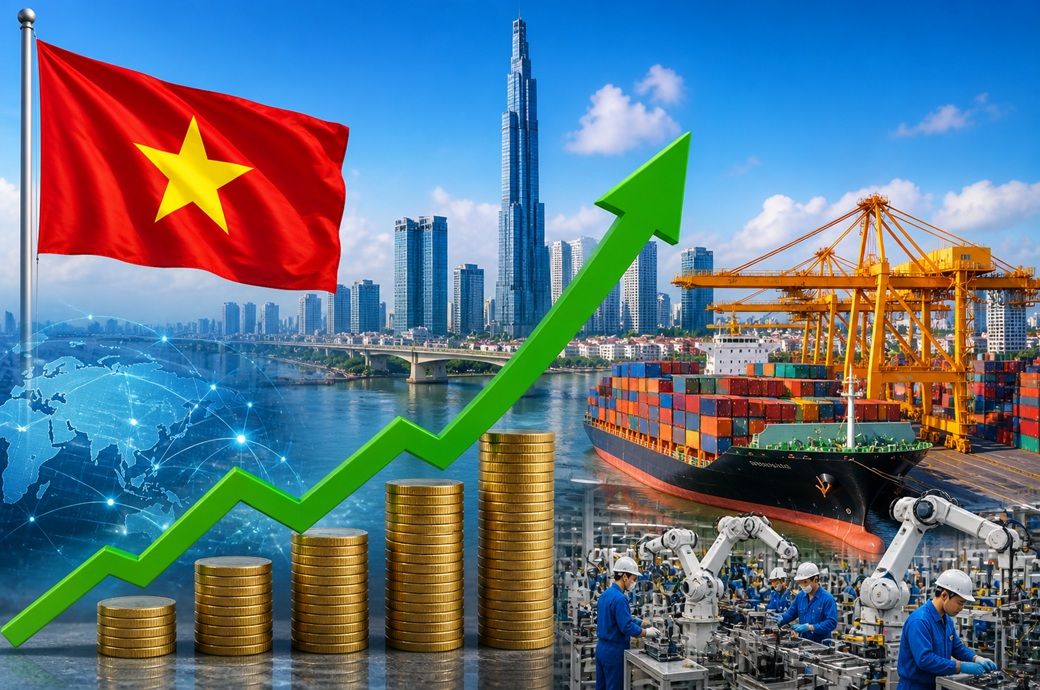
Total registered FDI, including newly registered and adjusted capital, along with foreign investors’ contributions and share purchases, reached $18.24 billion as of April 27, up 32 per cent year on year (YoY), according to the Ministry of Finance’s National Statistics Office (NSO).
Vietnam attracted $18.24 billion in FDI in January–April 2026, up 32 per cent, driven by manufacturing and processing.
Realised FDI hit a five-year high, signalling continued capacity expansion.
Trade surged to $344.17 billion, supported by strong US demand and rising imports from Asia, highlighting deeper global supply chain integration and export momentum.
A total of 1,249 new projects were licensed with combined registered capital of $12.15 billion, reflecting a 3.7 per cent annual increase in project numbers and a 2.2-fold rise in value. Manufacturing and processing dominated, attracting $8.12 billion, or 66.8 per cent of total newly registered capital.
Realised FDI in the January–April period was estimated at $7.40 billion, up 9.8 per cent YoY and marking the highest level for the period in the past five years. Of this, the manufacturing and processing sector disbursed $6.12 billion, accounting for 82.7 per cent. Meanwhile, 316 existing projects registered additional capital of $3.13 billion, representing a sharp 51 per cent decline compared to the same period last year. Combining newly registered and adjusted capital, total FDI into manufacturing and processing reached $10.49 billion, or 68.6 per cent of the total.
Foreign investors carried out 976 capital contribution and share purchase transactions worth $2.96 billion, up 61.9 per cent YoY. Among these, 325 deals increased enterprises’ charter capital by $445.13 million, while 651 share acquisitions without capital increases totalled $2.51 billion. Wholesale and retail trade led these investments, capturing $1.89 billion, or 63.9 per cent.
Among 53 countries and territories with newly licensed projects, Singapore was the largest investor with $6.05 billion, accounting for 49.8 per cent of the total. It was followed by the Republic of Korea with $4.08 billion (33.6 per cent), China with $524.1 million (4.3 per cent), Japan with $462 million (3.8 per cent), Hong Kong (China) with $329.2 million (2.7 per cent), and the Netherlands with $318.5 million (2.6 per cent).
On the trade front, Vietnam’s total trade with the rest of the world was estimated at $344.17 billion in the first four months of 2026, a significant increase from $277.21 billion in the same period last year, the NSO said. In April alone, trade volume reached an estimated $94.32 billion, rising 8 per cent from March and 26.7 per cent YoY.
The United States remained the largest importer of Vietnamese goods, with imports valued at $53.9 billion, while China continued as the top supplier with $69 billion. Imports from traditional markets also surged, with South Korea and ASEAN recording growth rates of 57.8 per cent and 44.3 per cent, respectively.
Fibre2Fashion News Desk (MS)


‘I Actually Thought He Was Going to Hit Me,’ OpenAI’s Greg Brockman Says of Elon Musk

Government needs to act on Middle East impact on retail, industry warns

WWE star Chelsea Green reveals she underwent ‘heart procedure’ to address SVT

-

 Tech1 week ago
A Brain Implant for Depression Is About to Be Tested in Humans
-

 Tech1 week ago
Almost 90% of women leave tech industry within 10 years | Computer Weekly
-

 Sports1 week ago
Pro wrestling star Steph De Lander reveals how colleague’s advice helped lead her to title triumph at ACW
-
 Business1 week ago
‘I had £20,000 stolen and had to fight a 13-month fraud reporting rule to get it back’
-

 Entertainment1 week ago
Norway joins Type 26 Frigate Programme to boost NATO naval power
-

 Entertainment1 week ago
Melania Trump says ABC should ‘take a stand’ on late-night host Kimmel
-

 Tech1 week ago
Are tech leaders risking a cyber resourcing crisis? | Computer Weekly
-
 Business6 days ago
PSX plunges over 4,800 points | The Express Tribune