

Politics
China to build ‘birth-friendly society’, refine social security system

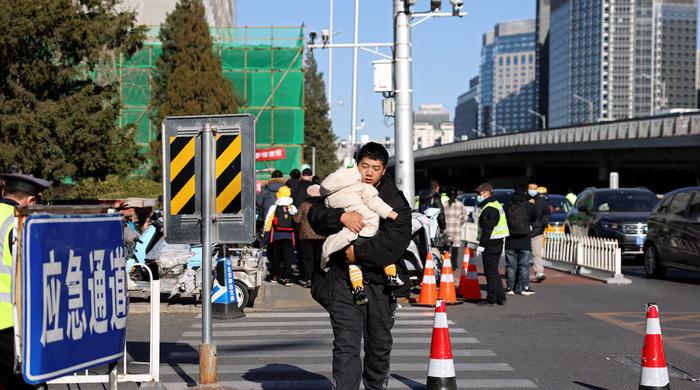

China said on Thursday it would build a “childbirth-friendly society” in the next five years, pledging to address concerns over employment, education, medical care, health and income, according to an official government report.
Authorities will improve population services and respond proactively on ageing, including “promoting high-quality, full employment, improving the income distribution system, and refining the social security system.”
They will also foster “positive attitudes towards marriage and childbearing,” the report said, adding that it would boost housing support for families with children.
China’s population fell for a fourth consecutive year in 2025, as the birth rate plunged to a record low, official data showed in January, with experts warning of further decline.
Policymakers have made population planning a key part of the country’s economic strategy and this year Beijing faces a total potential cost of around 180 billion yuan ($25.8 billion) to boost births, according to Reuters estimates.
Key costs are the national child subsidy, which was introduced for the first time last year, as well as a pledge that women throughout pregnancy have “no out-of-pocket expenses” in 2026, with all medical costs, including in vitro fertilisation (IVF), fully reimbursable under its national medical insurance fund.
Authorities will continue to implement the childcare subsidy system and expand demonstrations and trials for subsidised childcare services, the report said, without giving further details.
Services for women in early stages of pregnancy as well as reproductive health would be improved while authorities aimed to better prevent and treat birth defects.
Authorities will also refine policies on free preschool education and increase the supply of regular senior secondary school places, with government spending on education mandated to be higher than 4% of GDP, the report said.
Developing the ‘silver economy’
China’s population has been shrinking since 2022 and is ageing rapidly, complicating Beijing’s plan to boost domestic consumption and rein in debt.
New policies will be introduced to promote “high-quality development of the silver economy”, targeted at those aged 60 and older, with elderly care services to be increased, particularly in rural areas, the report said.
Authorities will also draw up measures to refine supportive policies designed for seniors including pension finance, wellness and care, it said.
By 2035, the number of Chinese over-60s is set to hit 400 million – roughly equal to the populations of the US and Italy combined – meaning hundreds of millions of people are set to leave the workforce at a time when pension budgets are already stretched.
China has already increased retirement ages, with men now expected to work until they are 63 rather than 60, and women until they are 58 rather than 55.


- Options include suspending Spain from Nato.
- Proposals to decrease European ‘sense of entitlement’.
- Trump has threatened to pull US out of 76-year-old alliance.
WASHINGTON: An internal Pentagon email outlines options for the United States to punish Nato allies it believes failed to support US operations in the war with Iran, including suspending Spain from the alliance and reviewing the US position on Britain’s claim to the Falkland Islands, a US official told Reuters.
The policy options are detailed in a note expressing frustration at some allies’ perceived reluctance or refusal to grant the United States access, basing and overflight rights – known as ABO – for the Iran war, said the official, who spoke on condition of anonymity to describe the email.
The email stated that ABO is “just the absolute baseline for Nato,” according to the official, who added that the options were circulating at high levels in the Pentagon.
One option in the email envisions suspending “difficult” countries from important or prestigious positions at Nato, the official said.
President Donald Trump has harshly criticised Nato allies for not sending their navies to help open the Strait of Hormuz, which was closed to global shipping following the start of the air war on February 28.
He has also declared he is considering withdrawing from the alliance.
“Wouldn’t you if you were me?” Trump asked Reuters in an April 1 interview, in response to a question about whether the US pulling out of Nato was a possibility.
But the email does not suggest that the United States do so, the official said. It also does not propose closing bases in Europe.
The official declined to say whether the options included a widely expected US drawdown of some forces from Europe, however.
Asked for comment on the email, Pentagon Press Secretary Kingsley Wilson responded: “As President Trump has said, despite everything that the United States has done for our Nato allies, they were not there for us.
“The War Department will ensure that the President has credible options to ensure that our allies are no longer a paper tiger and instead do their part. We have no further comment on any internal deliberations to that effect,” Wilson said.
Trump administration sees European ‘sense of entitlement’
The US-Israeli war with Iran has raised serious questions about the future of the 76-year-old bloc and provoked unprecedented concern that the US might not come to the aid of European allies should they be attacked, analysts and diplomats say.

Britain, France and others say that joining the US naval blockade would amount to entering the war, but that they would be willing to help keep the Strait open once there was a lasting ceasefire or the conflict ended.
But Trump administration officials have stressed that Nato cannot be a one-way street.
They have expressed frustration with Spain, where the Socialist leadership said it would not allow its bases or airspace to be used to attack Iran. The United States has two important military bases in Spain: Naval Station Rota and Moron Air Base.
The policy options outlined in the email would be intended to send a strong signal to Nato allies with the goal of “decreasing the sense of entitlement on the part of the Europeans,” the official said, summarising the email.
The option to suspend Spain from the alliance would have a limited effect on US military operations but a significant symbolic impact, the email argues.
The official did not disclose how the United States might pursue suspending Spain from the alliance, and Reuters could not immediately determine whether there was an existing mechanism at NATO to do so.
The memo also includes an option to consider reassessing US diplomatic support for longstanding European “imperial possessions,” such as the Falkland Islands near Argentina.
The State Department’s website states that the islands are administered by the United Kingdom but are still claimed by Argentina, whose Libertarian President Javier Milei is a Trump ally.
Britain and Argentina fought a brief war in 1982 over the islands after Argentina made a failed bid to take them. Some 650 Argentine soldiers and 255 British troops died before Argentina surrendered.
Trump has repeatedly insulted British Prime Minister Keir Starmer, calling him cowardly because of his unwillingness to join the US war with Iran, saying he was “No Winston Churchill” and describing Britain’s aircraft carriers as “toys.”
Britain initially did not grant a request from the US to allow its aircraft to attack Iran from two British bases, but later agreed to allow defensive missions aimed at protecting residents of the region, including British citizens, amid Iranian retaliation.
Addressing reporters at the Pentagon earlier this month, Defence Secretary Pete Hegseth said “a lot has been laid bare” by the war with Iran, noting that Iran’s longer-range missiles cannot hit the United States but can reach Europe.
“We get questions, or roadblocks, or hesitations … You don’t have much of an alliance if you have countries that are not willing to stand with you when you need them,” Hegseth said.
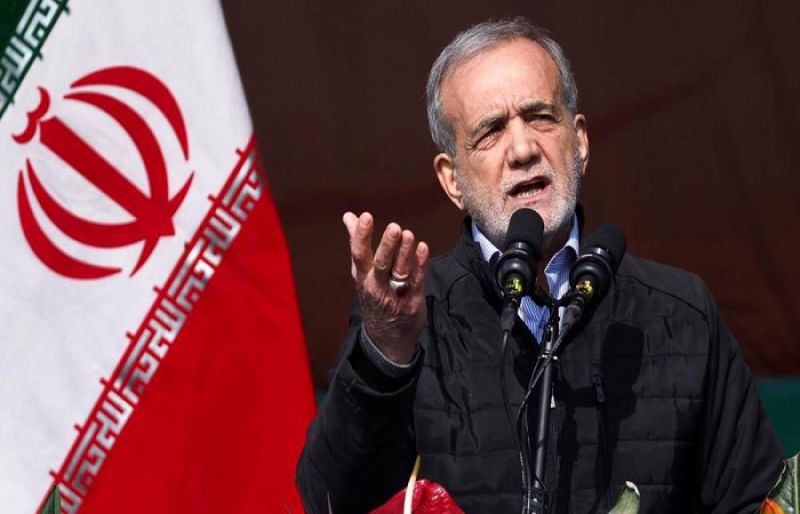
The Islamic Republic of Iran has invariably welcomed dialogue and agreement, but Washington’s constant breach of commitments, naval blockade and military threats remain the main obstacles to genuine negotiations, President Masoud Pezeshkian said on Wednesday.
In a post on X, the president reiterated Tehran’s openness to diplomacy while calling out Washington’s contradictory behavior.
“The Islamic Republic of Iran has welcomed dialogue and agreement and continues to do so,” Pezeshkian wrote.
“Breach of commitments, blockade and threats are the main obstacles to genuine negotiations. The world sees your endless hypocritical rhetoric and contradiction between claims and actions,” he added.
The United States and Israel launched their illegal, unprovoked war of aggression against Iran on February 28, assassinating Leader of the Islamic Revolution Ayatollah Seyyed Ali Khamenei and striking military installations and civilian infrastructure, including schools, hospitals and bridges.
Since then, Iran has demonstrated its responsible approach by agreeing to a two-week ceasefire brokered by Pakistan, despite having the upper hand on the battlefield after 100 waves of decisive retaliatory strikes under Operation True Promise 4.
Despite the ceasefire, Washington keeps highlighting a naval blockade of Iranian ports. Tehran considers it illegal under international law and a clear violation of the truce.
The United States has also threatened further military action, while its officials have issued contradictory statements about their commitment to diplomacy.
Iranian officials have said no decision has been made yet on whether to take part in a second round of negotiations in Islamabad, citing US violations of the ceasefire, including the naval blockade.


A composed half-century from captain David Warner, supported by a late surge from Khushdil Shah, guided Karachi Kings to a five-wicket win over Lahore Qalandars in Pakistan Super League (PSL) 11 encounter at Lahore’s Gaddafi Stadium on Thursday.
Set to chase a daunting 200-run target, the visitors knocked off the winning runs for the loss of five wickets and eight balls to spare to keep their playoff hopes alive.
The Kings got off to a shaky start to the pursuit as Ubaid Shah dismissed right-handed opener Jason Roy (nine) in the second over with just 10 runs on the board.
Warner then shared brief partnerships with Reeza Hendricks and Salman Ali Agha, who could contribute 10 and 14, respectively.
The skipper then received ample support from the other end in the form of Moeen Ali, and the experienced duo put together 58 runs at a brisk pace before Ubaid struck again, dismissing the latter, who made a 17-ball 39, laced with four sixes and a four.
The Kings then suffered another setback nine deliveries later as wicketkeeper batter Azam Khan, who scored 14 off eight balls, was cleaned up by Daniel Sams.
His dismissal paved the way for Khushdil Shah to walk out and bat at No.7, and the left-handed batter turned the game on its head with belligerent hitting, the highlight of which was the pulsating 18th over, bowled by Shaheen Shah Afridi, which went for 23 runs.
With just 11 runs required off 12 deliveries, Khushdil hit Haris Rauf for back-to-back sixes and steered the Kings over the line in the penultimate over.
Khushdil remained unbeaten with a swashbuckling 14-ball 44, comprising five fours and two sixes, while Warner top-scored with 63 not out from 44 deliveries, laced with 10 boundaries, including a six.
Ubaid was the pick of the bowlers for the Qalandars, taking three wickets for 41 runs in his four overs, while Daniel Sams and Haris Rauf made one scalp apiece.
Khushdil was named Player of the Match for a match-winning 44 off just 14 balls.
Kings captain David Warner’s decision to field first backfired as the holders piled up 199/6 in their 20 overs, courtesy of a century-plus partnership between Fakhar and Shafique.
The Qalandars, however, had a shaky start to their innings as Warner sent back young opener Mohammad Farooq (18) with a direct hit in the third over with just 24 runs on the board.
Fakhar was joined by Shafique in the middle, and the duo steered the Qalandars into a commanding position by knitting a 110-run partnership for the second wicket off just 61 deliveries until the former was dismissed by Moeen Ali in the 14th over.
The left-handed opener made a brisk 61 off 41 deliveries, hitting five fours and three sixes.
Moeen struck again in his next over, getting rid of Charith Asalanka (zero), and brought the total down to 148/3.
Shafique, on the other hand, was cleaned up by debutant Rizwanullah in the next over and walked back after top-scoring for the Qalandars with a 36-ball 62, studded with five fours and three sixes.
With the scoreboard reading 160/4 in 16.5 overs, all-rounders Sikandar Raza and Daniel Sams (20) stitched a handy 23-run partnership, which culminated with the latter’s run-out on the fifth delivery of the penultimate over.
Meanwhile, Raza remained unbeaten with a 12-ball 18 and ensured adding crucial runs to the Qalandars’ total at the backend with captain Shaheen Shah Afridi, who made 10 off four.
Moeen was the standout bowler for the Kings as he took two wickets for just 26 runs in his four overs, while Rizwanullah and Hasan Ali made one scalp.


North India cotton yarn steady despite continued push by spinners

The WIRED Gear Team’s Tips on Ways to Save Money

Bangladesh, EU sign Partnership and Cooperation Agreement

-

 Fashion1 week ago
France’s LVMH Q1 revenue falls 6%, shows resilience amid Iran war
-

 Entertainment1 week ago
Is Claude down? Here’s why users are seeing errors
-

 Sports1 week ago
PSL 11: Peshawar Zalmi win toss, opt to field first against Quetta Gladiators
-

 Tech1 week ago
CYBERUK ’26: UK lagging on legal protections for cyber pros | Computer Weekly
-
 Business1 week ago
PepsiCo earnings beat estimates as North American food business improves
-

 Sports5 days ago
WWE WrestleMania 42 Night 2: Live match results and analysis
-

 Fashion1 week ago
Raymond unveils luxury Chairman’s Collection Store in Mumbai
-

 Sports5 days ago
NCAA men’s gymnastics championship: All-time winners list