

Fashion
China’s central bank to inject $72.5 bn via one-year MLF operation


The People’s Bank of China (PBoC) is set to conduct a one-year medium-term lending facility (MLF) operation worth 500 billion yuan (~$72.52 billion) on Wednesday. The move is aimed at ensuring sufficient liquidity within the banking system.
The People’s Bank of China will conduct a 500-billion-yuan (~$72.52 billion) one-year MLF operation to support banking liquidity.
Conducted via variable-rate tenders, the move will offset 450 billion yuan in maturing funds, resulting in a net injection of 50 billion yuan (~$6.9 billion).
This marks the 13th consecutive month of net liquidity infusion by the central bank.
The operation will be carried out via variable-rate tenders with a fixed volume, using a multiple-price auction mechanism, said Chinese media reports quoting the central bank.
With 450-billion-yuan worth of MLF funds due to mature this month, the latest operation will result in a net liquidity injection of. This marks the 13th consecutive month in which the PBoC has added net liquidity through the facility.
The operation will result in a net liquidity injection of 50 billion yuan (~$6.9 billion), after accounting for 450 billion yuan in MLF funds maturing this month, extending the PBoC’s streak of net injections to 13 consecutive months.
Fibre2Fashion News Desk (SG)













The company posted a net loss of $7 million, compared to a net income of $16.3 million in FY24. Adjusted EBITDA fell to $63.6 million, or 6.4 per cent of sales, from $109.1 million, or 9.9 per cent a year earlier.
Torrid Holdings has reported a weak FY25, with sales falling 9.4 per cent to $1 billion and a net loss of $7 million amid margin pressure.
The company closed 151 stores and saw EBITDA decline.
Q4 performance also weakened.
Despite this, Torrid expects modest recovery in FY26, supported by optimisation efforts, improved marketing and a stronger operational foundation.
The company closed a total of 151 stores during the year as part of its retail optimisation strategy, reducing its footprint from 634 to 483 stores, Torrid Holdings said in a press release.
Torrid ended the year with $20 million in cash and cash equivalents, while total liquidity stood at $84.9 million. Net cash used in operations was $13 million, compared to positive operating cash flow of $77.4 million in the previous year.
For the fourth quarter (Q4), net sales dropped 14.3 per cent year-on-year (YoY) to $236.2 million, while comparable sales fell 10 per cent. Gross margin contracted to 30.0 per cent from 33.6 per cent a year earlier. The company reported a net loss of $8.1 million, widening from a $3.0 million loss in the same period last year. Adjusted EBITDA declined sharply to $5.1 million, or 2.2 per cent of sales, compared to $16.7 million, or 6.1 per cent, previously.
During the quarter, Torrid closed 77 stores under its Store Footprint Optimisation Project, taking the total store count to 483 locations.
Commenting on performance, Lisa Harper, chief executive officer at Torrid Holdings, said, “2025 was a transformational year. We delivered $1 billion in net sales, in line with our guidance, and $63.6 million in Adjusted EBITDA, exceeding the high end of our outlook, while making deliberate strategic decisions required to put this business on a stronger footing. We closed 151 structurally unproductive locations, launched five sub-brands that generated approximately $70 million in sales, and fundamentally restructured our product assortment around core franchises and fabrications our customers value most. Trends in Q4 and early Q1 give us confidence that the foundation we’ve built is beginning to take hold.”
Looking ahead, the company expects first-quarter fiscal 2026 net sales in the range of $236 million to $244 million, with Adjusted EBITDA between $14 million and $18 million. For the full year, Torrid forecasts net sales between $940 million and $960 million and Adjusted EBITDA of $65 million to $75 million, alongside capital expenditure of $8 million to $10 million.
“We enter 2026 with a strong operational foundation—optimised channels, product and pricing. This positions us to accelerate customer file growth through renewed marketing efforts, helping us re-engage past shoppers, attract new customers and deepen loyalty across our existing base. I am confident we are on the right path and encouraged by early signs of progress we are seeing in the business,” added Harper.
Fibre2Fashion News Desk (SG)
During the second month of ****, apparel and accessories accounted for *.* per cent of Japan’s total imports, which stood at *,***,*** million yen. Imports of textile yarn and fabric rose **.* per cent to **,*** million yen (~$***.** million), representing * per cent of total imports.
On the export side, textile yarn and fabric shipments decreased *.* per cent to **,*** million yen (~$***.** million). Textile machinery exports rose *.* per cent to **,*** million yen (~$***.** million), contributing *.* per cent to Japan’s total exports of *,***,*** million yen.
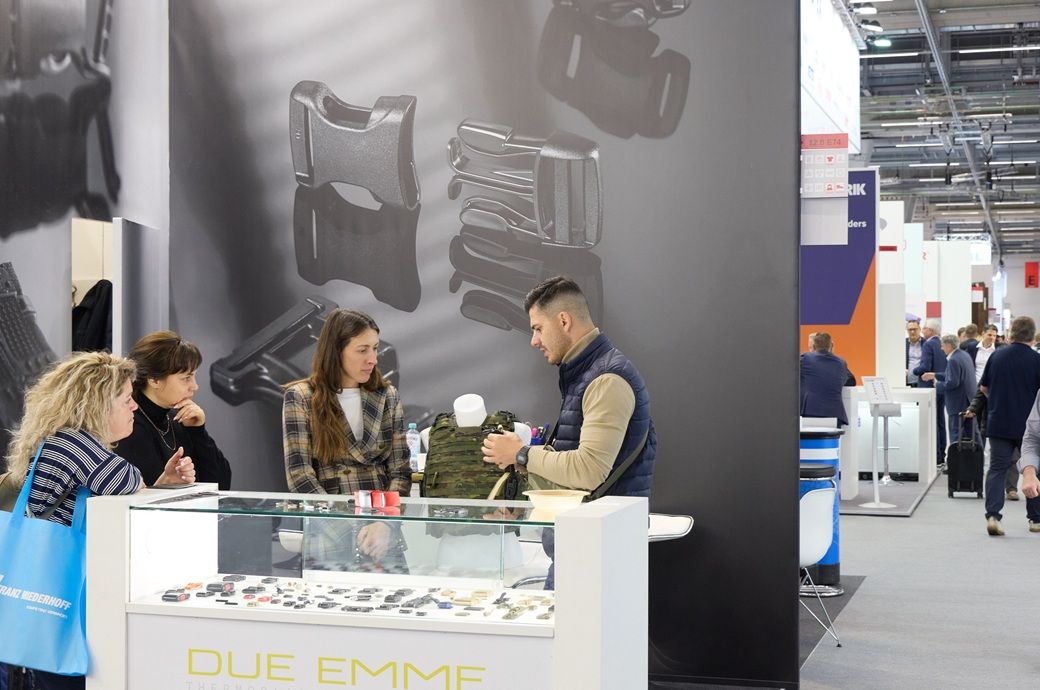
For product developers and OEM manufacturers, the performance of personal protective equipment is determined deep within the textile value chain. Materials are required that deliver ballistic protection, flame resistance and exceptional durability – without compromising on comfort and ergonomics. At the same time, regulations such as PFAS restrictions are increasing demand for alternatives to water-, oil- and dirt-repellent finishes.
Driven by rising EU defence spending, Techtextil 2026 will spotlight scalable textile solutions for defence and protective applications.
More than 150 exhibitors will present material innovations for protective textiles, advanced fibres, smart fabrics and compliant finishes, enabling OEMs and system providers to source reliable components for ballistic, flame-resistant and CBRN protection.
For procurement managers, buyers and technical leads at system providers, industrial feasibility is coming into sharper focus. They need market-ready materials and textile components that can be processed in compliance with standards, reproducibly and at reliable volumes – for example in ballistic protection systems or CBRN protective clothing.
Techtextil offers decision-makers from the defence sector the market overview they need to position themselves strategically in the growing market for protective textiles. More than 150 specialised exhibitors form the technological backbone: from fibre innovations for developers and manufacturers to finished materials for procurement. The Lenzing Group, for example, presents inherently flame-retardant cellulose fibres that embed heat and flame protection directly into the fibre. Another example is HS Hyosung Advanced Materials, showcasing high-performance yarns made from synthetic polymers.
At the same time, Texprocess, with around 200 exhibitors in Hall 8.0, bridges the gap to finishing and industrial processing. Together, the two events bring together more than 1,700 exhibitors at the Frankfurt exhibition grounds.
“Requirements for protective fabrics are becoming increasingly similar across many fields of application: low weight, high durability, thermal comfort, and reproducible processing,” explains Lotje Oosterlinck, Product Manager Workwear at Concordia Textiles. “What is becoming decisive, therefore, is the ability to develop material solutions across different protection domains and to transfer them into industrial processes tailored to specific applications.”
Industrial scalability: from fibre to protective systems
In the “Performance Apparel Textiles” area (Hall 9.0), around 150 exhibitors bring together concrete applications for protective clothing – showcased in the live format “Performance Apparels on Stage”. The foundation is provided by the new “Textile Chemicals & Dyes” segment: more than 30 exhibitors connect chemical processes directly with textile applications.
Key mechanical components for these protective solutions are also supplied by specialists such as Güth & Wolf GmbH, JUMBO-Textil GmbH & Co. KG, and Otto Stockmayer & Sohn GmbH, offering high-performance narrow textiles, webbings and knitted fabrics.
“In protective textiles, market relevance is not determined by a new fibre or finish alone. Particularly in demanding applications, testability, reproducibility and the reliable transfer into industrial processes are becoming the true benchmarks of innovation,” says Dr. Heike Illing-Günther, Managing Director of the Saxon Textile Research Institute.
The Techtextil Forum provides the technological framework for this industrial scaling. Featuring practical insights from NASA experts and focusing on topics such as “Textile Intelligence” and “Resilient Textiles”, the platform addresses the industry’s operational needs: smart functionalities, material resilience and the rapid transition from concept to scalable application.
Note: The headline, insights, and image of this press release may have been refined by the Fibre2Fashion staff; the rest of the content remains unchanged.
Fibre2Fashion News Desk (JP)


US’ Torrid sees FY25 sales fall 9.4%, reports $7 mn loss

Wristband enables wearers to control a robotic hand with their own movements

UK inflation rate steady in February ahead of Iran war

-

 Fashion7 days ago
Sales at US apparel, clothing accessories stores up 4% YoY in Jan 2026
-
 Business1 week ago
Peloton is launching bikes and treadmills for gyms, accelerating commercial strategy
-

 Tech1 week ago
Justice Department Says Anthropic Can’t Be Trusted With Warfighting Systems
-

 Fashion1 week ago
Trump signs order to combat fraudulent ‘Made in America’ labels
-
 Business1 week ago
Stocks and pound rise as US rate call approaches
-
 Fashion1 week ago
Lenzing launches TENCEL Lyocell-HV100 at Intertextile Shanghai
-

 Entertainment7 days ago
Val Kilmer revived 1 year after death through AI
-

 Sports1 week ago
PCB files complaint over allowing Bangladesh to take review on penultimate ball – SUCH TV