

Tech
Wristband enables wearers to control a robotic hand with their own movements

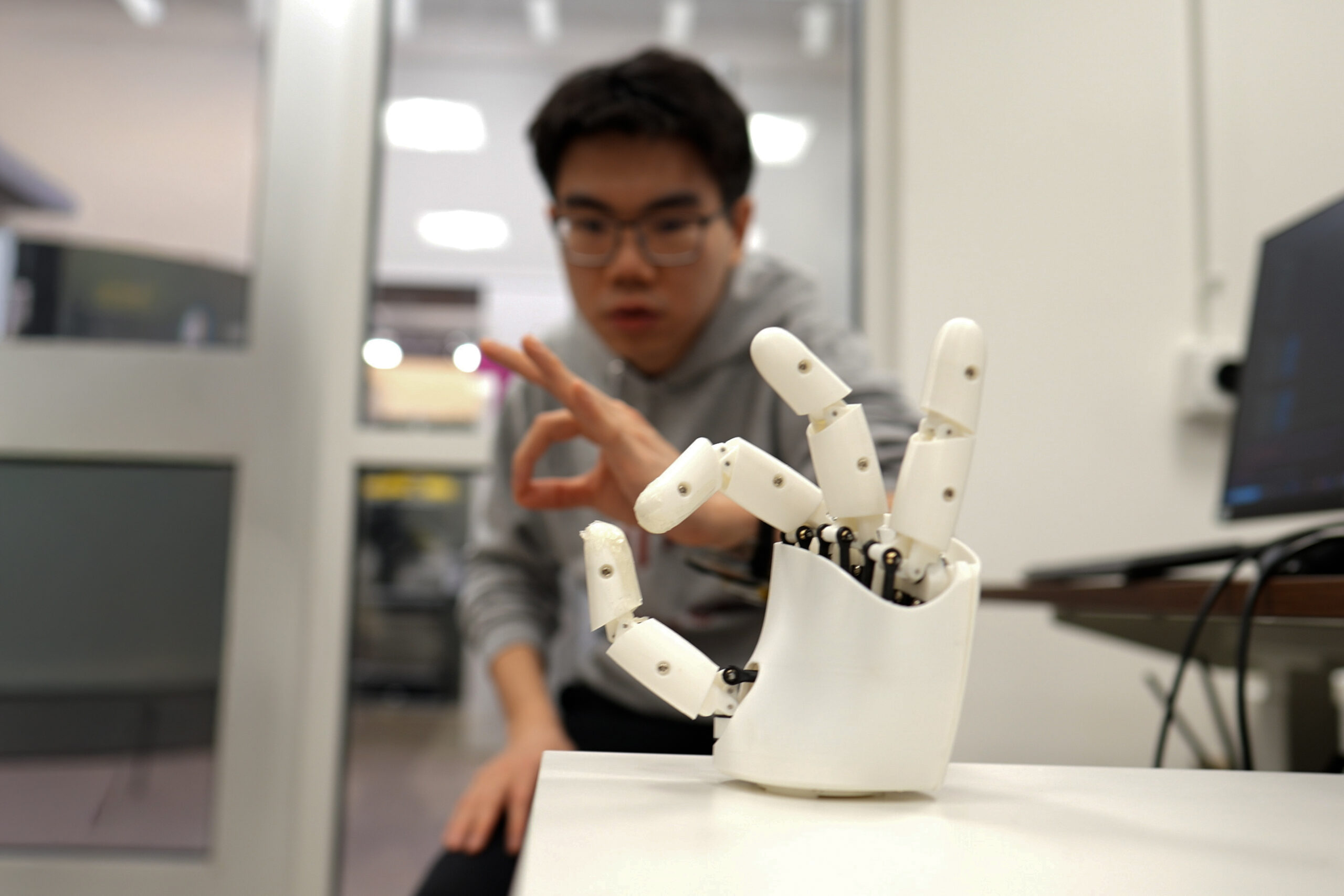
The next time you’re scrolling your phone, take a moment to appreciate the feat: The seemingly mundane act is possible thanks to the coordination of 34 muscles, 27 joints, and over 100 tendons and ligaments in your hand. Indeed, our hands are the most nimble parts of our bodies. Mimicking their many nuanced gestures has been a longstanding challenge in robotics and virtual reality.
Now, MIT engineers have designed an ultrasound wristband that precisely tracks a wearer’s hand movements in real-time. The wristband produces ultrasound images of the wrist’s muscles, tendons, and ligaments as the hand moves, and is paired with an artificial intelligence algorithm that continuously translates the images into the corresponding positions of the five fingers and palm.
The researchers can train the wristband to learn a wearer’s hand motions, which the device can communicate in real-time to a robot or a virtual environment.
In demonstrations, the team has shown that a person wearing the wristband can wirelessly control a robotic hand. As the person gestures or points, the robot does the same. In a sort of wireless marionette interaction, the wearer can manipulate the robot to play a simple tune on the piano and shoot a small basketball into a desktop hoop. With the same wristband, a wearer can also manipulate objects on a computer screen, for instance pinching their fingers together to enlarge and minimize a virtual object.
The team is using the wristband to gather hand motion data from many more users with different hand sizes, finger shapes, and gestures. They envision building a large dataset of hand motions that can be plumbed, for instance, to train humanoid robots in dexterity tasks, such as performing certain surgical procedures. The ultrasound band could also be used to grasp, manipulate, and interact with objects in video games, design applications, or other virtual settings.
“We think this work has immediate impact in potentially replacing hand tracking techniques with wearable ultrasound bands in virtual and augmented reality,” says Xuanhe Zhao, the Uncas and Helen Whitaker Professor of Mechanical Engineering at MIT. “It could also provide huge amounts of training data for dexterous humanoid robots.”
Zhao, Gengxi Lu, and their colleagues present the wristband’s new design in a paper appearing today in Nature Electronics. Their MIT co-authors are former postdocs Xiaoyu Chen, Shucong Li, and Bolei Deng; graduate students SeongHyeon Kim and Dian Li; postdocs Shu Wang and Runze Li; and Anantha Chandrakasan, MIT provost and the Vannevar Bush Professor of Electrical Engineering and Computer Science. Other co-authors are graduate students Yushun Zheng and Junhang Zhang, Baoqiang Liu, Chen Gong, and Professor Qifa Zhou from the University of Southern California.
Seeing strings
There are currently a number of approaches to capturing and mimicking human hand dexterity in robots. Some approaches use cameras to record a person’s hand movements as they manipulate objects or perform tasks. Others involve having a person wear a glove with sensors, which records the person’s hand movements and transmits the data to a receiving robot. But erecting a complex camera system for different applications is impractical and prone to visual obstacles. And sensor-laden gloves could limit a person’s natural hand motions and sensations.
A third approach uses the electrical signals from muscles in the wrist or forearm that scientists then correlate with specific hand movements. Researchers have made significant advances in this approach, however these signals are easily affected by noise in the environment. They are also not sensitive enough to distinguish subtle changes in movements. For instance, they may discern whether a thumb and index finger are pinched together or pulled apart, but not much of the in-between path.
Zhao’s team wondered whether ultrasound imaging might capture more dexterous and continuous hand movements. His group has been developing various forms of ultrasound stickers — miniaturized versions of the transducers used in doctor’s offices that are paired with hydrogel material that can safely stick to skin.
In their new study, the team incorporated the ultrasound sticker design into a wearable wristband to continuously image the muscles and tendons in the wrist.
“The tendons and muscles in your wrist are like strings pulling on puppets, which are your fingers,” Lu says. “So the idea is: Each time you take a picture of the state of the strings, you’ll know the state of the hand.”
Mapping manipulation
The team designed a wristband with an ultrasound sticker that is the size of a smartwatch, and added onboard electronics that are about as small as a cellphone. They attached the wristband to a volunteer’s wrist and confirmed that the device produced clear and continuous images of the wrist as the volunteer moved their fingers in various gestures.
The challenge then was to relate the black and white ultrasound images of the wrist to specific positions of the hand. As it turns out, the fingers and thumb are capable of 22 degrees of freedom, or different ways of extending or angling. The researchers found that they could identify specific regions in their ultrasound images of the wrist that correlate to each of these 22 degrees of freedom. For instance, changes in one region relate to thumb extension, while changes in another region correlate with movements of the index finger.
To establish these connections, a volunteer wearing the wristband would move their hand in various positions while the researchers recorded the gestures with multiple cameras surrounding the volunteer. By matching changes in certain regions of the ultrasound images with hand positions recorded by the cameras, the team could label wrist image regions with the corresponding degree of freedom in the hand. But to do this translation continuously, and in real-time, would be an impossible task for humans.
So, the team turned to artificial intelligence. They used an AI algorithm that can be trained to recognize image patterns and correlate them with specific labels and, in this case, the hand’s various degrees of freedom. The researchers trained the algorithm with ultrasound images that they meticulously labeled, annotating the image regions associated with a specific degree of freedom. They tested the algorithm on a new set of ultrasound images and found it correctly predicted the corresponding hand gestures.
Once the researchers successfully paired the AI algorithm with the wristband, they tested the device on more volunteers. For the new study, eight volunteers with different hand and wrist sizes wore the wristband while they formed various hand gestures and grasps, including making the signs for all 26 letters in American Sign Language. They also held objects such as a tennis ball, a plastic bottle, a pair of scissors, and a pencil. In each case, the wristband precisely tracked and predicted the position of the hand.
To demonstrate potential applications, the team developed a simple computer program that they wirelessly paired with the wristband. As a wearer went through the motions of pinching and grasping, the gestures corresponded to zooming in and out on an object on the computer screen, and virtually moving and manipulating it in a smooth and continuous fashion.
The researchers also tested the wristband as a wireless controller of a simple commercial robotic hand. While wearing the wristband, a volunteer went through the motions of playing a keyboard. The robot in turn mimicked the motions in real-time to play a simple tune on a piano. The same robot was also able to mimic a person’s finger taps to play a desktop basketball game.
Zhao is planning to further miniaturize the wristband’s hardware, as well as train the AI software on many more gestures and movements from volunteers with wider ranging hand sizes and shapes. Ultimately, the team is building toward a wearable hand tracker that can be worn by anyone, to wirelessly manipulate humanoid robots or virtual objects with high dexterity.
“We believe this is the most advanced way to track dexterous hand motion, through wearable imaging of the wrist,” Zhao says. “We think these wearable ultrasound bands can provide intuitive and versatile controls for virtual reality and robotic hands.”
This research was supported, in part, by MIT, the U.S. National Institutes of Health, the U.S. National Science Foundation, the U.S. Department of Defense, and Singapore National Research Foundation through the Singapore-MIT Alliance for Research and Technology.








Microsoft has addressed around 140 newly discovered common vulnerabilities and exposures (CVEs) in its May Patch Tuesday update, but for the first time in a long time, the latest monthly drop contains no zero-day flaws, meaning that none of the issues in scope have been actively exploited or publicly disclosed.
But while a less panic-inducing drop will be welcomed by security teams around the world, the May 2026 Patch Tuesday update contains almost 20 critical severity flaws that will inevitably draw the attention of threat actors in the coming days and weeks.
Jack Bicer, Action1 director of vulnerability research, said: “Although the absence of zero-days is a positive sign, the high number of critical vulnerabilities – particularly compared to recent months – means organisations should still move quickly to evaluate and deploy updates across affected systems.”
This month’s update is also particularly significant as it heralds a critical Secure Boot certificate expiration deadline on 26 June, a few weeks from now. Devices that fail to receive updated Secure Boot certificates – which are now rolling out – face potentially catastrophic failures or as-yet-undiscovered security flaws that may prove impossible to fix.
“The May 2026 update cycle is a high-stakes bridge to the 26 June certificate expiration deadline, making fleet-wide rotation to new trust anchors the month’s absolute priority,” said Rain Baker, senior incident response specialist at Nightwing’s ShadowScout team.
“For those who haven’t patched for last month’s releases for the Windows Shell and Microsoft Defender bypass flaws, it is imperative that security teams give these the highest priority,” added Baker.
Bugs abounding
Among some of the critical updates issued this month is a fix for a Windows DNS Client remote code execution (RCE) flaw tracked as CVE-2026-41096. This vulnerability stems from a heap-based buffer overflow condition in Windows NetLogon and could enable an unauthenticated actor to take over the target system by sending it a malicious DNS response.
“Because DNS is a core networking service used across enterprise environments, exploitation could impact a large number of systems rapidly,” said Action1’s Bicer.
“Successful attacks may lead to widespread endpoint compromise, ransomware deployment, credential harvesting, and operational disruption across corporate networks.
Bicer added: “This CVE requires immediate attention considering its severity rating, network-based attack vector, no authentication requirements, and no user interaction. DNS-related vulnerabilities are especially dangerous because they target foundational network services that are broadly exposed across enterprise infrastructure.”
Also drawing attention this evening is CVE-2026-42898, another RCE issue, this one in on-prem versions of Microsoft Dynamics 365, which bears a common vulnerability scoring system (CVSS) score of 9.9. Again, this issue requires no user interaction and because it can impact systems beyond the original security scope of the vulnerable component, carries an extreme risk to enterprises.
Previous attacks on Dynamics 365 infrastructure have exposed important, privileged data, and because CRM environments plug into so many other important systems, successful exploitation could lead to wholesale compromise.
Meanwhile, Automox chief technology officer Jason Kikta weighed in on CVE-2026-41089, an RCE flaw in Windows Netlogon, and CVE-2026-40402, an elevation of privilege (EoP) vulnerability in Hyper-V.
“CVE-2026-41089 – CVSS 9.8 out of 10 – is a stack-based buffer overflow in Windows Netlogon,” explained Kikta. “An attacker sends a crafted network request to a domain controller. No authentication required. No user interaction required. If you’ve been doing this long enough, the description language sounds sadly familiar.
“I’d be careful drawing a direct line to Zerologon. The underlying bug is a stack overflow, not a crypto protocol flaw, and Microsoft has not labeled this one as wormable. The mechanism is different, but the blast radius is still ugly when you’re talking about pre-auth code execution on a domain controller.”
The Hyper-V issue can be exploited by a low-privileged account inside a guest virtual machine (VM) to execute code on the host with system-level privileges. Kikta warned that one compromised guest could serve as a pivot point for every other VM on the same host, and the host fabric into the bargain. Hosted desktop environments and shared virtualisation platforms are likely to be swiftly targeted.
“Multi-tenant VDI, on-premises virtualisation with untrusted workloads, or any Hyper-V host running guests you don’t fully control. Same-week, same-day patch depending on what’s on top of it,” Kikta advised.
Patch apocalypse?
Lacking though it is in zero-days, Redmond’s latest meaty update will do little to assuage the concerns of onlookers alarmed at the supposedly earth-shattering vulnerability discovery capabilities of Anthropic’s Claude Mythos frontier AI model.
Chris Goettl, vice president of security product management at Ivanti, said that these concerns were being taken seriously by many key software suppliers and other tech firms that are becoming far more aggressive in their patching in response to the changes of the past few weeks.
“Oracle announced a new release cadence starting in May 2026 to address the acceleration of vulnerability detection introduced by Mythos and other AI security models; monthly Critical Security Patch Update (CSPUs) will fill in the two-month gap between their quarterly Critical Patch Update (CPU),” he said.
“Apple is another early participant in Project Glasswing and has seen a recent spike in the number of exposures resolved. They typically average around 20 CVEs per iOS security update [but] for their most recent update on May 11, there is a spike of 52 CVEs resolved. Across the 11 Apple updates, the CVE counts range from 25 at the low end to 52 on the high end and Apple backported changes all the way to iPhone 6s and iOS 15. While there are not actively exploited vulnerabilities, there are a lot of updates to manage.”
Meanwhile, Mozilla, the backers of the Firefox browser, which is said to have had over 270 vulnerabilities identified after Claude Mythos was applied to it, has also moved to a more aggressive weekly cadence for its security updates since the release of Firefox 150.0.0 in April 2026 – version 150.0.3 of Firefox dropped earlier today (12 May).

Conspiracy theorists, wellness influencers, and grifters have already started promoting wild claims about the hantavirus outbreak that began aboard the MV Hondius, a cruise ship on the Atlantic.
Some conspiracy theorists compared the outbreak to the Covid-19 pandemic, claiming it was another effort to control the global population, while others pushed a false narrative that the Covid-19 vaccine caused hantavirus. Many others promoted ivermectin as a treatment, using the incident as a way to sell emergency medical kits featuring the antiparasitic drug typically used as a horse dewormer.
In more recent days, many of these same people spreading conspiracy theories have promoted the baseless and antisemitic claims that the entire incident is a false flag orchestrated by Israel.
Conspiracy theories flooding social media in response to breaking news are nothing new, but what is notable about those being pushed around the hantavirus outbreak is just how closely they echo the conspiracy theories promoted during the Covid-19 pandemic.
“One of the most striking shifts since the Covid pandemic is how rapidly misinformation narratives now organize themselves around emerging outbreaks,” Katrine Wallace, an epidemiologist at University of Illinois Chicago School of Public Health, tells WIRED.
“Within hours of the first hantavirus headlines, social media accounts were already promoting ivermectin, attributing the outbreak to Covid vaccines, and warning about a hantavirus vaccine that does not exist. The claims themselves were often contradictory, but that contradiction no longer appears to limit their spread.”
Once the hantavirus outbreak started making headlines around the world, conspiracy theorists and grifters jumped into action, spreading dangerously ill-informed claims and, of course, trying to sell people ivermectin.
“Ivermectin should work against it,” Mary Talley Bowden wrote on X. Bowden, a doctor, is a prominent promoter of medical misinformation who has promoted ivermectin as a treatment for Covid-19 and prescribed ivermectin to a Covid-19 patient. Hours after her first post on Hantavirus went viral, she followed up to say that she is selling ivermectin to Texans. Bowden did not respond to a request for comment.
Her post, which has been viewed 4 million times, was shared by former Congresswoman Marjorie Taylor Greene, who added that vitamin D and zinc would help fight the infection. Greene even claimed that not getting the Covid-19 vaccine had somehow allowed her to “develop natural immunity” against hantavirus.
Greene separately claimed, without evidence, that the pharmaceutical company Moderna had purposely manipulated the virus in order to allow them to cash in by developing a hantavirus vaccine. Greene did not respond to a request for comment.
Other prolific health disinformation promoters boosted the ivermectin claims, including Simone Gold, the founder of Covid denial group America’s Frontline Doctors, and Peter McCullough, a disinformation peddler who promoted the “sudden death” conspiracy theory about the Covid-19 vaccine, which falsely claimed that those who received the shot were at risk of dropping dead without any warning.
McCullough is also the chief scientific officer for The Wellness Company, which has been described as “Goop for the GOP.” The company has used the hantavirus outbreak to promote a $325 “Contagion Emergency Kit” which includes both ivermectin and hydroxychloroquine.
All the false claims and posts about ivermectin gained enough traction online that the World Health Organization responded to say that there is no research to suggest ivermectin is an effective treatment for hantavirus.
Conspiracy theorists have, meanwhile, been pushing the baseless idea that a side effect of Covid vaccines includes a hantavirus infection.

Hot on the heels of announcing its parent company has entered into a deal worth £4.3bn to buy CK Hutchison’s stake in the recently merged VodafoneThree in the UK, Vodafone has launched 5G Broadband, bringing high-speed connectivity via its 5G network to an additional 3.7 million homes and premises currently unable to access full-fibre networks.
By combining 5G Broadband and its existing full-fibre footprint, Vodafone says it can now bring full-fibre-like speeds to over 26 million homes, more than any other UK provider. The offer is targeted at households who cannot currently access full-fibre – renters, students and anyone who, says Vodafone, “wants powerful connectivity with flexibility”.
The launch reinforces the commitment made by VodafoneThree to connect every community as part of its £11bn investment programme to build out a network that can compete with the likes of BT/Openreach and Virgin Media O2. By bringing together the Vodafone and Three networks, the company said the combined 5G footprint will expand rapidly nationwide.
The offer is also a result of bringing the Vodafone and Three networks together and deploying its Multi Operator Core Network (MOCN) technology in more than 10,000 sites nationwide. This is designed to provide users with improved coverage with higher speeds in areas where it wasn’t previously available.
The enhanced coverage will also enable Vodafone 5G Broadband to reach 3.7 million more homes where there is currently no full-fibre. This complements Vodafone’s existing full-fibre footprint of 23.2 million homes – the largest of any UK provider.
With the service, customers can enjoy speeds from 50Mpbs to up to 150Mbps – 3x faster than a typical part-fibre connection – and unlimited data on every plan. For homes where the outdoor 5G signal is stronger than indoors, Vodafone assured that it would soon launch an outdoor hub to provide an extra boost.
The outdoor hub will require self-installation outside the property, where it will lock on to the strongest 5G signal available in the area and connect directly to the indoor Power Hub router. The result is claimed to be a consistent connection and “fast, seamless experience” throughout the home, even in rural areas.
Rob Winterschladen, consumer director at VodafoneThree, said: “Millions of households are still paying over the odds for unreliable and slow broadband that often only reaches 74Mbps. With Vodafone 5G Broadband, we’re giving those homes a genuinely fast alternative, at great value, with no installation, no waiting and no hassle … By adding 5G Broadband, we can now reach millions more [homes]. This launch is about giving customers real choice: full-fibre where it’s available, and powerful 5G broadband where it’s not – plus, better options for anyone wanting speed with ease and flexibility.”
Launching alongside Vodafone 5G Broadband is an integrated availability checker on Vodafone.co.uk, designed to make choosing the right connection effortless. Customers simply enter their postcode and are shown whether full-fibre or 5G broadband will give them the fastest speeds in their area.
Users can choose from a rolling 30-day or 24-month plan starting at £21 a month, with a £2-a-month discount for Vodafone Together customers. However, the operator cautioned that while the service operates on 5G where available, it may use 4G networks in limited circumstances.


President to undergo medical examination amid serious concerns

Taylor Swift spends quality time with family in New York City

US-Iran deal: Trump reaffirms Iran must not have nuclear weapons, praises Shehbaz, Munir for diplomacy

-
 Tech1 week ago
DHS Demanded Google Surrender Data on Canadian’s Activity, Location Over Anti-ICE Posts
-
 Business1 week ago
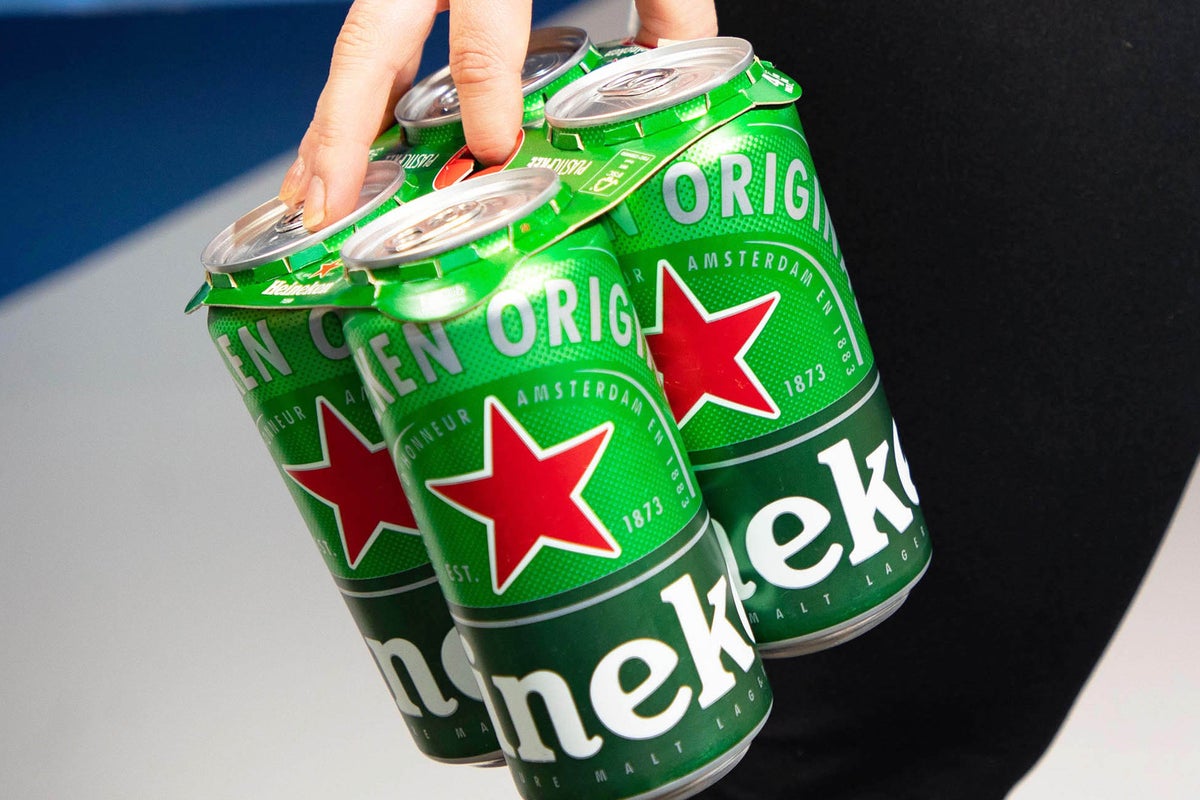
Heineken plans huge investment in hundreds of UK pubs ahead of World Cup
-

 Tech5 days ago
A new frontier: Identity stack evolves for agentic systems | Computer Weekly
-

 Tech4 days ago
‘Orbs,’ ‘Saucers,’ and ‘Flashes’ on the Moon: Pentagon Drops New UFO Files
-
 Business1 week ago
India among most resilient large EMs, better placed for future global shocks; policy reforms & strong buffers help: Moody’s – The Times of India
-

 Fashion5 days ago
New orders in German manufacturing up 5% MoM in Mar 2026: Destatis
-

 Tech5 days ago
What Microsoft Executives Really Thought About OpenAI in 2018
-
 Business1 week ago
US denies Iranian report warship was struck by missiles