

Politics
China’s Xi slams ‘bullying’ behaviour in world order as SCO nations gather

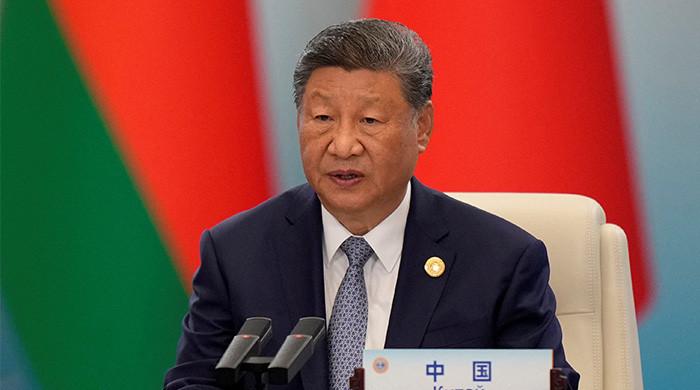
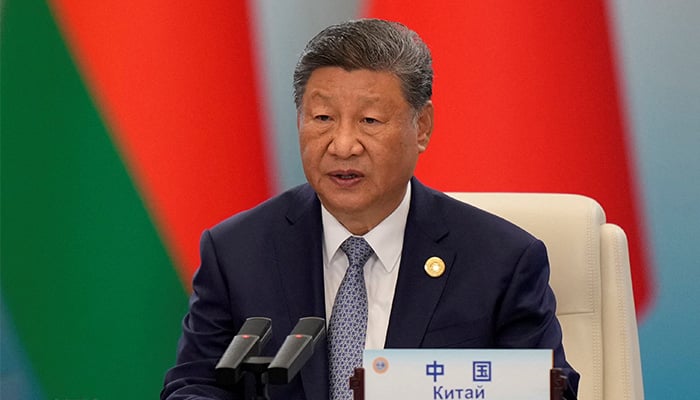
- PM Shehbaz, Russia’s Putin, Indian PM Modi and other leaders attend session.
- Xi speaks about constructive participation in int’l affairs, opposes hegemonism.
- SCO has set a model for a new type of international relations: President Xi.
Chinese President Xi Jinping criticised on Monday “bullying behaviour” in the world order as he gathered regional leaders for a summit.
He called on the leaders — including Prime Minister Shehbaz Sharif, Russia’s Vladimir Putin and India’s Narendra Modi — to “adhere to fairness and justice… oppose Cold War mentality, camp confrontation, and bullying behaviour”, in a speech in the northern city of Tianjin.
The Shanghai Cooperation Organisation, which is gathering for a two-day summit, comprises China, Pakistan, India, Russia, Iran, Kazakhstan, Kyrgyzstan, Tajikistan, Uzbekistan and Belarus — with 16 more countries affiliated as observers or “dialogue partners”.
China and Russia have sometimes touted the SCO as an alternative to the NATO military alliance.
“The current international situation is becoming chaotic and intertwined,” Xi told the leaders.
“The security and development tasks facing member states have become even more challenging,” he added.
“Looking back, despite tumultuous times, we have achieved success by practicing the Shanghai spirit,” he said, referring to the name of the group.
“Looking to the future, with the world undergoing turbulence and transformation, we must continue to follow the Shanghai spirit, keep our feet on the ground, forge ahead, and better perform the functions of the organisation.”
Xi said China will work with all parties in the SCO to take the regional security forum to a new level, as he unveiled his ambition for a new global security order that poses a challenge to the United States.
The SCO has set a model for a new type of international relations, Xi said in opening remarks at the summit, adding that the forum unequivocally opposed external interference.
Xi spoke also about constructive participation in international affairs, opposing hegemonism and power politics, as well as promoting multilateralism in his remarks.
The security-focused bloc, which began as a group of six Eurasian nations, has expanded to 10 permanent members and 16 dialogue and observer countries in recent years.
United Nations Secretary-General Antonio Guterres said China played a “fundamental” role in upholding global multilateralism on Sunday.
Analysts say China will use this year’s largest-ever summit to demonstrate an alternative vision of global governance to the American-led international order at a time of erratic policymaking, a U.S. retreat from multilateral organisations and geopolitical flux.
Beijing has also used the summit as an opportunity to mend ties with New Delhi.
Modi, who is in China on his first visit in seven years, and Xi both agreed on Sunday their countries are development partners, not rivals, and discussed ways to improve trade ties amid the global tariff uncertainty.
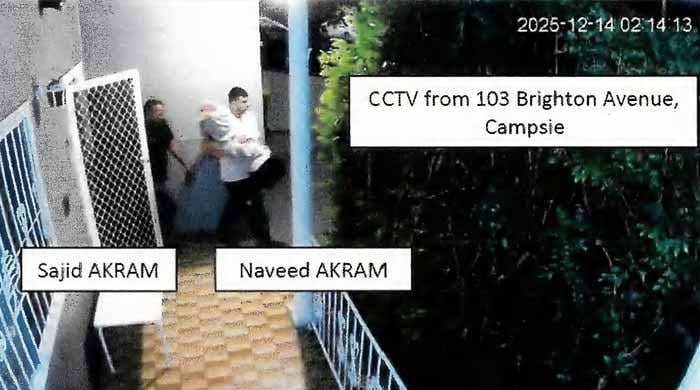
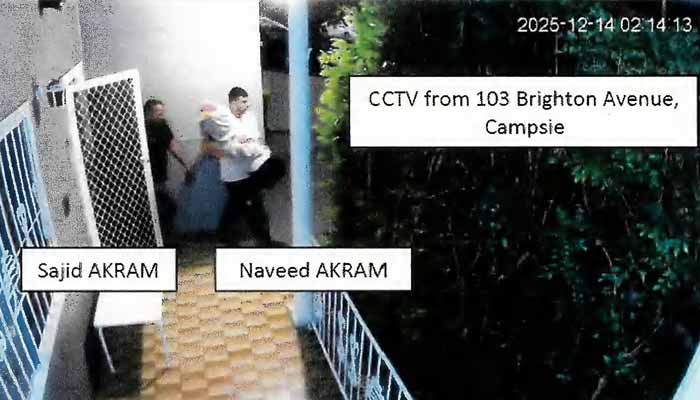
As Australia continues its investigation into the deadliest mass shooting in decades, the newly released court documents on Monday revealed fresh details and images of the father-and-son duo, who are accused of opening fire on a religious festival at Sydney’s Bondi Beach, killing 15 people.
The documents, released by the NSW Courts as part of the police facts sheet on Monday, contain redactions, images from a video of Sajid Akram and his son Naveed Akram.
The documents claimed that the father-and-son duo had carried out “firearms training” in what was believed to be the New South Wales countryside prior to the shooting.
An alleged video found on Naveed’s mobile phone from late October shows the father and son training, “firing shotguns and moving in a tactical manner” in the countryside.
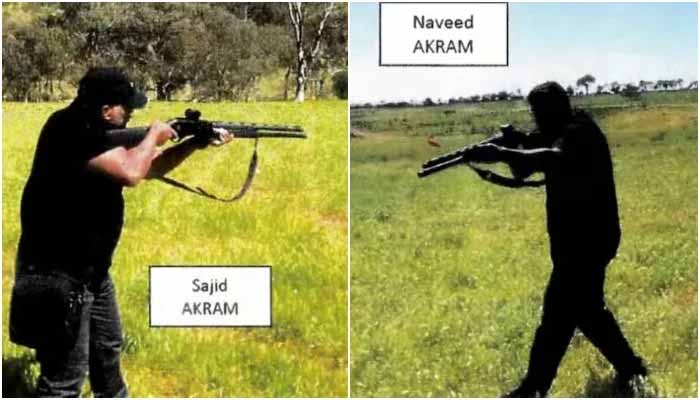
The NSW police believe that the suspects were inspired by Daesh, saying the group’s flags were found in a car they drove.
While Sajid was shot dead by police, Naveed is still recovering from his bullet injuries in hospital and has been charged with 59 offences, including murder and terrorism.
The pair also recorded a video in October railing against “Zionists” while sitting in front of a flag of the Daesh alongside four long-barrelled guns and rounds of ammunition and detailing their motivations for the attack, police said.
The attackers made a nighttime reconnaissance trip to Bondi Beach just days before the killings, documents showed.
A CCTV footage, presented to the court, showed the two men allegedly leaving an Airbnb in Campsie on the day of the attack and travelling toward Bondi Beach while carrying concealed weapons.
According to the alleged facts, the duo threw four improvised explosive devices into the crowd moments before opening fire. While none of the devices detonated, police say three pipe bombs and a tennis ball bomb were all viable.

Australia’s federal government has flagged a suite of reforms to gun ownership and hate speech laws, as well as a review of police and intelligence services.
Prime Minister Anthony Albanese also announced a sweeping buyback scheme to “get guns off our streets”.
The government of New South Wales — where the shooting took place — recalled its parliament for two days on Monday to introduce what it called the “toughest firearm reforms in the country”.
“We can’t pretend that the world is the same as it was before that terrorist incident on Sunday,” New South Wales Premier Chris Minns told reporters.
The new rules will cap the number of guns an individual can own to four, or 10 for exempted individuals like farmers. There are more than 1.1 million firearms in the state, officials said.
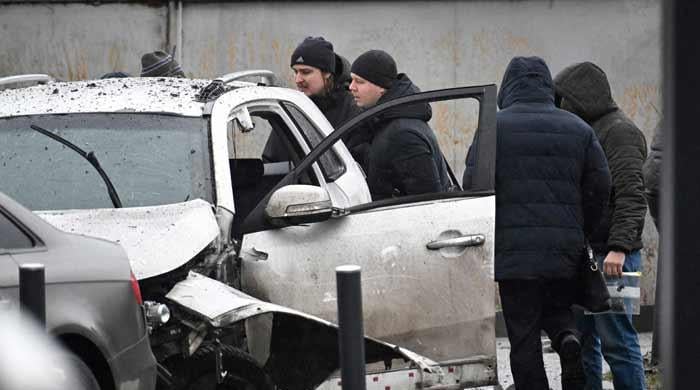
A car bomb killed a senior Russian general in southern Moscow on Monday morning, the latest high-profile army figure to be blown up in a blast that came just hours after Russian and Ukrainian delegates held separate talks in Miami on a plan to end the war.
Kyiv has not commented on the incident, but Russian investigators said they were probing whether the blast was “linked” to “Ukrainian special forces”.
The attack was similar to other assassinations of generals and pro-war figures that have either been claimed, or are widely believed to have been orchestrated, by Ukraine.
Lieutenant General Fanil Sarvarov, 56, head of the Russian General Staff’s training department, was killed when the bomb, which had been placed under his parked car, detonated in a residential quarter of southern Moscow.
AFP reporters at the scene saw a mangled white Kia SUV, its doors and back window blown out. The frame was twisted and charred from the blast.
The scene had been cordoned off by security forces, and investigators were sifting through the debris. Eyewitnesses reported a loud bang.
“We absolutely didn’t expect it. We thought we were safe, and then this happens right next to us,” local resident, Tatiana, 74, told AFP.
“The windows rattled, you could tell it was an explosion,” said Grigory, 70, who also declined to give his surname.
“We need to treat it more calmly. It’s the cost of war,” he added.
Russia’s Investigative Committee, which probes major crimes, said it was “working through various lines of enquiry into the murder. One of them involves the possible organisation of the crime by Ukrainian special services.”
Sarvarov fought in the Russian army’s campaigns in the North Caucasus, including Chechnya in the 1990s, according to his official biography on the defence ministry’s website.
He also commanded Russian forces in Syria in 2015-16.
Talks intensify
The Kremlin said Putin had been informed about Monday’s killing, which came after three days of talks in Miami as the United States intensifies its efforts to broker an end to the four-year war.
Ukrainian negotiator Rustem Umerov and US special envoy Steve Witkoff hailed “progress” in the negotiations on Sunday.
Russian envoy Kirill Dmitriev also met with the US team, which included Jared Kushner, US President Donald Trump’s son-in-law.
Witkoff had also called those meetings “productive and constructive.”
An initial 28-point plan to end the war put forward by US President Donald Trump adhered to Moscow’s core demands, triggering panic in Kyiv and European capitals.
Ukraine and its allies have since been working to refine the plan, though Kyiv says it is still being asked to make massive concessions, such as giving up the entire eastern Donbas region to Russia.
Ukrainian President Volodymyr Zelensky has expressed scepticism over whether Russia really wants to end the war, which has killed tens of thousands and decimated eastern and southern Ukraine.
The Kremlin on Monday also denied that it wanted to recreate the Soviet Union, seize the whole of Ukraine and more land in eastern Europe after Reuters reported that US intelligence had concluded Putin seeks much more than just control over eastern Ukraine.
Since Moscow sent troops into Ukraine in February 2022, Kyiv has been blamed for several attacks targeting Russian military officials and pro-Kremlin figures in Russia and in Russian-occupied parts of Ukraine.
A car blast near Moscow in April killed General Yaroslav Moskalik, a deputy of the General Staff.
In December 2024, Igor Kirillov, the head of the Russian radiological, chemical and biological defence forces, was killed when a booby-trapped electric scooter exploded in Moscow, an attack claimed by Ukraine’s SBU security service.
A Russian military blogger, Maxim Fomin, was killed when a statuette exploded in a Saint Petersburg cafe in April 2023.
And in August 2022, a car bomb killed Daria Dugina, the daughter of ultranationalist ideologue Alexander Dugin.
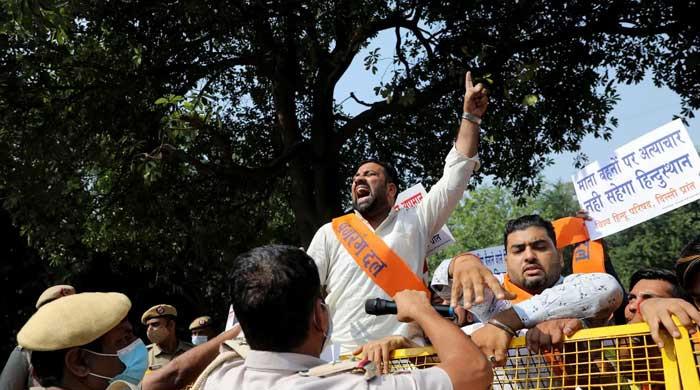
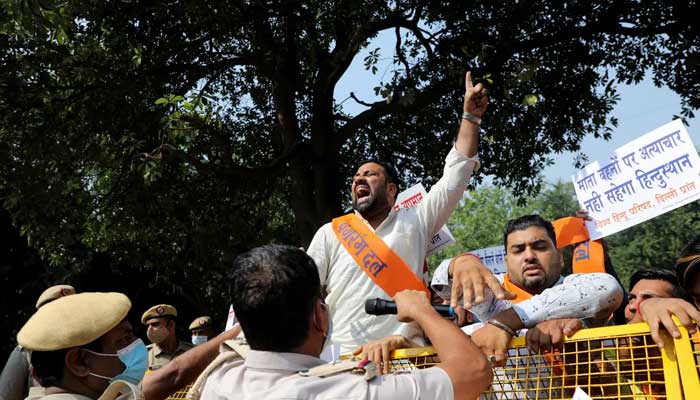
- ‘Akhand Hindu Rashtra Sena’ holds protests outside Babgladesh HC.
- Miscreants allowed to carry out activities outside HC perimeters.
- Dhaka’s FO terms protest “unjustifiable” and “highly regrettable”.
Amid the public uproar over the killing of prominent Bangladeshi student leader Sharif Osman Hadi, Dhaka has rejected India’s stance on the protest outside the Bangladesh High Commission in New Delhi.
Terming the incident “unjustifiable” and “highly regrettable”, Bangladesh’s Ministry of Foreign Affairs said that the incident cannot be labelled “misleading propaganda” — as argued by India’s Ministry of External Affairs (MEA).
“The miscreants were allowed to carry out their activities right outside the perimeters of the HC, creating panic among the personnel inside the complex,” said Bangladesh’s foreign office.
Dhaka’s response comes as a protest was held outside the Bangladesh HC under the banner of “Akhand Hindu Rashtra Sena” which New Delhi has said was against the killing of Dipu Chandra Das and for the protection of minorities in Bangladesh.
Das, a garment factory worker, was beaten to death on December 18 in Bhaluka, Mymensingh, on allegations of blasphemy, after which his body was also set ablaze, reported Prothom Alo.
In a statement, India’s MEA spokesperson Randhir Jaiswal said: “There was no attempt to breach the fence or create a security situation at any time. The police stationed at the spot dispersed the group after a few minutes”.
“We have noted misleading propaganda in sections of the Bangladesh media [….] Fact is that about 20-25 youth gathered in front of Bangladesh High Commission in New Delhi on December 20,” added Jaiswal.
“The police stationed at the spot dispersed the group after a few minutes. Visual evidence of these events is available publicly for all to see. India is committed to ensure the safety of foreign Missions/Posts in its territory in accordance with the Vienna Convention,” the statement further claimed, noting that New Delhi continues to “keep a close watch on the evolving situation in Bangladesh” and that its “officials remain in touch with Bangladesh authorities and have conveyed to them our strong concerns at the attacks on minorities”.
However, contrary to New Delhi’s stance on the protest, the Bangladesh mission officials say that the demonstrators raised anti-Bangladesh slogans and issued threats against Bangladesh High Commissioner M Riaz Hamidullah.
Countering New Delhi’s stance on the protest, Bangladesh’s foreign office said that its HC was not given advance notice on the “organised event”.
“We reject the attempt of Indian authorities to depict an isolated attack on a Bangladeshi citizen, who happens to belong to the Hindu community, as attacks on minorities,” it maintained while rebuking New Delhi’s stance on the matter.
The protest outside the Bangladesh HC comes amidst public uproar in Bangladesh over the killing of prominent Bangladeshi student leader Sharif Osman Hadi.
Hadi, 32, was shot in the head by masked assailants in Dhaka while launching his campaign for the elections. He was a spokesperson for the Inquilab Mancha, or Platform for Revolution, and participated in the protests that overthrew Hasina.
His death triggered mass protests with mobs even attacking the Indian Assistant High Commission in Chittagong, as well as setting fire to multiple newspapers’ outlets in Dhaka.
Critics accused the publications of favouring neighbouring India, where Bangladesh’s ousted PM Sheikh Hasina has taken refuge since fleeing Dhaka in the wake of the 2024 uprising.


The Doomsday Glacier Is Getting Closer and Closer to Irreversible Collapse

US’ Nike Q2 FY26 revenue edges up despite sharp fall in direct sales

New details and images of Bondi Beach attackers emerge
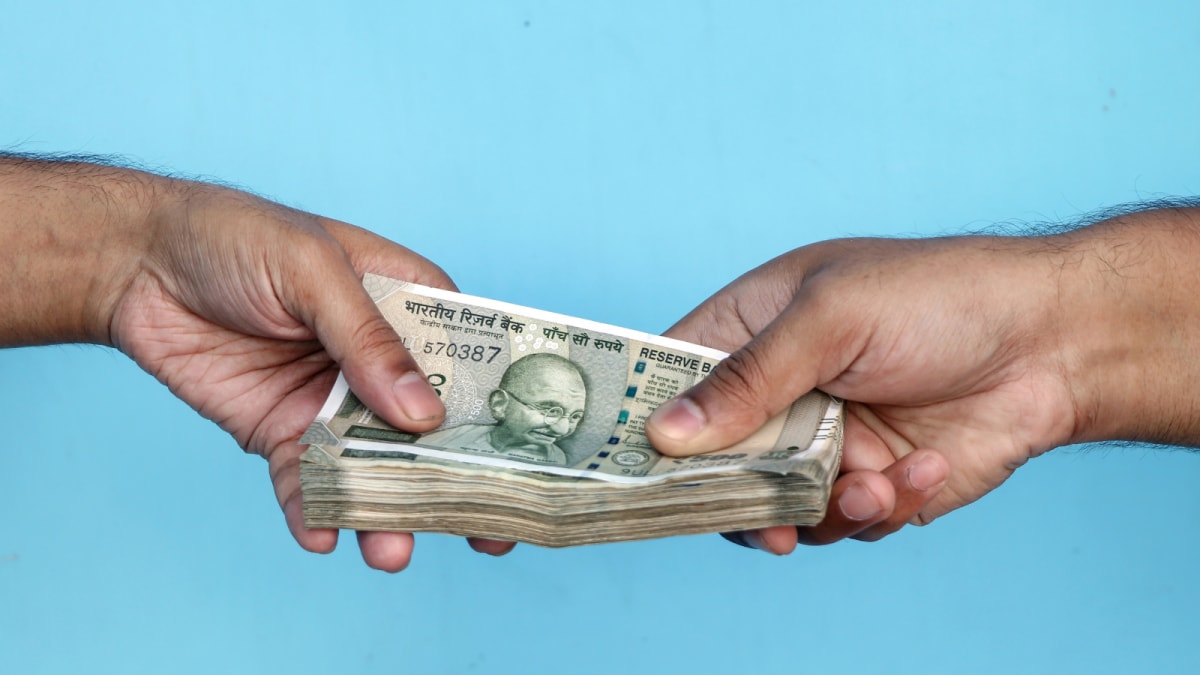
Hitting The ‘High Notes’ In Ties: Nepal Set To Lift Ban On Indian Bills Above ₹100

Studying Abroad Is Costly, But Not Impossible: Experts On Smarter Financial Planning
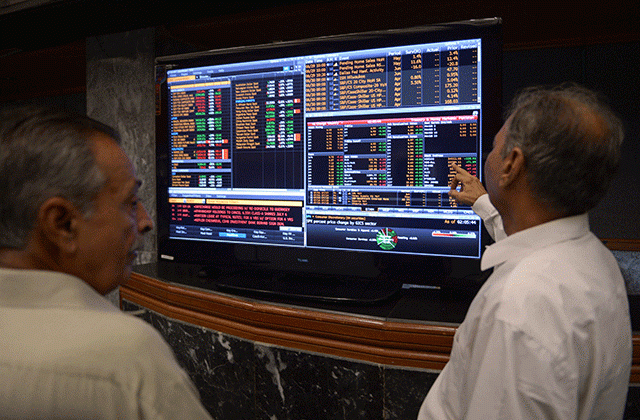
KSE-100 index gains 876 points amid cut in policy rate | The Express Tribune

-
Business1 week ago
Hitting The ‘High Notes’ In Ties: Nepal Set To Lift Ban On Indian Bills Above ₹100
-
Business1 week ago
Studying Abroad Is Costly, But Not Impossible: Experts On Smarter Financial Planning
-
Business1 week ago
KSE-100 index gains 876 points amid cut in policy rate | The Express Tribune
-

 Sports7 days ago
Jets defensive lineman rips NFL officials after ejection vs Jaguars
-

 Fashion4 days ago
Indonesia’s thrift surge fuels waste and textile industry woes
-
 Business4 days ago
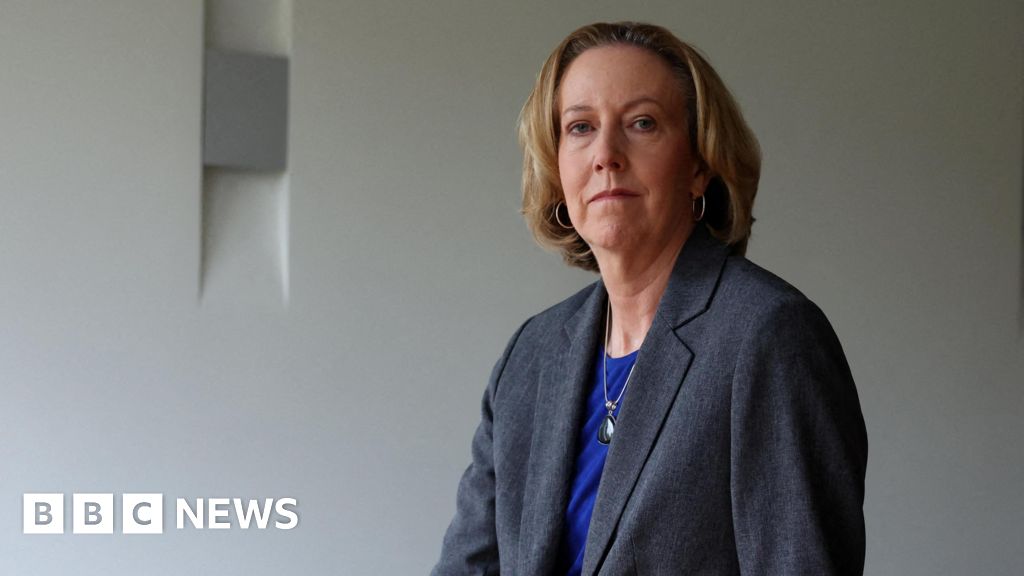
BP names new boss as current CEO leaves after less than two years
-
 Tech1 week ago
For the First Time, AI Analyzes Language as Well as a Human Expert
-

 Entertainment7 days ago
Prince Harry, Meghan Markle’s 2025 Christmas card: A shift in strategy