

Politics
Climate tipping points are being crossed, scientists warn ahead of COP30

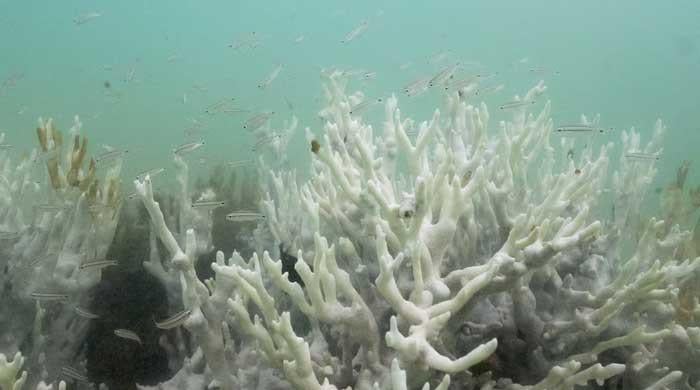
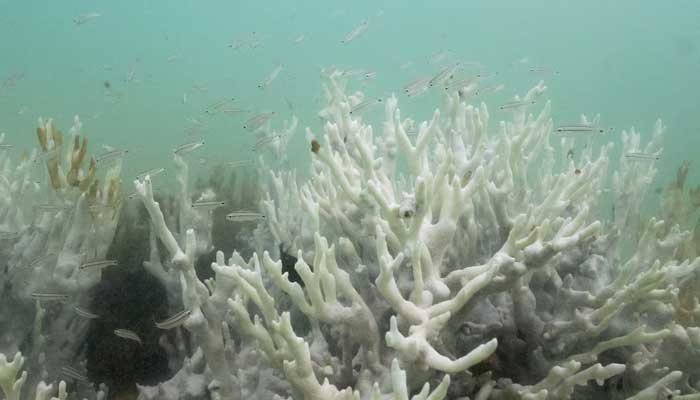
Global warming is crossing dangerous thresholds sooner than expected with the world’s coral reefs now in an almost irreversible die-off, marking what scientists on Monday described as the first “tipping point” in climate-driven ecosystem collapse.
The warning in the Global Tipping Points report by 160 researchers worldwide, which synthesises groundbreaking science to estimate points of no return, comes just weeks ahead of this year’s COP30 climate summit being held at the edge of the Amazon rainforest in Brazil.
That same rainforest system is now at risk of collapsing once the average global temperature warms beyond just 1.5 degrees Celsius based on deforestation rates, the report said, revising down the estimated threshold for the Amazon.
Also of concern if temperatures keep rising is the threat of disruption to the major ocean current called the Atlantic Meridional Overturning Circulation, or AMOC, which helps to ensure mild winters in northern Europe.
“Change is happening fast now, tragically, in parts of the climate, the biosphere,” said environmental scientist Tim Lenton at the University of Exeter, who is the lead author of the report.
Some positive signs
Lenton noted positive signs when it came to phasing out the fossil fuels most responsible for climate change. Renewables, for example, accounted for more electricity generation than coal this year for the first time, according to data from the nonprofit think tank Ember.
“Nobody wants to be just traumatised and disempowered,” Lenton said. “We still have some agency.”

The scientists implored countries at November’s COP30 to work toward bringing down climate-warming carbon emissions.
Scientists have been surprised by how quickly changes are unfolding in nature, with average global temperatures already having warmed by 1.3-1.4 degrees Celsius (2.3 to 2.5 degrees Fahrenheit) above the preindustrial average, according to data from U.N. and EU science agencies.
Warmest on record
The last two years were Earth’s warmest on record, with marine heatwaves that stressed 84% of the world’s reefs to the point of bleaching and, in some cases, death. Coral reefs sustain about a quarter of marine life.
For corals to recover, the world would need to drastically ramp up climate action to reverse temperatures back down to just 1 degree C above the preindustrial average, the scientists suggested.
“The new report makes clear that each year there is an increase in the scope and magnitude of the negative impacts of climate change,” said Pep Canadell, a senior scientist at Australia’s CSIRO Climate Science Centre.
The world is currently on track for about 3.1 degrees C of warming in this century, based on national policies.


- US says nuclear issues must be dealt with from the outset.
- Trump unhappy with delaying deal on Iran nuclear programme.
- Iran demands blockade be lifted before any negotiations begin.
US President Donald Trump is unhappy with the latest Iranian proposal on resolving the two-month war, a US official said, dampening hopes for a resolution to the conflict that has disrupted energy supplies, fuelled inflation, and killed thousands.
Iran’s latest proposal would set aside discussion of Iran’s nuclear programme until the war is ended and disputes over shipping from the Gulf are resolved.
That is unlikely to satisfy the US, which says nuclear issues must be dealt with from the outset, and Trump was unhappy with Iran’s proposal for that reason, a US official briefed on the president’s Monday meeting with his advisers said, speaking on condition of anonymity.
White House spokeswoman Olivia Wales said the US “will not negotiate through the press” and has “been clear about our red lines” as the Trump administration looks to end the war against Iran it began in February alongside Israel.
A previous agreement in 2015 between Iran and multiple other countries including the US sharply curtailed Iran’s nuclear programme, which it has long maintained is for peaceful, civilian purposes. But that deal fell apart when Trump unilaterally withdrew from it in his first term in office.
Hopes of reviving peace efforts have receded since the US president scrapped a visit planned for last weekend by his special envoy Steve Witkoff and son-in-law Jared Kushner to Islamabad, where Iranian Foreign Minister Abbas Araqchi shuttled in and out twice during the weekend.
Araqchi also visited Oman and on Monday went to Russia, where he met President Vladimir Putin and received words of support from a longstanding ally.
Oil prices rise again
With the warring sides still seemingly far apart, oil prices resumed their upward march, extending gains in early Asia trade on Tuesday.
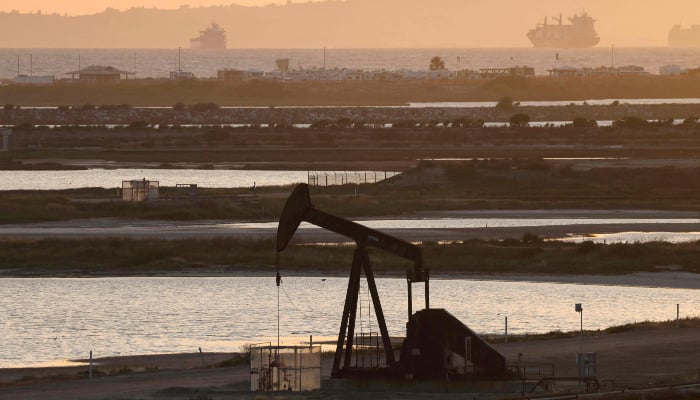
“For oil traders, it’s not the rhetoric that matters any more, but the actual physical flow of crude oil through the Strait of Hormuz, and right now, that flow remains constrained,” Fawad Razaqzada, market analyst at City Index and FOREX.com, said in a note.
At least six tankers loaded with Iranian oil have been forced back to Iran by the US blockade in recent days, ship-tracking data showed, underscoring the war’s impact on traffic.
Iran’s foreign ministry condemned US seizures of Iran-linked tankers as “outright legalisation of piracy and armed robbery on the high seas”, in a social media post.
Between 125 and 140 ships usually crossed in and out of the strait daily before the war, but only seven have done so in the past day, according to Kpler ship-tracking data and satellite analysis from SynMax, and none of them were carrying oil bound for the global market.
With his approval ratings falling, Trump faces domestic pressure to end a war for which he has given the US public shifting rationales.
Araqchi told reporters in Russia that Trump had requested negotiations because the US has not achieved any of its objectives.
Senior Iranian officials, speaking on condition of anonymity, told Reuters the proposal carried by Araqchi to Islamabad over the weekend envisioned talks in stages, with the nuclear issue to be set aside at the start.
A first step would require ending the US-Israeli war on Iran and providing guarantees that the US cannot start it up again. Then negotiators would resolve the US Navy’s blockade of Iran’s trade by sea and the fate of the Strait of Hormuz, which Iran aims to reopen under its control.
Only then would talks look at other issues, including the longstanding dispute over Iran’s nuclear programme, with Iran still seeking some kind of US acknowledgement of its right to enrich uranium.
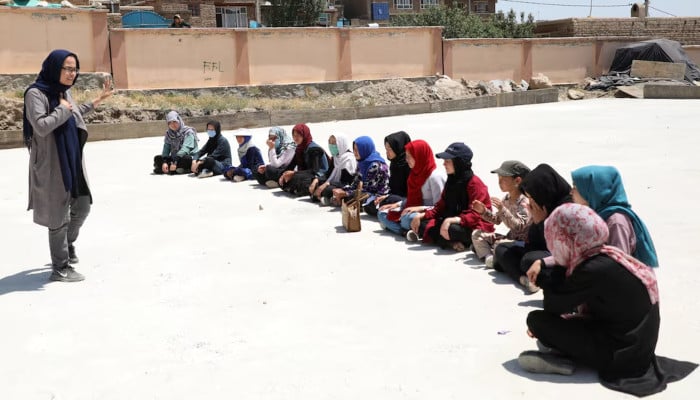
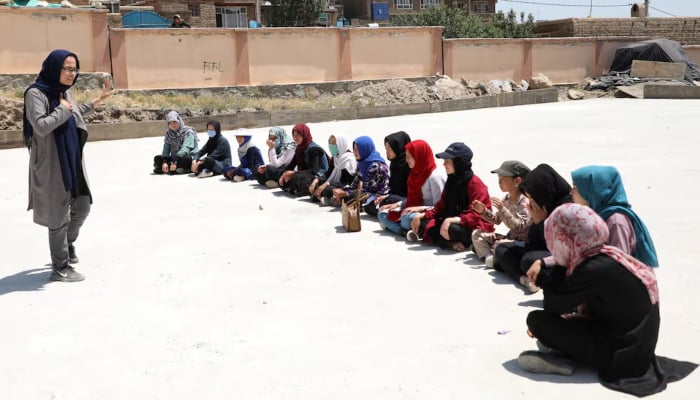
Afghanistan is at risk of losing more than 25,000 female teachers and health workers by 2030 if the Taliban-led country’s restrictions on girls’ education and women’s employment are not lifted, according to a new Unicef report released on Monday.
The Taliban has banned women from most public sector jobs and limited girls to receiving an education only until the age of 12.
These restrictions, according to the report, have already affected at least 1 million girls — a figure that is expected to double by 2030 if nothing changes. Unicef called on the Taliban to lift the ban that it imposed after returning to political power in 2021.
Unicef’s “The Cost of Inaction on Girls’ Education and Women’s Labour Force Participation in Afghanistan” report found a rapid decline in qualified women entering the teaching and healthcare sectors.
Up to 20,000 female teachers and 5,400 health workers could be lost by 2030, according to the report, which estimated that this figure is about 25% of Afghanistan’s 2021 workforce. As many as 9,600 health workers could be lost by 2035, it added.
“Afghanistan cannot afford to lose future teachers, nurses, doctors, midwives, and social workers, who sustain essential services,” Unicef Executive Director Catherine Russell said. “This will be the reality if girls continue to be excluded from education.”
Female healthcare workers are required to attend to female patients, and female teachers are preferred for girls in gender-disaggregated schools whenever possible, the report noted.
The growing decrease could have at least a AFN 5.3 billion ($84 million) annual economic impact on Afghanistan’s economy, according to Unicef, which added that this is the equivalent of about 0.5% of the country’s gross domestic product.
Afghanistan’s de facto authorities should safeguard skills training and allow women to participate in the labor market, Unicef said.
- Survivor says passengers were “crushed on top of one another” in impact.
- Victims feared suffocation as bodies piled up inside mangled carriages.
- All deaths reported from commuter, women-only carriage hit hardest.
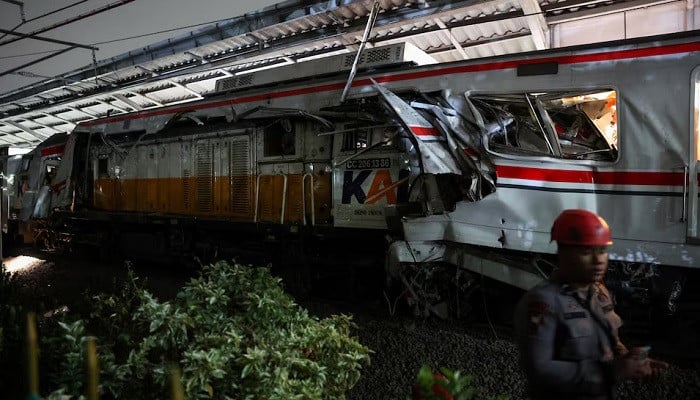
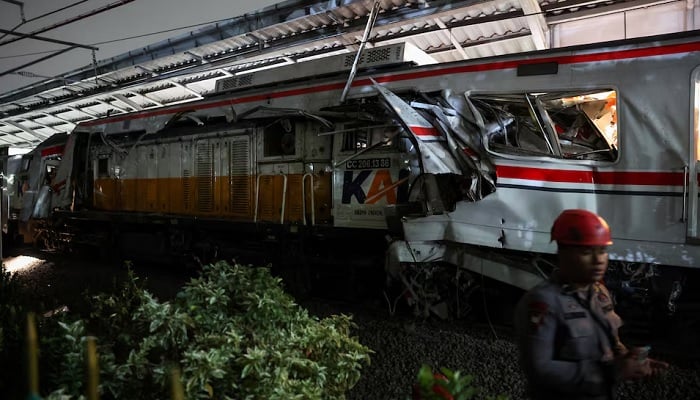
Rescuers were racing to reach survivors Tuesday morning outside Indonesia’s capital Jakarta after two trains collided overnight, killing at least seven people and injuring dozens.
Anna Purba, a spokeswoman for the state-owned KAI rail company, told local television in the early morning hours that seven people had been killed in the crash and 81 were injured.
She said rescuers were working to get to two people still trapped, alive, in the wreckage.
One survivor told AFP of the horrific moments after a long-distance train slammed into the stationary commuter train she was in, trapping people inside mangled carriages.
“I thought I was going to die,” Sausan Sarifah, 29, told AFP from her bed at the RSUD Bekasi hospital, where she was admitted with a broken arm and a deep cut to one thigh.
She was on her way home from work, she said, when her train stopped at the Bekasi Timur station some 25 kilometres (15 miles) from Jakarta.
“It all happened so fast, in a split second,” Sausan recounted.
“There were two announcements from the commuter train. Everyone was ready to get off, and then suddenly there was the sound of the locomotive, really loud,” she said.
“There was no time to get out, and everyone ended up piled up inside the train, crushed on top of one another. I don’t know how the person underneath me is doing.”
She said she had feared suffocating to death in the human pile-up, and worried that some pinned underneath didn’t make it.
“Thank God I was on top, so I could be evacuated quickly,” said Sausan.
According to Franoto Wibowo, a spokesman for rail operator KAI, a taxi appears to have clipped the commuter train on a level crossing, causing it to come to a standstill on the tracks, where it was hit.
At the station, chaotic scenes unfolded in the aftermath of the crash, with rescue workers shouting for oxygen tanks as ambulances stood by in a snaking queue, lights flashing.
An AFP reporter at the scene witnessed people being carried out of the wreckage on gurneys and loaded into waiting ambulances as hundreds of bystanders looked on, some seemingly in shock.
As rescuers worked to free many more trapped in the crushed train carriages, Deputy House Speaker Sufmi Dasco Ahmad said the toll could rise.
“Judging from the evacuation process that is still underway, it is possible that the number of victims may continue to rise,” he told reporters at the scene.
Franoto told Kompas TV the military, fire brigade, the national search and rescue agency, and the Red Cross were aiding in the evacuation effort.
Passengers trapped
Jakarta police chief Asep Edi Suheri said the long-distance train had crashed into the last, women-only, carriage of the commuter train.
All the victims were in the commuter train, and all 240-odd passengers on the other train had been evacuated safely, according to Purba.
The collision caused “significant damage to several train carriages”, the Jakarta search and rescue agency said in a statement.
“The incident caused a number of passengers to suffer injuries, and several victims were reported to be trapped inside the carriages due to the force of the impact,” it added.
The agency said rescuers were “carrying out the evacuation process for the trapped victims using extrication equipment to free them from the wrecked train structures”.
Eva Chairista, 39, told AFP she had rushed to the RSUD hospital after hearing that her sister-in-law, whom she named only as 27-year-old Fira, had been injured in the crash.
She arrived at a frenetic scene of medical triage.
“The doctor told us to be patient; there are many whose condition is worse than my sister-in-law’s,” she said.
The last major train crash in the Southeast Asian country killed four crew members and injured about two dozen people elsewhere in West Java province in January 2024.
Transport accidents are not uncommon in Indonesia, a vast archipelago nation where buses, trains and even planes are often old and poorly maintained.
Sixteen people were killed when a commuter train crashed into a minibus on a level crossing in Jakarta in 2015.


Buckingham Palace issues ‘disappointing’ update on King Charles amid threat

Trump not happy with latest Iran proposal to end war, says US official

World Cup FAQ: How Are Penalties Awarded And What Are The Rules?

-

 Sports1 week ago
NCAA men’s gymnastics championship: All-time winners list
-

 Sports1 week ago
WWE WrestleMania 42 Night 2: Live match results and analysis
-

 Fashion1 week ago
UK’s Sosandar returns to profitability amid robust FY26 performance
-

 Politics7 days ago
UK’s Starmer seeks to deflect blame over Mandelson appointment
-
 Business1 week ago
No fuel shortage: Govt assures 100% domestic LPG, PNG, CNG supply amid Hormuz energy crunch – The Times of India
-

 Entertainment1 week ago
Lee Anderson, Zarah Sultana kicked out of UK Parliament for calling PM ‘liar’
-
 Business1 week ago
How Trump’s psychedelics executive order could unlock stalled cannabis reform
-

 Sports1 week ago
Quetta Gladiators opt to bowl after winning toss against Peshawar Zalmi in PSL 11 clash