

Business
Daily Mail owner agrees to buy Daily Telegraph for £500m

 Getty Images
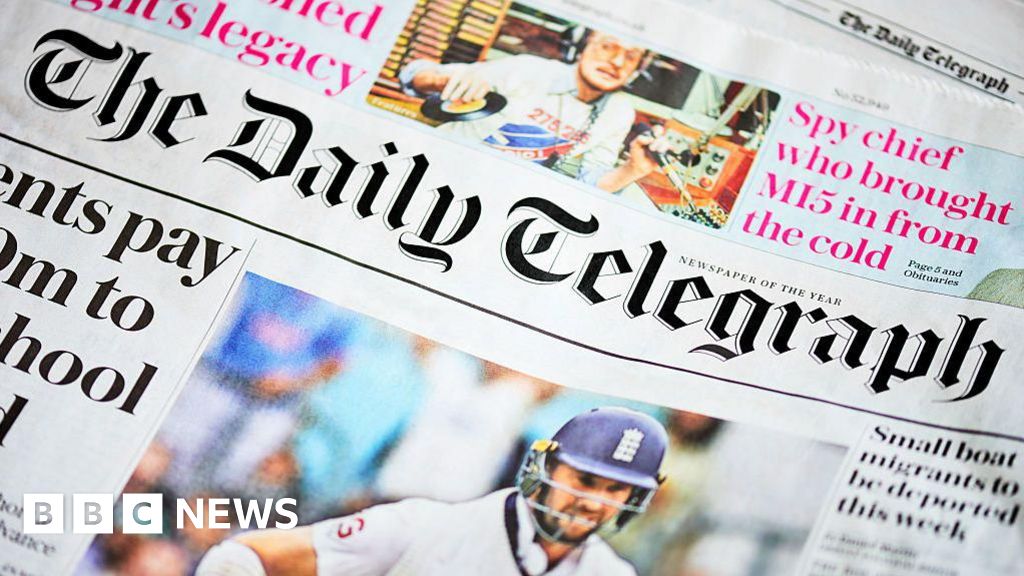
The publisher of the Daily Mail has agreed to buy the Daily and Sunday Telegraph for £500m.
The Daily Mail and General Trust (DMGT) said it had entered a period of discussion with RedBird IMI, which is a joint venture between the United Arab Emirates and the US private equity firm RedBird Capital Partners.
RedBird Capital’s own bid for control of the Telegraph collapsed last week.
The deal needs to be signed off by Culture Secretary Lisa Nandy. A spokesperson said Nandy would “review any new buyer acquiring the Telegraph in line with the public interest and foreign state influence media mergers regimes”.
DMGT and RedBird IMI have said they expect the deal to be finalised “quickly”.
DMGT chairman Lord Rothermere said he had “long admired the Daily Telegraph” and the deal would give “much-needed certainty and confidence” to its employees.
He said: “The Daily Telegraph is Britain’s largest and best quality broadsheet newspaper and I have grown up respecting it. It has a remarkable history and has played a vital role in shaping Britain’s national debate over many decades.”
He added: “Chris Evans is an excellent editor and we intend to give him the resources to invest in the newsroom. Under our ownership, the Daily Telegraph will become a global brand, just as the Daily Mail has.”
The purchase would see the Telegraph become part of DMGT’s portfolio of media organisations, which includes the i Paper, Metro and New Scientist, along with the Daily and Sunday Mail papers.
The group said the Telegraph would remain editorially independent from DMGT’s other titles.
It also said its case for having the deal approved was “compelling” and would comply with UK regulations, as there would be no foreign state investment or capital in the funding structure.
A spokesman for RedBird IMI said: “DMGT and RedBird IMI have worked swiftly to reach the agreement announced today, which will shortly be submitted to the secretary of state.”
RedBird Capital pulled out of a deal to buy the Telegraph last week.
It had a previous attempt to buy the group rebuffed by politicians as it was majority-funded by Abu Dhabi’s IMI group – which is owned in turn by the Abu Dhabi royal family.
A law change meant that foreign sovereign wealth funds could take a maximum stake of 15% in newspapers or periodicals.
Its more recent bid complied with that rule, but it was understood that the government intended to submit the deal to regulatory review.
Sources close to RedBird insisted that they were confident that the bid would have passed a government review process, but cited negative articles toward the bid from the current Telegraph newsroom as a factor in shelving their interest.
RedBird founder Gerry Cardinale had planned to expand the Telegraph’s reach and subscriber base in the US, believing there to be a gap in the market.
Among other investments, RedBird owns the Italian football team AC Milan.
The Telegraph has been in limbo for over two years, when the RedBird IMI consortium paid off the debts of the Telegraph’s previous owners, the Barclay family, hoping to take eventual ownership of the newspapers.
Business
Top stocks to buy today: Stock recommendations for April 17, 2026 – check list – The Times of India

Stock market recommendations: Reliance Industries, and Varun Beverages are the top stock recommendations by Bajaj Broking Research for April 17, 2026.Reliance IndustriesBuy in the range of ₹ 1330.00-1350.00
Reliance Industries stock has undergone a corrective phase over the past three months and is currently consolidating near a crucial support zone of ₹1270–₹1300. This technical setup offers a favorable risk-reward profile, positioning the stock for a potential bullish reversal and the next leg of uptrend.This ₹1270–₹1300 range serves as a crucial support area, reinforced by the convergence of multiple technical factors: (a) 61.8% retracement of the previous April 2025-January 2026 up move (1115-1611) (b) 200 weeks EMA placed around 1292, which has historically acted as strong demand area for the stockThe ongoing corrective phase appears to be nearing exhaustion, with price action indicating the potential for a fresh bullish reversal. We anticipate the stock to resume its uptrend and head towards ₹ 1474 levels in the coming quarters being the high of February 2026 and the 61.8% retracement of the recent decline of the last 3 months ₹ 1611-1290.Varun BeveragesBuy in the range of 455-465
The share price of Varun Beverages has generated a breakout above the falling channel containing last 3 months decline signaling strength and offers fresh entry opportunity.The stock has also formed a higher high and higher low signaling resumption of up move after recent corrective decline.We expect the stock to head higher towards 503 levels in the coming weeks being the 80% retracement of the previous decline from 534 to 381.(Disclaimer: Recommendations and views on the stock market, other asset classes or personal finance management tips given by experts are their own. These opinions do not represent the views of The Times of India)
Experts say Mythos potentially has an unprecedented ability to identify and exploit cybersecurity weaknesses.
Source link
Business
Anthropic’s new AI model exposes fresh risks, flaws for cybersecurity, IT services – The Times of India
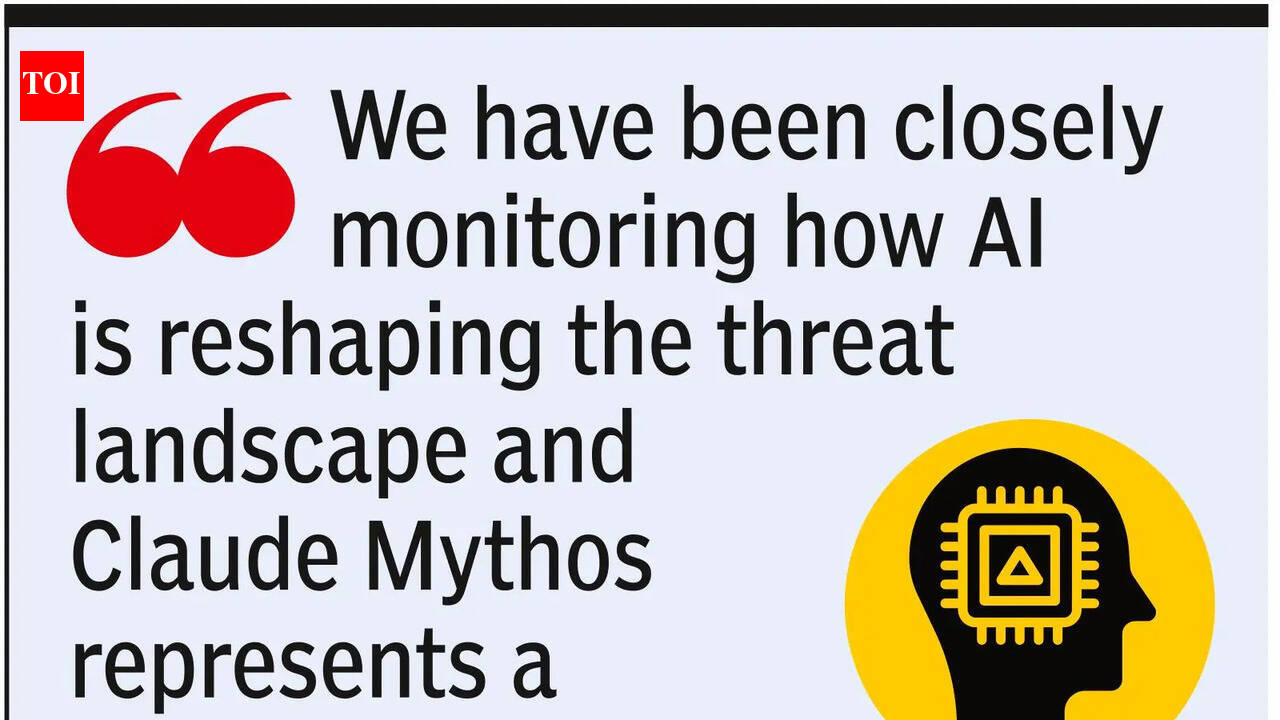
New Delhi: A powerful new AI model is forcing govts, banks, and technology firms to rethink the rules of cybersecurity – and in India, the stakes may be even higher.Claude Mythos, developed by Anthropic, has demonstrated the ability to autonomously detect and exploit software vulnerabilities, including flaws that have persisted for decades. Early tests revealed that the model could identify long-standing weaknesses and simulate complex, multi-step cyberattacks, prompting the company to restrict its wider release. Anthropic CEO Dario Amodei highlighted the shift, noting that AI systems are now capable of finding vulnerabilities “that humans have missed”, a signal of how quickly the cybersecurity landscape is changing.US Treasury Secretary Scott Bessent reportedly convened a meeting with top bank executives – including leaders from JPMorgan Chase, Goldman Sachs, Citigroup, BoA, and Morgan Stanley – to assess the risks posed by such advanced AI systems.That concern is not theoretical. According to Jaydeep Singh, GM for India at Kaspersky, the emergence of such systems represents a turning point not just for security professionals, but for everyday users. “We have been closely monitoring how AI is reshaping the threat landscape, and Claude Mythos represents a moment that every user, not just the cybersecurity industry, needs to understand,” Singh said.The dual-use nature of AI is at the heart of the concern. The same capability that strengthens defences can just as easily be weaponised. “The same capability that finds a 27-year-old vulnerability in hardened infrastructure is the capability that, in the wrong hands, turns every unpatched system into an open door,” Singh added.Cybersecurity firm Check Point Software Technologies echoed the warning. Sundar Balasubramanian, MD, India and South Asia, for Check Point, says, AI is “dramatically lowering the barrier to entry for cyber attackers,” enabling even less-skilled actors to identify and exploit vulnerabilities. He added that defensive tools can be repurposed offensively, compressing the traditional gap between attackers and defenders. Jayant Saran, partner, Deloitte India, described this as a “changed reality,” where organisations must prepare for risks that were previously invisible. He called AI a “double-edged sword…that cannot be reversed,” highlighting an accelerating race between those securing systems and those attempting to break them.In India, the risks are amplified by scale. From UPI to banking and govt platforms, millions depend on digital infrastructure – much of it built on legacy systems. These systems are often slower to patch, harder to monitor, and lack continuous threat intelligence, creating what Saran called an “asymmetric risk exposure.” Singh pointed out that this gap is especially critical in India, where legacy infrastructure serves hundreds of millions.Beyond cybersecurity, ripple effects could reach financial markets. Analysts say models like Mythos could automate parts of software development, testing, and security – core functions of IT services industry. While disruption may be gradual, labour-intensive outsourcing models could face pressure, while firms embracing AI may benefit.


China’s industrial output grows 6.1% in Q1 2026

Italy’s apparel export-import plunge after positive trend in 2025
Top stocks to buy today: Stock recommendations for April 17, 2026 – check list – The Times of India

-

 Entertainment1 week ago
Queen Elizabeth II emotional message for Archie, Lilibet sparks speculation
-

 Tech1 week ago
Azure customers up in arms over ‘full’ UK South region | Computer Weekly
-

 Tech1 week ago
As the Strait of Hormuz Reopens, Global Shipping Will Take Months to Recover
-

 Fashion1 week ago
CII submits 20-pt agenda to Indian govt to back firms hit by Iran war
-

 Tech1 week ago
This AI Button Wearable From Ex-Apple Engineers Looks Like an iPod Shuffle
-

 Politics7 days ago
Indian airlines hit hardest after Dubai limits foreign flights until May 31
-
Uncategorized1 week ago
[CinePlex360] Please moderate: “Trump considers
-

 Entertainment4 days ago
Palace left in shock as Prince William cancels grand ceremony