

Fashion
Data and traceability drive discussions at the 12th “4sustainability” event

Translated by
Nazia BIBI KEENOO
Published
October 7, 2025
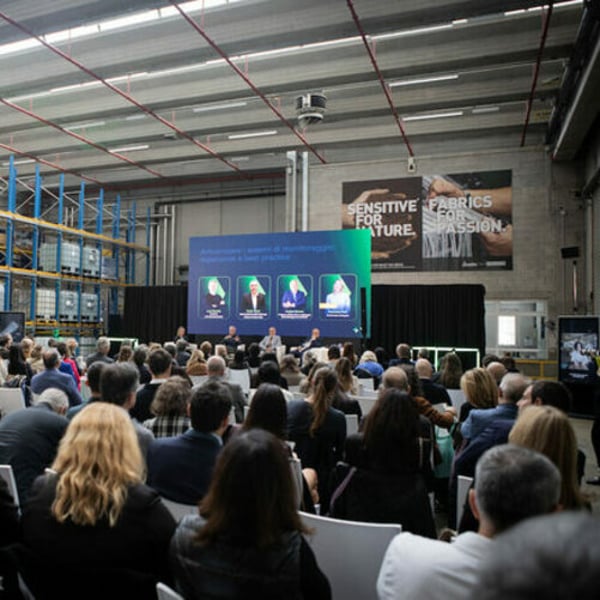
The 12th annual 4sustainability event took place on Friday, October 3, at Eurojersey’s headquarters in Caronno Pertusella, Italy. Ympact—an ecosystem that connects brands with their supply chains to track product and process data, monitor compliance, reduce environmental impacts, and optimize operations—organized the gathering.
Ympact, founded by Francesca Rulli and Massimo Brandellero, leads the YHub Group, which counts Foro delle Arti (the holding company of Brunello Cucinelli SpA), Matteo Marzotto, Federico Marchetti, Giorgio Armani SpA, and Fondazione del Tessile Italiano among its shareholders.
More than 500 participants attended in person and online. Speakers centered their sessions on data, traceability, new technologies, and harmonized methods for sustainable fashion.
Eurojersey’s general manager, Andrea Crespi, hosted the event.
“We are proud to host the annual 4sustainability event at Eurojersey, sharing a united message on sustainability with more than 500 players in the Italian textile supply chain,” Crespi said. “Tracking and monitoring production is now fundamental: the added value lies not in what we do but in how we do it inside our factories, a heritage to be protected and preserved for today and for tomorrow. What is produced in our country is expensive because it is made with quality materials, by skilled people and with the best technologies. If we do not understand the importance of this value, the Italian supply chain risks succumbing.”

After opening remarks from Rulli and Crespi, Valentina Boschetto Doorly, associate partner in Italy at the Copenhagen Institute for Futures Studies, presented four megatrends shaping the era—climate change, demographic shifts, technology and artificial intelligence, and deglobalization—and explored their implications for the fashion industry.
“We are in a destabilizing period, which I call the new world disorder; after a historical era of great stability, in which the future was synonymous with progress, today the future is synonymous with anxiety,” Boschetto Doorly said. “The balance is shifting: the economic weight of the new technological economy is in China, the demographic weight is in Africa, which will grow from 1.256 billion in 2017 to 2.528 billion in 2050, doubling its population, while Europe’s population declines. Another reason for destabilization is the transfer of wealth: money is moving from west to east and from east to south, from the real economy to the financial economy (worth ten times the real one), and from the middle classes to the upper classes. In Italy, the largest economic transfer in the country’s history has begun; by 2050, 40 percent of the Italian population will be over 60, while young people are increasingly going abroad—almost 6 million in 2024.”
She also addressed fashion’s role: “Fashion today is bulimic, the life cycle of products is very short, and we no longer know how to distinguish the price of things from their value. The world is regurgitating back at us what we have done to it. Fashion today must be a conscious choice that recognizes our role as guardians of our world.”
Rulli and Brandellero presented Ympact’s vision through the tagline “Tracing Fashion to a Responsible Future.” They emphasized how tracing data, processes, and supply chains enables responsible production models based on harmonized frameworks supported by technology and expert implementation.
Ympact’s system facilitates the adoption of the Digital Product Passport (DPP), mandated by the European Ecodesign Regulation (ESPR), to help brands protect products from counterfeiting—an industry worth $2 billion annually. Michele Zuccheri, head of business development at Certilogo, and Carolynn Bernier, coordinator of the CIRPASS-2 consortium, discussed this topic in a session moderated by Martina Schiuma, head of global strategy and partnerships at Ympact.
A panel then examined how systematic data collection can drive genuine improvements.
Elisa Gavazza, southern Europe and quality management director at ZDHC; Daniele Massetti, regional lead for Italy at the Apparel Impact Institute; Alessandro Barrani, industrial sustainability manager at Prada; and Elisa Santi, sustainability manager at Beste, debated the question in a session moderated by Ester Falletta, technical director at Consorzio Physis and consultant for Ympact.
“With Ympact we are running an excellent project on raw material traceability. This has an impact on the day-to-day relationship between brands and suppliers. Data should not be seen as brand control over the supply chain but as something that strengthens trust and brings transparency,” Barrani of Prada said. “We must explain to suppliers why we collect data and give them the technical tools to do so. In this way, the value of data will become increasingly evident and we will see tangible improvements for the entire ecosystem in terms of competitiveness.”

Santi, representing Beste—a Tuscan company specializing in luxury fabrics and garments and part of the Hind Group—shared the supplier’s perspective:
“When we received requests from brands to be more transparent, we welcomed them as an opportunity. We are a highly vertical company and already had this data; we just weren’t sharing it. In addition to market demands, new regulations have also emerged; it was essential to move in this direction. We adopted a platform with Ympact that enabled us to share data more simply and effectively, giving us greater control over our processes and allowing us to provide end consumers with usable, real-time, and up-to-date data.
The biggest challenge for us has been involving the supply chain—upstream suppliers—who have experienced this as an imposition; we have tried to convey the message that it is also a goal of improvement for them. At Hind Group level, we have a dedicated team that conducts audits at our suppliers’ facilities, involving them and explaining the importance of sharing information. Traceability today should not be seen as an obligation, nor as a finish line; there must be a change in mindset, a greater awareness of data.”
The discussion on supply chain due diligence compared consultancy insights from Franco Amelio, partner at Deloitte, with the perspective of a major brand, Giorgio Armani. Rossella Ravagli, sustainability director at Giorgio Armani, emphasized that brands must commit fully to supplier monitoring systems. To strengthen its long-standing practices, the Armani Group has streamlined its supplier base, imposed clear contractual clauses, and conducted unannounced audits.
“In our contracts, we ask not to go beyond the second tier of supply, because we know that the longer the supply chain, the greater the risks, due, for example, to unauthorized subcontractors. Audits are necessary, even unannounced ones; they are indispensable and should be written into the contractual clauses,” Ravagli said.
“At the governance level, it is essential to adopt and share a code that protects human rights, with a set of requirements laid down in writing and accepted across all tiers of the supply chain, and then properly implemented. The fragmentation of our precious supply chain is a characteristic that is distinctly Italian; suppliers must be protected. At Armani, we have implemented a new tool, building on existing capabilities and accelerating an improvement process that was already underway. It is a technology platform we are developing with Ympact, starting from a solid foundation we already had, thanks to Mr. Armani, who has always encouraged teams to collaborate and share. All suppliers are already on the platform, and in addition to on-site audits, we can also analyze the data. Engagement, involvement, and training of suppliers are essential.”
Speakers emphasized that monitoring systems must be standardized and harmonized to ensure consistency and effectiveness. Without harmonization, suppliers face overwhelming and repetitive requests that lack value. Guided by this principle, Ympact launched 4s ETHIC, a new 4sustainability pillar that enables suppliers to certify their compliance—environmental, social, and reputational—in line with market, due diligence, and legal protocols.
Luca Sburlati, president of Confindustria Moda; Paolo Tondi, Italy certification sales manager at Bureau Veritas; and Andrea Sianesi, professor of operations and supply chain management at Politecnico di Milano, discussed this topic.
“In the first six months of this year, exports fell by 3–4 percent, a figure we expected. What was perhaps not expected is a 6 percent rise in imports, and in particular, a 20 percent increase in products from China. Ultra-fast fashion, whose products are not subject to duties as they are priced below €150, is invading our homes at a dramatic speed,” Sburlati said. “We must pay close attention to what is happening and take countermeasures, creating a supply chain partnership. Of the €90 billion value of textile, fashion, and leather goods, €60 billion is generated by the supply chain; we cannot afford to lose it. Responsibility rests with everyone; today’s attack on Made in Italy is evident.”
Speakers also highlighted the “Memorandum of Understanding for the Legality of Subcontracting in Fashion Production Supply Chains,” signed in May at the Milan Prefecture.
Sianesi explained that collaboration among stakeholders can turn Made in Italy into a global leader in social sustainability by protecting responsible businesses and isolating non-compliant players. He stressed that for this mechanism to succeed in market terms, stakeholders also need incentives that reward sustainable production.
Matteo Ward, CEO of Inside Out Fashion Textiles & Home, closed the event: “In this moment of destabilization, we must find the courage we have always shown in times of crisis to rewrite the rules, without waiting for someone else to do it. To escape the self-constructed cage that forces a choice between sustainability and the status quo, we must remember who we are; raising awareness, collective action, and strong leadership are essential.”

Bringing the event to a close was Matteo Ward, CEO of Inside Out Fashion Textiles & Home: “In this moment of destabilisation, we must find the courage we have always shown in times of crisis to rewrite the rules, without waiting for someone else to do it. To escape the self-constructed cage that forces a choice between sustainability and the status quo, we must remember who we are; raising awareness, collective action and strong leadership are essential.”
This article is an automatic translation.
Click here to read the original article.
Copyright © 2025 FashionNetwork.com All rights reserved.









Imports of knitted apparel and clothing accessories (Chapter **) were valued at $***.*** million in January ****, slightly lower than $***.*** million a year earlier. The imports of non-knitted apparel and clothing accessories (Chapter **) totalled $***.*** million, down *.** per cent from $***.*** million in January ****.
South Korea typically exports fabrics and textile materials while importing readymade garments. During January ****, exports of man-made filaments, strips and similar materials (Chapter **) were valued at $***.*** million, down *.** per cent from $***.*** million a year earlier. Exports of knitted or crocheted fabrics (Chapter **) reached $***.*** million, easing *.** per cent from $***.*** million.

The additional week in the fourth quarter of fiscal 2025, compared to the fourth quarter of fiscal 2024, contributed approximately $37.0 million in consolidated net sales. On a comparable week basis, net sales grew 3.4 per cent. On a reported basis including the extra week in fiscal 2025, the US retail, international, and US wholesale segments grew 9.4 per cent, 10.2 per cent, and 3.4 per cent, respectively. US retail comparable net sales increased 4.7 per cent. Changes in foreign currency exchange rates used for translation in the fourth quarter of fiscal 2025, as compared to the fourth quarter of fiscal 2024, had a favourable effect on consolidated net sales of approximately $3.0 million, or 0.3 per cent.
Carter’s reported Q4 fiscal 2025 sales of $925.5 million, up 7.6 per cent, boosted by a $37 million extra week; on a comparable basis, sales rose 3.4 per cent.
Growth spanned US retail, international, and wholesale segments.
Operating income edged up to $84.7 million, though margin dipped to 9.2 per cent.
Full-year sales increased 1.9 per cent to $2.9 billion.
Operating income increased $1.5 million, or 1.8 per cent, to $84.7 million, compared to $83.2 million in the fourth quarter of fiscal 2024. Operating margin decreased 50 basis points to 9.2 per cent, reflecting incremental tariff costs, investments in product mix and make, and higher performance-based compensation provisions, partially offset by higher pricing, lower corporate expenses, and an asset impairment charge in the prior year period.
“Carter’s delivered improved fourth quarter results with each of our business segments posting sales growth over last year. We see momentum building behind our products and demand creation initiatives, which have driven an improvement in the rate of traffic, new customer acquisition, higher realised pricing, and increased penetration of the best portions of our product assortments. All of this gives us confidence that our strategies are gaining traction,” said Douglas C Palladini, chief executive officer & president.
“2025 was a year of meaningful progress in stabilising our business while responding to significant new tariffs. We took actions to right-size our cost structure and we launched several important initiatives to improve the productivity of our merchandise assortments and store fleet. We also strengthened our balance sheet and liquidity with the successful refinancing of our long-term debt and a new asset-based revolving credit facility in place,” Palladini added.
Consolidated net sales increased $54.3 million, or 1.9 per cent, to $2.90 billion, compared to $2.84 billion in fiscal 2024, reflecting growth in our US retail and international segments that were partially offset by a decline in the US wholesale segment. The additional week in fiscal 2025, compared to fiscal 2024, contributed approximately $37.0 million in consolidated net sales. On a comparable week basis, net sales grew 0.6 per cent. On a reported basis including the extra week in fiscal 2025, the company’s US retail and international segments grew 3.5 per cent, and 6.3 per cent, respectively, while US wholesale net sales declined 2.0 per cent. US retail comparable net sales increased 1.4 per cent. Changes in foreign currency exchange rates used for translation in fiscal 2025, as compared to fiscal 2024, had an unfavourable effect on consolidated net sales of approximately $6.7 million, or 0.2 per cent, the company said in a press release.
“While we are encouraged by our progress, much work remains. Excluding the recent tariff developments, for 2026 we are planning growth in net sales as we build on the momentum of our product and demand creation strategies. We are also planning growth in operating income. We will remain focused and disciplined in our investments and overall spending and expect solid contributions from productivity initiatives. We believe the recent news regarding tariffs will be net positive for Carter’s, but it will take some time to fully understand the implications for our business and the broader marketplace. Our talented and dedicated teams and I are committed to returning Carter’s to long-term sustainable, profitable growth over time,” Palladini concluded.
Fibre2Fashion News Desk (RR)

The model will be fuelled by both domestic and foreign direct investment. The country’s tax-to-GDP ratio currently sits at the bottom level globally.
Rashed Al Mahmud Titumir, Prime Minister’s Adviser Finance and Planning, recently outlined a comprehensive road map to overhaul the country’s economic framework, setting a target to raise the tax-GDP ratio to 15 per cent by 2035, while taking the nation forward on a path of investment-led growth.
A key pillar of this transition is a significant increase in internal resource mobilisation, he said.
A key pillar of this transition is a significant increase in internal resource mobilisation, he said.
“The previous consumption-led growth model was unsustainable and had left the country burdened by a mountain of debt accumulated particularly between 2009 and 2024,” he told a recent roundtable on the government’s priorities in the short-to-medium term.
The roundtable was organised by the Centre for Policy Dialogue (CPD) and The Daily Star newspaper.
There is a need for a tax culture rooted in investment, production and employment, he was cited as saying by domestic media reports.
He identified several systemic maladies in the current revenue structure that require urgent reform.
The government intends to move from greenfield incentives (based on identity and influence) to performance-based subsidies (ex-post subsidies), he said, adding that this model, which proved successful in the garments sector, will reward actual results rather than potential.
Fibre2Fashion News Desk (DS)


Holly Willoughby spotted with Nicole Appleton as she prepares for Youtube comeback

Want To Buy A House In Karnataka? Know About The ‘Namma Mane’ Scheme With Affordable Housing & Subsidies

South Korea’s apparel imports slightly lower at $1 billion in January

-
 Business1 week ago
Attock Cement’s acquisition approved | The Express Tribune
-

 Fashion1 week ago
Policy easing drives Argentina’s garment import surge in 2025
-

 Politics1 week ago
What are Iran’s ballistic missile capabilities?
-
 Business1 week ago
India Us Trade Deal: Fresh look at India-US trade deal? May be ‘rebalanced’ if circumstances change, says Piyush Goyal – The Times of India
-

 Sports1 week ago
LPGA legend shares her feelings about US women’s Olympic wins: ‘Gets me really emotional’
-

 Fashion1 week ago
South Korea’s Misto Holdings completes planned leadership transition
-

 Entertainment1 week ago
Bobby J. Brown, “The Wire” and “Law & Order: SUV” actor, dies of smoke inhalation after reported fire
-

 Fashion1 week ago
Texwin Spinning showcasing premium cotton yarn range at VIATT 2026