

Business
Developing Rosebank oil field ‘pure climate vandalism’, Scottish Green insists


Scottish Greens will “call out the lies of big polluters”, co-leader Gillian Mackay said as she branded plans to develop the Rosebank oil field as “pure climate vandalism”.
Ms Mackay spoke out as demonstrators opposed to drilling the site gathered in London on Saturday.
Plans to develop the North Sea field – which is estimated to contain up to 300 million barrels of oil – have been submitted again by owners Equinor.
However, Ms Mackay told the Scottish Green Party conference in Edinburgh: “We have to be the party that calls out the lies of big polluters.”
Ms Mackay, who was elected co-leader with fellow MSP Ross Greer in August, told her fellow Scottish Greens: “Drilling for new oil and gas in fields like Rosebank will do nothing to lower energy bills or protect our planet.
“It is pure climate vandalism and we have to stop Rosebank.”
Development of the oil field, which lies 80 miles west of Shetland, had been approved by the Conservative government in 2023 but that decision was challenged in the courts in the wake of a Supreme Court ruling which said the emissions created from burning fossil fuels should be considered when granting permission for new drilling sites.
Her comments came as Zack Polanski, leader of the Green Party of England and Wales, insisted the UK is “one of the most nature depleted countries in the world”.
Addressing protesters in London, Mr Polanski said: “The very least this Government need to do is to stop making things worse.”
Ms Mackay also used her conference speech to hit out at the UK Government over the closure of Scotland’s only oil refinery in Grangemouth.
Hundreds of jobs were lost after owners Petroineos closed the refinery earlier this year, with Ms Mackay, who grew up in the area saying: “I’m sick of governments and corporations using tags like ‘just transition’ as a cheap slogan.
“What happened in Grangemouth is not a just transition.
“Our communities don’t need empty words, words don’t pay the bills, or put food on the table.
“They need real plans to provide real jobs and real opportunities.”
Ms Mackay insisted: “That site could have been saved. Labour promised to save it – they promised £200 million – and the message from the workers is clear: show us the money.”
She said that the Grangemouth plant “could have been nationalised”, adding: “We cannot leave the future of our communities in the hands of billionaires who are all too happy to abandon us when the money dries up.”
With the Scottish Greens having set the target of overtaking Labour in May’s Holyrood ballot, Ms Mackay said her party was “on the verge of a historic election” with the “chance to elect more green voices than ever before”.
She also told how the birth of her first child, Callan, in June meant she had “never felt more committed to building a greener Scotland”.
She joked that she was speaking at Saturday’s conference “in relatively one piece, without too much baby dribble on me” as she said the Green model, with two co-leaders at the helm, had allowed her to take on the challenge.
“In other parties there would have been a whole load of barriers to a new mum being elected to a leadership role,” Ms Mackay said.
“It is only because of our co-leadership model and the support of ordinary members, I have been afforded this opportunity.”
She continued: “The support I have had says something about our party and the values we stand for.
“When I think about the country I want us to be, it is one where we support each other, one where we lift each other up and one where we do things differently.”
Business
Has oil crisis Trumped US? Inside the war-time paradox of fighting Iran and funding its crude – The Times of India
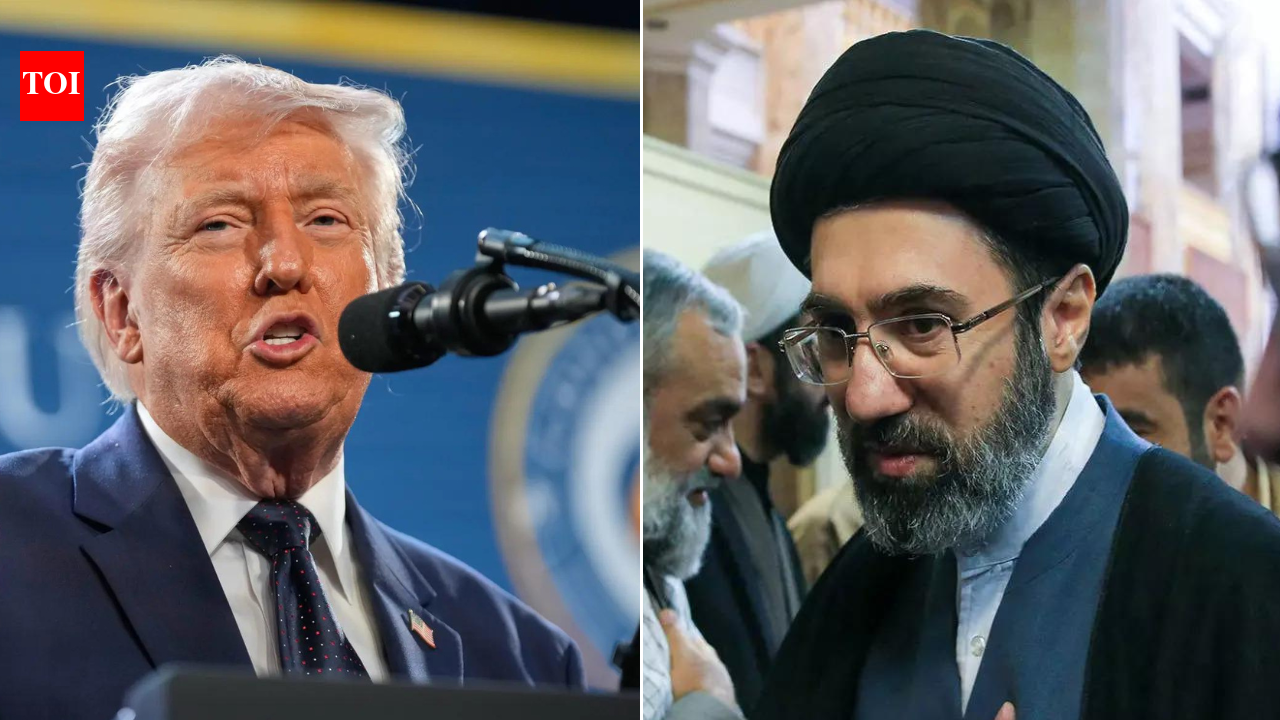
The United States is fighting Iran on the battlefield, and turning to its oil to keep the global economy afloat. As war in the Middle East chokes supplies through the Strait of Hormuz and sends prices soaring, the Donald Trump administration has begun easing restrictions on Iranian crude, allowing allies to buy the very resource that funds Tehran. For a president who came to power vowing to avoid “stupid” wars, the moment is especially fraught, a conflict he helped set in motion now risks slipping beyond his control, both on the battlefield and in its economic fallout.The move lays bare a stark war-time paradox — in trying to weaken Iran, Washington is being forced to rely on it.Though the move has been framed as “very temporary”, Mike Waltz, speaking at a CNN town hall, defended it as necessary to counter Iran’s strategy of driving up global energy prices.Even the administration’s messaging has been mixed — de-escalation in rhetoric, escalation in action. Trump said he was considering “winding down” military operations in the Middle East, even as the United States deployed three more amphibious assault ships and roughly 2,500 additional Marines to the region. Moreover, it attacked Iran’s nuclear facility Natanz again, even as Tehran has clearly warned against any attacks on its energy infrastructure, else bear oil shocks. Then what explains this sanctions shift?
World’s energy lifeline hit
Three weeks into the war with Iran, the United States is confronting a supply disruption of a scale few policymakers had anticipated. The near-total shutdown of the Strait of Hormuz has choked one of the world’s most critical oil arteries, sending shockwaves through global markets.The crisis has been compounded by direct attacks on critical energy infrastructure across the region. Strikes on Iran’s South Pars gasfield, part of the world’s largest natural gas reserve, were followed by missile attacks on Qatar’s Ras Laffan LNG facilities, causing extensive damage to one of the world’s biggest gas export hubs. Additional targets have included refineries in Saudi Arabia, Kuwait, and the UAE, raising fears of a broader energy war. With some of these facilities expected to take three to five years to fully repair, the disruption is no longer temporary — it threatens to lock in a prolonged global supply crunch. Brent crude, the international benchmark, has surged to around $106 per barrel, up sharply from roughly $70 before the conflict, underscoring how rapidly the crisis has escalated and how tightly global prices are tied to Middle East stability. Inside the administration of Donald Trump, officials are scrambling for solutions that can meaningfully ease supply pressures. A newly announced pause in sanctions applies only to Iranian oil already loaded on ships and is set to expire by April 19, limiting its immediate impact. Crucially, the move does not increase actual production, a central factor behind soaring prices, and much of Iran’s oil was already finding its way to buyers despite sanctions. That reality mirrors earlier steps, including a temporary pause on restrictions on some Russian shipments, which critics said offered only modest relief while exposing the limits of Washington’s options.
Policy levers pulled with little effect
Washington has already deployed nearly every conventional mechanism to cushion the blow. Hundreds of millions of barrels have been released from strategic reserves, sanctions on Russian oil have been partially eased, and domestic crude flows have been accelerated in an effort to boost supply. Yet these measures have barely dented rising prices. Global benchmarks continue to surge, and US consumers are feeling the impact at the pump. Officials privately acknowledge that the tools at their disposal are either insufficient in scale or too slow to counter the immediacy of the crisis, exposing the limits of state intervention in a tightly wound global oil market. The strain is also evident in Washington’s shifting diplomatic posture. After initially insisting the US did not need Nato’s help to secure the Strait of Hormuz, Donald Trump publicly urged allies to “step up” and help reopen the vital route. The appeal has met a muted response, with many countries reluctant to be drawn into a conflict they did not start, further complicating efforts to stabilize the situation and underlining the limits of US leverage even among its partners.Trump has criticized Nato countries as “cowards” for refusing to assist while insisting the campaign is unfolding according to plan, even declaring the battle “militarily won.” Yet those claims sit uneasily against the reality of a defiant Iran continuing to choke off Gulf energy flows and launch missile strikes across the region, underscoring the widening gap between rhetoric and conditions on the ground.
Finally, turning to enemy’s oil
With options dwindling, the administration has turned to a controversial stopgap: allowing allies to purchase Iranian oil already at sea. The move is designed to inject roughly 140 million barrels into a market starved of supply, offering short-term relief even as the broader conflict rages on. Officials argue that this oil would have likely been sold regardless, particularly to countries willing to bypass sanctions. Redirecting those flows to US allies, they contend, helps stabilize markets without fundamentally altering the pressure campaign against Tehran. Still, the decision lays bare an uncomfortable truth, that immediate economic needs are forcing Washington into choices that cut against its own strategic posture.
But is it enough to solve the energy crisis?
Even with Iranian barrels entering the market, the relief is expected to be fleeting. The additional supply amounts to barely a day and a half of global consumption, underscoring how limited the impact will be if disruptions persist. Energy experts warn that without a reopening of key shipping routes, the imbalance between supply and demand will continue to widen. That leaves the administration facing a stark choice: find a way to restore passage through the Strait of Hormuz or brace for prolonged economic fallout. For now, officials appear to be managing rather than resolving the crisis, navigating a war where the battlefield extends far beyond missiles and troops, deep into the fragile mechanics of the global economy.
Will the war end?
Beyond the immediate energy crisis, the conflict is pushing Donald Trump toward a deeper strategic crossroads. Analysts say the administration now faces a narrowing set of choices under what it has called Operation Epic Fury, with no clear indication of which path it is prepared to take, Reuters reported. One option is escalation — intensifying the offensive, potentially targeting critical infrastructure such as Iran’s oil hub at Kharg Island or expanding the US military footprint along Iran’s coast to neutralize missile threats. But such a move risks drawing Washington into a prolonged conflict, one that could face significant resistance from an American public wary of another long war in the Middle East. The alternative is to claim victory and scale back operations. Yet that, too, carries risks. It could leave Gulf allies exposed to a weakened but still defiant Iran, capable of disrupting shipping lanes and projecting power across the region. With diplomacy stalled and neither side showing signs of backing down, the administration is left navigating a conflict where every option deepens the very uncertainty it is trying to contain.
Business
Dalal Street sees massive bloodbath as Middle East tensions intensify, what should investors do? Here’s what NSE’s Harish Ahuja says – The Times of India

Global markets have been on a bit of a roller-coaster ride lately, shocked by the ongoing Middle East conflict, which has now entered its fourth week. Just by Thursday, he sharp sell off wipped off Rs 12.87 lakh crore from investor’s wealth as Dalal Street witnessed a bloodbath. Going back further, ever since the crisis unfolded in the region, investors have lost over Rs 37 lakh crore as of March 19.As indices swing, investors are left staring at red screens and wondering whether to act or sit tight. The big question is what should you do? Make a move now, or wait for that golden opportunity. But amid the noise, a familiar reminder is making the rounds: market moves may be sharp in the short term, but reacting too quickly can often do more harm than good. Speaking on the volatility in global markets, Harish K Ahuja, head of sustainability, Power & Carbon Markets, Listing & Social Stock Exchange at the National Stock Exchange of India (NSE), has called on retail investors to stay steady and avoid reacting to short-term market swings.Commenting on recent trends, Ahuja said that the correction being witnessed is not restricted to India but is part of a broader global movement. “Most of the exchanges across the globe are seeing a correction of 7% to 10%. And this up and down is a part of the very market,” he said.He cautioned retail participants against panic-driven decisions during periods of uncertainty. “My suggestion to retail investors: don’t panic. Show the patience, you are an investor, not a trader,” he said.According to Ahuja, India’s economic fundamentals continue to remain supportive despite external pressures. “My understanding of the Indian market, India is growing. Indian fundamentals in terms of GDP growth, inflation, most of the indicators, be it industrial growth, electricity consumption, are very positive,” he stated.He also highlighted the strength and scale of India’s capital markets, pointing to strong participation levels and activity. “India has witnessed the largest number of IPOs in the world. We are one of the largest exchanges in terms of the number of unique investors and unique accounts,” he said.Ahuja highlighted that investing should be viewed with a long-term perspective rather than a daily trading mindset. “Investment means, for me, the definition of investment is once you buy a stock, at least for the next five to ten years, don’t watch the stock daily,” he said.Reiterating his outlook, he added that patience and an understanding of macroeconomic fundamentals are key to navigating volatility. “I think I am always positive about the market because I am a patient investor. Once you have patience, once you understand the fundamentals of the economy and the country as a whole, you should not panic.”He further indicated that investors who maintain discipline and focus on long-term horizons are more likely to withstand short-term geopolitical disruptions and benefit from market growth over time.

The government is set to pay oil marketing companies (OMCs) up to Rs176 per litre under price differential claims (PDCs) in the wake of the decision against fuel price hike in the country, read the Ministry of Energy’s (Petroleum Division) letter addressed to the Oil and Gas Regulatory Authority (Ogra).
The letter, dated March 20, says that the government will pay PDCs to the OMCS from March 21 (today) till March 27, which amounts to around Rs48 billion, with the payment set to be made by the Finance Division via the Ogra.
In this regard, the government will pay a price differential of Rs176.41 per litre on high-speed diesel (HSD) and Rs77.98 per litre on petrol (MS) to the OMCs.
The PDCs will be paid as Prime Minister Shehbaz Sharif, on Friday, announced the government’s decision to keep the petrol and diesel prices unchanged for next week after rejecting a proposal to raise rates on the occasion of Eid ul Fitr.
The prime minister announced this during an address to the nation, delivered on the eve of Eid ul Fitr. The statement comes as the federal government was scheduled to review the fuel prices on March 20.
Previously, on March 13, the government maintained the petroleum prices despite a surge in global oil prices.
Addressing the nation today, PM Shehbaz referred to the global situation in light of the Middle East conflict between Iran, US and Israel leading to the closure of the Strait of Hormuz — which has disrupted the oil shipping routes resulting in hike in global oil price — and said: “Today, the world is facing an extraordinary test. [Mideast] conflict has shaken the global economy as well as peace and stability”.
The premier pointed out that attacks on energy installations in brotherly countries have worsened the crisis. “There is a fear that this crisis may intensify further,” he said.
Highlighting the economic impact, the prime minister said oil prices in the global market have surged sharply. “Oil, which was priced at $72 per barrel just weeks ago, has now reached $158 per barrel,” he stated.
The prime minister warned that the situation could lead to rising inflation.
The prime minister further said that another increase in oil prices had been observed in the week starting today, after which he was advised again to raise petrol by Rs76 per litre and diesel by Rs177 per litre, but he rejected the proposal.
“So, the federal government will bear the additional burden of Rs45bn once again,” the PM added.
He said the federal government had spent Rs69bn from its savings and development budgets over the past two weeks to prevent petrol prices from rising by Rs127 per litre and diesel by Rs252 per litre.


Jude Bellingham available for Real Madrid to face Atlético Madrid – Álvaro Arbeloa

UK skies set for second night of dazzling display

Michigan-Saint Louis shaped by Dusty May, Josh Schertz friendship

-
 Business1 week ago
US issues 30-day waiver for Russian oil shipments stranded at sea | The Express Tribune
-

 Fashion1 week ago
Chinese firm to invest $15.34 million in garment factory at BEPZA
-
 Fashion1 week ago
US unemployment rate 4.4% in Feb 2026, LFPR 62%: BLS
-

 Tech1 week ago
Tips and Advice for Buying Used or Refurbished Electronics
-

 Sports1 week ago
Bilas’ All-America teams: My top 20 men’s college basketball players of 2025-26
-
 Business1 week ago
Oil holds above $100 as tensions escalates between Iran, US and Israel – SUCH TV
-
 Business7 days ago
UAE savings strategies 2026 explained: Best apps, tools, budget rules and smart money hacks to beat rising cost of living in emirates – The Times of India
-
 Entertainment6 days ago
Strategic oil stocks to be released ‘immediately’ in Asia and Oceania: IEA