

Business
Dubai gold prices break records: What’s driving the rally and should you buy in 2026? – The Times of India

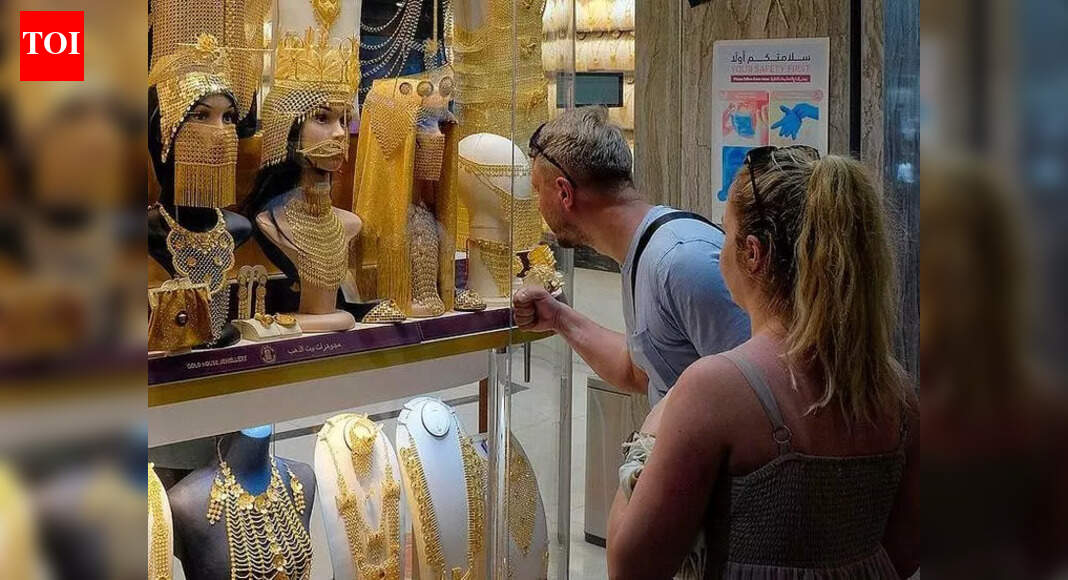
Dubai’s gold market delivered a giant surprise in 2025, marking one of the most dramatic rallies in recent history. What started as a modest year for bullion turned into a breakout performance, with the price of 24-carat gold climbing by more than Dh200 per gram and delivering massive gains for investors, collectors and everyday residents alike.
Gold’s remarkable rally in 2025
According to market data, the price of 24K gold opened the year at Dh318 per gram on January 1, 2025 and finished the year at Dh520 per gram on December 31, a jump of roughly 63.5 percent. This means that anyone holding physical gold throughout the year saw the value of their holdings rise by more than Dh200 per gram. The 22-carat variant also saw remarkable gains, climbing from about Dh294.50 to Dh481.50 per gram, roughly a Dh187 increase, while even 21K gold rose around Dh176.75 per gram over the same period. By contrast, the newly introduced 14K gold, launched in the UAE on November 29, posted a more modest 2.3 percent gain, reflecting its lighter weight and broader affordability for everyday wear.
Why gold took off
Several economic forces came together in 2025 to fuel this dramatic upswing. Given the safe-haven demand, global investors and central banks including those in the Gulf, shifted capital into gold as a hedge against market uncertainty and geopolitical risk, a pattern seen throughout 2025. According to reports, gold’s rally in 2025 was the strongest annual performance since the late 1970s, with prices soaring nearly 70 percent globally.

Dubai Gold Shock: 24K Prices Jump Over Dh200 Per Gram in One Year. Are You Sitting on a Fortune?
Interest rate dynamics with expectations of lower US Federal Reserve interest rates and the appeal of non-yielding assets helped lift gold’s allure. Lower real yields often make gold more attractive relative to bonds and other financial instruments. The Central Bank of the UAE increased its gold holdings significantly in 2025, growing reserves by about 26 percent to nearly $7.9 billion as global economic uncertainty persisted, a historic move that underscored gold’s strategic value. These factors combined to create a strong backdrop for prices, pushing bullion sharply higher even as other asset classes posted uneven returns.
Impact on Dubai and the Gulf region
For residents and investors in Dubai, long accustomed to the Gold Souk’s bustling trade and precious-metal culture, the surge translated into real-world gains. Retail buyers saw both jewellery and bullion values climb, lifting the wealth of long-term holders. With 24K gold prices consistently near or above Dh520 per gram in late December and into early 2026, bullion became a focal point for investment as much as adornment. At the same time, short-term volatility such as a near Dh18 drop in just one day toward the end of the year due to profit-booking in global markets, reflected how active trading and profit-taking can influence local UAE prices even amid a strong overall rally. Jewellers and bullion dealers across Dubai’s famous Gold Souk and regional markets noted the heightened interest, particularly from expatriate buyers and Middle Eastern investors seeking to protect wealth in an uncertain macroeconomic environment. The UAE’s competitive pricing environment, where making charges and taxes are relatively low, further incentivises local and international buyers alike.
Global gold context: Safe haven, surging demand
Dubai’s gold price story fits into a broader global trend. Precious metals surged worldwide in 2025 as investors raced toward safe havens amid geopolitical unrest and economic concerns. Gold topped record levels over $4,300 per ounce internationally, one of the metal’s best annual performances in decades.

Gold Made Dubai Richer in 2025: Why Prices Exploded and What It Means for 2026
Analysts and major institutions such as Deutsche Bank and Goldman Sachs forecast continued strength through 2026 and beyond, with projections ranging from $4,000 to over $4,900 per ounce by year-end, supported by sustained central bank buying and geopolitical tension. This global backdrop helped lift sentiment in Dubai and the broader Gulf, where gold remains culturally and economically significant.
What’s ahead for gold in 2026?
After a spectacular run in 2025, markets are closely watching how 2026 unfolds. Early data suggests that gold prices continued to hold near high levels in early January 2026, even after slight profit-taking in global markets. Forecasts by international analysts suggest continued upside potential if geopolitical risks and safe-haven demand remain strong. For Gulf investors, this means that gold remains a key hedge and wealth preserver, not just a jewellery purchase.
Bottom line: A golden year that redefined markets
Dubai’s gold surge in 2025, with 24K climbing more than 60 percent, marked a rare standout year for precious metals. From record price gains to heightened global demand and strong central bank involvement, gold’s rally reflected broader economic and geopolitical forces at play. As 2026 begins, many investors and analysts see bullion continuing to play a central role as a store of value, especially in a world marked by uncertainty and shifting financial landscapes.





ChatGPT developer OpenAI has halted plans for a significant UK data centre project, citing high energy costs and regulatory challenges as barriers to investment.
The US technology giant had intended to establish its “Stargate” data centre initiative within a new artificial intelligence growth zone in the north-east of England.
The venture was slated for multiple sites, including Cobalt Park near Newcastle and Blyth.
However, OpenAI said the plans are now on hold, awaiting “the right conditions” to facilitate long-term infrastructure investment across the UK.
A spokesman for OpenAI said: “We see huge potential for the UK’s AI future. London is home to our largest international research hub, and we support the Government’s ambition to be an AI leader.
“AI compute is foundational to that goal – we continue to explore Stargate UK and will move forward when the right conditions such as regulation and the cost of energy enable long-term infrastructure investment.”
The reference to energy costs come at a time when prices are being pushed higher by the US and Israel’s war with Iran.
The International Monetary Fund (IMF) said in March that the UK was one of the nations particularly exposed to soaring wholesale costs because of its reliance on gas-fired power, as opposed to sources such as nuclear and renewable energy.
Data centres are powered by very large amounts of energy so are more likely to be exposed to volatile prices.
OpenAI added: “In the meantime, we are investing in talent and expanding our local presence, while also delivering on the commitments under our MOU (memorandum of understanding) with the Government to adopt frontier AI in UK public services.”
Its Stargate project aims to invest billions of dollars into AI infrastructure in the US, with funding from OpenAI, SoftBank, Oracle and MGX and partnering with tech giants including Nvidia and Microsoft.
Building it into the UK came as part of a landmark tech deal between Britain and the US, announced last September amid President Donald Trump’s second state visit.
The deal also included a 30 billion US dollar (£22.3 billion) pledge from Microsoft, the largest ever made by the company in the UK, to fund the expansion of Britain’s AI infrastructure.
Conservative MP and shadow science minister Ben Spencer said: “When global firms cite high energy costs and regulatory uncertainty as reasons to walk away, it tells you everything about the direction of travel.
“For too long, Labour have prioritised courting big tech headlines while neglecting our domestic start-ups, but also the fundamentals that actually attract investment at home.”
Importers are in line for tariff refunds. But whether everyone who paid the for the tariffs will get money back is a trickier question.
Source link

Somerset councillor Heather Shearer said: “One thing the Crisis Resilience Fund wants us to do is not just support people in crisis, it also wants us to work in our community, give more strength and support for the organisations who already support our families.”


This Bayern are special and a force to be reckoned with in Germany and Europe

US container imports steady despite Iran conflict: NRF

Transfer rumors, news: Arsenal look to raise £100m from double exit

-
 Business1 week ago
Jaguar Land Rover sees sales recover after cyber attack
-
Uncategorized1 week ago
[CinePlex360] Please moderate: “Trump signals p
-

 Entertainment7 days ago
Joe Jonas shares candid glimpse into parenthood with Sophie Turner
-

 Tech7 days ago
Our Favorite iPad Is $50 Off
-

 Sports6 days ago
UConn Final Four run could trigger a $50M furniture giveaway for Massachusetts-based Jordan’s Furniture
-

 Entertainment7 days ago
Blake Lively reacts to harassment claims dismissal against Justin Baldoni
-

 Politics7 days ago
Iran can sustain Strait of Hormuz closure for years, will cut US military logistics: Official
-
 Business1 week ago
Gold prices in Pakistan Today – April 3, 2026 | The Express Tribune