

Business
Ed Miliband hints at cut to VAT on energy bills


Becky MortonPolitical reporter
 BBC
BBCThe government is looking at the possibility of cutting the rate of VAT on energy bills, Ed Miliband has suggested.
The energy secretary said he would not speculate ahead of the chancellor’s Budget in November.
But asked if the government would consider scrapping the 5% rate, he told the BBC the country was facing a “cost-of-living crisis that we need to address as a government” and “we’re looking at all of these issues”.
The government is under pressure to reduce household energy costs and before the election Labour pledged to lower average bills by £300 a year by 2030.
Miliband told the BBC’s Sunday with Laura Kuenssberg programme he stood by that promise but the reason bills were so high was “because of our dependence on fossil fuels”.
He added: “There is only one route to get bills down, which is to go for clean power, home-grown, clean energy, that we control, so we’re not at the behest of the petrol states and the dictators.”
Pressed over whether the government was considering scrapping the 5% VAT rate on energy bills in November’s Budget, Miliband said: “The whole of the government, including the chancellor, understand that we face an affordability crisis in this country.
“We face a cost-of-living crisis, a longstanding cost-of-living crisis, that we need to address as a government. We also face difficult fiscal circumstances… so obviously we’re looking at all of these issues.”
A Treasury spokesperson said: “We do not comment on speculation.”
Scrapping VAT on domestic energy bills would save the average household £86 per year and cost an estimated £2.5bn per year to implement, according to the charity Nesta.
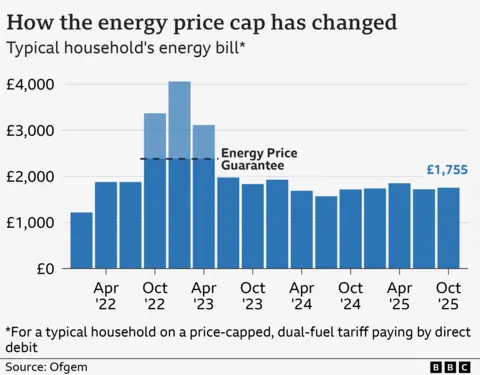
There was a rapid spike in energy prices in 2021, following Russia’s invasion of Ukraine, and although costs have gone down, they have remained high by historical standards.
This month bills went up by 2% for millions of households, under the energy regulator Ofgem’s price cap.
It means a household using a typical amount of energy will pay £1,755 a year, up £35 a year on the previous cap.

Earlier this week Chancellor Rachel Reeves told the BBC she was planning “targeted action to deal with cost-of-living challenges” in her Budget next month.
The BBC understands this could also include reducing some of the regulatory levies currently added to energy bills.
Levies known as “policy costs” – which are used to fund environmental and social schemes such as subsidies for renewables – made up around 16% of the average electricity bill and 6% of the average gas bill last year.
Some energy bosses have argued green levies are partly to blame for rising bills and the government’s independent adviser, the Climate Change Committee, has long recommended removing policy costs from electricity bills to help people feel the benefits of net-zero transition.
Asked whether these could be funded through taxes rather than coming off energy bills, Miliband said: “That’s always a judgement for the chancellor, but let’s be honest we know we’ve got really difficult fiscal circumstances that we inherited… but absolutely we look at those things.”
He argued the government had to invest in “aging electricity infrastructure” but there needed to be a “balance between public expenditure and levies”.
The cost of household energy bills has become a major political battleground, with the Conservatives and Reform UK blaming net-zero policies for higher prices.
The Conservatives have said they would scrap the Climate Change Act, which legally requires the UK government to reduce emissions to net zero by 2050, as well as ditch carbon taxes on electricity generation and cut a funding scheme for renewables.
Shadow energy secretary Claire Coutinho said her party’s plans would cut electricity bills for everyone by 20%.
“[The public] care about climate change but what I don’t think they are signing up for is much higher bills and jobs being lost to countries abroad,” she told the BBC.
In an interview with the same programme, Green Party leader Zack Polanski argued nationalising energy companies would help cut costs for customers.
His party has also proposed a new tax on carbon emissions to drive fossil fuels out of the economy and raise money to invest in the green transition.
Challenged over whether businesses would simply pass on these costs to customers, Polanski rejected this and said the tax would be “vital for tackling the climate crisis”.
“What we need to be doing is finding other ways to support particularly small and local businesses… We know the big corporations are destroying our environment, our democracy and our communities,” he said.
“They can make a profit, sure, but this isn’t about squeezing out every single profit they can make.”

Business
Noida International Airport inauguration: Delhi-NCR gets new airport – all you need to know – The Times of India

NEW DELHI: Prime Minister Narendra Modi on Saturday inaugurated Phase I of the Noida International Airport at Jewar in Uttar Pradesh, marking a significant milestone in India’s expanding aviation infrastructure.PM Modi was accompanied by Uttar Pradesh chief minister Yogi Adityanath and Governor Anandiben Patel.
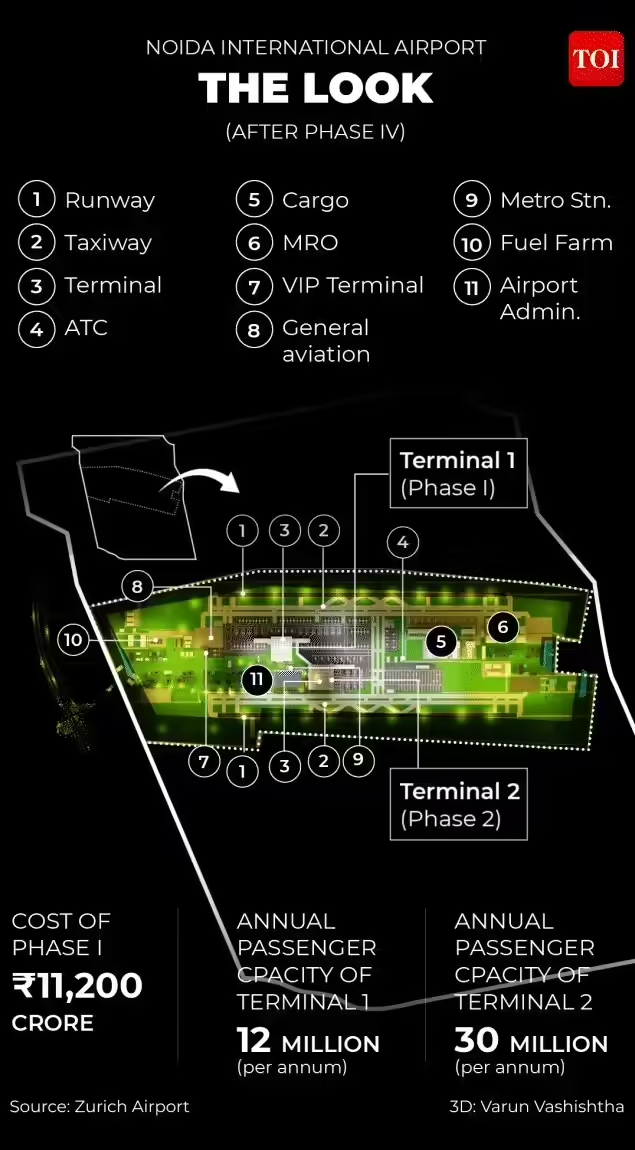
Developed at an investment of around Rs 11,200 crore under a Public–Private Partnership (PPP) model, the project is expected to enhance both regional and international connectivity for the National Capital Region (NCR).The airport is being positioned as a key addition to India’s aviation network, aimed at easing pressure on existing infrastructure while supporting the country’s ambition of becoming a global aviation hub.
Second international gateway for Delhi NCR
Noida International Airport has been developed as the second international gateway for Delhi NCR, complementing the existing Indira Gandhi International Airport, which currently handles the majority of the region’s air traffic.
.
With rising passenger demand and capacity constraints at IGI Airport, the new facility is expected to play a crucial role in distributing traffic more efficiently.Together, the two airports will function as an integrated aviation system, helping reduce congestion, improve connectivity, and enhance the region’s standing among leading global aviation hubs.
Phase I capacity and future expansion plans
Phase I of the airport is designed to handle 12 million passengers per annum (MPPA), providing immediate relief to the region’s growing air travel demand.The project has been planned with scalability in mind, with provisions to expand capacity to 70 million passengers annually in subsequent phases. This long-term vision reflects the government’s strategy to future-proof infrastructure and accommodate sustained growth in air travel.
Modern infrastructure and all-weather operations
The airport features a 3,900-metre runway capable of handling wide-body aircraft, making it suitable for both domestic and international long-haul operations.
.
Equipped with advanced navigation systems such as the Instrument Landing System (ILS) and modern airfield lighting, the facility is designed to support efficient, all-weather, round-the-clock operations. These features ensure operational reliability even under challenging weather conditions.
Cargo hub and logistics ecosystem
In addition to passenger services, the airport includes a comprehensive cargo ecosystem aimed at strengthening logistics and trade.The Multi-Modal Cargo Hub comprises an Integrated Cargo Terminal and dedicated logistics zones, with an initial handling capacity of over 2.5 lakh metric tonnes annually. This capacity is expected to expand significantly to around 18 lakh metric tonnes in the future, positioning the airport as a major cargo and logistics centre in North India.
Dedicated MRO facility to enhance efficiency
A key component of the airport’s infrastructure is a 40-acre Maintenance, Repair and Overhaul (MRO) facility.This dedicated facility is expected to improve operational efficiency by enabling airlines to service and maintain aircraft locally, reducing turnaround times and operational costs. It also strengthens India’s capabilities in aviation maintenance services.
Sustainability and future-ready design
Noida International Airport has been designed as a sustainable and future-ready infrastructure project, with a focus on achieving net-zero emissions.The project incorporates energy-efficient systems and environmentally responsible practices, aligning with India’s broader climate goals. The airport’s development reflects a growing emphasis on green infrastructure in large-scale projects.
Architecture inspired by Indian heritage
Blending modern infrastructure with cultural aesthetics, the airport’s architectural design draws inspiration from traditional Indian elements such as ghats and havelis.This approach aims to create a distinctive identity for the airport while offering passengers a sense of place rooted in Indian heritage.
Strategic location and multi-modal connectivity
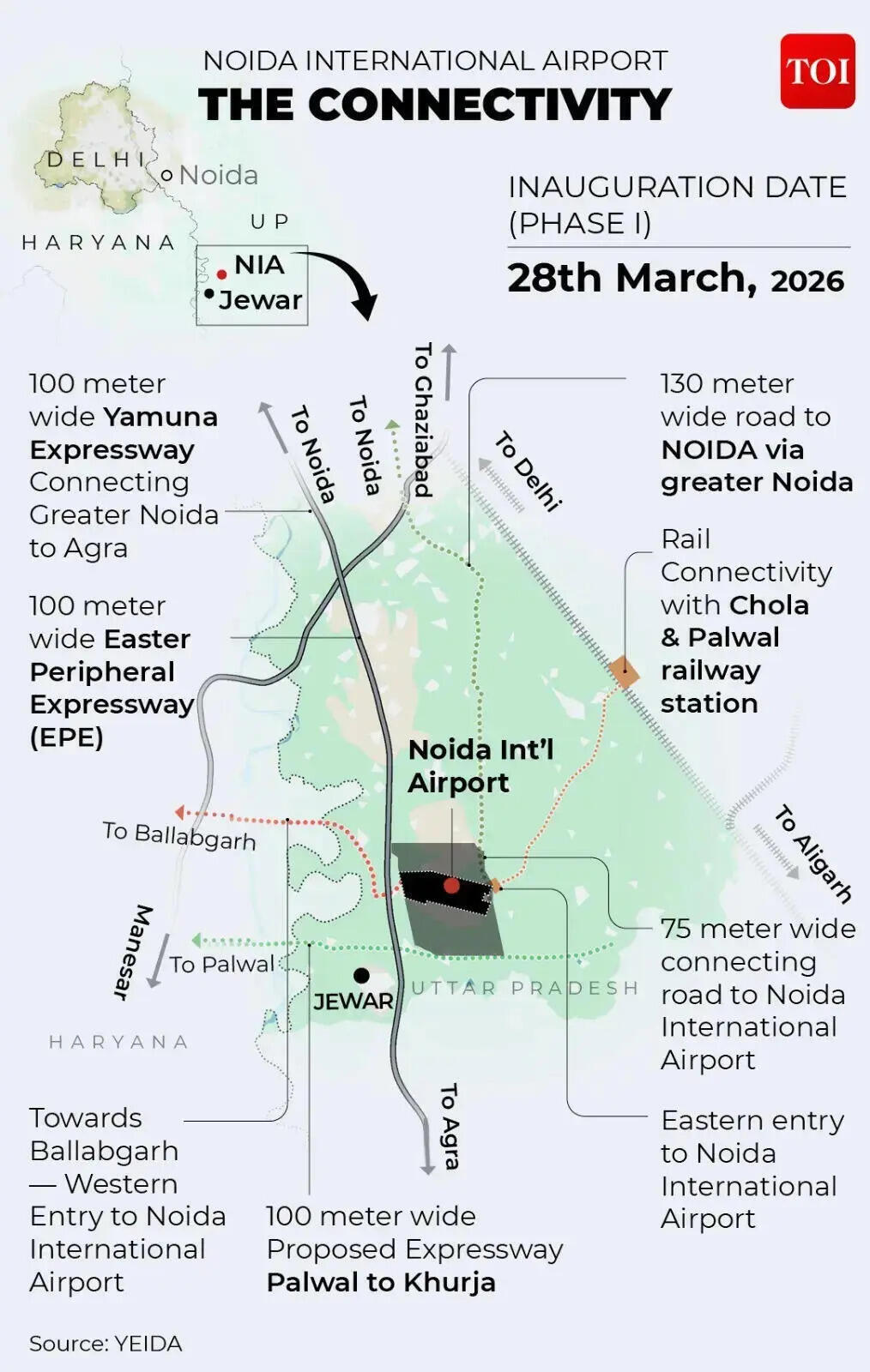
Strategically located along the Yamuna Expressway in Gautam Buddha Nagar district, the airport is planned as a multi-modal transport hub.It will feature seamless integration with road, rail, metro and regional transit systems, ensuring smooth connectivity for passengers and cargo. This connectivity is expected to significantly improve accessibility for travellers across Delhi NCR and neighbouring regions.
Boost to India’s aviation ambitions
The inauguration of Phase I of Noida International Airport is being seen as a major step in strengthening India’s aviation ecosystem.By expanding capacity, improving connectivity, and integrating modern infrastructure with sustainability, the project is expected to play a key role in positioning Delhi NCR as a major global aviation hub while supporting economic growth and regional development
Business
Iran permits 2 Pakistani cargo ships to pass through Strait of Hormuz | The Express Tribune

Iran has permitted two Pakistani cargo ships to transit through the Strait of Hormuz, sources in the Ministry of Maritime Affairs confirmed on Saturday.
The vessels, Multan and P-Akili, which were previously held after Iranian forces took control of the strait — a key global oil supply route — have now crossed and are en route to Karachi. They are expected to dock at Karachi port on March 31, a source familiar with the matter said.
Multan is a general cargo ship, while P-Akili is carrying over 80 million litres of crude oil. Sources added that Iranian authorities not only allowed the vessels to pass but also provided an escort until they cleared the strait’s flashpoint line.
Read: Global poll says Iran war leaves US increasingly isolated internationally
This move comes amid ongoing mediation efforts by Islamabad, in coordination with Turkiye and Egypt, to curb the escalating conflict in the Middle East.
It is the second time Tehran has permitted a Pakistani ship to pass through the Strait of Hormuz since the conflict began on February 28. Previously, a Pakistani oil tanker transited the strait on March 16.
The Middle East region remains on high alert following the joint US-Israel offensive on Iran that began on February 28, which has resulted in over 1,900 deaths, including then-Supreme Leader Ali Khamenei.
Tehran has retaliated with drone and missile strikes targeting Israel, Jordan, Iraq, and Gulf countries hosting US military assets, causing casualties, infrastructure damage, and disruption to global markets and aviation.

Butter, chocolate, coffee and milk have all seen prices rocket. Tracing back through the story of one particular supermarket staple begins to explain why
Source link


Transfer rumors, news: Salah eyes Roma after Liverpool exit

NHL playoff watch: Guide to all 15 games on Showdown Saturday

I Tested Garmin Watches for a Decade While Hiking, Biking, and Climbing. Here’s What You Should Buy

-
 Business1 week ago
Flipkart group CFO to leave co amid IPO plans – The Times of India
-
 Business1 week ago
Video: The Effects of High Oil Prices
-

 Fashion1 week ago
China’s textile & apparel exports surge 17% to $50 bn in Jan-Feb 2026
-

 Sports1 week ago
Rating Adidas’ 2026 World Cup away shirts: Argentina, Spain, Mexico and more
-

 Sports1 week ago
American Conference Commissioner Tim Pernetti thanks Trump for Army-Navy game executive order
-
Tech1 week ago
The Corsair 4000D RS PC Case Keeps Your System Cool
-

 Tech1 week ago
Gamers Hate Nvidia’s DLSS 5. Developers Aren’t Crazy About It, Either
-

 Tech1 week ago
‘Uncanny Valley’: Nvidia’s ‘Super Bowl of AI,’ Tesla Disappoints, and Meta’s VR Metaverse ‘Shutdown’