

Business
Eli Lilly launches program to help boost employer coverage of obesity drugs in U.S.


Eli Lilly on Thursday launched a new program designed to help more employers cover obesity drugs in the U.S., targeting a major barrier to access for patients.
Lilly and its chief rival, Novo Nordisk, have moved to slash the cash prices of their popular obesity injections for those who want to pay entirely out of pocket. But employer coverage of obesity drugs remains uneven due to high costs, leaving roughly half of people with commercial insurance unable to start or stay on treatment, Lilly said in a release. List prices for Lilly’s weight loss and diabetes treatments, Zepbound and Mounjaro, top $1,000 per month.
Nearly one-fifth of firms with more than 200 workers, including 43% with 5,000 or more workers, said they cover GLP-1 drugs for weight loss as of October, according to a survey by the Peterson-KFF Health System Tracker.
“I think we’ll learn in the coming months ahead, if this is a solution that maybe enables some employers who have been sitting on the sidelines to opt into obesity coverage for their employees,” Kevin Hern, senior vice president of Lilly Employer, said in an interview. He added that some employers could opt to add coverage in the upcoming months, while others could wait until 2027.
Eli Lilly’s new “Employer Connect” platform gives employers more flexibility in how they cover obesity treatments, aiming to broaden employee access to the drugs at low out-of-pocket costs, while also limiting expenses for companies. Hern said the program addresses some of the “core tensions” for employers when considering coverage of obesity drugs, including transparency around drug prices, flexibility in benefits design and the ability to choose among independent administrators.
Through the program, employers can pay a net discounted price of $449 per month for a new multi-dose form of Zepbound across all doses, Hern said. He added that the arrangement does not involve rebates, and that the net price gives employers clearer visibility to determine whether they can offer the drug.
Instead of relying on traditional benefit designs, employers can use Lilly’s platform to connect with more than a dozen different third-party program administrators that help manage obesity treatment benefits and costs.
“Every employer is different. They all want to design things according to their unique needs and workforce,” Hern said.
Employers can choose among more than 15 administrators to design benefits that fit their budget and workers’ needs. Some of the administrators may focus on administering the obesity benefits to employees, dealing with core functions such as enrollment, eligibility, claims and more. Other administrators may specialize in comprehensive obesity management, offering telehealth, nutrition and lifestyle support for patients.
Lilly plans to expand the number of program administrators on the platform. The administrators already on the platform are GoodRx, Mark Cuban’s Cost Plus Drug Co., Sesame, Teladoc Health, 9amHealth, Andel, Calibrate Health, Crux Health, eMed, FlyteHealth, Form Health, Goodpath, Ilant Health, Onsera Health, ReviveHealth, Salta Direct Primary Care, Transcarent and Waltz Health.
“Our goal was to kind of create a platform where these firms could compete … with the value of their services for the employers,” Hern said. All of the administrators are offering the same medicine at the same price, so employers will determine “who can provide me the best service in terms of administering this program as I define that.”
Those with government insurance could also see easier access to obesity drugs: Under landmark deals that Lilly and Novo struck with President Donald Trump, Medicare will cover those medicines for the very first time later this year.


Business
LPG relief: Two Indian vessels cross Strait of Hormuz safely with 92,700 tonne cargo, set to dock March 16 & 17 – The Times of India
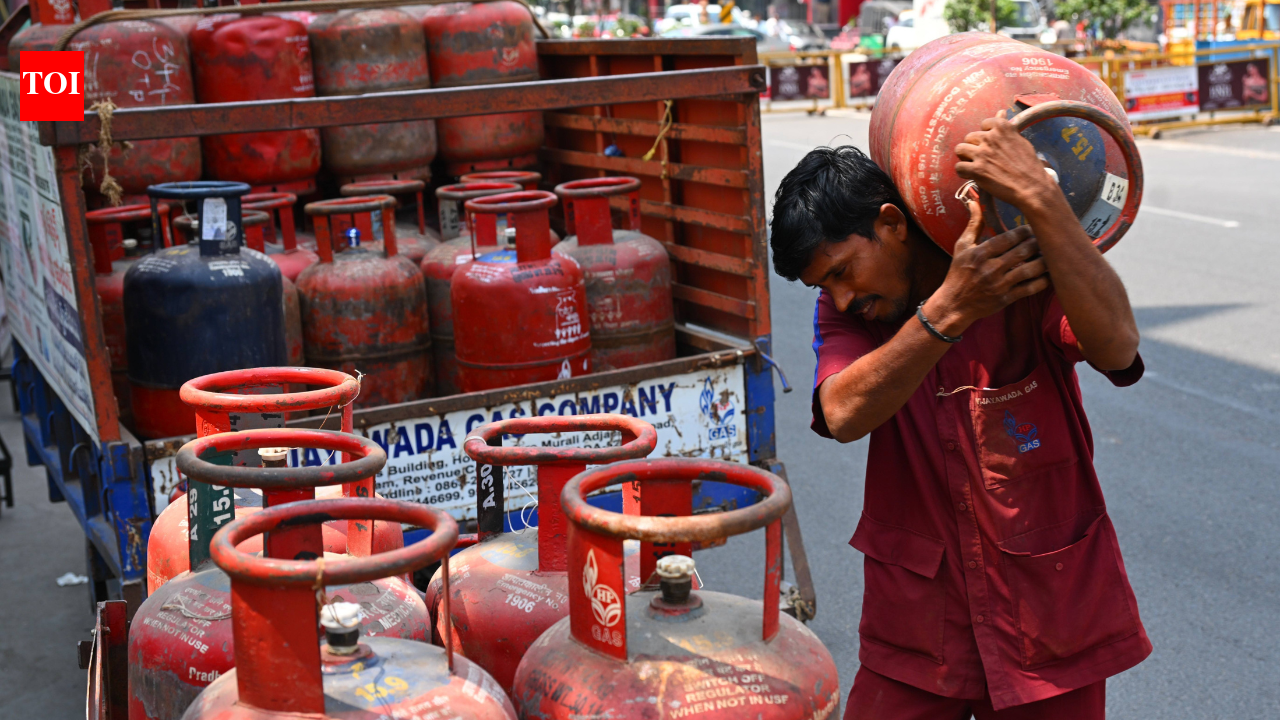
In a boost to domestic energy supplies amid disruptions in West Asia, two Indian-flagged LPG carriers safely crossed the conflict-hit Strait of Hormuz early Saturday and are now on course for ports in Gujarat. LPG carriers Shivalik and Nanda Devi are heading to Mundra and Kandla, respectively, Rajesh Kumar Sinha, Special Secretary in the Ministry of Shipping, said at a media briefing. The ships are carrying a combined 92,700 tonne of LPG and are expected to dock at Indian ports on March 16 or 17, he said. The two vessels were among 24 ships that had been stranded on the western side of the strategic waterway since the war broke out in the region.
Petrol, diesel stocks adequate
India has sufficient availability of petrol and diesel and refineries are operating at full capacity despite disruptions linked to the West Asia conflict, a senior petroleum ministry official said, urging consumers to avoid panic booking of LPG cylinders.Addressing an inter-ministerial briefing, Joint Secretary (Marketing & Oil Refinery) Sujata Sharma said the country currently has enough crude supplies and domestic production is meeting fuel requirements.“As far as crude oil and refineries are concerned, we have a sufficient supply of crude and our refineries are operating at full capacity. There have been no reports of any dry-out at retail outlets. Adequate petrol and diesel are available,” she said.She added that India does not need to import petrol and diesel at present. “We produce enough petrol and diesel in the country according to our requirements, and therefore there is no need for us to import them,” Sharma said.
LPG supply under watch, PNG push for commercial users
While domestic fuel supplies remain stable, the official flagged concerns about cooking gas availability amid the prevailing geopolitical situation.“Regarding LPG supply, I would like to say that it is still a matter of concern for us in view of the prevailing geopolitical situation. However, no dry-out has been reported,” she said.The government is encouraging commercial consumers facing supply disruptions to switch to piped natural gas (PNG). In this context, the Gas Authority of India Limited (GAIL) has held meetings with city gas distribution operators to facilitate immediate PNG connections wherever feasible.“There was considerable discussion regarding commercial cylinders, and after that it was decided that some LPG should also be supplied to commercial consumers,” Sharma said, adding that distribution has begun in about 29 states and Union territories.
Panic booking spikes, govt appeals for restraint
Sharma also pointed to a sharp increase in LPG bookings, describing the trend as panic-driven.“Panic booking is still happening on a very large scale. Yesterday, we informed you that the number of bookings was around 7.5-7.6 million, and now that number has increased to almost 8.8 million. So this is nothing but panic booking,” she said.Appealing for restraint, she urged consumers to place orders only when required. “I would like to appeal to the citizens of the country to avoid panic booking and to make bookings only when there is an actual need. This will be good for everyone,” Sharma added.Highlighting the progress in digital adoption, the official said most LPG bookings are already being made online. “Online booking is currently about 84 per cent, but it needs to improve to almost 100 per cent,” she said.(With inputs from agencies)
Mumbai: Net FPI selling on Indian exchanges reached around Rs 54,455 crore ($5.9 bn) by 13 Mar 2026 as global risk sentiment turned negative after a brief recovery in foreign flows earlier in the year.The earlier improvement in flows followed the India–US tariff deal, which reduced tariffs on Indian exports to the US and improved investor sentiment toward India’s growth and export outlook. February saw strong foreign buying in equities as market corrections and resilient corporate earnings supported investor confidence.“The weakness in global equity markets following the war in West Asia, the steady depreciation of the rupee and concerns surrounding the impact of high crude price on India’s growth and corporate earnings contributed to the concern of FPIs. The poor returns from India vis a vis other markets – both developed and emerging- during the last eighteen months is the principal reason for FPI’s indifference towards India. If their sustained selling strategy is to change, there should be clear indications of earnings recovery in India. In the present uncertain context, this will take time,” said VK Vijayakumar, Chief Investment Strategist at Geojit Financial Services.Geopolitical tensions escalated after US–Israel strikes on Iran at the end of Feb, triggering a global risk-off move. Foreign investors began unwinding positions in Indian equities soon after the conflict intensified. The escalation also triggered outflows from India’s fully accessible Govt bond route as investors reassessed risks in emerging markets.“Now FPIs regard South Korea, Taiwan and China as better markets to invest since they are relatively cheaper than India even after the recent correction. Also, the corporate earnings prospects in these markets appear better than that of India. Therefore, further selling by FPIs in India is likely in the short term. On the positive side, huge selling by FPIs in financials has made their valuations attractive and investable for domestic investors,” added Vijayakumar.Investors cited the risk of higher crude oil prices, pressure on the rupee, and rising bond yields as key concerns. The selling reversed improving flows seen earlier in the year.Domestic institutional investors absorbed much of the selling, which helped limit broader declines in equity markets.The outflows reflect portfolio de-risking and a reassessment of external risks rather than a structural change in India’s growth outlook.
Business
A Paramount-Warner Bros. movie slate could rule the 2027 box office, but is it sustainable?

Paramount Skydance CEO David Ellison speaks during the Bloomberg Screentime conference in Los Angeles on October 9, 2025.
Patrick T. Fallon | Afp | Getty Images
Hollywood could soon have a new king of the box office.
With Paramount Skydance set to take over Warner Bros. Discovery, the combined film studios could dominate the theatrical slate.
Paramount CEO David Ellison has repeatedly promised not to pull back on production from either studio, with the goal of making 30 movies a year — 15 from Paramount and 15 from Warner Bros. The pending transaction, with an enterprise value of $111 billion, must still win regulatory approval both in the U.S. and in Europe.
As the current 2027 slate stands, the combination of WBD and Paramount would result in 26 theatrical releases. However, additions to that calendar could come as soon as April at the annual CinemaCon conference in Las Vegas.
This behemoth of a slate is dominated by Warner Bros. titles, and it’s likely that those films would account for the bulk of ticket sales.
The studio is set to release films from major franchises including Godzilla-Kong, Superman, Batman, Minecraft, The Conjuring universe, Gremlins and Lord of the Rings.
Meanwhile, Paramount will have new entries for Sonic the Hedgehog, Paranormal Activity, A Quiet Place and its animated Teenage Mutant Ninja Turtles franchises.
Still from Paramount’s “Sonic the Hedgehog 2.”
Paramount
While Paramount’s franchises are popular and have generated solid ticket sales at the box office, its major releases in 2027 are smaller budget features. In fact, no film in any of those four franchises has generated more than $350 million globally, according to data from Comscore. But with smaller budgets, they don’t have to in order to be profitable.
Warner Bros.’ part of the slate, on the other hand, has bigger budget features that in the past have generated bigger box office returns. The most recent Godzilla-Kong film generated $572 million globally, 2025’s “The Conjuring: Last Rites” tallied nearly $500 million, “The Batman” took in $772 million and “A Minecraft Movie” nearly hit $1 billion.
“When you look at the films on the horizon from the PAR/WBD combo it is most impressive,” Paul Dergarabedian, head of marketplace trends at Comscore, told CNBC. “And it may not be an overstatement to say that that slate could indeed have the potential to generate the biggest single studio box office in 2027.”
The Warner Bros. movie studio is a big part of why Ellison was so committed to winning over WBD’s board and its shareholders in a bidding war against Comcast and Netflix. Last year, Warner Bros. was the second-highest grossing studio at the domestic and global box office. Paramount was fifth.
Disney has long held the box office heavyweight title, although it was briefly overthrown in 2023 by Universal. Warner and Universal have jockeyed between second and third position, with Sony, Lionsgate and Paramount falling in line behind them.
A tricky feat
“Doubling up two major slates adds to the potential for a very strong 2027, but nothing is ever certain when it comes to assuming a potential annual box office winner among studios,” said Shawn Robbins, director of analytics at Fandango and founder of Box Office Theory. “That’s especially true when the likes of Disney and Universal will each bring out their own heavy-hitters next year.”
Disney, in particular, has franchises like Ice Age, Star Wars, Frozen and Avengers on the docket for 2027.
Of course, franchise tentpoles are not always guaranteed to succeed at the box office, but the combined efforts of Paramount and Warner Bros. is a compelling offering for an industry that has been shrinking dramatically over the last decade.
“The notion of two major studio slates under one large umbrella in 2027 makes for an intriguing prospect while raising some fair speculation,” said Robbins. “We’ve seen the decline in theatrical output in the years following Disney’s acquisition of Fox, although caveats such as the pandemic and streaming explosion somewhat skew that comparison.”
A combined Paramount and Warner Bros. slate also faces some logistic issues. There are only 52 weekends on the calendar, and with 30 movies, the studio would need to strategically place its releases as not to cannibalize its own ticket sales.
David Corenswet stars are Superman in Warner Bros.’ “Superman.”
Warner Bros. Discovery
Robbins noted that rival studios typically only go head-to-head on the same weekend or on back-to-back weekends if they are certain there isn’t a major overlap in audience demographics. It’s why there is often a horror movie set for release at the same time as a family-friendly animated feature, for example.
In contrast, Robbins noted, Paramount is scheduled to release “Sonic the Hedgehog 4” just one week ahead of Warner Bros.’ “Godzilla X Kong: Supernova.”
“It wouldn’t be a shock to see one of those shifted earlier or later on the calendar since the parent studio will want to minimize risk and do what’s best for the financial bottom line while remaining competitive,” he said.
And while Ellison has touted a 30-movie slate in the years after 2027, it’s unclear if that future is feasible.
Traditionally, when two major studios merge, the number of films released declines and there is a major wave of layoffs as consolidation weeds out redundancies. Not to mention, the marketing costs of big-budget films can be prohibitive.
“What will actually become normal for the newly unified house of Paramount and Warner remains to be seen,” Robbins said. “The longevity of such a slate in the years after 2027 will be challenging to produce, but never say never.”
Disclosure: Versant is the parent company of CNBC and Fandango.


Frank Lampard’s Coventry beaten by Southampton, winning run ends

Meet one of the last true paparazzi

Trump urges other nations to send ships to secure Hormuz

-

 Politics1 week ago
India let Iran warship dock the day US sank another off Sri Lanka, say officials
-

 Sports1 week ago
Pakistan set for FIH Pro League debut | The Express Tribune
-
 Business1 week ago
Restaurant group changes name after bid to buys pubs across the UK
-

 Entertainment1 week ago
Harry Styles kicks off new era with ‘One Night Only’ comeback show
-

 Sports1 week ago
Winners and losers of the 2026 NHL trade deadline
-
 Business1 week ago
Home heating oil: ‘Most of my pension has gone on home heating oil’
-
 Business3 days ago
Stock market crash today (March 12, 2026): Nifty50 opens below 23,600; BSE Sensex down over 900 points on continuing US-Iran war – The Times of India
-

 Entertainment1 week ago
Kanye ‘Ye’ West trips during trial: ‘Is he asleep?’