

Entertainment
Ethan Hawke on “Blue Moon,” and taking nothing for granted

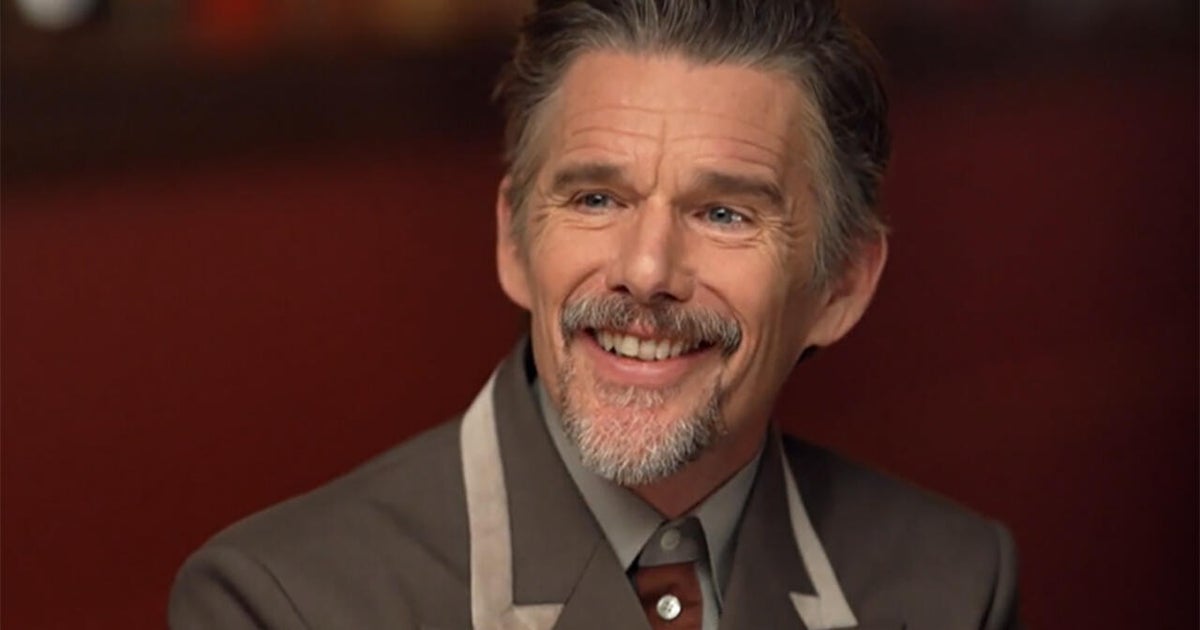
Nearly a hundred years ago, Richard Rodgers and Lorenz Hart helped put the “great” in the Great American Songbook, with songs like “My Funny Valentine,” “The Lady Is a Tramp,” and “Blue Moon.”
But by the early 1940s, Hart’s heavy drinking made him an unreliable partner. So, Rodgers teamed up with Oscar Hammerstein II, and their first production, the landmark musical “Oklahoma!” opened at the St. James Theatre on March 31, 1943.
It was an immediate hit, and that night there was a big party a few doors down at Sardi’s, that legendary Broadway watering hole, with its walls hung with the caricatures of famous faces. Lorenz Hart showed up at Sardi’s that night, and what happened next is now a movie.
In “Blue Moon,” Ethan Hawke is Hart, drowning his sorrows at the bar.
Sony Pictures Classics 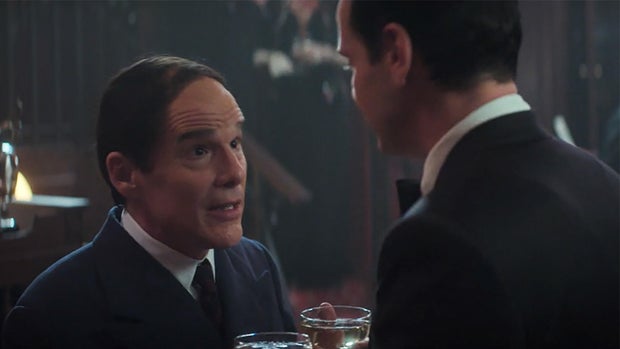
For the film, they re-created Sardi’s on a soundstage, but “Sunday Morning” met Hawke at the real thing.
“I was definitely the type of young person that would walk in and think, ‘When am I gonna get my painting up there?'” he said. “I’m not above that. I’m a little heartbroken that I don’t have one up yet!”
Perhaps his time will come. “My time’s coming,” he said. “I have hope. I’m not done yet!”
And this performance is proof: the real Lorenz Hart was less than five feet tall, so director and frequent Hawke collaborator Richard Linklater used camera tricks to make the 5’9″ actor look short. Hawke also shaved the top of his head to make a real combover, and he learned a mountain of dialogue.
“It’s definitely the most text I’ve ever had in a movie,” Hawke said. “I remember calling my wife after the first day – I think I had more lines than I had in the previous five films.”
CBS News 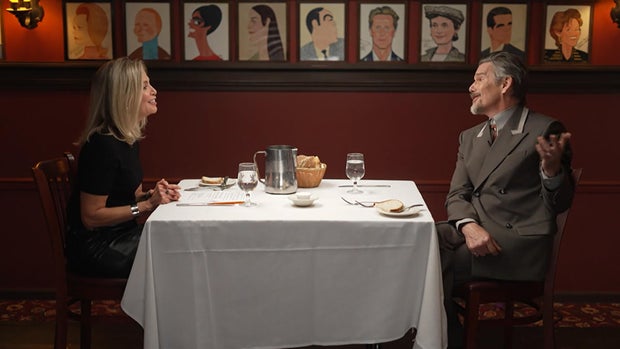
It was a challenge for an actor whose face usually says it all. In the 1989 film “Dead Poets Society,” Hawke played a student, and he says he learned a lot from co-star Robin Williams. “There’s a scene where he’s talking about how to grade poetry, and he has all the kids rip it out – I didn’t realize how much I was being taught, and how that sustained me through negative criticism. It’s like, there’s not any rules about being a great actor. Drop dead. So you don’t like it? Suck an egg. You don’t know what great acting is any more than I do.”
I asked, “When you’re in a movie like that so young, does it set you up? Or does it set you up?”
“It’s a great question, ’cause it’s possibly both,” he replied. “If you let it be the high-water mark of your life, it will be, you know, if you put too much on that. You don’t want anything at 18 to be the high-water mark of your life.”
Between movies, Hawke made his Broadway debut with, he says, a lot more confidence than skill. “That’s the weird thing about being young. I had no business being confident at anything. I was a total moron. And I walked in here like I was, you know, John Barrymore.”
His performance in Chekhov’s “The Seagull” (1992) was described as “promising.” But it was clear that his best work was ahead of him.
Hawke got the first of four Oscar nominations for his role in the 2001 film “Training Day” opposite Denzel Washington. His performance still resonates. Hawke said, “When my son was about six, Levon, he said to me, ‘Dad, what’s “Training Day?”‘ I said, ‘Oh, it’s the movie I did a few years ago. Why?’ He said, “’cause every time we walk down the street, when people pass you, they say, “Training Day”!'”
But after “Training Day,” there was a time when Hawke says he passed on more parts than he took – and the offers started drying up. “When you’re young, you think it’s everybody. You don’t realize that This is a young person’s game, and those kinds of job offers, there’s a shelf life on that.”
“When did your shelf life, when did that hit?” I asked.
“Around the same time gray starts appearing in your beard,” he replied.
The gray in the beard works for him now, as a hard-nosed investigative reporter in the critically-acclaimed FX series “The Lowdown.” In the series, you never know what’s around the next corner – just as in real life. As we were wrapping up at Sardi’s, owner Max Klimavicius suddenly showed up with a surprise for Hawke: “Ethan, I would like your permission to make you part of our collection,” he said.
He was a bit stunned, and to be honest, so were we. But after Ethan Hawke’s career on screen and stage, it wasn’t all that surprising.
“Wow!” he said. “It finally happened. I’ve got my portrait at Sardi’s. I’ve arrived! Things are looking up in this life!”
CBS News 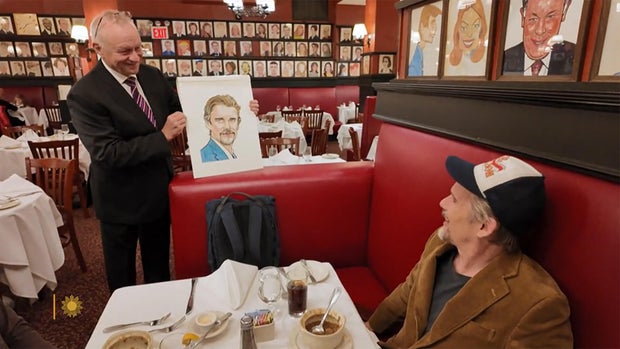
And now, with his latest film in mind, there’s talk of more accolades to come.
How does he handle the Oscar buzz surrounding “Blue Moon”? Does he tune it out? He said, “There’s the obvious other part of you that goes, like, ‘Hey, I dedicated my life to this job, and this is seen as a barometer.’ And I would be dishonest if I didn’t say that, like, that would be amazing.
“This is so corny, but it just flashed through my head: I was like 11 or something, I said to my mother, ‘What’s gonna happen with my life? What’s gonna happen?’ And she – and I remember it so vividly – in the kitchen, like Doris Day [sings] ‘When I was just a little girl…’ you know, it goes into ‘Que Sera, Sera.’
“You have to have a little ‘Que Sera, Sera.’ I don’t take any of it for granted. That’s, I guess, the right answer. Any little bit of it.”
WEB EXCLUSIVE: Watch an extended interview with Ethan Hawke
To watch a trailer for “Blue Moon” click on the video player below:
For more info:
Story produced by John D’Amelio. Editor: Ed Givnish.
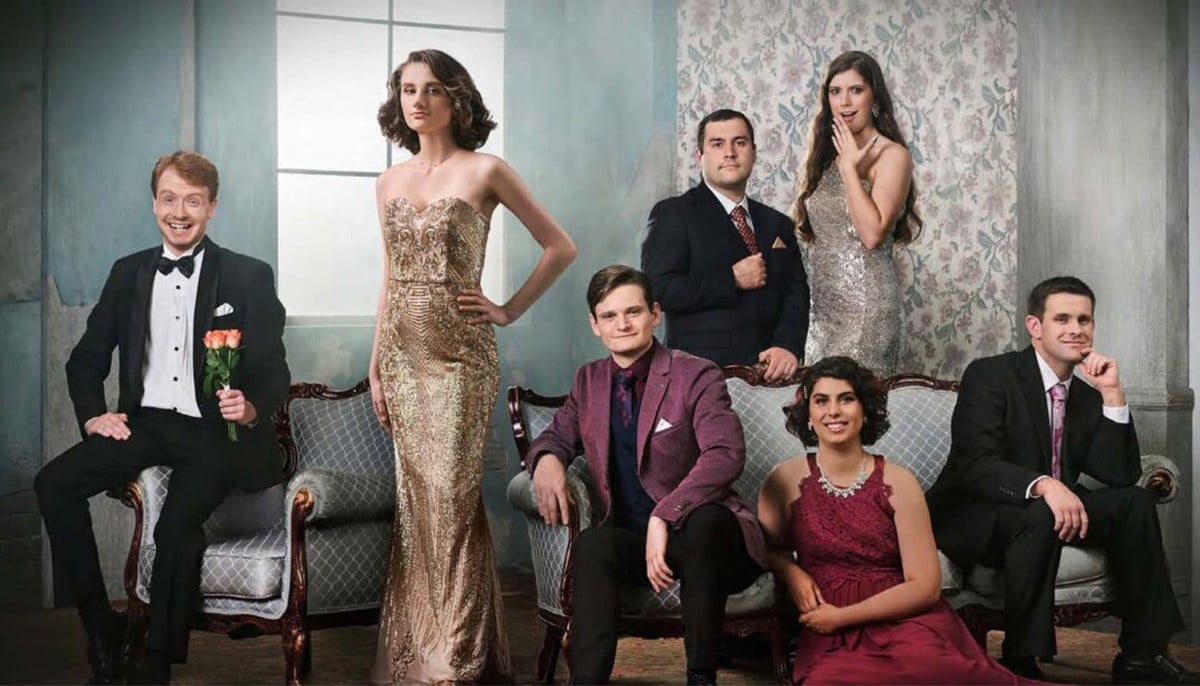
Netflix has officially renewed Love on the Spectrum for a fifth season, extending the journey of one of its most celebrated reality series.
The announcement came just days after season 4 premiered to strong reception, reflecting the show’s enduring appeal and cultural impact.
Created by Karina Holden and Cian O’Clery of Northern Pictures, the series has become a global phenomenon since its U.S. debut in 2022, following the original Australian version launched in 2019.
With seven Primetime Emmy Awards to its name including Outstanding Unstructured Reality Program in 2022 and 2025, Love on the Spectrum has carved out a unique space in reality television.
It offers a heartfelt and authentic look at people on the autism spectrum navigating dating and relationships.
Season 4 featured Connor Tomlinson, Dylan Aguilar, Emma Sue Miller, Georgie Harris, James B. Jones, Logan Pereira, Madison Marilla, Shelley Wolfee and Tyler White, whose personal journeys resonated deeply with viewers.
Their stories helped secure the renewal, ensuring that season 5 will continue to explore new paths to love and connection.
The renewal signals Netflix’s confidence in the franchise, which has grown from its Australian roots into a global touchstone.
With season 5 now on the horizon, the series promises to deliver more emotional storytelling and genuine representation, keeping audiences invested in the lives of its cast while reinforcing its reputation as one of the streamer’s most heartfelt reality hits.
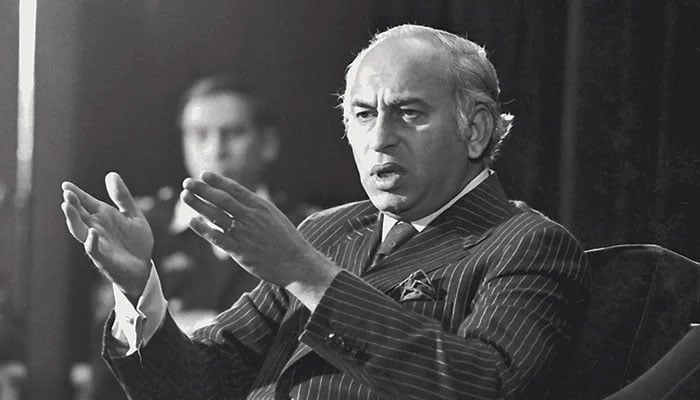
Shaheed Zulfikar Ali Bhutto defied the suffocating politics of his time, nurturing a new consciousness rooted in human rights, dignity, equality and justice. Rejecting absolutism, he sought to transform politics into public service. As we mark his death anniversary, we reflect not only on a remarkable leader but on the enduring imprint he left on Pakistan’s identity and democratic imagination.
Long after his passing, his light refuses to dim, his voice refuses to fade and his vision of an inclusive, just, united, prosperous, strong and dignified Pakistan continues to guide our great nation. I take pride that my own political journey was shaped and inspired by the ideology and ideas of Quaid-e-Awam. His conviction that power belonged to the people has been a guiding light for me through every office I have held. Today, as I preside over the Senate, I see his vision embodied in the constitution he gave us and in the institution he conceived to protect our federation.
Shaheed Bhutto’s journey to leadership was shaped early by the towering figure of Quaid-e-Azam Muhammad Ali Jinnah. At just seventeen, he wrote to the Quaid, declaring that he would one day sacrifice his life for Pakistan. And true to his word, he sacrificed his life for Pakistan exactly thirty-four years later in April 1979. Jinnah wrote back, advising him to study politics thoroughly but not neglect his education. That exchange marked the beginning of a relationship that would define Bhutto’s political philosophy. He carried Jinnah’s memory with him throughout his life.
Boasting an illustrious academic career at Berkeley and Oxford, where he completed a demanding law degree in just two years, Bhutto returned to Pakistan. He soon represented the country at the United Nations, and by 1958, at the age of 30, he became the youngest cabinet member in Pakistan’s history.
His diplomatic skills were evident early. When he met US president John F Kennedy in the White House in 1963, Kennedy remarked that if Bhutto were American, he would be in his cabinet. Bhutto’s response was characteristically sharp: “Be careful, Mr President, if I were American, I would be in your place”.
Razor-sharp wit, a formidable intellect and an unshakeable commitment to Pakistan’s sovereignty made him a towering figure on the world stage. As foreign minister, he brought balance to Pakistan’s foreign policy, forging closer ties with China and advocating for an independent course that served the nation’s interests. He supported China’s entry into the UN, a bold move that laid the foundation for the “higher than the Himalayas and deeper than the oceans” relationship that continues to benefit Pakistan today.
However, the true greatness of Shaheed Bhutto emerged like a phoenix from the very ashes of the 1971 war. Those were troubled times. Pakistan was a shattered nation. Half the country had been lost and five thousand square miles of territory was under occupation. The world had written us off. Yet within months, through sheer diplomatic acumen, Bhutto secured the release of our prisoners and the return of our land through the Simla Agreement. He had prepared meticulously, consulting opposition leaders, military commanders, and visiting fourteen Muslim countries to secure their support before entering negotiations with Indira Gandhi.
And, unquestionably, perhaps, his greatest gift to the nation and the country was the 1973 Constitution. Before Bhutto, Pakistan had never enjoyed a democratic constitution framed by the will of its people. He gave us a constitution that declared sovereignty belongs to Allah Almighty, but the people of Pakistan are its trustees. He created the Senate to ensure that every province, large or small, would have an equal voice.
Equally transformative and highly seminal were his domestic reforms. Within three months of taking office, he announced land reforms, distributing over 800,000 acres to landless peasants. He established Pakistan Steel Mills, built Port Qasim and laid the foundation for Quaid-i-Azam University. His government prioritised labour welfare and expanded educational access, making education free up to matriculation. These policies were part of a coherent vision encapsulated in his slogan Roti, Kapra aur Makan.
Years later, that commitment found its most powerful expression in the Benazir Income Support Programme, which I had the honour to launch as Prime Minister. Today, BISP is recognised globally as one of the most effective social safety nets, empowering women and lifting millions from poverty.
Shaheed Bhutto always had his fingers on the pulse of the masses. He understood the geopolitical and strategic alchemy that tied Pakistan’s destiny to the Muslim world. In February 1974, he hosted the Islamic Summit in Lahore, bringing together leaders from thirty-eight Muslim nations. King Faisal of Saudi Arabia, Anwar Sadat of Egypt, Colonel Qaddafi of Libya, and Yasser Arafat were among the distinguished guests.
Equally unwavering was his commitment to Pakistan’s defence. He had famously declared that Pakistan would “eat grass” if necessary to acquire nuclear capability. As prime minister, he initiated the nuclear programme. That programme, completed after his martyrdom, has ensured Pakistan’s security for all time.
And then darkness descended when his democratically elected government was overthrown in July 1977. What followed was a judicial process that the world recognised as a travesty and, ultimately, a ‘judicial murder’. Despite international appeals from leaders across the globe, he was sent to the gallows on April 4, 1979. His daughter Benazir’s account of their final meeting, with iron bars separating father from daughter, remains one of the most poignant passages in Pakistan’s history.
The Bhutto family paid an extraordinary price – the Quaid-e-Awam, his sons Shahnawaz and Murtaza, and his beloved daughter and the first female prime minister of the Muslim world and Pakistan Shaheed Mohtarma Benazir Bhutto, all gave their lives for the cause of the people. Today, President Asif Ali Zardari and Chairman Bilawal Bhutto Zardari carry this legacy forward with unwavering dedication.
Through my political and parliamentary journey, I have endeavoured to honour that vision. The 18th Amendment, passed during my tenure as prime minister, was a historic step towards realising Bhutto’s dream of provincial autonomy.
Shaheed Bhutto once said, “We are not merely the heirs of a party, we are the custodians of a vision”. That vision was of a Pakistan where the poor are not forgotten, where the provinces are not silenced, where democracy is not a slogan but a way of life.
As we remember him today, let us renew our commitment to that vision. His light continues to guide us. May his soul rest in eternal peace. May his vision continue to inspire generations.
The writer is the chairman of the Senate of Pakistan.
Disclaimer: The viewpoints expressed in this piece are the writer’s own and don’t necessarily reflect Geo.tv’s editorial policy.
Originally published in The News
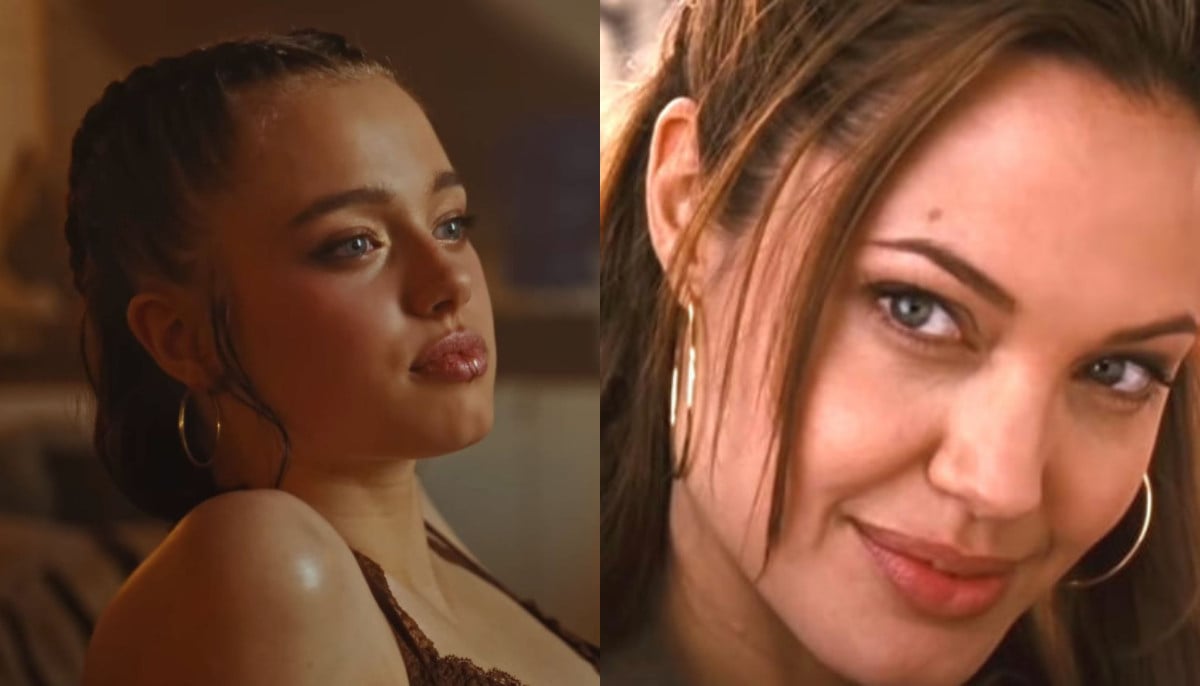
Shiloh Jolie has made her music video debut, and the internet has ground to a halt, not just because of the appearance itself, but because of just how strikingly she resembles her mother, Angelina Jolie.
The 19-year-old dancer appears in the teaser for K-Pop singer Dayoung’s new single What’s a Girl to Do, due for release on 7 April.
The clip began circulating on social media on Friday, and fans were quick to clock the resemblance when Shiloh appeared later in the trailer.
The reaction was immediate.
“Look at Shiloh, man. Crazy to see Angie’s kids follow in her footsteps,” one X user wrote. “Literally looks exactly like her momma oh my god,” posted another.
A third simply declared: “Holy sh*t, mamma’s good genes are sooooo strong.”
It is not yet clear whether Shiloh will appear in an acting capacity, as one of Dayoung’s dancers, or both.
The Jolie family resemblance is not a new talking point.
Last April, Shiloh was widely noted for appearing to channel her mother’s iconic Lara Croft look from Tomb Raider with a similar hairstyle.
Friday’s teaser has taken those comparisons to a whole new level.


The Trajectory of the Artemis II Moon Mission Is a Feat of Engineering

Netflix renews ‘Love on the Spectrum’ for season 5

China moves to regulate digital humans, bans addictive services for children

-

 Entertainment1 week ago
Lee Sang-bo dies at 45: Funeral details revealed
-

 Sports1 week ago
Illinois defense gets tough, ousts Houston to reach Elite Eight
-

 Sports6 days ago
USMNT handed reality check by Doku, Belgium ahead of World Cup
-

 Sports6 days ago
2026 NCAA men’s hockey tournament: Schedule, results
-
 Business1 week ago
How do you spot a fake online review?
-

 Fashion1 week ago
China rolls out tariff cuts on Congo imports from April 1
-

 Fashion1 week ago
EU apparel imports slump 15.48% YoY in Jan; Bangladesh hardest hit
-

 Sports6 days ago
Man City show why they are worthy WSL title winners as tired United wilt