

Business
Five ways weight-loss jabs are changing spending habits


Esyllt CarrBusiness reporter
 BBC
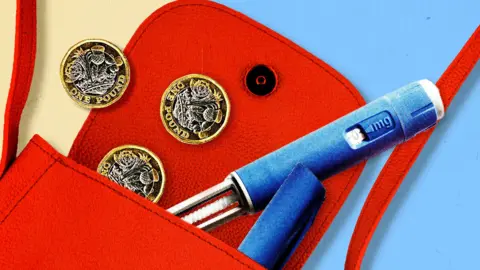
BBCThey’re the injections helping some people shed pounds, but weight-loss drugs are also transforming the way people spend.
About 1.6 million people in the UK used weight-loss jabs in 2024, the latest research from University College London suggests, with millions more saying they’d be interested in trying them.
For those paying privately, they can cost more than £300 a month – but with their popularity only expected to rise, how are businesses adapting to a new type of consumer?
Buying groceries: The rise of more nutrient-dense foods

 Sam Gillson
Weight-loss injections work by mimicking a natural hormone, GLP-1, which regulates hunger, and those who use them find their appetite is reduced.
“My weekly food shop’s really gone down,” says Sam Gillson, 38, from Shropshire, who got in touch with BBC Your Voice. He’s lost more than four stone using weight-loss jabs since June.
“I’m definitely buying more fresh foods, and fewer unhealthy ready meal/easy dinner options like pizza, chips and nuggets.”
In the last few weeks, supermarkets The Co-op, Morrisons and Marks and Spencer have brought out nutrient-dense ranges of ready meals, and Ocado now sells a 100g steak, which it said was in response to the growing number of customers seeking smaller portions.
Sam says eating less means he wants to make sure that “the smaller quantity does contain all those nutrients and vitamins you need”.
And it’s not just portion size. It’s also the kinds of foods.
Protein-rich products have been appearing on the shelves as smoothies and snacks.
Jonny Forsyth, food and drink strategist at consumer research group Mintel, says many of these trends are part of a wider shift, with health becoming more important, particularly for younger consumers.
He thinks GLP-1 drugs are “changing the culture”, making it fashionable to eat more nutrient-dense foods and “adding oxygen to existing trends”.
Dining out: ‘I used to go to a restaurant once a week. Now I don’t’
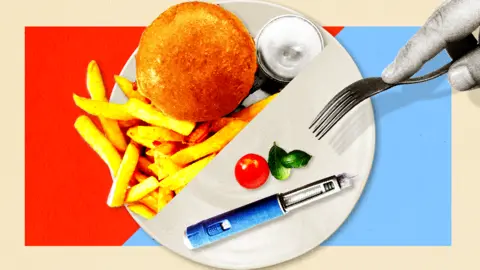
A survey by research consultancy KAM Insight last year found that nearly a third of people using GLP-1 drugs were going out to eat and drink less often.
Annie Haslam, 70, from Cornwall, has been using weight-loss injections since last March, and is currently spending around £186 a month on the jabs.
“Instead of having takeaways once or twice a month, I haven’t had one for months,” she says. “I used to eat out at a restaurant once a week maybe, I don’t do that any more.”
Sam also says he’s cut down on the number of takeaways he gets, but adds that while he feels healthier, he’s not actually saving any money given the cost of the injections themselves.
Earlier this month the boss of the bakery chain Greggs said there was “no doubt” that weight-loss drugs have led to people looking for “smaller portions”.
And it’s happening in fine dining too. The Michelin-starred restaurant The Fat Duck in Berkshire, run by celebrity chef Heston Blumenthal, has brought out a new menu, which Blumenthal said was for people looking to eat more “mindfully”, including those who are on appetite suppressants.
Drinking: ‘A strong trend towards sobriety’
There’s evidence too that those taking weight-loss drugs drink less alcohol.
A study carried out in February 2025 by consumer research firm Worldpanel by Numerator found a 15-percentage point drop in alcohol volume purchases among households with GLP-1 users compared to a controlled benchmark.
The Co-Op’s food trading director Nicole Tallant told the BBC the supermarket’s members who take weight-loss drugs are “reducing their alcohol intake alongside their consumption intake from food,” adding that “they’re much more concerned with overall health and holistic well-being”.
Recent years have also seen a surge in non-alcoholic drinks options hitting shelves and bars. The British Beer and Pub Association expects a record 200 million pints of low and no-alcohol beer to have been consumed in 2025.
“There’s already quite a strong trend towards sobriety,” says Mintel’s Jonny Forsyth.
“If I was an alcohol company, I’d be a bit worried about this. GLP-1 drugs could give that trend another boost.”
Fashion: A wardrobe that no longer fits

For Annie, one area she couldn’t avoid spending on was clothing. After going from a size 18 to a size 12, she says her old clothes were “literally falling off”.
She estimates that replacing everything, including underwear, probably cost her “a couple of thousand pounds”.
Dan Coatsworth, head of markets at AJ Bell, says that while none of the big fashion retailers on the stock market have explicitly talked about weight-loss drugs in their financial results commentary, in his view, the direction of travel is clear.
The popularity of weight-loss drugs will provide “a massive tailwind (boost) for the fashion sector”, he says.
While it’s unclear how this will present itself, Coatsworth believes second-hand platforms like Vinted, which are already popular, could see even more growth, for people who quite quickly find their wardrobe no longer fits.
 Annie Haslam
People who have lost a lot of weight quickly may also find a new sense of confidence and be inspired to “reinvent” themselves by trying new clothes that they wouldn’t have before, says Simone Konu-Rae, a senior lecturer in fashion communication at Central Saint Martins, University of the Arts in London.
“You may not have felt that any of these trends or fashion outlets have been speaking to you, if you were a bigger size,” she says. “So you might shop completely differently.”
Beauty, health and fitness: More people going to the gym
That desire for a new look is also being felt in the beauty and fitness sector.
Market research firm Worldpanel by Numerator’s survey last year suggested a boost in spending on healthcare, toiletries and supplements among people taking weight-loss injections.
Some companies – in the US and now in the UK too – that offer wellness breaks are now advertising specific “retreats” targeting GLP-1 users.
Will Orr, chief executive of The Gym Group, says weight-loss drugs are leading to a greater demand for fitness services as people taking them look to keep the weight off and build muscle mass.
“We have begun educating our trainers on how best to support members on these treatments,” he says.
But he also notes a broader pattern of behaviour that pre-dates weight-loss drugs, calling health, fitness and wellness “juggernaut trends that are not going anywhere”.
That view is echoed by Georgia Stafford, research analyst in the beauty and personal care team at Mintel, who says while GLP-1s are “definitely something on most brands’ radars”, unlike the food industry, beauty brands are yet to launch products in the UK aimed specifically at users of weight-loss drugs.
“There have been some launches in the US,” she says, “but they’re very niche and very expensive,” pointing out that the cost of weight-loss drugs may also lead to people cutting back on spending in other areas.
Instead, she says many products on offer promising plumper skin and fuller hair, often marketed as anti-ageing, will already be aligned with what may appeal to those on weight-loss drugs.
Meanwhile, data from the British Association of Aesthetic Plastic Surgeons indicated there was an 8% rise in demand for facelifts in 2024, with the group’s president saying it was “an extension of a pattern we’ve always observed in post-weight-loss patients” that was “now amplified by the wider use of these medications”.
Additional reporting by Emer Moreau and Kris Bramwell
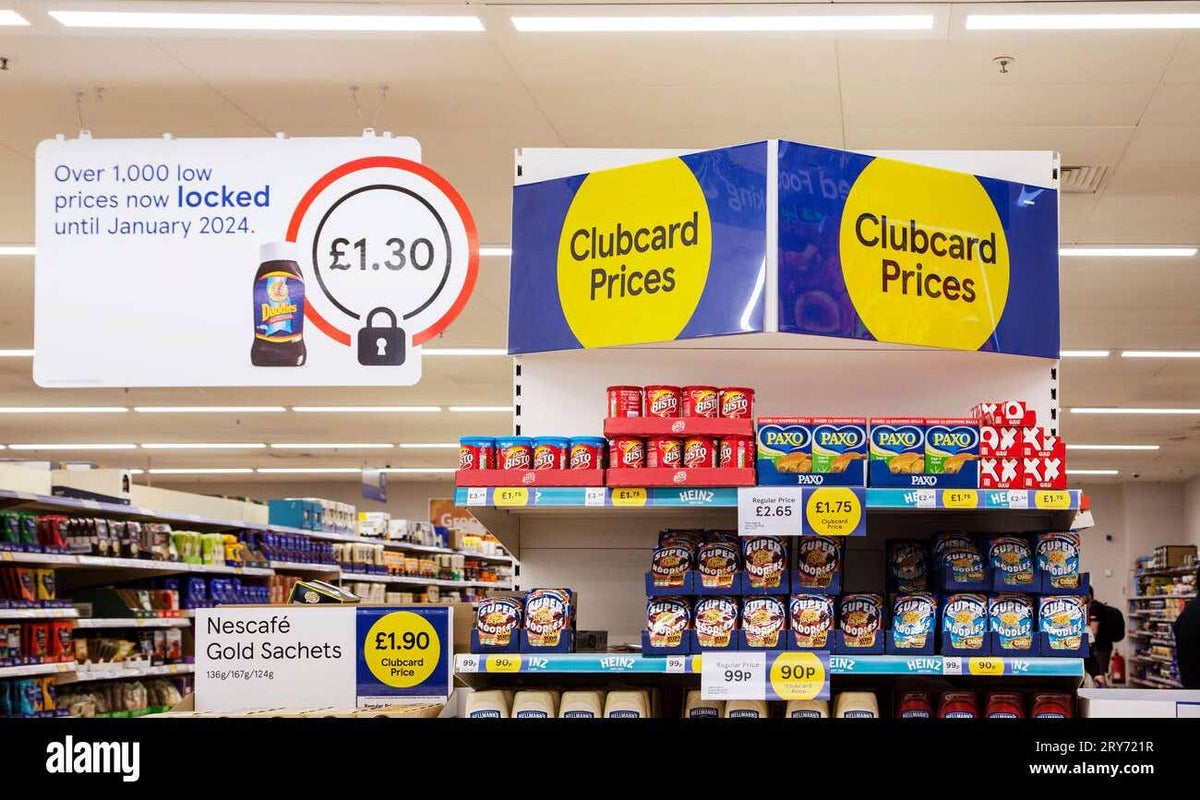
Tesco and Sainsbury’s customers are paying more than Waitrose shoppers for some common branded groceries if they are not using a loyalty scheme, analysis by Which? has found.
The watchdog compared a list of 245 branded items including Heinz, Nescafe and Mr Kipling in February, finding that it was, on average, most expensive for customers at Sainsbury’s and Tesco who were not using the Nectar or Clubcard loyalty schemes.
Which? acknowledged that most shoppers are part of a membership scheme, but said some may be unwilling to sign up to loyalty cards for reasons such as data privacy, while others have no choice because of eligibility criteria.
Tesco customers who are under 18 can not sign up to a Clubcard, although the supermarket has announced it will review this before the end of the year.
The Which? list of items was most expensive at Sainsbury’s for non-Nectar members at £942.66 – 14% more than the cheapest retailer in the study Asda, which cost £823.58.
Tesco followed behind Sainsbury’s, with its non-Clubcard price totalling 11% more than Asda at £916.56.
Which? said it did not include discounters Aldi and Lidl in the study because they did not stock a sufficiently large range of branded goods.
Both Tesco and Sainsbury’s – the UK’s two largest grocers – were more expensive for non-members of their loyalty schemes than Waitrose, which cost £899.05.
Waitrose was 9% more expensive than Asda and emerged as a “more competitive option”, Which? said.
Which? found several products that were cheaper at Waitrose, including Amoy Straight To Wok Noodles, which were on average £1.25 at both Waitrose and Morrisons but most expensive at Sainsbury’s and Tesco without a loyalty card at an average of £2.15 – a 72% difference.
Sea salt and vinegar Ryvita Thins were also cheapest on average at Waitrose at £1.25, but shoppers buying this product at Morrisons, Tesco, and Sainsbury’s without a loyalty card would all have paid an average of £2.30, making them 84% more expensive.
For customers with a Clubcard, Which? found that the same list of groceries at Tesco fell to £837.43 on average – just 2% more expensive than Asda.
Which? found various instances of branded products where the Tesco Clubcard price was the cheapest on average.
Carex Hand Wash was 95p at Tesco with a Clubcard but £1.70 at Waitrose where it was the most expensive.
Another example showed Kellogg’s Crunchy Nut cornflakes was £1.55 on average in February, while the highest average price among the supermarkets was at Waitrose where it cost £2.50.
Which? said the figures showed the “dramatic price gulf” created by loyalty pricing.
In one example at Tesco, Which? found a 200ml bottle of L’Oreal Paris Elvive Bond Repair Shampoo was double the price on average for shoppers without a Clubcard – at £13 compared to £6.50.
The higher price was also found at both Morrisons and Sainsbury’s.
Which? found that a 200g jar of Kenco Smooth coffee cost shoppers at Tesco and Sainsbury’s without a loyalty card £8.35 – the highest price on the market.
In contrast, the same jar was £7 at Waitrose and £6.32 at Asda, on average.
Similarly, Waitrose had the cheapest average price for Nescafe Gold Blend at £6.25, while non-members at Sainsbury’s were asked to pay £8.35.
Meanwhile, Which? found customers who used a Nectar card at Sainsbury’s could expect to pay only 3% more than Asda at £848.56 for the entire list of items.
Morrisons averaged 4% more expensive than Asda when using a More card and 5% more expensive without one.
Ocado was also 5% more expensive than Asda.
Which? retail editor Reena Sewraz said: “Our analysis reveals a shocking truth and shows the impact loyalty schemes have had on grocery pricing.
“Branded favourites can actually be cheaper at Waitrose than at the UK’s biggest supermarkets for shoppers who don’t use a loyalty card – something that would have seemed unthinkable until a few years ago.
“If you’ve got your heart set on specific brands, your best bet is to shop around, keep a close eye on the unit price, and stock up whenever you see a good deal – otherwise, you’re likely to end up paying way over the odds.
“While loyalty cards definitely offer some savings, if you don’t use one you’re better off heading to Asda, where the pricing is usually cheaper on a range of branded goods.”
A Sainsbury’s spokesman said: “We have invested over £1 billion in recent years to help keep prices low and we know more customers are choosing to do their shop at Sainsbury’s.
“We are committed to helping customers access great quality at lower prices and remain focused on offering outstanding value across thousands of products through our Aldi price match scheme, Nectar prices, Your Nectar Prices and our own-brand value lines.”
A spokesman for Tesco said: “It’s no secret that Tesco Clubcard unlocks exceptional savings for the 24 million UK households who have one.
“More than 80% of our sales are made with a Clubcard – but it’s just one of the ways our customers get great value.
“Though everyday low prices we keep prices consistently low on thousands of branded products, and our Aldi price match ensures shoppers can be confident they’re getting competitive prices.”
Business
MLB faces a historic shift as potential lockout, media rights and other league changes loom

Thursday’s Opening Day may be the calm before the storm for Major League Baseball.
The league’s collective bargaining agreement with its players expires at the end of this season. Owners, with the commissioner’s backing, are almost sure to push for a salary cap (which would likely come with a salary floor to get players to the negotiating table).
MLB owners have never been able to get a cap passed by the players union. It’s unclear if the end of the 2026 season will lead to a different result, but MLB Players Association Interim Executive Director Bruce Meyer told ESPN last month he expects a lockout is “all but guaranteed.”
In addition to the CBA’s expiration, there are major shifts underway for baseball media rights. One-third of the league’s teams didn’t have local TV deals in place for this season until this week.
Nine MLB teams – the Washington Nationals, Seattle Mariners, Milwaukee Brewers, St. Louis Cardinals, Miami Marlins, Tampa Bay Rays, Cincinnati Reds, Kansas City Royals, and Detroit Tigers – announced Wednesday their brand new MLB-operated team channels will be carried by DirecTV.
Most of those teams had previously been part of Main Street Sports (previously Diamond Sports Group), which operates FanDuel Sports Networks (previously Bally Sports). That entity has been teetering with liquidation, and the teams terminated their contracts with the company due to missed payments earlier this year.
A 10th team, the Atlanta Braves, is launching a new network called BravesVision. The Braves and Charter’s Spectrum announced a multiyear distribution agreement earlier this week.
MLB ideally wants the rights to all 30 teams in its control by the end of the 2028 season so that it can sell the in-market local games as a national package to a streamer. That would become the modern replacement to regional sports networks, and it would likely be a new, coveted package for streaming services such as ESPN and Amazon Prime Video.
Also at the end of the 2028 season, MLB’s national media rights for all of its packages will expire, allowing the league to redistribute games to its partners and potentially select new ones.
NBC, ESPN, Fox and a combined CBS/Turner have dominated national rights for the past few decades.
“The key in media negotiations now is having all of your rights available,” MLB Commissioner Rob Manfred told me last year. “If you have all of your content – all of your playoffs, all of your regular season – available, there will be buyers, and I’m confident there will be buyers at a higher price for us.”
Manfred has even floated the idea of expanding to 32 teams and realigning the league geographically, upending or even eliminating the American and National leagues that have existed for more than 100 years.
Soaring TV ratings
It’s, of course, unclear how much of this hypothetical change will actually come to fruition.
But the potential for transformation at MLB is greater than at any of the other Big 4 professional leagues in the U.S.
And yet, baseball isn’t struggling — on the contrary. The implementation of the pitch clock in 2023 has led to shorter games, rising attendance and higher TV ratings.
Rob Manfred, Commissioner of the MLB, attends the annual Allen and Co. Sun Valley Media and Technology Conference at the Sun Valley Resort in Sun Valley, Idaho, U.S., on July 9, 2025.
David A. Grogan | CNBC
More than 50 million people in the U.S., Canada and Japan watched Game Seven of the World Series last year – the most-watched baseball game in 34 years. MLB recently wrapped up the World Baseball Classic – a global preseason tournament – which captured nearly 11 million viewers on Fox and Fox Deportes for its final game.
MLB team valuations rose 13% from last year. The average MLB team is now worth $2.95 billion, according to CNBC Sport data.
Still, the profitability of the league is in far worse shape than it is for the NFL, NBA and NHL, according to CNBC’s calculations. In 2025, MLB’s 30 teams had an EBITDA — earnings before interest, taxes, depreciation and amortization — margin of under 2%. Team average revenue was $426 million with average EBITDA of $7 million, including non-MLB ballpark events. In contrast, the comparable margin for the NFL was 20%; the NBA, 21% and the NHL, 22%, according to CNBC’s most recent valuations.
The new CBA at the end of this season could be the first significant step toward a very different MLB. But, similar to the WNBA, which announced its new CBA earlier this week, MLB must ensure negotiations to get a new labor agreement don’t jeopardize a wave of positive momentum.
A JLR spokesperson said: “Due to a part supply challenge with a supplier, we are temporarily pausing production on certain vehicle lines at our Solihull manufacturing facility. We are working closely with that supplier to resolve the issue as quickly as possible and minimise any impact on our clients or our operations.”


China concludes Mexico tariffs create trade barriers for firms

Taylor Swift wins seven awards at iHeartRadio Music Awards 2026

How Cole Hutson is taking a role in the next wave for the Capitals

-

 Fashion1 week ago
Sales at US apparel, clothing accessories stores up 4% YoY in Jan 2026
-
 Fashion1 week ago
Spain’s Inditex FY25 sales rise 3.2% to $46.28 bn amid strong demand
-

 Entertainment1 week ago
Val Kilmer revived 1 year after death through AI
-

 Politics1 week ago
Iran strikes Tel Aviv with cluster-warhead missiles in retaliation of Larijani’s martyrdom
-

 Sports1 week ago
March Madness 2026 – How to watch in SA, start time, schedule, TV channel for NCAA championship basketball tournament
-
 Fashion1 week ago
US’ G-III Apparel’s FY26 sales fall 7% to $2.96 bn
-

 Politics1 week ago
US judge directs Trump administration to bring VOA employees back
-
 Business1 week ago
Brits cashing in jewellery as gold price hits record high