

Sports
Flamengo lift Copa Libertadores, but Brazil’s players look exhausted

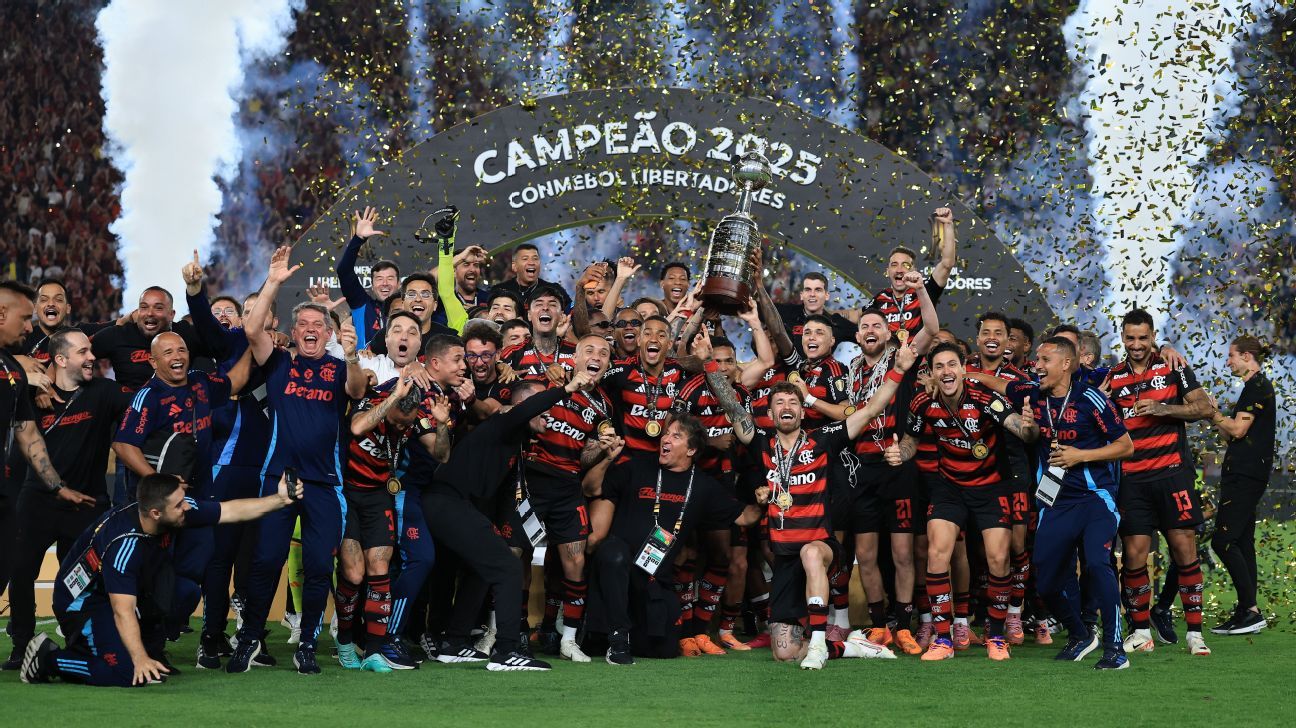
Brazil’s unprecedented domination of the Copa Libertadores — no country has ever come close to winning seven titles in a row — has come about despite the mammoth amount of minutes the nation’s top players have to play.
Flamengo and Palmeiras have broken away from the pack. The two giants have now claimed the last five continental titles between them, and, in the next few days, Flamengo look likely to wrap up the Brazilian Serie A title too — prolonging the celebrations after winning the Saturday’s Libertadores final 1-0. Palmeiras, for their part, will run a close second in a championship that has been won by either the Mengão or the Verdão in seven of the last 10 seasons.
The price the two clubs pay for such success is an accumulation of matches and a burden on the players that borders on inhumane.
Representing a number of different national teams, the majority of Flamengo and Palmeiras players were in action during the recent FIFA international window. On the Tuesday, then, many were playing in Europe, Mexico or the United States. The next day, they were back on the field in crunch domestic games. With Flamengo and Palmeiras going toe-to-toe for the domestic title, there was no chance for anyone to take their foot off the pedal.
– Neymar’s World Cup hopes hit new low as Estêvão’s star rises
– Muscat’s ‘most hated’ tag precedes him, but a move to Europe is inevitable
– Iran boycotting World Cup draw citing visa denials
This clearly took some of the shine away from Saturday’s Copa Libertadores decider in Lima, when an eagerly awaited “final of the century” turned into an attritional battle. The Libertadores final was a very different match from the bright, open and attractive encounter they fought out in the league in the middle of last month.
Flamengo won that one 3-2 — and there were many more goals in the Maracana that day than efforts on target in Lima. It needs a somewhat charitable approach to statistics to find the two attempts on target that the official statistics awarded to Flamengo. Most will only recall one — the flying header from Danilo, meeting Giorgian de Arrascaeta‘s corner, that flew inside the far corner and won the game. And even Danilo was only playing because first choice fullback Leo Ortiz broke down under the sequence of matches and was not fit to start.
The news coming out of the Palmeiras camp going into the game was that the squad was close to physical and mental breakdown. This clearly had an effect on the thinking of Portuguese coach Abel Ferreira. Often tempted to take a cautious approach to big matches, this time he appeared to have settled for a “while it’s 0-0 we’re doing fine” strategy. He trusted in the capacity of his team to hold the Flamengo attack, and believed that as the game wore on, space would open up, and his team could snatch a goal.
But for one moment of slack marking at a corner — Allan lost Danilo, and Bruno Fuchs did not do enough to fill the space — it might have worked. Palmeiras might also point to the incident towards the end of the first half when Flamengo midfielder Erick Pulgar seemed very lucky to avoid a red card for a rash kick on Fuchs. Then again, all soccer games could have taken an alternative course. In the one that mattered, the one that was played in Lima, there can be little doubt that Flamengo were the better side and deserved their win.
The absence of centre forward Pedro, injured, and of his likely replacement Gonzalo Plata, suspended, clearly depleted Flamengo’s attacking resources — and presumably gave the Palmeiras coach more confidence in a defensive strategy. It was little wonder, then, that the only goal came from a defender. Danilo is a figure of great experience and intelligence; one of the main reasons Carlo Ancelotti retains him in the Brazil squad is because he says Danilo is capable of playing anywhere across the back four.
Flamengo coach Filipe Luis probably sees something of himself in Danilo. Two years ago, he stopped playing for Flamengo at left back and started coaching the youth team, stepping up to the seniors after elimination from the 2024 Libertadores. He has made an excellent start to a highly promising career. The manner of this Libertadores conquest was a little strange; his Flamengo are typically a free flowing, free scoring side. In the Brazilian league they have outscored Palmeiras 74 to 60.
But in the continental competition, however, it has been a different story. Palmeiras chalked up a grand total of 30 goals. Flamengo could only manage 13. They flirted with elimination in the group phase, needed a penalty shootout to get through the quarterfinals, and made it through to the big decider after a backs-to-the-wall operation in the second leg of the semis. There was perhaps only one truly outstanding display in the entire campaign — a majestic 2-0 triumph away to compatriots Internacional in the first knockout round. Even so, they fought their way through to a historic fourth Libertadores title — becoming the first Brazilian team to reach that mark.
And the season is still not done. On Wednesday Flamengo will hope to wrap up the Brazilian title in front of their own fans in Rio’s Maracana stadium. Failing that, there is another opportunity on Sunday — followed by a trip to Qatar for the Intercontinental Cup where Cruz Azul of Mexico are waiting. Get through that one and they face Pyramids of Egypt. Win that one and the year at last comes to a close with a game against Paris Saint-Germain — and a brief period of holidays before the next Brazilian league kicks off at the end of January.
It never stops. And it is hard not to think that the quality of the spectacle might be better with the occasional pause for a well-deserved rest.
THE VERDICT IS all but in, the coronation all but official.
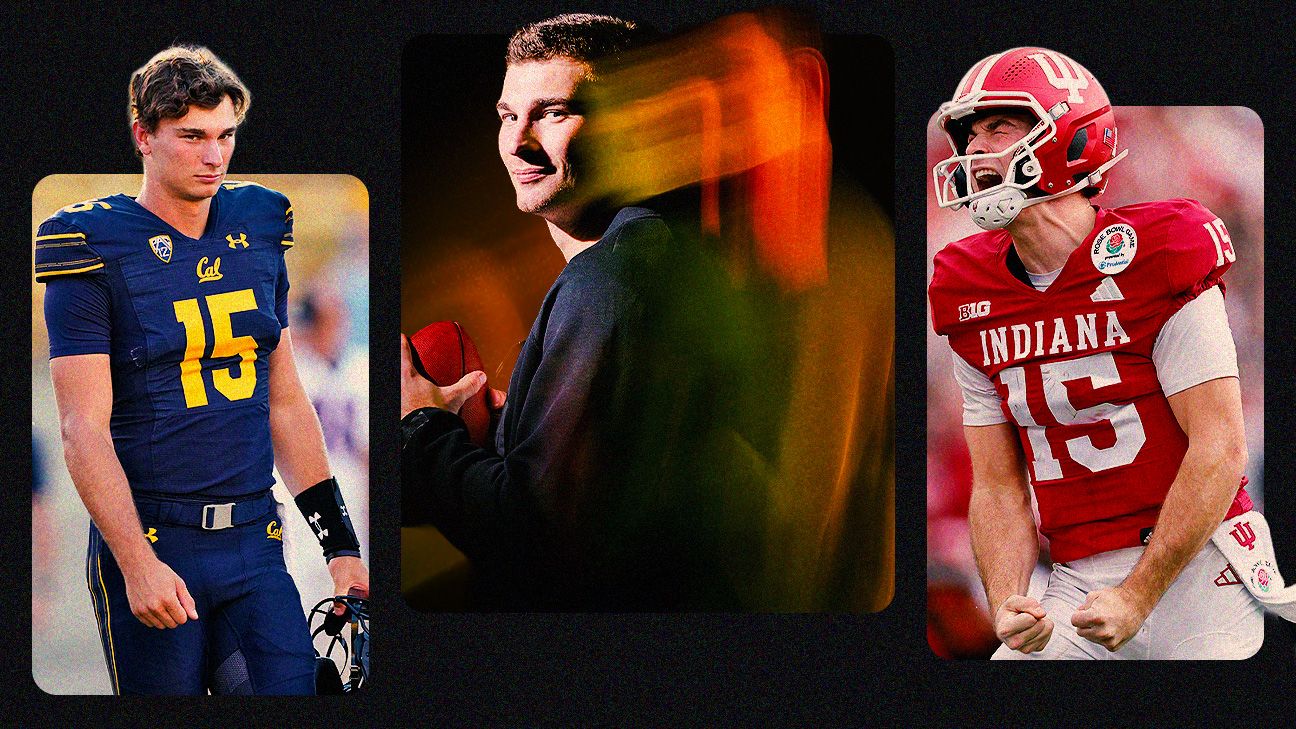
Fernando Mendoza‘s presence here, in Indianapolis at the combine, is formality over function. It’s late February, two months to go until the 2026 NFL draft, but he has already done the fairytale, done the unthinkable, done the proving. There’s no throw he can make this week that could outdazzle the missile he launched to beat Penn State last fall, with a pair of defenders closing in and the clock ticking down. There’s no strength test he can crush that will tell us more about what he can and will put his body through than the beating he took scrambling for his life to score the touchdown that helped seal Indiana’s first national championship in January.
This thing is so wrapped up, even Mendoza — normally so polished, so tactful — briefly slips. He’s at the podium, fielding questions from a flock of reporters who are so eager to hear what the “likely” top draft pick has to say, they throw elbows to get an inch closer. Mendoza gets asked about Tom Brady — former NFL great, current minority owner of the Las Vegas Raiders, who are, in turn, owners of the first pick in this year’s draft — and he’s duly effusive.
“Who hasn’t admired Tom Brady?”
“He’s the greatest quarterback of all time by a wide margin.”
“To have,” he says, stops, then tries again. “To potentially have a mentor like that would be pretty impressive.” Underscore, highlight, ALL CAPS that potentially, he all but says out loud.
The rest of his news conference proceeds without a hitch, which is to say, it’s typically Mendozian. He smiles when he listens to questions, he smiles when he answers questions, he smiles when he can’t hear questions, he smiles when there is no more time for questions. He delivers his answers with class-president-acing-his-presentation energy, full of direct eye contact and workshopped points and counterpoints. It’s tempting to look for notecards hidden somewhere discreet on the dais.
This is the pinnacle of the Mendoza experience. He looks like a star quarterback dreamed up in a lab: 6-foot-5, 236, respectable mobility, good arm, rarefied accuracy, all the while sounding like few star quarterbacks who have come before. He is, to hear those in his orbit tell it, the most unfootball-like of adjectives: “goofy.”
So goofy (or “awkward” or “different” or “not normal,” depends on who you ask) that one of his old coaches from his Cal days, Tim Plough, now head coach at UC Davis, has fielded a slew of calls from NFL scouts plying him with questions. Is Mendoza always like this? Is he really like this? Is that going to fly in a room of full-grown adults?
Yes, Plough, tells them. When he is in front of a camera or in front of a locker or in front of the dining room table in Plough’s home, he is always like this. He will talk you and thank you to death. He’ll drill you with questions and take the conversation in winding ways and be courteous to the point of oh, wow, enough already. It’s an acquired taste for some, Plough concedes, but it’s more than that too. The way that Mendoza is? The way he always is?
“It’s Fernando’s superpower.”
THE STORY OF Mendoza’s time in Bloomington, which ended with a cascade of increasingly unfathomable feats — the Heisman crowning, the Big Ten title, the national championship, the 16-0 record, and all this for Indiana (?!) — was a fairytale starring a new kind of hero.
“He’s not …” Plough starts, then pauses, in search of the best way to put this gently. “He’s not the cool guy.”
So what is it, exactly? What uncool boxes is he checking? Corniness? (“Some people might think he is corny, but I think he’s a blessing,” former Hoosiers running back Roman Hemby says.) Nonconformity? (“Everyone gives him a hard time, myself included, that he’s kind of nerdy,” his old high school coach Dave Dunn says.) Stone-cold quirkiness? (“Sometimes he’d just say the stupidest stuff, and you’re like, ‘What are you talkin’ about, dude,'” former Indiana tight end Riley Nowakowski says.) Check, check, check. It’s not a bad package, they all say, just not your typical star (or starting) quarterback package. They sort of love it, in fact.
He calls wide receiver Charlie Becker “Chuck-o-nator,” and calls Nowakowski something “not PG,” and has absolutely no nickname for Curt Cignetti whatsoever, because he does not have a death wish. Cignetti, now going into his third season as Indiana’s head coach, makes Bill Belichick look positively joyful. “Yeah, Cignetti’s not a nicknames guy,” Nowakowski says.
For all his quirks, Mendoza is quick to read a room. Or a sideline. Sometimes Nowakowski would steal a glance at Mendoza and Cignetti conferring in the middle of the game, and snicker at Mendoza’s total, if temporary, transformation. The quarterback had to shift gears to disgruntled grouch in order to game plan.
“Nando would get super serious,” he says. “Silent. It was like a completely different person.”
His eccentricities have an off button. It’s just that Mendoza’s default setting is on, turned all the way up. Which works. It worked at Indiana — killed at Indiana, really. And it will work in the NFL, people think. People hope. People are trying to make sure, which is why Plough fielded all those calls in the first place.
“Is he a little different? Yeah,” one NFL scout says. “Is that going to be a bad thing? I don’t know. The issue that you have is: Can you see him leading your team? Is he going to be the guy that says, ‘You ran the wrong route,’ and then, ‘M-F you,’ in the huddle?”
Spoiler: He will not. On the first play of the Big Ten title game against Ohio State, Nowakowski was meant to block the edge on a rollout, but he got beat and Mendoza got crushed. The man can take a beating, but even he had to leave the game for a play, and Nowakowski spiraled. He just let the soon-to-be Heisman winner get destroyed. Their whole season rides on this one guy being able to play … and now he might not be able to play. The quarterback returned two plays later and waved off Nowakowski’s repeated apologies. Mendoza was still in pain but was also still Mendoza. “Jolly,” Nowakowski says. No M-Fs in sight. “He was like, ‘Dude, I got cracked!'”
But here’s a spoiler addendum: He doesn’t need to be that kind of leader. Back in 2024, Jayden Daniels had one of the best rookie seasons of all time. The coach who oversaw all that history, Dan Quinn, says the biggest misread on what a young, highly drafted quarterback needs to be is this: “The outside thinks he has to be the leader of the team, right when he walks in the locker room. And that’s not the case. Man, learn the system so well you can be counted on in clutch moments. Be a great teammate. Help others get better. But you don’t have to go lead by ripping a guy for being in the wrong alignment.”
If you’re inauthentic, Quinn says, these guys will sniff you out. They don’t want to see their young, albeit transcendent, quarterback force leadership that isn’t there. They just want to see him really freaking care.
Back in early November, when the Hoosiers were already an endearing story but not yet a mythical one, they survived an unexpected battle at Penn State to stay undefeated. Mendoza had 80 yards and less than two minutes left in the game to try to escape State College with a win, and the effort started with a 7-yard sack. From there, though, it was death by gashing: a 22-yard pass, a 12-yard pass, a 29-yard pass, a 17-yard pass, and a 7-yard touchdown pass that was part brass from Mendoza (two Penn State defenders coming in hot) and part wizardry from his wide receiver (Omar Cooper Jr. toe-tapping a millimeter of grass in the back of the end zone).
After the game, Nowakowski found Mendoza sitting on the bench crying. The quarterback had just authored a game-winning, two-minute fire drill, but he couldn’t stop apologizing. He was so sorry because although he led an amazing final drive, he had played only fine the rest of the game, which is why he needed an amazing final drive in the first place. Nowakowski told him to stop; he couldn’t always be perfect, and he was already more perfect than most of those guys out there anyway. Pat Coogan, Indiana’s center, joined in the rescue effort with some gentle ribbing: “Nando, you are so ridiculous.”
Maybe so. But he really freaking cared.
IF MENDOZA WAS emotionally ruined by the thought of less-than-stellar play, it probably had something to do with this: For much of the 2025 season, he went full football whisperer. That ball did what it was told.
On a wet, miserable day last summer in Bloomington, the team was deciding whether it was dismal enough to abandon its 7-on-7. While his teammates deliberated, Mendoza warmed up with the rest of the quarterbacks. There he was, ripping 50-yard dimes with tight spirals as if the ball weren’t soaking wet. Nowakowski sought out Grant Wilson, another quarterback on Indiana’s roster, because he was curious.
Nowakowski: “Can you throw like that in the rain?”
Wilson: “Are you kidding me? No. Of course not.”
Wretched conditions or not, Mendoza had command of the ball — and its precise location. According to ESPN Research, he overthrew or underthrew his receiver on just 7.1% of pass attempts in 2025, the third-lowest rate in the FBS. He completed 54% of his passes on throws 20-plus yards downfield, fourth best. His receivers dropped only 2.6% of his pass attempts last year, sixth lowest among power conferences, which seems like a credit to Mendoza as much as it is to the team’s sure-handed receivers, because if a ball’s placement is perfect, what’s left to do but not drop it? And he developed one of the best back-shoulder throws in the game, which scouts coveted for that pinpoint accuracy and for what it told them about his football acumen.
“His football IQ is so high,” says Mike Giddings, owner of Proscout Inc., which has worked with 39 Super Bowl teams in its decades of scouting. “Whether it’s, ‘Oh, he’s got him beat. Throw it out in front of him.’ Or, ‘Oh, he’s got him covered, I’m going to back-shoulder it.’ To me, that’s Peyton-like.”
Giddings does plenty of name-dropping. In Mendoza, he sees Philip Rivers-like preparation, Joe Montana-like game management and Andrew Luck-like facility for making the big play when needed.
Because he was, simply, clutch. Mendoza ranked first in the FBS in expected points added per dropback last year overall (+0.52), second in EPA per dropback on third and fourth downs (+0.58), and fourth in EPA per dropback when tied or trailing in the fourth quarter (+0.66).
Yes, he could do with taking fewer sacks. His arm strength is good but not great, certainly not Josh Allen-level obscene. But there just aren’t that many pokable spots in his game. The NFL ruling class has spoken: He’s the best quarterback in a bad quarterback class. Maybe he’s not a Caleb Williams-Jayden Daniels-Trevor Lawrence god-tier prospect, but his biggest green flag as an NFL hopeful might just be his lack of red flags.
“Everything I’m hearing about the kid, he’s going to come in as humble as a quarterback who didn’t have the success he had,” one current NFL general manager says.
He wouldn’t be here, in these interview rooms with these teams, if not for that success. But ears sure do perk up when they hear a guy has that kind of outsized success and a normal-sized sense of self.
“A lot of quarterbacks come in and they think they’re the man,” one scout says. “And they like the fact that he’s not an egomaniac.”
In this one specific and vital way, Mendoza, king of quirk, is perfectly ordinary.
BEFORE HE WAS anyone’s conquering hero, Mendoza was the quarterback no one wanted. Not even his own team.
In the summer of 2023, he was coming off his redshirt season at Cal and seeing about as many snaps in camp as he had the year before: practically none.
“An afterthought,” says Plough, who was the team’s tight ends coach at the time.
Mendoza had been an afterthought recruit too. Two stars and one lonely power conference offer, and even that, only after Cal came calling a week before signing day because it had lost a quarterback pledge. Now, he was a ghost out there. No reps, which turned into no meeting time with coaches, which turned into him being invisible. It was an exhausting hamster wheel, and Mendoza figured he’d try just about anything to hop off, so he knocked on Plough’s door, looking for support. Plough had coached quarterbacks for more than a decade, but since it wasn’t his day job at Cal, he told Mendoza he could help out at night.
Starting in August, Mendoza would show up to Plough’s office at 9 p.m., then stay until midnight. They’d convene every night that month to mine the basics, a How to Be a Better Quarterback seminar for one. How to learn the offense; how to call plays; how to suss out defensive schemes; how to locate blitzes; how to refine throwing mechanics; how to have pocket presence. By the time the season rolled around, Plough insisted they scale back these “midnight meetings,” as they took to calling them, to just Monday through Wednesday. Plough needed to take his wife out for at least one date night or she’d leave him, he said, so Mendoza “let” him have Thursdays off.
Then, about halfway through the season, the Cal coaches, looking for any juice at quarterback, tabbed Mendoza as the starter. Plough thought he might be let off the hook. He was happy for Mendoza but assumed the quarterback would trade his sessions with the tight ends coach for more time with the offensive coordinator.
Right after he was named the starter, Mendoza showed up to Plough’s office at 9, like normal. “‘Hey, we’re still going to meet, right?'”
Their midnight sessions continued for the year, sometimes just bleeding into time together at Plough’s house with his family. Plough had met his wife back in college when he was coaching in the sorority flag football league and she played on an opposing team. When this football meet-cute was brought to Mendoza’s attention, he had questions. What kind of plays had Plough called? What kind of plays had his wife run? What were those plays called? And why those plays? And how those plays? And …
“We might have talked for 90 minutes about the plays we were calling in sophomore year, in sororities,” Plough says. “But that’s just the way his mind works.”
He can’t let things go. Mendoza “rages to master,” Plough says, like all the best quarterbacks the coach has come across. Mendoza can’t sleep. Can’t move on. Can’t think about anything else. Whether it’s making sure he thanks you enough for dinner, or thanks you enough for the after-hours tutoring, or wants to get at the root of why that flag football play was called 20 years ago, or wants to intimately understand why that nickel lined up 2 yards outside of the field safety last week, he won’t stop, can’t stop, does not stop.
“It goes from being a joke, like, ‘Oh, that’s just Fernando being Fernando, what a goofball,'” he says, “to like, ‘Oh, no, that’s actually his greatest strength.'”
It will be hard to outwork Mendoza, hard to out-effort Mendoza, Plough says. And impossible to out-Mendoza Mendoza.
BACK AT THE combine, it’s the rare stretch of days when Mendoza will be outworked and out-efforted. Because he lapped the 2026 quarterbacks field, he has opted out of workouts. Instead, he’ll spend his few days in town reminding anyone who will listen that nothing is set in stone, that this is a job interview, that he still must prove himself. (Nowakowski says this is Mendoza’s spiel in private too. “If I asked him right now, ‘Do you think you’ll be the first pick?’ He’ll be, like, ‘I don’t know. Man, I hope so.'”)
He won’t call it a coronation, though there are plenty of people in Indiana this week willing to do the coronating for him.
Word is he received a standing ovation as he walked through St. Elmo Steak House, one of the city’s (and combine’s) most revered institutions, just for the act of getting dinner.
Earlier that day, Mendoza walked the length of a hallway that led to Lucas Oil Stadium, where all the workouts he did not have to do were taking place. At the end of the corridor, a police officer with a buzz cut and white beard manned the security checkpoint. He was there to keep overeager fans at bay, but as Mendoza drew closer, hands in his pocket, the officer turned zealous himself: “Theeeeeere’s Fernando,” he yelled. Then he pointed at the quarterback. “You’re a blessing,” he told him.
And Friday, after he has completed his news conference duties, Mendoza walks past a different security guard, overseeing a different checkpoint, who pulls him aside. “Mr. Mendoza, we’re all so proud of you,” she says, then gives him a black bracelet. A token of her appreciation, perhaps, for what Mendoza just did, for what he might do yet.
His response is like so many of his others: earnest and a touch over the top. It’s impossible to out-Mendoza Mendoza.
“Oh wow, I love this,” he tells her. “Thank you. I love it. God bless you.”
He walks away, then turns back one more time for good measure. “Thank you!”
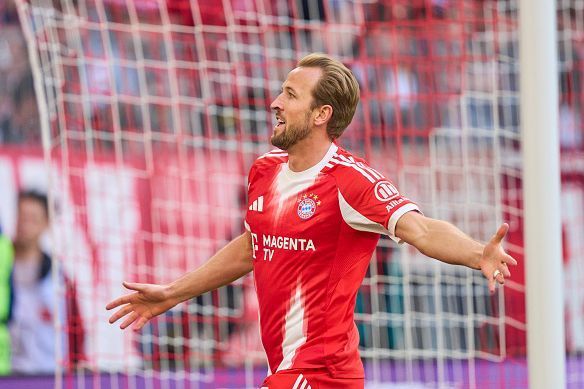
Harry Kane has reiterated that Bayern Munich still have “a lot to play for” this season after winning the Bundesliga title following their 4-2 thrashing of Stuttgart on Sunday.
The England international was substituted on at half time to bag his 31st goal, taking his tally to 51 across all competitions for Bayern this season, the most by any player for a top-five league side since Erling Haaland in 2022-23 (52).
After retaining the title — Bayern’s 13th in 14 seasons — an overjoyed Kane shared his ambitions for the remainder of the season.
“It’s been a fantastic season for us to finish the league off in the way we have with the goals that we scored.” Kane said.
“It’s a credit to the mentality of the boys, from the first game to the last we just keep pushing.
“We still have a lot to play for in other competitions, but all the hard work and days together this makes it worth it to be champions again.”
Kane, Michael Olise and Luis Díaz have a combined 94 goal contributions between them this season — the most by a trio on record (since 1988) in the Bundesliga.
– The numbers behind Harry Kane’s record-breaking Bundesliga season for Bayern Munich
– Bayern Munich retain Bundesliga title after thrashing Stuttgart
– Who has won Bundesliga? All-time German soccer winners list
Kane celebrated the trio’s chemistry: “It’s special, I feel like the relationship just get stronger and stronger, it grows every time we play and train with each other.
“There is still a lot to play for we feel good every time when we’re on the pitch.
Two more trophies are up for grabs for Vincent Kompany’s side, with a semifinal against Bayer Leverkusen in the German Cup to play next as well as a highly-anticipated clash against Paris Saint-Germain in the Champions League semifinals.
Kompany, who has now won the Bavarian club’s 34th and 35th Bundesliga crowns, hailed the opportunity to keep winning trophies.
“The numbers are great, but it’s not over yet,” Kompany said.
“We keep going. It’s also a question of mentality. We always give our all, whether in pre-season or for a competitive fixture and I don’t want to stop yet.
“We’ve got crucial weeks to come. We’re excited, but also know how tough it’ll be. Our belief is there, and that’s very valuable in football.”
Additional information from PA contributed to this report.
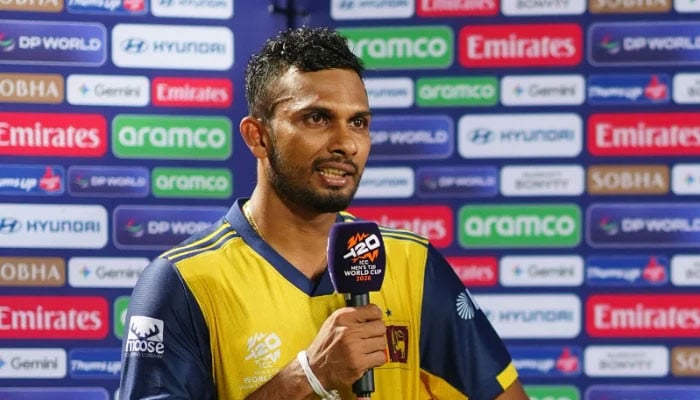
The Pakistan Cricket Board (PCB) has imposed a one-year ban on Sri Lanka’s Dasun Shanaka from participation in the next edition of the Pakistan Super League (PSL), citing contractual violations.
Shanaka was signed by defending champions Lahore Qalandars for Rs7.5 million in the accelerated round of the inaugural players auction, held in February this year.
But just three days before the commencement of the ongoing PSL 11, the franchise confirmed that the Sri Lankan all-rounder has withdrawn due to personal reasons and was replaced by Australia’s Daniel Sams in the squad.
In a statement, the PCB said it conducted a comprehensive assessment of recent contractual developments involving Shanaka and Lahore Qalandars, after the player withdrew from the tournament on March 21, 2026.
The board concluded that the unilateral withdrawal amounted to a clear breach of the player registration terms and the tripartite agreement. It further noted that the reasons cited for the withdrawal were not covered under the existing contractual framework.
While acknowledging Shanaka’s expressions of regret and his stated desire to continue playing in Pakistan, the PCB said the nature of the breach required regulatory action to safeguard the integrity and exclusivity of the league.
As a result, the PCB confirmed that Shanaka has been barred from participating in PSL 12, effective immediately.
Meanwhile, in a statement released by the PCB, the Sri Lankan all-rounder issued an apology to Pakistani fans and the wider cricket community.
“I deeply regret my decision to withdraw from the HBL PSL and offer my sincere apologies to the people of Pakistan, the fans of HBL PSL, and the wider cricket community,” Shanaka was quoted as saying by the PCB.
“The HBL PSL is a prestigious tournament, and I fully understand the disappointment caused by my actions. To the loyal fans of Lahore Qalandars, I am truly sorry for letting you down.”
He further clarified that he had no intention of joining any other franchise league at the time of his withdrawal from the PSL, urging that he has great respect for Pakistani fans and expressing his hope to make his return to the marquee league soon.
“I must clarify that at the time I withdrew from the PSL I had no intention of joining any other tournament. I have the greatest respect for Pakistani Fans and have always enjoyed my time in Pakistan. I hope to return to the HBL PSL in the future with renewed dedication and the trust of the fans.”


Education department forgives student loans for 21,200 borrowers: New changes explained

War Memes Are Turning Conflict Into Content

‘It’s his superpower’: Inside Fernando Mendoza’s extraordinary rise to No. 1

-

 Fashion4 days ago
France’s LVMH Q1 revenue falls 6%, shows resilience amid Iran war
-

 Sports1 week ago
The case for Man United’s Fernandes as Premier League’s best
-

 Entertainment1 week ago
Palace left in shock as Prince William cancels grand ceremony
-
 Business1 week ago
UK could adopt EU single market rules under new legislation
-

 Entertainment5 days ago
Is Claude down? Here’s why users are seeing errors
-

 Fashion1 week ago
Energy emerges as biggest cost driver in textile margins
-

 Tech1 week ago
A Lot of Shops Won’t Fix Electric Bikes. Here’s Why
-
 Business1 week ago
Delta Air Lines unveils first new Delta One suite in premium cabin arms race