

Business
Flights are already getting more expensive after a jet fuel spike. When should you book?


Travelers wait in line at a Transportation Security Administration (TSA) checkpoint at William P. Hobby Airport in Houston, Texas, US, on Monday, March 9, 2026.
Mark Felix | Bloomberg | Getty Images
The surge in fuel prices since the U.S. and Israel attacked Iran nearly two weeks ago is already driving up airfare. Consumers’ appetite for travel this year will dictate just how much.
Cathay Pacific on Thursday said it would roughly double fuel surcharges on tickets starting March 18.
Earlier this week, Australia’s Qantas said it is raising fares to help cover its costs, Scandinavian Airlines said the “unusually rapid and substantial increase” in fuel prompted it to raise prices, and Air New Zealand pulled its financial outlook “until fuel markets and operating conditions stabilise,” adding that it has made “initial fare adjustments.”
“If the conflict leads to continued elevated jet fuel costs, the airline may need to take further pricing action and adjust its network and schedule as required,” Air New Zealand said.
U.S. airline CEOs and other executives will update investors on Tuesday at the J.P. Morgan Industrials Conference in Washington, D.C.
Analysts expect an earnings hit at least in the first quarter if not the first half of the year, though the impact will depend on how long higher fuel prices last.
“We think a hit to 1Q EPS appears almost certain at this point,” UBS airline analysts Atul Maheswari and Thomas Wadewitz wrote in a note last week.
United Airlines CEO Scott Kirby said last week on the sidelines of an event at Harvard University that higher fares were likely on the way because of the surge in fuel prices.
Kirby said travel demand is still strong, however. Two other senior airline executives at U.S. carriers, speaking on the condition of anonymity because they weren’t authorized to speak to media, also said travel demand has held up. If those trends persist, it could give airlines more pricing power, but that will depend on the war’s duration.
“Airlines never met a higher fare they didn’t want,” said Scott Keyes, founder of flight deal company Going, previously known as Scott’s Cheap Flights.
So what should consumers do?
Keyes said travelers can’t lose by booking early, as long as they’re not buying restrictive basic economy tickets. That way, customers can try to exchange or cancel their tickets and buy cheaper ones if airfare ends up falling.
“If you book a $500 summer flight today, and two weeks from now the price drops to $350, you can call up the airline and get the $150 difference back as a credit. Heads you win; tails the airlines lose,” he said.
Fuel costs
Jet fuel is airlines’ biggest cost after labor, accounting for about a fifth or more of expenses, depending on the airline.
United alone spent $11.4 billion last year on fuel, at an average price of $2.44 a gallon, according to a securities filing. U.S. jet fuel on Wednesday was going for $3.78 a gallon, according to Platts.
Jefferies airline analyst Sheila Kahyaoglu said in a note Thursday that she expects “the most acute financial impact to airlines from surging oil prices to be in the next 30-90 days as airlines have been booking yields for close-in flights assuming a much lower fuel price and carriers cannot retroactively raise fares.”
She said Delta Air Lines and United, which produce most U.S. airline profits, are better positioned than other carriers because of their high-end demand. Risks to demand, particularly for more price-sensitive customers, include the recent jump in gasoline prices.
Jet fuel has more than doubled in some regions since the first U.S.–Israel attacks on Iran on Feb. 28.
Oil prices surged to roughly four-year highs after the initial strikes. Energy prices have swung wildly since then as traders assess just how long the war — and all the logistics headaches — could last.
U.S. jet fuel prices were up more than 60% from before the attacks to a peak last week, according to pricing data assessed by Platts. Jet fuel can rise by a greater degree than crude because it includes the price of processing and ever-more difficult and costly transportation from oil fields to refineries to airplane fuel tanks.
On Feb. 27, the day before the attacks, the cost to fill the fuel tanks of a Boeing 737-800 would have would have been about $17,000 based on average prices in New York, Houston, Chicago and Los Angeles, compiled by Argus. Less than a week later, on March 5, it would have cost more than $27,000. On Tuesday, after oil prices fell following President Donald Trump‘s comment that the Iran war could end “very soon,” it would have cost around $23,000.
Line Service Technician Austin Beadles refuels a plane using a Federal Aviation Administration approved unleaded aviation fuel at Sheltair at Rocky Mountain Metropolitan Airport in Broomfield on Tuesday, Feb. 17, 2026. Sheltair, a fixed-base operator, will offer the Swift UL94 unleaded aviation alternative gas to pilots. (Photo by Matthew Jonas/MediaNews Group/Boulder Daily Camera via Getty Images)
Matthew Jonas | Boulder Daily Camera | MediaNews Group | Getty Images
After prior fuel price surges, airlines started making customers pay for bags — or charging them more. Even seemingly minor changes in weight can save airlines hundreds of thousands, if not millions of dollars, a year in fuel. United in 2018 changed to a lighter paper stock for its in-flight magazine. In 2014, American Airlines said it would switch to digital manuals for flight attendants, following changes for pilots. It said at the time that it would save $650,000 in fuel a year.
All about capacity
High fuel prices don’t automatically mean higher fares. The ongoing strong demand for travel is a key factor and so is capacity, or the amount that carriers fly.
If airlines raise fares and passengers balk, then capacity will likely go down in the form of fewer frequencies on a route or broader cuts, in more severe cases.
“Airlines love to say fuel is expensive so you have to pay more. What they’re doing is they’re setting the expectation,” said Courtney Miller, founder of Visual Approach Analytics, an airline industry advisory firm. “They price to prevent empty seats.”
If fuel prices come down, “they’re not suddenly saying ‘We’re making too much money,'” Miller added. “But they are likely to add another flight.”
Capacity, especially to and from the Middle East, is constrained because of airspace closures and other stop-and-start flights. More than 46,000 flights have been canceled to and from the region since the Feb. 28 attacks began, aviation data firm Cirium said.
Those constraints are driving up fares as well as demand, as United’s Kirby said, from regions where customers are looking for alterative routes.
Airspace closures are also requiring airlines to take longer, more fuel-guzzling routes, but many have strong demand, too.
Qantas, for example, told CNBC that its flight from Perth, Australia, to London is temporarily stopping in Singapore to refuel, allowing it to pick up another 60 customers, and that its Perth-London and Perth-Paris routes are more than 90% full this month, 15 percentage points higher than normal for this time of year.
Finnair said the increased demand for travel to Asia from Helsinki has pushed up its prices by 15% on average.
“The impact of higher fuel prices will be reflected in market fares with a delay, as airlines typically hedge at least part of their fuel purchases,” it said.
Airlines have been grappling with airspace closures for years, including from on-and-off conflict in the Middle East and since Russia’s 2022 invasion of Ukraine, that have left a large swath of airspace out of use for many carriers.
‘You can’t dry up an airport’
Most U.S. airlines no longer hedge fuel costs, or lock in prices using futures and other securities. Southwest Airlines was one of the last holdouts, and it quit last year. A spokesman for the Dallas-based airline told CNBC that Southwest currently has “no plans” to resume hedging.
That leaves U.S. carriers more susceptible to price swings.
Travelers at William P. Hobby Airport in Houston, Texas, US, on Monday, March 9, 2026.
Mark Felix | Bloomberg | Getty Images
Kirby said there would likely be an impact to United’s first-quarter results and to the second quarter if the war — and blockage of the Strait of Hormuz, a key shipping channel — persists. However, he said demand was increasing sharply from regions that have been affected by the thousands of flight cancellations and airspace closures in the Middle East.
Because of airlines’ upbeat outlooks on demand to start the year, “the environment is conducive for passing along fare increases. Further, should jet fuel stay higher for longer, it should help push off-peak capacity lower,” supporting unit revenues, UBS analysts said.
Rick Joswick, who heads of near-term oil research and analytics at S&P Global Energy, told CNBC that “demand for jet fuel is inelastic. You cannot shortchange an airport. If the cost of jet fuel goes up, it’s not like the plane will choose not to fly that day.
“You can’t dry up an airport,” he said.




Business
A Paramount-Warner Bros. movie slate could rule the 2027 box office, but is it sustainable?

Paramount Skydance CEO David Ellison speaks during the Bloomberg Screentime conference in Los Angeles on October 9, 2025.
Patrick T. Fallon | Afp | Getty Images
Hollywood could soon have a new king of the box office.
With Paramount Skydance set to take over Warner Bros. Discovery, the combined film studios could dominate the theatrical slate.
Paramount CEO David Ellison has repeatedly promised not to pull back on production from either studio, with the goal of making 30 movies a year — 15 from Paramount and 15 from Warner Bros. The pending transaction, with an enterprise value of $111 billion, must still win regulatory approval both in the U.S. and in Europe.
As the current 2027 slate stands, the combination of WBD and Paramount would result in 26 theatrical releases. However, additions to that calendar could come as soon as April at the annual CinemaCon conference in Las Vegas.
This behemoth of a slate is dominated by Warner Bros. titles, and it’s likely that those films would account for the bulk of ticket sales.
The studio is set to release films from major franchises including Godzilla-Kong, Superman, Batman, Minecraft, The Conjuring universe, Gremlins and Lord of the Rings.
Meanwhile, Paramount will have new entries for Sonic the Hedgehog, Paranormal Activity, A Quiet Place and its animated Teenage Mutant Ninja Turtles franchises.
Still from Paramount’s “Sonic the Hedgehog 2.”
Paramount
While Paramount’s franchises are popular and have generated solid ticket sales at the box office, its major releases in 2027 are smaller budget features. In fact, no film in any of those four franchises has generated more than $350 million globally, according to data from Comscore. But with smaller budgets, they don’t have to in order to be profitable.
Warner Bros.’ part of the slate, on the other hand, has bigger budget features that in the past have generated bigger box office returns. The most recent Godzilla-Kong film generated $572 million globally, 2025’s “The Conjuring: Last Rites” tallied nearly $500 million, “The Batman” took in $772 million and “A Minecraft Movie” nearly hit $1 billion.
“When you look at the films on the horizon from the PAR/WBD combo it is most impressive,” Paul Dergarabedian, head of marketplace trends at Comscore, told CNBC. “And it may not be an overstatement to say that that slate could indeed have the potential to generate the biggest single studio box office in 2027.”
The Warner Bros. movie studio is a big part of why Ellison was so committed to winning over WBD’s board and its shareholders in a bidding war against Comcast and Netflix. Last year, Warner Bros. was the second-highest grossing studio at the domestic and global box office. Paramount was fifth.
Disney has long held the box office heavyweight title, although it was briefly overthrown in 2023 by Universal. Warner and Universal have jockeyed between second and third position, with Sony, Lionsgate and Paramount falling in line behind them.
A tricky feat
“Doubling up two major slates adds to the potential for a very strong 2027, but nothing is ever certain when it comes to assuming a potential annual box office winner among studios,” said Shawn Robbins, director of analytics at Fandango and founder of Box Office Theory. “That’s especially true when the likes of Disney and Universal will each bring out their own heavy-hitters next year.”
Disney, in particular, has franchises like Ice Age, Star Wars, Frozen and Avengers on the docket for 2027.
Of course, franchise tentpoles are not always guaranteed to succeed at the box office, but the combined efforts of Paramount and Warner Bros. is a compelling offering for an industry that has been shrinking dramatically over the last decade.
“The notion of two major studio slates under one large umbrella in 2027 makes for an intriguing prospect while raising some fair speculation,” said Robbins. “We’ve seen the decline in theatrical output in the years following Disney’s acquisition of Fox, although caveats such as the pandemic and streaming explosion somewhat skew that comparison.”
A combined Paramount and Warner Bros. slate also faces some logistic issues. There are only 52 weekends on the calendar, and with 30 movies, the studio would need to strategically place its releases as not to cannibalize its own ticket sales.
David Corenswet stars are Superman in Warner Bros.’ “Superman.”
Warner Bros. Discovery
Robbins noted that rival studios typically only go head-to-head on the same weekend or on back-to-back weekends if they are certain there isn’t a major overlap in audience demographics. It’s why there is often a horror movie set for release at the same time as a family-friendly animated feature, for example.
In contrast, Robbins noted, Paramount is scheduled to release “Sonic the Hedgehog 4” just one week ahead of Warner Bros.’ “Godzilla X Kong: Supernova.”
“It wouldn’t be a shock to see one of those shifted earlier or later on the calendar since the parent studio will want to minimize risk and do what’s best for the financial bottom line while remaining competitive,” he said.
And while Ellison has touted a 30-movie slate in the years after 2027, it’s unclear if that future is feasible.
Traditionally, when two major studios merge, the number of films released declines and there is a major wave of layoffs as consolidation weeds out redundancies. Not to mention, the marketing costs of big-budget films can be prohibitive.
“What will actually become normal for the newly unified house of Paramount and Warner remains to be seen,” Robbins said. “The longevity of such a slate in the years after 2027 will be challenging to produce, but never say never.”
Disclosure: Versant is the parent company of CNBC and Fandango.
Business
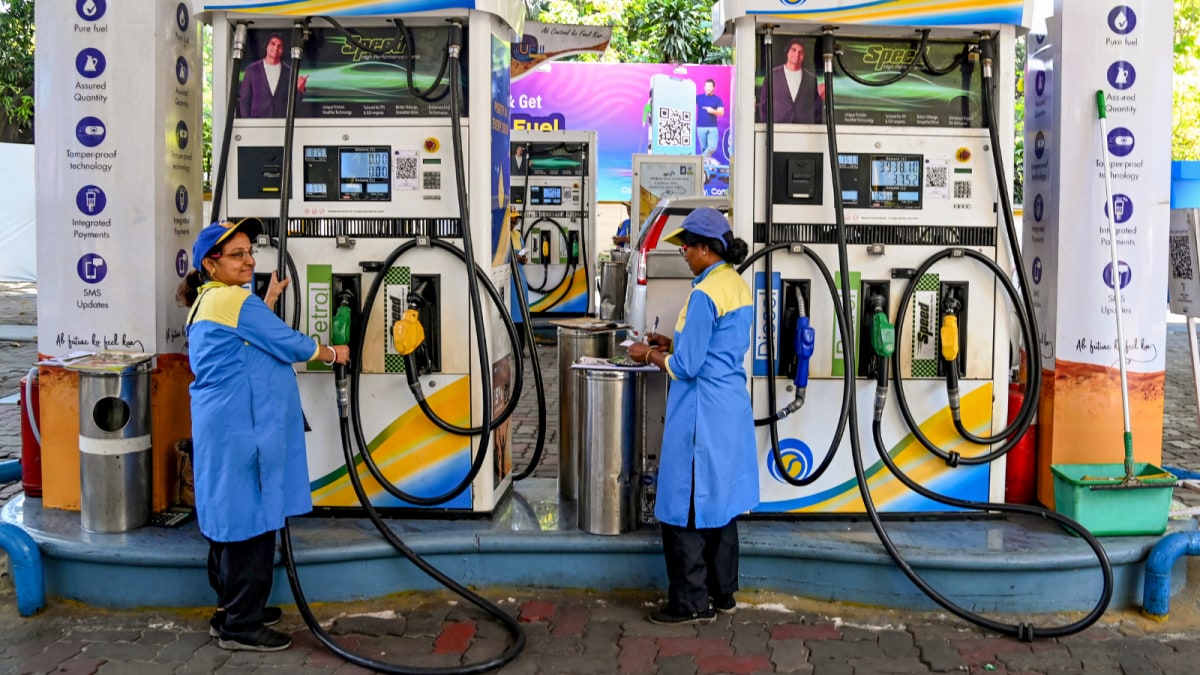
‘Petrol, Diesel Adequately Available In India’: Govt Urges Citizens Not To Hoard Fuel Amid US-Iran War
Last Updated:
‘Consumers are advised not to take or store fuel in loose or inappropriate containers, as it poses serious safety risks,’ says the Ministry of Petroleum and Natural Gas.




The government said all retail outlets and dealers have been instructed to strictly follow safety guidelines while dispensing fuel. Any violation will invite strict action.
Amid rising concerns over fuel supply due to escalating geopolitical tensions in the West Asia, the Ministry of Petroleum and Natural Gas on Saturday issued an advisory assuring citizens that petrol and diesel remain adequately available across the country. It also urged people to avoid unsafe practices such as storing petrol or diesel in loose containers.
In a post on X, the ministry said, “Petrol and diesel are adequately available at retail outlets across the country. Consumers are advised not to take or store fuel in loose or inappropriate containers, as it poses serious safety risks.”
Important advisory for citizens.Petrol and diesel are adequately available at retail outlets across the country. Consumers are advised not to take or store fuel in loose or inappropriate containers, as it poses serious safety risks.
Retail outlets have been instructed to… pic.twitter.com/5KtQW5dbnR
— Ministry of Petroleum and Natural Gas #MoPNG (@PetroleumMin) March 14, 2026
The advisory comes after authorities detected a case in Tamil Nadu where petrol was reportedly being dispensed in a loose container at a retail outlet, which violates safety norms.
“It has come to notice that at one retail outlet in Tamil Nadu, petrol was being taken in a loose container, which is unsafe and not advisable,” the ministry said.
Govt warns of strict action for violations
The ministry added that strict action has already been taken in the matter.
“The concerned petrol pump has been suspended, and appropriate action has been taken,” the ministry said.
The ministry also said all fuel retailers across the country have been directed to strictly adhere to safety guidelines while dispensing petrol and diesel.
“All retail outlets and dealers have been instructed to strictly follow safety guidelines while dispensing fuel. Any violation will invite strict action,” the advisory said.
Advisory comes amid supply concerns
The government’s clarification comes at a time when concerns over fuel availability have risen due to disruptions in global energy supply chains due to closure of the Strait of Hormuz amid US-Iran-Israel war.
Rumours of shortages have also triggered panic buying in some areas, temporarily affecting supplies at a few petrol pumps despite adequate overall stock levels.
Authorities have urged the public not to believe unverified information and assured that the country’s fuel supply chain remains stable.
The country saw a huge shortage of LPG cylinders after the supply was stopped in the West Asia amid the ongoing Iran war. However, two Indian cargo ships carrying LPG have been allowed by the Iranian authorities to pass through the Strait of Hormuz. The first Indian LPG vessel, Shivalik, had already begun its movement through the Strait of Hormuz after negotiations helped secure safe passage. The ship has since reached open sea and is sailing safely under Indian Navy guidance. Now, India’s second LPG carrier Nanda Devi has successfully exited the Strait of Hormuz and entered open waters, government sources told CNN-News18, marking another step forward in India’s efforts to safely move its energy cargo through the tense Gulf region.
Nanda Devi is carrying more than 46,000 metric tonnes of liquefied petroleum gas (LPG).
March 14, 2026, 15:35 IST
Read More
Business
Middle East turmoil: After IndiGo and Air India, now Akasa Air to levy fuel surcharge – check details – The Times of India
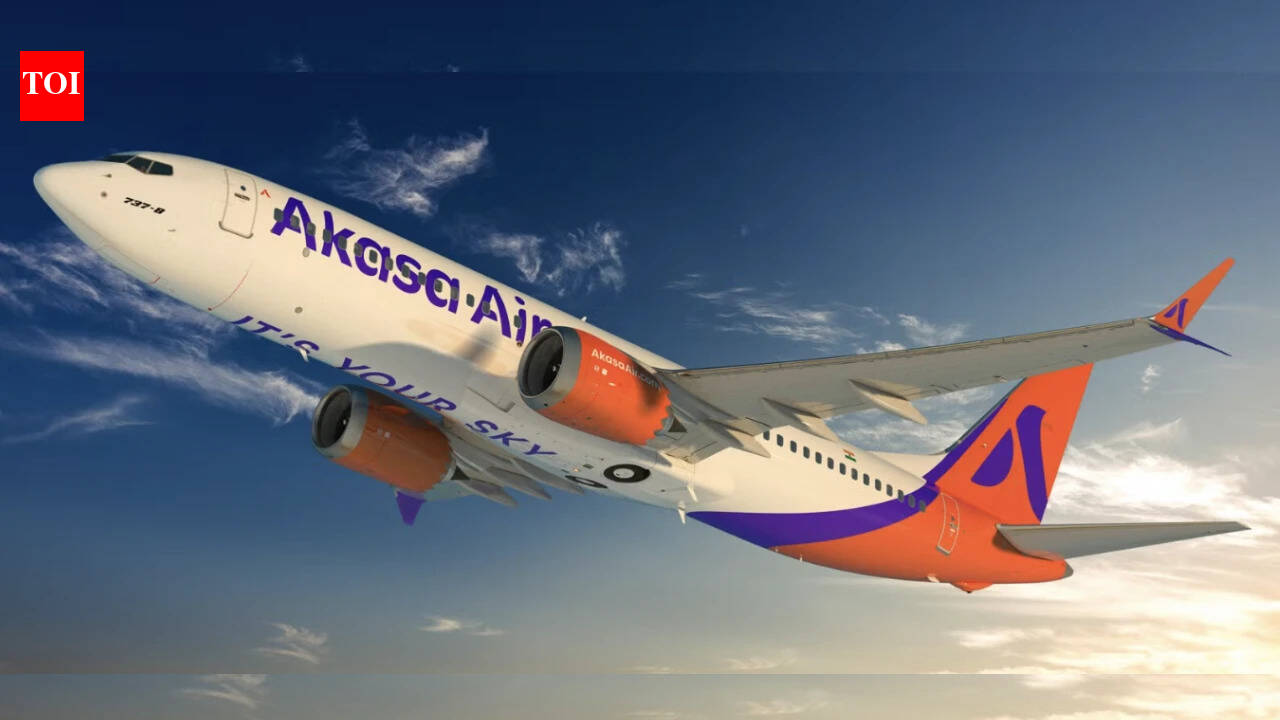
Akasa Air on Saturday announced that it will introduce a fuel surcharge ranging from Rs 199 to Rs 1,300 on domestic and international flight tickets booked from March 15, citing a sharp rise in aviation turbine fuel (ATF) prices amid escalating geopolitical tensions in the Middle East.In a post on X, the airline said the surcharge will apply to all bookings made from 00:01 hrs on March 15, 2026, and will not be applicable to tickets booked before that time. The airline said the additional charge will be levied per sector and will vary depending on the duration of the flight.
Akasa cites sharp rise in ATF prices
“There has been a significant increase in the price of aviation turbine fuel, driven by evolving geopolitical developments in the Middle East,” Akasa Air said in its statement.“As fuel represents a significant portion of airline operating costs, this impacts the cost of operations across the aviation industry,” it added.The airline said it remains focused on offering “warm and efficient customer service, reliable operations, and affordable fares while maintaining the highest standards of operational efficiency”, and added that it will continue to monitor the operating environment and review the fuel surcharge periodically.
Move follows Air India, IndiGo fare actions
Akasa’s decision comes after larger Indian carriers Air India Group and IndiGo also moved to pass on part of the fuel cost burden to passengers.Earlier, IndiGo said it will levy an additional fuel charge of Rs 425 to Rs 2,300 on all new domestic and international bookings made from 00:01 hrs on March 14, citing “the significant surge in fuel prices following the ongoing geopolitical issues”.IndiGo said IATA’s jet fuel monitor showed an over 85% rise in fuel prices for the region, adding that ATF represents a major share of airline operating costs.Air India Group had earlier introduced a fuel surcharge ranging from Rs 399 to $200 on flights beginning Thursday, saying that without the move, some services may not cover operating costs and could face cancellation.
Middle East conflict driving fuel cost pressure
The latest surcharge announcements come as the widening conflict in the Middle East continues to disrupt global oil supplies and push up jet fuel prices worldwide.Attacks on commercial shipping and oil infrastructure in the Gulf region, along with disruption through the Strait of Hormuz, have tightened supplies and driven a steep increase in fuel prices. Airlines are also facing added operational costs due to airspace restrictions and longer rerouted flights, which burn more fuel.Industry experts said long-haul international routes are likely to feel the greatest impact, though domestic fares may also remain under pressure if fuel prices stay elevated.With Akasa now joining Air India Group and IndiGo, Indian flyers are set to face higher ticket costs across more carriers as airlines respond to the sustained spike in fuel expenses.


Tips and Advice for Buying Used or Refurbished Electronics

June Marlow, star of ‘Doc Martin’ dies days after celebrating 95th birthday
A Paramount-Warner Bros. movie slate could rule the 2027 box office, but is it sustainable?

-
 Politics1 week ago
India let Iran warship dock the day US sank another off Sri Lanka, say officials
-

 Sports1 week ago
Pakistan set for FIH Pro League debut | The Express Tribune
-
 Business1 week ago
Restaurant group changes name after bid to buys pubs across the UK
-

 Entertainment1 week ago
Harry Styles kicks off new era with ‘One Night Only’ comeback show
-

 Sports1 week ago
Winners and losers of the 2026 NHL trade deadline
-
 Business1 week ago
Home heating oil: ‘Most of my pension has gone on home heating oil’
-
 Business2 days ago
Stock market crash today (March 12, 2026): Nifty50 opens below 23,600; BSE Sensex down over 900 points on continuing US-Iran war – The Times of India
-

 Entertainment1 week ago
Kanye ‘Ye’ West trips during trial: ‘Is he asleep?’