

Tech
Former USDS Leaders Launch Tech Reform Project to Fix What DOGE Broke


The past year has been traumatic for many of the volunteer tech warriors of what was once called the United States Digital Service (USDS). The team’s former coders, designers, and UX experts have watched in horror as Donald Trump rebranded the service as DOGE, effectively forced out its staff, and employed a strike force of young and reckless engineers to dismantle government agencies under the guise of eliminating fraud. But one aspect of the Trump initiative triggered envy in tech reformers: the Trump administration’s fearlessness in upending generations of cruft and inertia in government services. What if government leaders actually used that decisiveness and clout in service of the people instead of following the murky agendas of Donald Trump or DOGE maestro Elon Musk?
A small though influential team is proposing to answer that exact question, working on a solution they hope to deploy during the next Democratic administration. The initiative is called Tech Viaduct, and its goal is to create a complete plan to reboot how the US delivers services to citizens. The Viaduct cadre of experienced federal tech officials is in the process of cooking up specifics on how to remake the government, aiming to produce initial recommendations by the spring. By 2029, if a Democrat wins, it hopes to have its plan adopted by the White House.
Tech Viaduct’s advisory panel includes former Obama chief of staff and Biden’s secretary of Veterans Affairs Denis McDonough; Biden’s deputy CTO Alexander Macgillivray; Marina Nitze, former CTO of the VA; and Hillary Clinton campaign manager Robby Mook. But most attention-grabbing is its senior adviser and spiritual leader, Mikey Dickerson, the crusty former Google engineer who was the first leader of USDS. His hands-on ethic and unfiltered distaste for bureaucracy embodied the spirit of Obama’s tech surge. No one is more familiar with how government tech services fail American citizens than Dickerson. And no one is more disgusted with the various ways they have fallen short.
Dickerson himself unwittingly put the Viaduct project in motion last April. He was packing up the contents of his DC-area condo to move as far away as possible from the political scrum (to an abandoned sky observatory in a remote corner of Arizona) when McDonough suggested he meet with Mook. When the two got together, they bemoaned the DOGE initiative but agreed that the impulse to shred the dysfunctional system and start over was a good one. “The basic idea is that it’s too hard to get things done,” says Dickerson. “They’re not wrong about that.” He admits that Democrats had blown a big opportunity “For 10 years we’ve had tiny wins here and there but never terraformed the whole ecosystem,” Dickerson says. “What would that look like?”
Dickerson was surprised a few months later when Mook called him to say he found funding from Searchlight Institute, a liberal think tank devoted to novel policy initiatives, to get the idea off the ground. (A Searchlight spokesperson says that the think tank is budgeting $1 million for the project.) Dickerson, like Al Pacino in Godfather III, was pulled back in. Ironically, it was Trump’s reckless-abandon approach to government that convinced him that change was possible. “When I was there, we were severely outgunned, 200 people running around trying to improve websites,” he says. “Trump has knocked over all the beehives—the beltway bandits, the contractor industrial complex, the union industrial complex.”
Tech Viaduct has two aims. The first is to produce a master plan to remake government services—establishing an unbiased procurement process, creating a merit-based hiring process, and assuring oversight to make sure things don’t go awry. (Welcome back, inspector generals!) The idea is to design signature-ready executive orders and legislative drafts that will guide the recruiting strategy for a revitalized civil service. In the next few months, the group plans to devise and test a framework that could be executed immediately in 2029, without any momentum-killing consensus building. In Viaduct’s vision that consensus will be achieved before the election. “Thinking up bright ideas is going to be the easy part,“ Dickerson says. “As hard as we’re going to work in the next three to six months, we’re going to have to spend another two to three years, through a primary season and through an election, advocating as if we were a lobbying group.”











After a week of product announcements—starting with the iPhone 17e, a refreshed iPad Air, and more powerful MacBook Pro models—Apple has unveiled a new category in its laptop lineup for the first time in a while: the “MacBook Neo.”
Photograph: Julian Chokkattu
Positioned below the MacBook Air as an entry-level machine, this new MacBook is the most affordable laptop the company has ever made, with a starting price of $599. While it’s been possible to buy a new MacBook Air at lower prices—like the 2020 M1 MacBook Air Apple sold for several years for $699 exclusively through Walmart—this is officially the cheapest MacBook out the gate.
Aside from the price, its approach to color also makes it unique among the other MacBooks in Apple’s lineup. You have several color options, including Silver, Indigo, Blush, and Citrus. The colors harken back a bit to the iBook G3 of yesteryear and are akin to the current iMac design. In person, the colors aren’t a bright and bold as expected, still exhibiting a more subtle hue. Apple says the aluminum device weighs 2.7 pounds, which is the same as the 13-inch MacBook Air. We’re still waiting on official measurements on the thickness.
Despite its price, Apple doesn’t appear to be cutting corners on the quality of the screen. With a resolution of 2408 by 1506 and up to 500 nits of brightness, Apple boasts that it is “both brighter and higher in resolution than most PC laptops in this price range.” The display doesn’t use a notch for the webcam like the MacBook Air or MacBook Pro. There’s a 1080p camera, a Touch ID sensor, and side-firing speakers with Dolby Atmos. Unfortunately, the Touch ID sensor is only available on the $699 model, which comes with 512 GB of storage.
The MacBook Neo does make plenty of other concessions to hit its aggressive price though. It’s powered by the A18 Pro chip—the same processor inside the iPhone 16 Pro and 16 Pro Max. Yup—you read that right. iPads have used Mac chips for years, but now a MacBook is using an iPhone chip. Still, this processor should deliver more power than the original M1 chip in the MacBook Air. Apple claims the chip gives the MacBook Neo up to 16 hours of battery life. That’s less than the MacBook Air or MacBook Pro. Apple also says the chip is up to 50 percent faster in daily tasks like web browsing than “the bestselling PC with the latest chipping Intel Core Ultra 5.” According to the liner notes, this was based on a Speedometer test, a popular browser-based benchmark.
Other compromises to the device are the use of a mechanical multi-touch trackpad (rather than one that uses haptic feedback), a non-backlit keyboard, and the more limited port selection. The use of the iPhone chip means this MacBook only supports one external monitor through one if its two USB-C ports. Either port can be used for charging. There’s also a headphone jack, located in an odd position next to the side-firing speakers near the front of the device. While technically this is the same amount of USB-C ports as the MacBook Air, it’s missing the magnetic MagSafe 3 charging port, which frees up one of the USB-C ports.
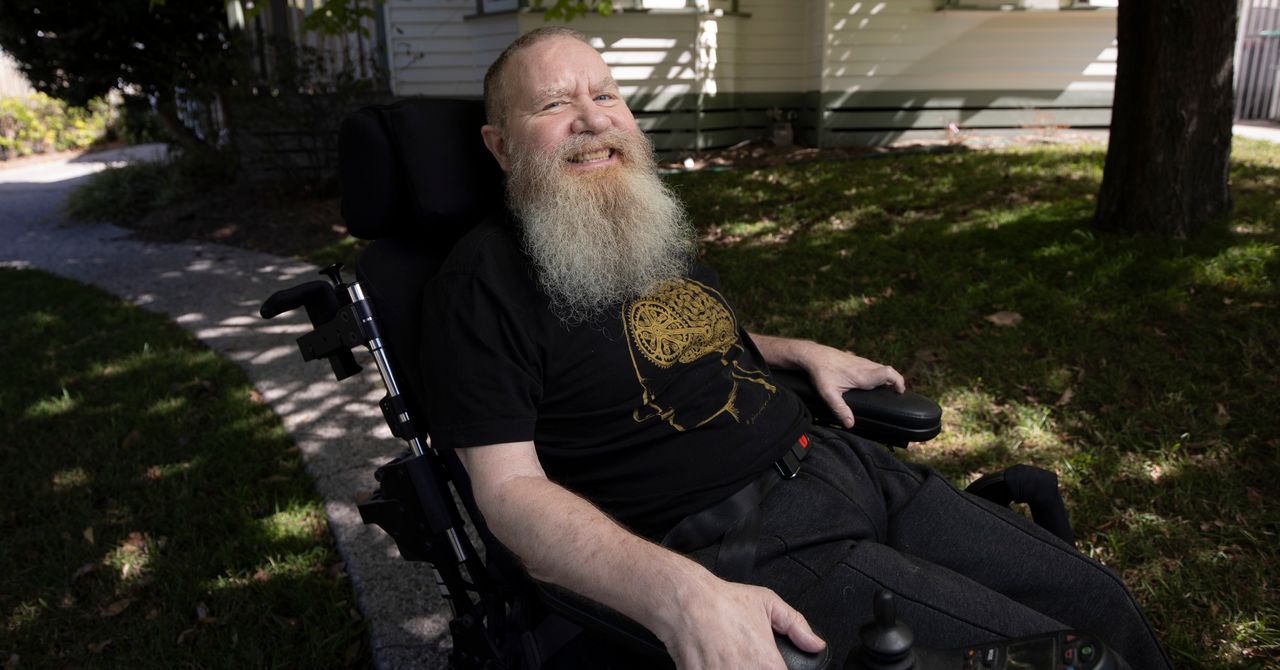
Initially, Gorham used his brain-computer interface for single clicks, Oxley says. Then he moved on to multi-clicks and eventually sliding control, which is akin to turning up a volume knob. Now he can move a computer cursor, an example of 2D control—horizontal and vertical movements within a two-dimensional plane.
Over the years, Gorham has gotten to try out different devices using his implant. Zafar Faraz, a field clinical engineer for Synchron, says Gorham directly contributed to the development of Switch Control, a new accessibility feature Apple announced last year that allows brain-computer interface users the ability to control iPhones, iPads, and the Vision Pro with their thoughts.
In a video demonstration shown at an Nvidia conference last year in San Jose, California, Gorham demonstrates using his implant to play music from a smart speaker, turn on a fan, adjust his lights, activate an automatic pet feeder, and run a robotic vacuum in his home in Melbourne, Australia.
“Rodney has been pushing the boundaries of what is possible,” Faraz says.
As a field clinical engineer, Faraz visits Gorham in his home twice a week to lead sessions on his brain-computer interface. It’s Faraz’s job to monitor the performance of the device, troubleshoot problems, and also learn the range of things that Gorham can and can’t do with it. Synchron relies on this data to improve the reliability and user-friendliness of its system.
In the years he’s been working with Gorham, the two have done a lot of experimenting to see what’s possible with the implant. Once, Faraz says, he had Gorham using two iPads side by side, switching between playing a game on one and listening to music on the other. Another time, Gorham played a computer game in which he had to grab blocks on a shelf. The game was tied to an actual robotic arm at the University of Melbourne, about six miles from Gorham’s home, that remotely moved real blocks in a lab.
Gorham, who was an IBM software salesman before he was diagnosed with ALS in 2016, has relished being such a key part of the development of the technology, his wife Caroline says.
“It fits Rodney’s set of life skills,” she says. “He spent 30 years in IT, talking to customers, finding out what they needed from their software, and then going back to the techos to actually develop what the customer needed. Now it’s sort of flipped around the other way.” After a session with Faraz, Gorham will often be smiling ear to ear.
Through field visits, the Synchron team realized it needed to change the setup of its system. Currently, a wire cable with a paddle on one end needs to sit on top of the user’s chest. The paddle collects the brain signals that are beamed through the chest and transmits them via the wire to an external unit that translates those signals into commands. In its second generation system, Synchron is removing that wire.
“If you have a wearable component where there’s a delicate communication layer, we learned that that’s a problem,” Oxley says. “With a paralyzed population, you have to depend on someone to come and modify the wearable components and make sure the link is working. That was a huge learning piece for us.”

A judicial review against the Home Office’s electronic visa (eVisa) system will argue that the department’s refusal to issue alternative proof of immigration status in the face of persistent data quality and integrity issues is unlawful.
On 31 December 2024, the immigration documents of millions of people living in the UK expired after being replaced by the Home Office with a real-time, online-only immigration status.
While the department has been issuing eVisas for several years – including to European Union (EU) citizens who applied to the European Union Settlement Scheme (EUSS) after Brexit, those applying for Skilled Worker visas, and people from Hong Kong applying for the British National (Overseas) visa – paper documents have now been completely phased out.
Instead, people are now expected to use a UK Visas and Immigration (UKVI) digital account to generate “share codes”, which they must use to prove their immigration status when dealing with a range of third parties, including employers, letting agencies and landlords.
Despite persistent data quality and integrity issues plaguing the system since its inception, current Home Office policy means the eVisa system is the only way people can prove their lawful residence in the UK and evidence their associated rights and entitlements.
Two unnamed individuals affected by the system – a recognised refugee and survivor of trafficking, and a vulnerable adult – were previously granted permission to proceed with a judicial review against the Home Office in October 2025, with the Cardiff Administrative Court noting it is in the public interest for the legality of the Home Office’s policy to be determined.
Legal arguments
Beginning on 3 March 2026, lawyers from Deighton Pierce Glynn (DPG) argued across a two-day hearing in the High Court that the Home Office’s digital, online-only approach to visas is an “unlawful fettering of discretion” and the overall policy of not providing alternative proof of status is “irrational”.
Highlighting how the claimants were either unable to access an eVisa at all or their account displayed inaccurate information that meant it could not be relied on, the lawyers detailed that their situations lasted for nine and six months, respectively, “during which time, the [Home Office] … refused to provide them with any alternative means of proving their legal status”.
They detailed how one claimant was unable to claim the benefits they and their child were entitled to, as when they gave the share code to the Department for Work and Pensions (DWP), an error meant they were wrongly denied benefits.
This led the individual to mistakenly believe that their eVisa was correct and that they were not entitled to the benefits.
During this time, they were also living in “inadequate asylum support accommodation”, and at one point were notified by the Home Office that they would no longer be able to stay in the accommodation.
While this was eventually resolved, the Home Office did not explain the reason for the error or how long it would take to resolve, and did not provide any response to the request for urgent alternative proof.
The second individual – a recognised refugee and survivor of trafficking – experienced distress after their UKVI account showed the name used by their traffickers on their false passport.
While they approached the Home Office to correct this, it took nine months to resolve the issue, during which time the individual was also unable to prove their status to the DWP.
Lawyers claimed the distress caused to these and other individuals is the result of the Home Office’s “blanket” policy of only issuing visas digitally, noting that while the home secretary “undoubtedly” has the discretion to issue alternative forms of proof, officials have been “fettered” by their own policy decisions.
The lawyers further argued that if the court does not agree that there has been an unlawful fettering of discretion, then it must still see the blanket policy as irrational.
“Having adopted a policy that eVisas are the only operative proof of immigration status, the defendant’s failure to provide alternative proof of immigration status in circumstances where an individual’s UKVI account and/or eVisa is not functioning accurately or at all, is irrational,” they said.
“The claimants’ case is that where issues do arise and persist, as sometimes they do, then a rational policy would permit officials to consider providing an alternative means of proof where not doing so would cause real injustice and possible harm.
“It is not rational to have a policy which provides that however grave the harm and however long it may persist, caused by inability to prove status through the eVisa system, no consideration will be given to providing an alternative proof of status.”
Home Office stance
The Home Office, on the other hand, argued that it has put in place measures and support mechanisms to reduce the risk of issues associated with its eVisa system, and has implemented a 12-month stabilisation plan to improve the functioning of the system (although lawyers did not offer any details on this programme).
Home Office lawyers also argued that the home secretary’s policy has been “considered”, and that in the two particular cases in question, the home secretary has acted lawfully and rationally.
They added that while the Home Office accepts there have been glitches and delays for the claimants – which have negatively affected them and could therefore allow a judge to grant relief or order the home secretary to rectify the issues within a certain time frame – there is no basis for the entire eVisa policy to be found unlawful.
The lawyers said there were also a number of alternatives through which immigration status could be proved outside of the eVisa system, which include checking services for employers and landlords, as well as status verification services for visa holders.
They added the home secretary is also obliged to issue a formal notice in writing when status is granted, meaning that while the system is fully digital, applicants always receive a letter setting out their status.
Based on the existence of such alternatives, the lawyers said the home secretary has chosen not to exercise her discretion to issue physical proof, and outlined four further reasons for this.
These include claiming that the reintroduction of physical proof would lead to greater abuse of the immigration system due to outdated information on documents, there would be a substantial cost to taxpayers “at a time when public finances are constrained”, there might be practical difficulties associated with people appealing their status, and the reintroduction of physical proof would also require legislative changes via Parliament.
They also contended that if incorrect information is appearing on eVisas, then the same issues would persist with physical proof because the underlying data is the same. However, when the judge pointed out that eVisas have pulled out incorrect information from the underlying data, Home Office lawyers said they “accept” that, and this is one of many submissions.
Home Office lawyers concluded there was no way of implementing physical proof “without compromising the entire policy framework”, and that under the current circumstances, the secretary of state “would not be issuing physical proof to anyone”
It is the Home Office’s long-standing policy not comment on ongoing legal proceedings.
Serious, long-standing issues
People experiencing technical errors with the system have long reported being unable to travel, losing jobs and being denied housing due to faulty eVisa data.
It should be noted that even if people’s eVisa issues are resolved once, Computer Weekly has heard concerns that, because of how the system is set up to trawl dozens of disparate government databases in real time, every time a status is needed, the same people could once again find themselves without access to a working eVisa.
Not being able to reliably prove their immigration status in the face of a hostile and unresponsive bureaucracy has also taken a psychological toll on many of those affected, causing great anxiety.
Speaking on condition of anonymity, those affected variously told Computer Weekly that the entire experience had been “anxiety-inducing” and described how their lives had been thrust into “uncertainty” by the transition.
Each also described how the “inordinate amount of stress” associated with not being able to reliably prove their immigration status had been made worse by a lack of responsiveness and help from the Home Office, which they accused of essentially leaving them in the lurch.
In one case that was reported to the Information Commissioner’s Office (ICO), the technical errors with data held by the Home Office were so severe that the regulator found there had been a breach of UK data protection law.
In January 2025, Computer Weekly also reported that despite repeated warnings from civil society and migrant support groups, which started as early as October 2021, people were already having trouble proving their immigration status while travelling back to the country, just two weeks after the UK’s formal transition to the eVisa system.
While groups such as ORG and the3million have directly proposed alternatives to the Home Office, such as the use of QR codes or “stable token” systems, the department’s eVisa policy team insisted as far back as December 2023 that it would not “compromise on the real-time aspect” of the eVisa checks, as “any check of an individual’s immigration status must be done in real time to reflect the current immigration status held” on its systems.
“As we warned, people are having problems using eVisas to travel back to the UK,” said the ORG at the time. “We asked the Home Office to make the simple change of allowing people to have a QR code. This could be saved or printed without having to rely on a flawed online-only system.
“Many refugees are still waiting for their eVisas,” it said. “Without them, they cannot work, set up a bank account, rent somewhere to live or claim benefits. The Home Office needs to sort out this mess urgently.”
The Home Office states in the eVisa terms and conditions that it will take no liability for any problems or disruptions, and direct or indirect losses, when using a UKVI account – including for “any information that is lost or corrupted while data is being transmitted, processed or downloaded from the UKVI account” – which ORG said implies the department “is already aware of the many technical issues with the eVisa scheme and is pre-emptively protecting itself against legitimate legal claims”.
ORG and others have said the use of eVisas should be seen in the context of the UK’s “hostile environment” approach, which is intended to make life in the UK as difficult as possible for people choosing to live there.


Rupee falls to all-time low of 92.05 against dollar as oil surge, foreign outflows rattle markets – The Times of India

Stephen A Smith calls Zion Williamson a ‘food addict,’ suggests Pelicans ‘encouraged’ him to rip NBA star

US launches military operations in Ecuador amid ongoing Iran War

India Us Trade Deal: Fresh look at India-US trade deal? May be ‘rebalanced’ if circumstances change, says Piyush Goyal – The Times of India

Households set for lower energy bills amid price cap shake-up

What are Iran’s ballistic missile capabilities?

-
Business5 days ago
India Us Trade Deal: Fresh look at India-US trade deal? May be ‘rebalanced’ if circumstances change, says Piyush Goyal – The Times of India
-
Business1 week ago
Households set for lower energy bills amid price cap shake-up
-

 Politics6 days ago
US arrests ex-Air Force pilot for ‘training’ Chinese military
-
 Politics6 days ago
What are Iran’s ballistic missile capabilities?
-
 Business6 days ago
Attock Cement’s acquisition approved | The Express Tribune
-

 Fashion6 days ago
Policy easing drives Argentina’s garment import surge in 2025
-

 Sports1 week ago
Top 50 USMNT players of 2026, ranked by club form: USMNT Player Performance Index returns
-

 Sports6 days ago
Sri Lanka’s Shanaka says constant criticism has affected players’ mental health