

Entertainment
From Diddy to Kardashians the biggest celebrity legal battles of 2025


Another year, another round of celebrity legal battles that remind us that even in 2025, the toxicity and criminal activity in Hollywood runs deep.
The cracks have been showing for years if not decades; between bigshot filmmaker Harvey Weinstein being convicted of rape and the beloved Princess of Pop, Britney Spears, revealing she’d practically been made to perform on gunpoint, the industry’s reckoning has been a long time coming. And although we’re still a long ways away, significant strides were made this year.
If you thought 2024 was chaotic, 2025 proved Hollywood’s legal storm is just getting started.
1. The reckoning of Sean ‘Diddy’ Combs
A year after his September 2024 arrest, Sean “Diddy” Combs faced the biggest reckoning of his career: a federal criminal trial that ran for nearly two months in the summer of 2025. After weighing five felony counts, the court sentenced Combs to 50 months in prison (4 years) with a $500,000 fine. It could’ve been much worse; he avoided a potential life sentence after being acquitted of the two major charges — sex trafficking and racketeering conspiracy.
The trial, which was not televised, began on May 12 under Judge Arun Subramanian in a Manhattan courtroom with a 12-person New York jury made up of eight men and four women. From day one, Combs’ defence leaned on a technical distinction central to their case. “Domestic violence is not sex trafficking,” they argued in opening statements, framing the prosecution’s narrative as an overreach rather than a federal crime (BBC).
The prosecution’s star witness was Combs’ ex-girlfriend Cassandra “Cassie” Ventura, who signed onto Combs’ Bad Boy Records in 2005 at age 19. Her 2023 sexual assault lawsuit — settled within 24 hours for $20 million — had triggered a wave of more than 70 civil suits against Combs and helped set the stage for the federal investigation. On the stand for four days, Cassie described being assaulted by Combs while trying to flee one of his alleged “freak-offs” in 2016, a moment which was caught on camera and leaked by CNN months before Combs’ arrest.

Combs’ team called no defence witnesses, nor did Combs take the stand. They opted instead for aggressive cross-examinations. Legal analyst Mitchell Epner noted that the strategy signalled confidence: that the prosecution’s witnesses “made our case,” and that the defence didn’t need to present additional testimony to raise reasonable doubt (USA Today).
Several high-profile figures were pulled into the proceedings. Kid Cudi testified that his car was deliberately blown up during the period he briefly dated Cassie. Other celebrities, like Usher and Justin Bieber, surfaced in online conspiracy theories. Kanye West even appeared at the courthouse one day in support of Combs. Suge Knight, founder of Death Row Records, publicly defended Combs from prison despite their infamous rivalry. Meanwhile, 50 Cent’s top-streamed Netflix documentary on Combs intensified public scrutiny with footage and allegations that stretched back to the 1990s.
After six weeks, the jury delivered its verdict: not guilty on sex trafficking and racketeering conspiracy, but guilty on two counts of transportation with intent of prostitution. Combs was formally sentenced on October 3. With credit for time served and a one-month added sentence over alleged prison rule violations, the disgraced hip hop mogul is eligible for release on June 4, 2028.
2. Justin Baldoni loses defamation case against Blake Lively
Blake Lively closed out 2024 by officially filing a sexual harassment lawsuit against her It Ends With Us costar and director Justin Baldoni on December 31. That same day, Baldoni filed a $250 million defamation lawsuit against The New York Times over their report that Baldoni orchestrated a “smear campaign” against Lively. And thus, the stage was set for Lively vs. Baldoni 2025.
On January 16, Baldoni filed a second lawsuit alongside Wayfarer Studios — a $400 million countersuit targeting Lively and her husband Ryan Reynolds, accusing them of hijacking the film and orchestrating a smear campaign against him. In his complaint, Baldoni alleged Reynolds mocked him using the character “Nicepool” in Deadpool & Wolverine, which was released around the same time as IEWU. Baldoni’s team then launched an aggressive strategy, releasing videos, audio clips, emails, text messages, details of his lawsuits, and a timeline of events on a website called “Lawsuit Info.” The website is still available: thelawsuitinfo.com.
The move did not sit well with Federal Judge Lewis J. Liman, who warned both sides about litigating in the press and tainting a jury (ABC News).
By March, Reynolds filed a motion to dismiss Baldoni’s defamation suit, arguing it lacked legal grounding and stemmed solely from Baldoni’s “hurt feelings” over Nicepool. Lively filed her own motion to dismiss two days later, calling Baldoni’s claims an abuse of process and invoking California protections for harassment accusers.
On June 9, Judge Liman dismissed Baldoni’s $400 million countersuit and his $250 million suit against The New York Times. The newspaper later sought damages from Baldoni and Wayfarer for legal fees.
Taylor Swift became an unexpected figure in the dispute after Baldoni’s team issued subpoenas seeking her communications with Lively, accusing Lively of trying to pressure Swift to publicly pledge allegiance to her. Swift’s representatives brushed off the claim as a publicity stunt. The first subpoena was withdrawn, but Baldoni’s team reissued another later in the year. They also tried to depose Swift by serving her deposition papers outside her fiancé Travis Kelce’s house, but failed (People magazine).

Lively sat for her deposition on July 31. Shortly after, Baldoni’s team filed an unrevised draft in court, prompting Lively to move to strike it from court records. In August, Judge Liman granted Lively’s request to unseal evidence she says shows Baldoni’s team orchestrated a smear campaign. Lively is also seeking millions in attorney fees under California’s Protecting Survivors from Weaponized Defamation Lawsuit Act of 2023 — a point Baldoni’s team disputes.
Baldoni’s attorneys argue that the law doesn’t apply to this case as Lively “fabricated her allegations of sexual harassment,” which is what they’re going to try to prove in trial. But will that day actually come?
In early December, Judge Liman postponed the trial from March 9 to May 18 due to his criminal trials taking precedence over civil cases. He also advised both parties to consider settling outside of court.
3. Kendrick vs. Drake
Drake’s new year resolution for 2025 was to leave his feud with Kendrick behind. On January 3, Conductor Williams released a Drake freestyle track, Fighting Irish, where Drizzy reflects on the fallout from the battle and what he described as betrayal within the industry. “Just know the s**t is personal to us and wasn’t just business,” he rapped, framing the dispute as unresolved and deeply felt.
A week later, Drake filed a defamation lawsuit in New York City against his home label, Universal Music Group, accusing the company of promoting Kendrick’s diss track, Not Like Us, a song littered with “inflammatory and shocking allegations.”
UMG pushed back, moving to dismiss the lawsuit as Drake’s attempt to “save face” after losing the rap battle to Kendrick.
Meanwhile, Kendrick responded to the lawsuit by mocking Drake on the Super Bowl halftime show stage. “I want to perform their favourite song, but you know they love to sue,” he teased before performing it anyway. Drake subsequently amended his lawsuit to accuse Lamar of trying to “assassinate the character of another artist.”
The case reached its turning point in October 2025, when a federal judge dismissed Drake’s lawsuit. The court ruled that Drake had no grounds to sue UMG and noted that Kendrick’s diss was just that — a diss track and a “war of words.”
Drake’s legal team said they intended to appeal the decision. As of now, no appeal has been filed.
4. Jay-Z’s dual victory
Jay-Z spent much of 2025 navigating two legal battles, one involving Diddy and the other shocking paternity claims.
At the end of 2024, an anonymous woman, represented by attorney Tony Buzbee, accused Jay-Z and Sean “Diddy” Combs of raping her when she was 13 years old after the 2000 MTV Video Music Awards. As Diddy’s legal troubles mounted, many viewed the lawsuit as a potential turning point for Jay-Z as well.
That reckoning never came. In February 2025, the woman abruptly withdrew her lawsuit. One month later, Jay-Z filed a defamation suit against both the accuser and Buzbee, alleging she had “voluntarily admitted” the claims were false and made under pressure. His filing described the case as an “evil conspiracy” designed to extort money and damage his reputation. In July, a judge dismissed Jay-Z’s defamation lawsuit, effectively closing that chapter.
The second legal battle was one Jay-Z had been fighting for a decade against a man named Rymir Satterthwaite, who alleged the rapper was his biological father. In November 2025, the case was officially dismissed, bringing an end to the decade-long dispute. Jay-Z declined to seek attorney fees, closing out one of the longest-running legal sagas attached to his name.
5. The Kardashians vs. Ray J
Ray J reignited a decades-old feud with his ex, Kim Kardashian, and her mother, Kris Jenner, in 2025 by firing back after they sued him for defamation. In October, Kardashian and Jenner filed a lawsuit claiming Ray J made “blatantly false” statements accusing them of being on the verge of a federal racketeering investigation and likening them to Sean “Diddy” Combs’ legal troubles.
In November, Ray J responded with his own legal filing, accusing Kardashian and Jenner of breaching a confidential settlement agreement from April 2023. That deal, he says, included a $6 million payment and a mutual non-disparagement clause that barred any future public mention of their infamous 2003 sex tape. Ray J alleges that references to the tape on The Kardashians violated that agreement, entitling him to damages and undermining the defamation claim against him.
His cross-complaint also revives long-standing assertions that Kardashian and Jenner orchestrated the leak of the tape and manipulated public narratives for publicity. The Kardashians’ legal team has dismissed his claims as unfounded.

In October 2025, Pakistan closed all major western crossings with Afghanistan. Pakistan stated that the closures were necessary because of escalating tensions and TTP-linked attacks originating from Afghan territory. The current regime does not indicate a return to normal movement in the near future.
The immediate costs of the closure have been borne by traders, transporters, labourers, workers and borderland communities who depend on cross-border movement for both economic and social reasons.
Cross-border trade between Pakistan and Afghanistan is central to the borderland economy. It begins before the customs gate, in social connections, reputation, family ties, language, credit and preexisting business relationships. Much of this trade is mediated by trading networks and brokers, whose credibility depends on trust. For people living in Pakistan and Afghanistan, the border is more than a political line between the two countries; it is a long-standing socioeconomic space.
Anthropologically speaking, areas near borders comprise communities with ties to both countries – the country in which they reside and the country on the other side of the line where they have ethnic, linguistic and kinship ties. The official line between Pakistan and Afghanistan has been shaped by centuries of connection; thus, trade in the region is not simply a matter of goods passing through official channels. Much of it is also conducted on credit, given the region’s lack of formal banking and credit systems.
Policies regarding the borderlands of Pakistan and Afghanistan extensively employ concepts such as regulation, security, closure and control. For border populations, however, the frontier is not only about security but also a locally embedded economy of subsistence and mobility. It provides jobs for truck drivers, workers, warehouse staff, loaders, retailers and customs officers. The closure of the border not only affects trade figures but also disrupts the incomes, debts, mobility, and everyday planning of traders, transport workers and borderland households.
Representatives of the business community have often cited an earlier high point of around $2.7 billion in Pakistan-Afghanistan trade, though this should be treated as a business-community estimate, as published figures vary widely. A 2018 report in ‘Profit’ stated that bilateral trade had fallen from $2.7 billion to $1.2 billion in around 18 months, while other reports placed the earlier peak closer to $2.5 billion. Since then, trade has declined significantly. According to Afghanistan’s Ministry of Commerce, reported by Pajhwok, trade between Afghanistan and Pakistan in 2024 stood at $2.461 billion and in 2025 at $1.766 billion.
The Pakistan Trade Development Authority’s December 2025 report shows that Pakistan’s exports to Afghanistan fell from $754 million in July–December 2024–25 to $336 million in July–December 2025–26. Imports from Afghanistan also declined from $419 million to $239 million during the same period. This means that Pakistan’s recorded goods trade with Afghanistan fell from approximately $1.173 billion to $575 million in the first half of 2025–26.
My fieldwork with traders and transporters shows that many traders involved in the Pak-Afghan trade had homes and strong networks in Kabul. These networks gave traders from Khyber and Peshawar an advantage because they could supply goods to Afghan traders on credit due to the trust between them. My fieldwork with transporters in Karachi reinforces the same point about the importance of these networks.
After the border closure, profit margins fell sharply, in some cases by more than 50 per cent. The livelihood chain attached to even one truck is far wider than that of the driver alone, as thousands of households depend on the trucking economy indirectly through people like drivers, assistants, loading bay staff, mechanics, tyre dealers, service stations, roadhouses, warehouses, customs clearance agents, brokers and small traders. The effect of a complete stop of truck traffic for a certain period of time does not end with the transport companies. This will have a flow-on effect on the entire employment structure of the industry.
Today, many traders in Peshawar and Karachi remember a time when journeys to and from the frontier were easier and more familiar. They had homes, relatives, land – and contact networks in Kabul, Jalalabad and Kandahar. For the people of this region, the border has always been a shared space for passage, trade, kinship, and interdependence between the tribal areas and the border districts of Balochistan and neighbouring Afghanistan.
This is precisely what the current policy fails to recognise. The government cannot expect to keep borders safe by creating uncertainty in legitimate trade. While frequent closures may be justified on security grounds, in practice, they punish those who have invested time and money in legal trade to earn a living: drivers, workers, petty traders, brokers and families living near the border. In addition, closing legitimate lines of communication creates an environment that leads to the development of informal channels and increases capital outflow.
Trade and security must be addressed separately. This does not mean weakening regulations; it means recognising that lawful trade cannot survive repeated closures and uncertainty. Pakistan’s approach to Afghanistan should be more economy-centred, but it remains heavily security-centred. A viable frontier economy will require clear guidelines for opening borders, improved customs rules, payment systems and consultations with chambers, transport trade unions, customs brokers and traders from border areas.
Pakistan can manage the Pak-Afghan border more effectively if it does not see it only as a site of state control but also as a conduit for exchange, movement and community linkages.
Border communities should not be treated merely as objects of security policy and left to bear the costs of border closure. They should be recognised as economic actors whose participation is critical for durable border management and security. Policies should keep formal trade viable rather than forcing it outside of regulated systems.
The writer is a policy analyst and researcher. He is the author of ‘Pakistan’s Tribal Borderlands’ and can be reached at: [email protected]
Disclaimer: The viewpoints expressed in this piece are the writer’s own and don’t necessarily reflect Geo.tv’s editorial policy.
Originally published in The News

Pete Davidson’s friends have leaped to his defence after his ex-girlfriend, Elsie Hewitt, publicly claimed she was raising their infant daughter on her own.
Following news of the couple’s recent split, the actress posted a video on TikTok whispering that she has to work to make money and is doing it all by herself, which she described as hard.
However, an insider close to the former couple has hit back at the claims, telling Page Six that the allegations are completely untrue and that the comedian is actually paying for absolutely everything.
According to the source, the Bupkis star is currently covering the rent, general living expenses, and health insurance for both Hewitt and their daughter, Scottie Rose, who was born on 12 December.
The insider explained that those who know the pair are completely baffled by the posts, asserting that Davidson’s main priority is ensuring his family is looked after.
Despite the breakdown of the relationship and their personal disagreements, friends insist that the Saturday Night Live alum remains fully committed to being a good father.
The drama unfolded over the weekend when the Industry actress took to social media to ask for help.
Alongside her TikTok video, Hewitt shared a since-deleted Instagram Story looking for an assistant or nanny to act as her right-hand person, specifying that she would only look at applicants who provided a resume.
The public posts quickly divided fans online, with some labelling Davidson a deadbeat dad while others defended him by pointing out that he is involved in his daughter’s life and has to work as well.

In response to the backlash, Davidson’s inner circle maintains that he has rearranged his entire schedule and done everything possible to be there both physically and financially.
They emphasize that all the comic wants is for Hewitt to be happy and in a good position.
Though the pair have officially called it quits, Davidson’s camp is adamant that he is going above and beyond to be a supportive co-parent, despite the picture being painted on social media.
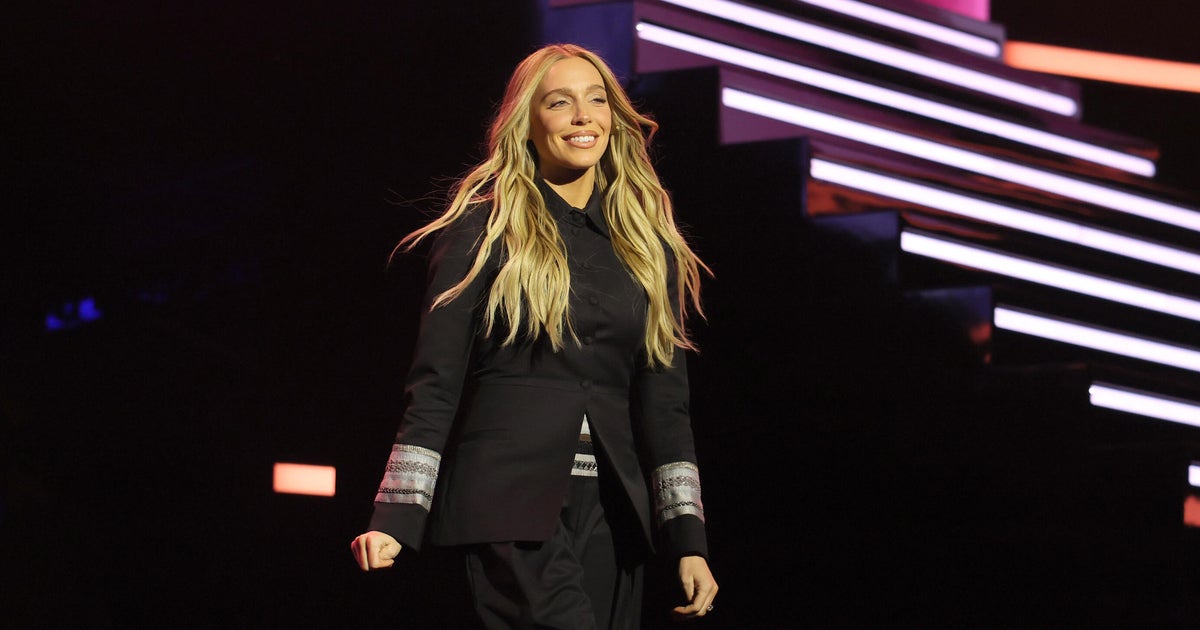
Alex Cooper, the host of one of the most popular podcasts in the United States, announced Sunday that she is expecting her first child.
The “Call Her Daddy” host shared the news in an Instagram post that showed her in a white crop top and sweatpants while looking at her husband, producer Matt Kaplan. Cooper and Kaplan tied the knot in April 2024.
“Our family,” Cooper wrote, along with a white heart emoji.
Cooper also shared the post on her Instagram story, along with a more candid selfie of herself and Kaplan. In another post, she joked that she was “honestly happy” to “finally stop trying to hide the bump.”
Cooper did not share a due date or any other information about her pregnancy.
Noam Galai
Cooper’s “Call Her Daddy” podcast has over 2.1 million subscribers on YouTube, while Cooper herself has over 7.2 million followers on Instagram.
“Call Her Daddy” features conversations covering a host of topics, including relationships, celebrity gossip and pop culture. Most episodes involve Cooper speaking with celebrities and prominent national figures, including an episode recorded with former Vice President Kamala Harris during her 2024 run for president.


Bangladesh net FDI inflows up 39.36% in 2025

US weighs drone threat from Cuba: report

India’s Pearl Global’s FY26 revenue crosses $521 mn milestone

-

 Entertainment5 days ago
Conan O’Brien hat tricks as Oscar host
-

 Tech1 week ago
Could Contact-Tracing Apps Help With the Hantavirus? Not Really
-

 Tech1 week ago
I Tried the Best Captioning Smart Glasses, and Only One Leads the Pack
-

 Fashion5 days ago
Italy’s Zegna Group’s Q1 growth boosted by strong organic performance
-

 Sports1 week ago
Bobby Cox, legendary Atlanta Braves manager who led 1995 World Series champions, dead at 84
-

 Entertainment1 week ago
Martin Short: Facing tragedy with joy
-

 Entertainment1 week ago
Tom Brady gets back at Kevin Hart during Netflix roast
-

 Entertainment1 week ago
Martha Stewart: How to make an omelet