

Business
FTSE 100 up as investors pin hopes on US rate cut

The FTSE 100 closed higher on Thursday, despite downbeat construction data, amid growing conviction of a US interest rate cut next week.
Matt Britzman of Hargreaves Lansdown said: “Investors are leaning into the idea that easier policy is coming, which is fuelling appetite for risk and lifting everything from blue chips to small caps.
“Still, with inflation data and Fed decisions ahead, the path is far from set in stone.”
He added: “Expectations have swung wildly over the past month, so assuming any cuts are a done deal could be a costly mistake, and volatility can just as quickly return if the rate-cutting narrative shifts.
“One thing’s clear, if markets want a Santa rally, they need the Fed to stay in line.”
The FTSE 100 index closed up 18.80 points, 0.2%, at 9,710.87. The FTSE 250 ended up 69.54 points, 0.3%, at 22,070.99, and the AIM All-Share closed up 0.26 of a point at 749.43.
In London, figures showed UK construction activity fell at the fastest pace in five and a half years in November, in the eleventh month of lower construction output.
The headline S&P Global UK construction purchasing managers’ index fell to 39.4 points in November from 44.1 in October. The reading was below the neutral 50-point mark separating growth from contraction for the eleventh month in a row.
The rate of decline in total industry activity was the steepest recorded since May 2020.
Rob Wood of Pantheon Macroeconomics said the report points to “catastrophic conditions in the construction sector, with the activity balance showing the sharpest output fall since the country was in lockdown in May 2020”.
“To say construction firms were unhappy with budget speculation would be an understatement,” Mr Wood added, although he thinks “the PMI remains too pessimistic”.
He said: “Looking ahead, we expect activity in the construction sector to remain muted in the coming months, albeit growth will likely continue to outperform the catastrophic PMI.
“That said, the risks must lie to the downside, with construction output falls now possible in the coming months.”
In European equities on Thursday, the CAC 40 in Paris closed up 0.4%, while the DAX 40 in Frankfurt ended 0.8% higher.
In Europe, car-makers fuelled gains on the back of the news that US President Donald Trump could seek to reduce fuel economy standards implemented by former president Joe Biden, aimed at making it easier for carmakers to sell fossil fuel cars.
Joshua Mahony at Scope Markets said: “While this is a move aimed at lowering costs for US consumers, it also provides a shot in the arm for European carmakers that have struggled to dominate the EV space given rampant Chinese competition.”
The sector was further boosted by positive comments from Bank of America, which sees benefits for the sector from an expected reduction in regulatory pressures in 2026.
Bank of America upgraded Renault, up 6.4%, and Porsche SE, up 4.8%, to “buy” from “neutral” and Mercedes-Benz, up 4.1%, to “neutral” from “underperform”.
Stocks in New York were down slightly at the time of the London equity close.
The Dow Jones Industrial Average, S&P 500 index and Nasdaq Composite were all 0.1% lower.
David Morrison of Trade Nation said the probabilities of a 25 basis point rate cut following next week’s Federal Reserve monetary policy meeting have shot higher, after several senior Federal Open Market Committee members said a weakening labour market was trumping inflation fears when it came to considering rates.
Despite this, Morrison said there will be plenty of interest when the latest core PCE update, the Fed’s preferred inflation measure, is released on Friday.
“Could it possibly come in so high that the Fed has to put off a rate cut? Unlikely, but stranger things have happened,” he added.
The pound was quoted higher at 1.3353 US dollars at the time of the London equities close on Thursday, compared to 1.3342 US dollars on Wednesday.
The euro stood at 1.1658 US dollars, down against 1.1664 US dollars. Against the yen, the dollar was trading lower at 154.75 yen compared to 155.02 yen.
The yield on the US 10-year Treasury was quoted at 4.10%, widened from 4.08%. The yield on the US 30-year Treasury was unchanged at 4.76%, stretched from 4.75%.
The FTSE 250 saw some big swings in prices, with a double-digit gain for SSP, while Trustpilot and Baltic Classifieds plummeted.
London-based SSP, which operates Upper Crust, leapt 11%, as it reported trading has “gained momentum” in recent weeks and announced a “wide-ranging review” of its Continental European rail business.
The operator of food and beverage outlets in travel locations in 38 countries said it is also mulling options to “realise value” in recently-listed Indian investee Travel Food Services.
The Continental European arm has struggled with a “slow return of passenger numbers” since the pandemic, SSP said.
Trustpilot dropped 32%, after a scathing report from short-seller Grizzly Research, which accused the Copenhagen-based consumer review platform of “mafia-style extortion campaigns against non-paying businesses”.
Grizzly said, citing its own investigation, that Trustpilot created “unsolicited review profiles for all kinds of businesses with the intention to attract hyper-negative reviews and force these businesses into paying subscription deals to ‘more actively manage’ the reviews.”
But Trustpilot called the claims “selective, misleading and framed to support a predetermined narrative”.
“It omits key context and publicly available facts, creating a false impression and exhibits a lack of understanding of how Trustpilot works. Trust is our guiding principle and is central to everything we do,” the firm added.
The short-seller recently also took aim at Hello Fresh, sending its shares into a tailspin.
Also firmly in the red was Baltic Classifieds, down 14%, after it warned that lower revenue growth and continued investment will depress margins in the short term.
Analysts were less than enamoured with the outlook commentary, with Panmure Liberum highlighting a “very poorly written statement” and “poor quality communications”, while Peel Hunt noted “lower clarity in its outlook than usual”,
Brent oil was quoted at 63.45 US dollars a barrel at the time of the London equities close on Thursday, up from 63.04 US dollars late on Wednesday.
Gold was quoted at 4,214.64 US dollars an ounce on Thursday, lower against 4,222.94 US dollars.
The biggest risers on the FTSE 100 were 3i, up 154.0p at 3,153.0p, Burberry, up 35.5p at 1,213.0p, Spirax Group, up 200.0p at 6,920.0p, JD Sports Fashion, up 2.0p at 80.5p and Rolls-Royce, up 28.0p at 1,091.0p.
The biggest fallers on the FTSE 100 were Entain, down 30.6p at 755.2p, Diageo, down 68.0p at 1,682.0p, Auto Trader, down 13.8p at 608.4p, London Stock Exchange, down 178.0p at 8,690.0p and Rightmove, down 9.6p at 522.8p.
Friday’s economic calendar has US personal consumption expenditures data, the Michigan consumer sentiment index, and unemployment and average hourly wages figures in Canada. In the UK, the Halifax house price index will be published.
There are no significant events scheduled in Friday’s UK corporate calendar.
Contributed by Alliance News.

The federal government announced a Rs26.77 per litre hike in the price of petrol and high-speed diesel each on Friday, according to a notification issued by the Petroleum Division.
The new prices will be effective from April 25, 2026 for a week, the notification stated.
Following the increase, the price of HSD has jumped from Rs353.42 to Rs380.19, while the petrol price now stands at Rs393.35.
The government has been reviewing petroleum prices every Friday night following the now-paused US-Israel war on Iran, which began on February 28.
In the previous weekly review, the prime minister announced a reduction of Rs32.12 per litre in the price of high-speed diesel, while the petrol price remained unchanged.
The government jacked up petrol and diesel prices despite oil prices falling globally on Friday after it appeared a second round of Middle East talks was back on, bolstering prospects for an end to a war that has crippled energy shipments from the Gulf.
Oil prices had been climbing earlier as investors worried about a lack of progress in ending the Middle East crisis, with Tehran keeping the Strait of Hormuz closed and the US maintaining a blockade of Iranian ports.
But they dropped on reports that Iran’s Foreign Minister Abbas Araghchi was to arrive in Islamabad on Friday night.
Brent crude, the international benchmark contract, fell back below $100 a barrel.
facebook twitter
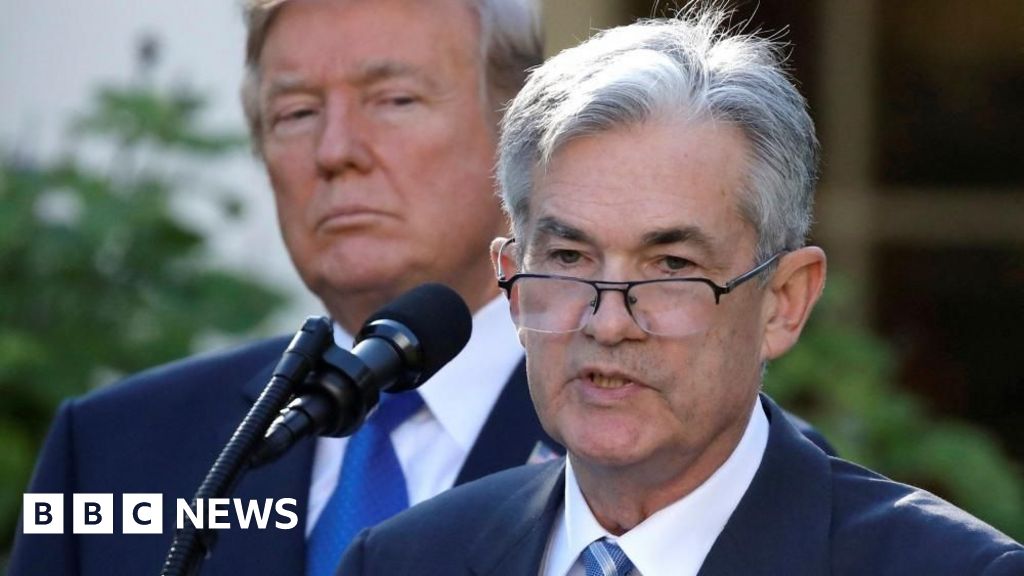
Powell’s term is nearing its end and the US Senate is considering Trump’s nominee for his replacement, Kevin Warsh. A key Republican, Thom Tillis, has withheld his support for Warsh unless the Trump administration would drop its investigation into Powell.
Business
Intel bags big gains! Chipmaker’s shares jump 26% on blockbuster results; how Trump admin benefits – The Times of India
Intel share price soared sharply on Friday after the chipmaker delivered a first-quarter performance that exceeded market expectations. And the win was not just for the chipmaker, but also the whole of US!The stock climbed 26.7% during trading on Friday, marking what could be its strongest single-day gain since 1987. Momentum continued after the closing bell, with shares rising a further 20% in after-hours trading as investors reacted to signs of a sustained turnaround driven by artificial intelligence.Intel reported revenue of $13.58 billion (€11.6bn) for the quarter, ahead of the $12.3 billion (€10.5 bn) forecast and up 7.2% from a year earlier. Adjusted earnings per share came in at $0.29, far exceeding expectations of $0.01.A key contributor to this performance was the company’s Data Centre and AI (DCAI) division, which delivered revenue of $5.05 billion (€4.2bn), up 22.4% year-on-year and well above analyst estimates of $4.41 billion (€3.77bn). The results indicate strong demand for Intel’s Xeon 6 processors and Gaudi 3 AI accelerators, particularly among enterprise clients and cloud service providers.Chief executive Lip-Bu Tan pointed to a broader shift in artificial intelligence usage as a major factor behind the growth. He said, “the next wave of AI will bring intelligence closer to the end user, moving from foundational models to inference to agentic.” He added, “This shift is significantly increasing the need for Intel’s CPUs and wafer and advanced packaging offerings.”The company also issued an upbeat outlook for the second quarter, forecasting revenue in the range of $13.8 billion (€11.8billion) to $14.8 billion (€12.6billion), surpassing investor expectations of $13 billion (€11.1billion).
But how is Washington winning?
The rally has had a direct impact on the US administration’s investment in Intel. In 2025, during a period of severe financial strain for the company, the administration of Donald Trump acquired a 9.9% stake in a move aimed at stabilising the business. The government invested $8.9 billion (€7.8bn) at a share price of $20.47 (€18.01), with $5.7 billion (€5bn) of that amount coming from previously approved but unpaid grants, according to the Euro News.At the time, Intel was facing multi-billion dollar losses and operational challenges, prompting concerns over its viability. As part of the intervention, the company cancelled planned factory projects in Germany and Poland, redirected focus towards US-based manufacturing, and reduced its global workforce by 25%, cutting around 25,000 jobs.Following the latest jump, Intel’s shares are now trading at $81.3 (€71.5), representing an increase of nearly 300% since the government first took its stake. The sharp rise highlights how the company’s improved financial performance has translated into substantial gains for the US administration.


Extended interview: Don Cheadle – CBS News

Charlie Sheen updates on relationship with old pal Jon Cryer

Iranian FM Abbas Araghchi lands in Pakistan ahead of renewed US talks

-

 Fashion1 week ago
France’s LVMH Q1 revenue falls 6%, shows resilience amid Iran war
-

 Tech1 week ago
CYBERUK ’26: UK lagging on legal protections for cyber pros | Computer Weekly
-

 Sports5 days ago
WWE WrestleMania 42 Night 2: Live match results and analysis
-

 Sports1 week ago
Faheem Ashraf backs Islamabad United’s push, calls league a ‘career-changing platform’
-

 Sports5 days ago
NCAA men’s gymnastics championship: All-time winners list
-
 Business1 week ago
PepsiCo earnings beat estimates as North American food business improves
-

 Tech1 week ago
Anthropic Plots Major London Expansion
-

 Entertainment4 days ago
Lee Anderson, Zarah Sultana kicked out of UK Parliament for calling PM ‘liar’