

Business
FTSE eases on weak US data as Ukraine peace summit looms

The FTSE 100 fell back after hitting a new all-time high to close lower on Friday amid caution ahead of the US-Russia peace summit, hints of more tariffs and weak US consumer sentiment.
The index closed down 38.34 points, 0.4%, at 9,138.90. It had earlier reached an all-time intra-day high of 9,222.07.
The FTSE 250 ended down 43.43 points, 0.2%, at 21,758.24, and the AIM All-Share finished 0.86 of a point higher, 0.1%, at 759.80.
For the week, the FTSE 100 rose 0.5%, the FTSE 250 fell 0.9% and the AIM-All Share declined 0.3%.
In Europe, the Cac 40 in Paris rose 0.7%, while the Dax 40 in Frankfurt closed down slightly.
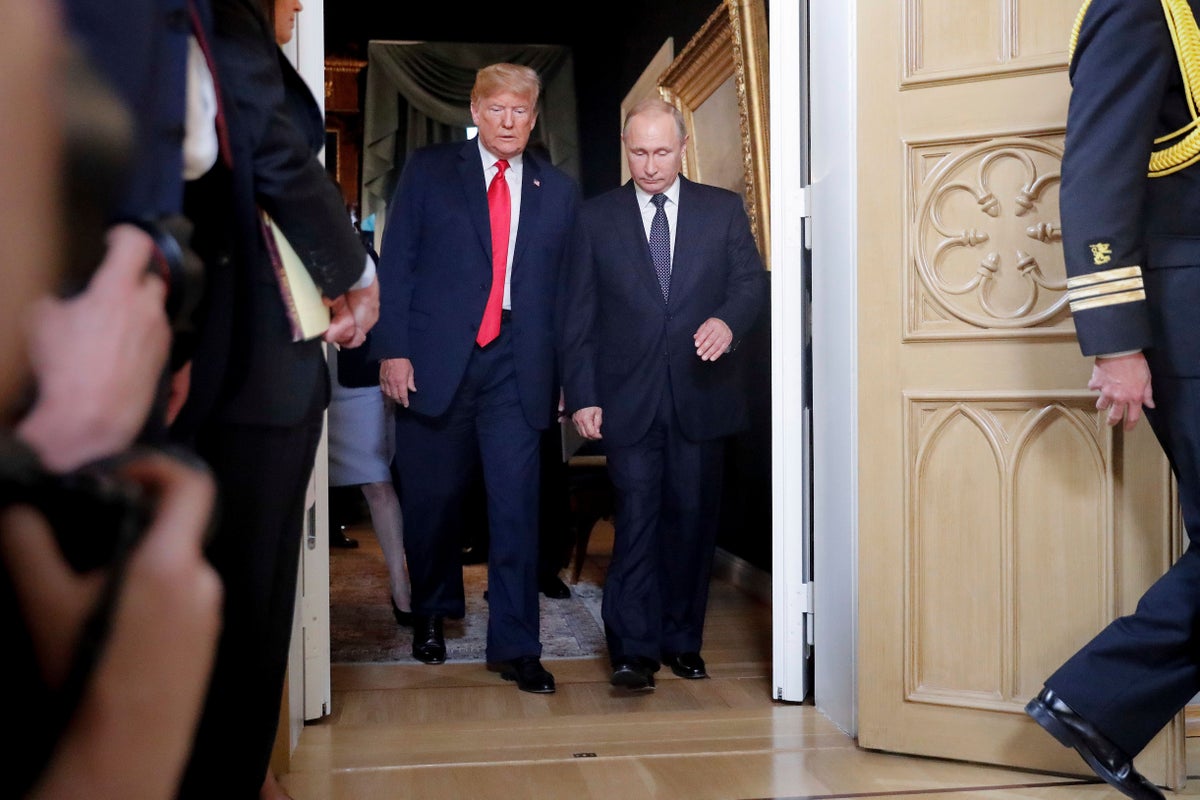
US President Donald Trump and Russian counterpart Vladimir Putin will meet later on Friday in Alaska in a summit that could prove decisive for the future of Ukraine.
Mr Putin will step on to western soil for the first time since he ordered the invasion of Ukraine in February 2022.
Mr Trump extended the invitation at the Russian leader’s suggestion, but the US president has since warned that the meeting could be over within minutes if Mr Putin does not compromise.
Speaking to reporters aboard Air Force One en route to Anchorage, the US leader sounded a more positive note, saying: “There’s a good respect level on both sides and I think something’s going to come out of it.”
“Investors will be watching closely for signs a credible peace deal is in the offing and any outcomes could set the mood music for next week,” said AJ Bell investment director Russ Mould.
Mr Trump also said he will be setting new tariffs on steel, semiconductors and computer chips from next week, but declined to say what rate would apply, according to AFP.
The US president said he would keep the new levies “lower at the beginning” to give companies “a chance to come in and build” in the US.
“And if they don’t build here, they have to pay a very high tariff, which doesn’t work. So they’ll come and build,” he said.
In New York, the Dow Jones Industrial Average was up 0.1%, the S&P 500 was 0.2% lower, and the Nasdaq Composite dropped 0.4%.
Figures showed US retail sales growth decelerated in July, although the number was in line with hopes.
The US Census Bureau said retail sales grew 0.5% monthly in July from June, when they had grown 0.9%, which revised up from 0.6%.
But separate data from the University of Michigan showed the preliminary August sentiment index fell to 58.6 from 61.7 a month earlier. FX Street consensus had forecast an improvement to 62.0.
The report showed US consumers are scaling back spending plans amid concerns about inflation and weakening job prospects.
The pound climbed to 1.3566 dollars late on Friday afternoon in London, compared with 1.3541 at the equities close on Thursday.
The yield on the US 10-year Treasury was at 4.31%, widened from 4.28%. The yield on the US 30-year Treasury was 4.90%, up from 4.87%.
On the FTSE 100, mining stocks rose despite weak data from China.
Anglo American rose 2.1%, Glencore climbed 1.8% and Antofagasta 1.2% on hopes the soft figures will spark action from Chinese authorities.
“Chinese economic activity slowed across the board in July, with retail sales, fixed asset investment, and value added of industry growth all reaching the lowest levels of the year,” ING said.
“After a strong start, several months of cooling momentum suggest that the economy may need further policy support,” the broker added.
Asia-focused bank Standard Chartered slumped 7.2% after a US politician asked the country’s attorney general to investigate the bank.
Republican Elise Stefanik, in a post on X, said she has asked Pam Bondi to investigate the bank for “illicit payments to known terrorists”.
Ms Stefanik shared a letter on X in which she alleged Standard Chartered had made 9.6 billion dollars from such payments.
“China has been using Standard Chartered to purchase sanctioned Iranian oil,” she claimed.
On a quiet day for company news, Associated British Foods ended up 0.2% after confirming the acquisition of Hovis Group from private equity firm Endless.
AB Foods plans to combine Hovis with its existing Allied Bakeries division to create a “profitable UK bread business that is sustainable over the long term”.
Allied Bakeries owns the bread brands Kingsmill, Allinson’s and Sunblest. It also produces own-label bakery ranges for major UK supermarkets.
Clive Black, retail analyst at Shore Capital, said the deal shows AB Foods has been true to its word and taken “demonstrable action to deal with persistent problem children”.
He said AB Foods and Endless need to overcome any UK antitrust concerns, but he believes there is “ample” choice for bread shoppers after any Hovis/Kingsmill alliance, providing a “firm basis” for regulatory approval.
On the FTSE 250, Bytes Technology Group jumped 8.4% after launching a share buyback programme worth up to £25 million.
A barrel of Brent fell to 66.33 dollars late on Friday afternoon from 66.80 on Thursday. Gold rose to 3,343.39 dollars an ounce against 3,339.74.
The biggest risers on the FTSE 100 were Anglo American, up 47.0p at 2,170.0p, BP, up 7.3p at 421.4p, Glencore, up 5.2p at 299.7p, Games Workshop, up 200.0p at 15,680.0p and Antofagasta, up 26.0p at 2,122.0p.
The biggest fallers were Standard Chartered, down 101.5p at 1,305.5p, Rolls-Royce, down 27.5p at 1,074.0p , 3i Group, down 96.0p at 3,971.0p, Airtel Africa, down 4.0p at 216.2p and Rightmove, down 13.8p at 761.0p.
Contributed by Alliance News
Business
Life sciences lab real estate is clawing back from disaster. Here’s what that means for investors
Business
Trump administration in advanced talks for a rescue package for Spirit Airlines, source says

A Spirit commercial airliner prepares to land at San Diego International Airport in San Diego, California, U.S., January 18, 2024.
Mike Blake | Reuters
The Trump administration is in advanced talks for a financing package for Spirit Airlines as the carrier is facing the risk of a liquidation, according to a person familiar with the matter.
Spirit had been facing a potentially imminent liquidation, people familiar with the matter told CNBC last week, speaking on the condition of anonymity to discuss matters that had not yet been made public. The Dania Beach, Florida-based carrier in August filed for its second Chapter 11 bankruptcy in less than a year, after it struggled to increase revenue to cover rising costs.
President Donald Trump hinted at potential government aid on Tuesday, telling CNBC’s “Squawk Box“, “Spirit’s in trouble, and I’d love somebody to buy Spirit. It’s 14,000 jobs, and maybe the federal government should help that one out.”
The White House didn’t immediately comment.
“We are hopeful that the government will recognize the needs for emergency funds especially in the current economic environment,” a spokesperson for the Associated of Flight Attendants-CWA, which represents Spirit’s cabin crews, said in a statement. “The last thing our economy needs is tens of thousands more people out of work and the last thing the travelling public needs is fewer choices in air travel.”
The terms of the financing deal weren’t immediately known. The Wall Street Journal earlier reported that the talks were in an advanced stage.
The U.S. airline industry accepted more than $50 billion in taxpayer aid to weather the Covid-19 pandemic, which is still its biggest-ever crisis, but those funds weren’t handed to one specific airline. Some of the aid gave the U.S. government stock warrants for airlines.
Airlines also received a government bailout following the Sept. 11, 2001, terrorist attacks, but that money was also for more than one company. The U.S. in 2008-2009 also bailed out the auto industry during the financial crisis and took stakes in manufacturers.
The Trump administration has taken equity stakes in some companies it deemed critical to national security like Intel and USA RareEarth, though Spirit stands out as it is in bankruptcy.
In February, Spirit said it expected to exit bankruptcy in late spring or early summer, telling a U.S. court that it would shrink and focus its planes on high-demand routes and travel periods. Pilot and flight attendant unions had also made concessions, including going on furlough in recent months, in a bid to help Spirit survive.
But jet fuel prices have nearly doubled in some parts of the U.S. since then, further adding to challenges for Spirit and the rest of the airline industry.
As a low-fare airline that also faces competition from larger carriers with their own no-frills, basic economy offerings, it has grown harder for Spirit to cover expenses. Spirit had introduced extra-legroom seats and other premium options to try to cater to higher-spending customers.
Business
Iran war: Trump sanctions waiver or not – why India continues to buy Russian oil – The Times of India
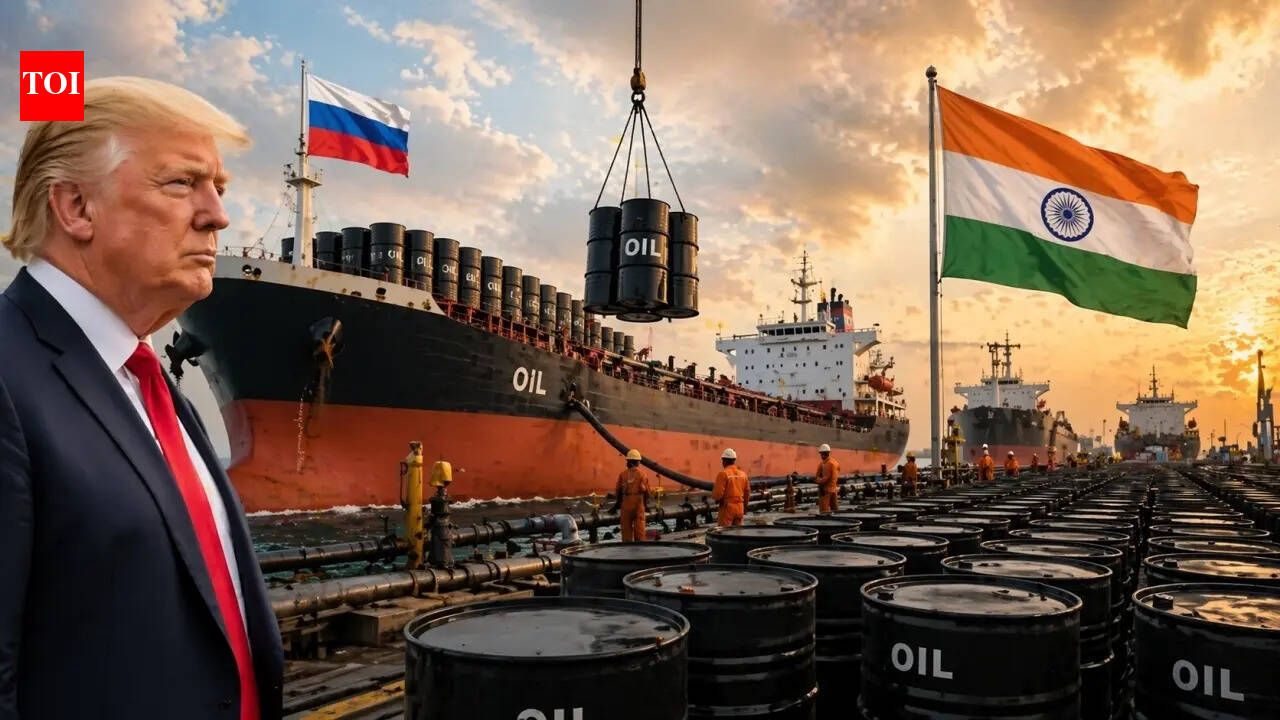
In early March, India was staring at a possible crude oil supply problem – the US-Iran war caused the Strait of Hormuz through which 20% of global crude transits to be effectively closed. To rescue came Russian crude oil! In fact, Russian crude has become a crucial support for India’s oil imports both in April and March. The import volumes are actually touching highs seen when India was bagging Russian crude at a huge discount.US President Donald Trump sanctioned two Russian oil majors towards the end of last year. This made it financially unviable for Indian refiners to continue to buy Russian crude at the same level as before, though flows of unsanctioned oil continued.However, in March, with the US sanctions waiver in effect, India has aggressively procured Russian crude, picking up millions of barrels. After the Russia-Ukraine war, Russian crude has maintained its position as the largest supplier of crude oil to India. Through Western sanctions, US President Donald Trump’s pressure and sanctions on Russian oil majors, crude from Russia has continued to flow to India, though the levels have varied.
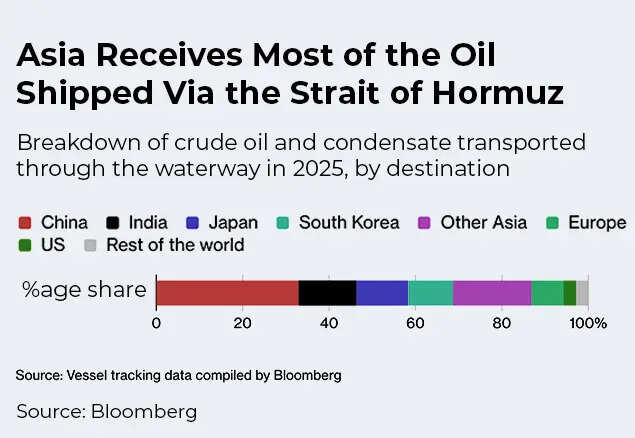
However, experts believe that once the situation in the Middle East normalizes, India will go back to buying crude from Gulf countries, and Russia’s percentage in India’s oil imports will come down.
US sanctions waiver & India’s aggressive buying
India has never officially said that it will stop buying Russian crude, and even when levels dropped after sanctions, Russia was still the biggest contributor. However, the Donald Trump administration’s decision to waive sanctions on Russian crude, and extend that waiver to May has allowed Indian refiners to step up procurement without any worries.According to the latest report from Centre for Research on Energy and Clean Air (CREA)’s analysis, while India’s total crude imports recorded a 4% reduction in March, Russian imports doubled.
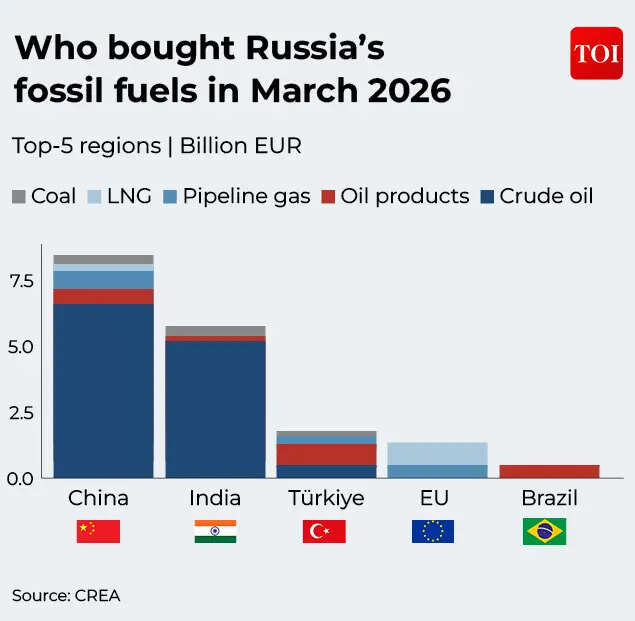
“The biggest shift was in state-owned refineries’ imports from Russia, which saw a massive 148% month-on-month increase. Their imports were in fact 72% higher than March 2025, presumably due to Russian barrels being more available in the spot market, which serves as the primary source of imports for them,” says CREA.Russia’s share of India’s crude oil imports in March 2026 placed the month at the upper end of historical highs, closely mirroring peak levels seen in 2023, when Western sanctions redirected Russian oil flows toward Asia and made Moscow India’s single largest supplier.Sourav Mitra, Partner – Oil and Gas, Grant Thornton Bharat explains the emergence of Russia as a dominant supplier of crude for India.Russia’s share surged sharply in the months following the Ukraine war, peaking during several months in mid‑2023, particularly around May–June, when imports rose to about 1.9-2.0 million barrels per day and accounted for nearly 42-45% of India’s crude basket, displacing Iraq and Saudi Arabia. That dominance persisted through much of 2023, with average shares close to 40% between April and September, before easing in 2024 and early 2025 as price discounts narrowed, compliance costs increased and refiners partially rebalanced toward Middle Eastern grades.“Against this backdrop, the rebound seen in March 2026 effectively matches the 2023 peak, although the underlying drivers differed, with the latest spike largely reflecting supply disruptions in West Asia that curtailed Gulf inflows and compelled refiners to rely more heavily on available Russian cargoes. We expect that while March marks a return to near‑record dependence on Russian crude, such elevated levels are unlikely to persist once Middle Eastern supply chains stabilize,” Mitra tells TOI.
No more discounts! India paying a premium for Russian crude
What stands out is the fact that when India stepped up its procurement of Russian crude after the Ukraine war began, the oil was available at very steep discounts. This was due to European sanctions that made Russian crude available at a much lower rate than Brent. Come 2026, with oil supplies via Hormuz disrupted and global crude oil prices rising, Russia is now selling at a premium!According to Sourav Mitra of Grant Thornton Bharat, Indian refiners are currently paying a premium of about $4-6 per barrel over the Brent benchmark for Russian crude. These are some of the highest delivered premiums on Russian crude since Russia began diverting large volumes of crude to Asia after the Ukraine war, he tells TOI. “This shift is attributed to intense competition for prompt Russian cargoes as disruptions to Middle Eastern supply routes pushed refiners to prioritise assured deliveries over price. The premium contrasts starkly with February 2026, when Indian buyers were still securing Russian crude at discounts of roughly $12–$15 per barrel, shortly before conditions deteriorated in the Strait of Hormuz,” he elaborates.In fact, the turnaround is even more pronounced compared with 2022-23, when Russian crude frequently traded $20-$30 below Brent. The price inversion was reinforced by the US sanctions waiver issued in early March 2026 and effectively released millions of barrels into the market, strengthening sellers’ leverage. “As a result, India has shifted from discount‑driven buying to security‑led procurement, paying a premium to ensure supply continuity while Gulf flows remain disrupted,” he adds.
Why India continues to buy Russian crude
Russian oil is not going out of India’s crude imports anytime soon, experts say.However, Ivan Mathews, Head of APAC Analysis at Vortexa expects Russian crude imports to decline month-on-month in April. “Discounts on Russian crude were less competitive due to increased demand during the sanctions waiver period, which has since been extended to 16 May. This will lead to lower marginal imports for economics-driven refineries in India. Additionally, reduced crude loadings from Russia will decrease the availability of Russian barrels for imports in the coming weeks,” Mathews tells TOI.
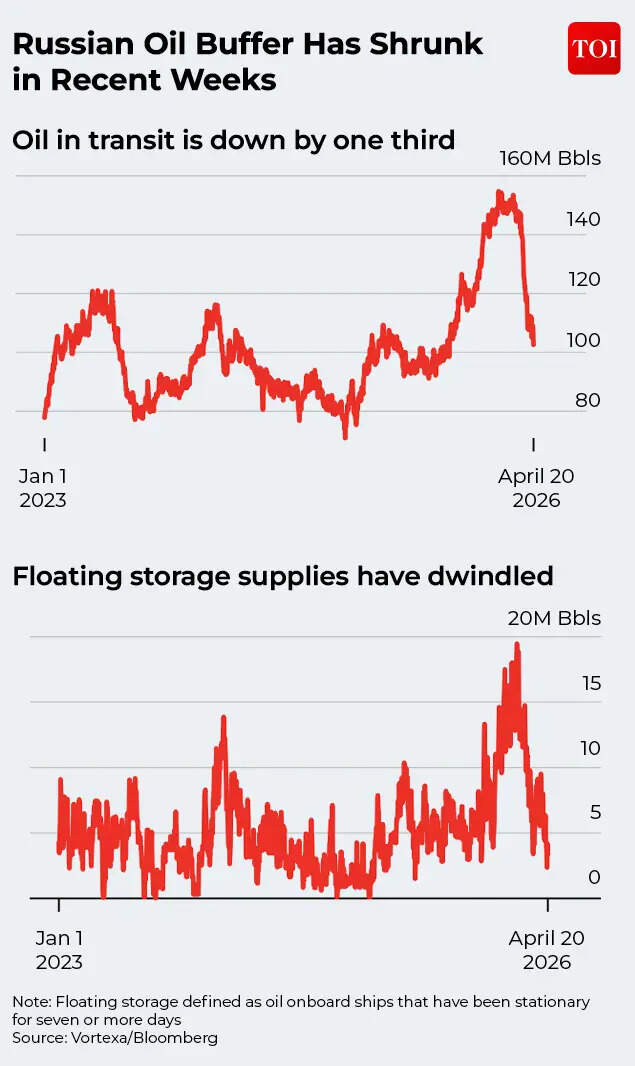
Mitra of Grant Thornton Bharat says that Russian crude is now well integrated into India’s refining system and serves as a reliable fallback when alternative supplies tighten. Russia is likely to remain an important supplier through 2026 even as its share moderates from March’s highs and Middle Eastern flows stabilize.Sumit Ritolia, Manager Modelling and Refining at Kpler believes that Russian oil will continue to be a major part of India’s crude oil imports in the coming months as well. Currently, India’s Russian crude imports are tracking at around 1.6mbd, which is approximately 375 kbd lower than March levels.However, as Ritolia points out, this dip needs context as Nayara (≈400 kbd, fully reliant on Russian crude) has been under maintenance since the second week of April. Adjusting for this, the underlying demand signal for Russian barrels remains intact.“The flows are expected to range between 1.5-2 mbd with a slight dip possible due to ongoing infrastructure issues in Russia due to the conflict with Ukraine,” Ritolia tells TOI.Interestingly, Kpler data shows that even after US sanctions on Russian majors Lukoil and Rosneft came into effect late last year, Russia continued to be the largest supplier of crude oil to India. However, admittedly the volumes saw a sharp drop, with February levels being much lower. While the Donald Trump administration claimed finalising a trade deal contingent on India stopping crude imports from Russia, New Delhi has never said it will not buy oil from Moscow.The US first waived the sanctions in early March and then extended the waiver recently. Experts are of the view that even when the sanctions waiver lapses, Russian oil will continue to be imported, though the quantities may dip.“A key point that is often missed is that Russian oil itself is not sanctioned but certain entities, vessels, and financial channels are,” says Sumit Ritolia.According to Ritolia, Russia continues to be a core supplier for India, but in the absence of sanctions waiver procurement must strictly ensure:• No involvement of sanctioned sellers or intermediaries• Use of non-sanctioned vessels• Fully compliant financial, insurance, and trading channelsIndia is unlikely to move away from Russian crude in the near term. Instead, we should expect more documentation, tighter screening rather than a structural shift in sourcing as and when sanctions lapse, Ritolia added.
India’s Diversified Crude Supplies
But even as Russia is expected to continue being an important player in India’s crude imports, it is equally important to note that New Delhi has diversified its basket to include over 40 countries.As Sushil Mishra, Director, Crisil Intelligence points out: Historically, Russia’s share in India’s crude imports peaked at over 40%, however, it has varied in the last few years amid diversification efforts and evolving geopolitical dynamics. Improved refinery flexibilities have enabled Indian refiners to process a wider range of crude grades including those from the American, Russian, and Middle Eastern.“India continues to strengthen its energy resilience by diversifying crude sourcing and maintaining a pragmatic sourcing strategy driven by price, availability, and energy security considerations. This approach allows flexibility to adjust sourcing patterns in response to changing global market conditions and geopolitical developments,” he tells TOI.


5 AI Models Tried to Scam Me. Some of Them Were Scary Good

Life sciences lab real estate is clawing back from disaster. Here’s what that means for investors

US-Iran talks could be held as early as Friday, says Trump

-

 Fashion6 days ago
France’s LVMH Q1 revenue falls 6%, shows resilience amid Iran war
-

 Entertainment1 week ago
Is Claude down? Here’s why users are seeing errors
-

 Sports1 week ago
PSL 11: Peshawar Zalmi win toss, opt to field first against Quetta Gladiators
-

 Tech1 week ago
The Deepfake Nudes Crisis in Schools Is Much Worse Than You Thought
-

 Tech1 week ago
Bremont Is Sending a Watch to the Moon’s Surface
-

 Tech1 week ago
Human-machine teaming dives underwater
-
 Business1 week ago
BP sees ‘exceptional’ oil trading result as Iran war sends crude costs soaring
-

 Fashion1 week ago
What no one is saying about the 2026 apparel slowdown