

Fashion
Gas above $100, sentiment at record low; US faces a spending storm


The US-Iran war has intensified cost pressures, with higher fuel and product prices sharply weakening consumer sentiment.
Lower- and middle-income households are bearing the steepest burden as gas takes a larger share of discretionary spending.
Higher-income consumers remain more resilient, keeping aggregate demand firm despite widening spending divergence.
Source link











The US–Iran military conflict has sent shockwaves through global energy and chemical markets. Crude surged past $*** per barrel in late March and April ****, its highest level in years. Prices briefly touched $*** per barrel in late April before stabilising near $*** per barrel, following several news-driven fluctuations. Year-on-year, this represents a surge of over +** per cent vs. **** highs and remains +** per cent above compared to last year’s equivalent period.
Key petrochemical feedstocks that directly feed the textile chain — Naphtha, Paraxylene (PX), Purified Terephthalic Acid (PTA), Mono Ethylene Glycol (MEG), Ethylene, and Ethylene Oxide are all under severe cost pressure. Further escalation above $***–***/barrel would trigger a new wave of downstream price hikes across yarn, fabric, and finishing chemicals.
The company reported gross merchandise value (GMV) of ₹19,666 crore (~$2.04 billion) in FY26, up 5 per cent year-on-year (YoY), while consolidated topline increased 4 per cent YoY to ₹13,110 crore (~$1.36 billion). The gross margin improved by 48 basis points (bps) to 20.6 per cent.
PDS Limited has reported higher FY26 revenue and profit despite global trade and demand uncertainties.
GMV rose 5 per cent YoY to ₹19,666 crore (~$2.04 billion), while consolidated topline grew 4 per cent to ₹13,110 crore (~$1.36 billion).
PAT stood at ₹178 crore (~$18.49 million), with gross margin improving to 20.6 per cent.
The company also strengthened its cash flow and reduced debt.
“FY26 was a challenging year marked by heightened global uncertainties—from evolving US tariff actions and geopolitical conflicts creating persistent trade and supply chain disruptions—all of which weighed on consumer sentiment and demand visibility,” said Pallak Seth, executive vice chairman, PDS.
It reported the profit after tax (PAT) of ₹178 crore (~$18.49 million) for full fiscal, with a margin of 1.4 per cent.
The company’s order book as of early April stood at ₹5,074 crore, up 11 per cent. Net working capital improved significantly from around 17 days to nearly 4 days, while operating cash flow stood at ₹781 crore in FY26. Net debt reduced from ₹374 crore in March 2025 to ₹105 crore in March 2026.
“PDS demonstrated the resilience of its platform by delivering stable growth, supported by deep customer relationships and disciplined execution through our diversified sourcing network. We continued to strengthen our US presence, secured a new sourcing-as-a-service mandate with a new value customer having a potential to scale over $50 million, alongside deeper engagement with existing customers,” added Seth.
Quarterly EBITDA and PAT improve
Meanwhile, PDS reported a consolidated topline of ₹3,519 crore (~$365.5 million) in Q4 FY26, up 11 per cent quarter-on-quarter (QoQ), while GMV for the quarter rose 5 per cent QoQ to ₹4,905 crore (~$509.4 million).
The company achieved EBITDA of ₹122 crore during the quarter, registering 12 per cent QoQ growth. EBITDA margin stood at 3.5 per cent, improving by 2 bps. PAT rose sharply by 95 per cent QoQ to ₹72 crore, with a margin of 2 per cent.
“As global sourcing corridors continue to evolve, PDS remains well positioned to benefit from emerging trade tailwinds, while simultaneously strengthening its competitive advantage through deeper integration of technology and AI across the value chain,” said Seth.
Fibre2Fashion News Desk (SG)
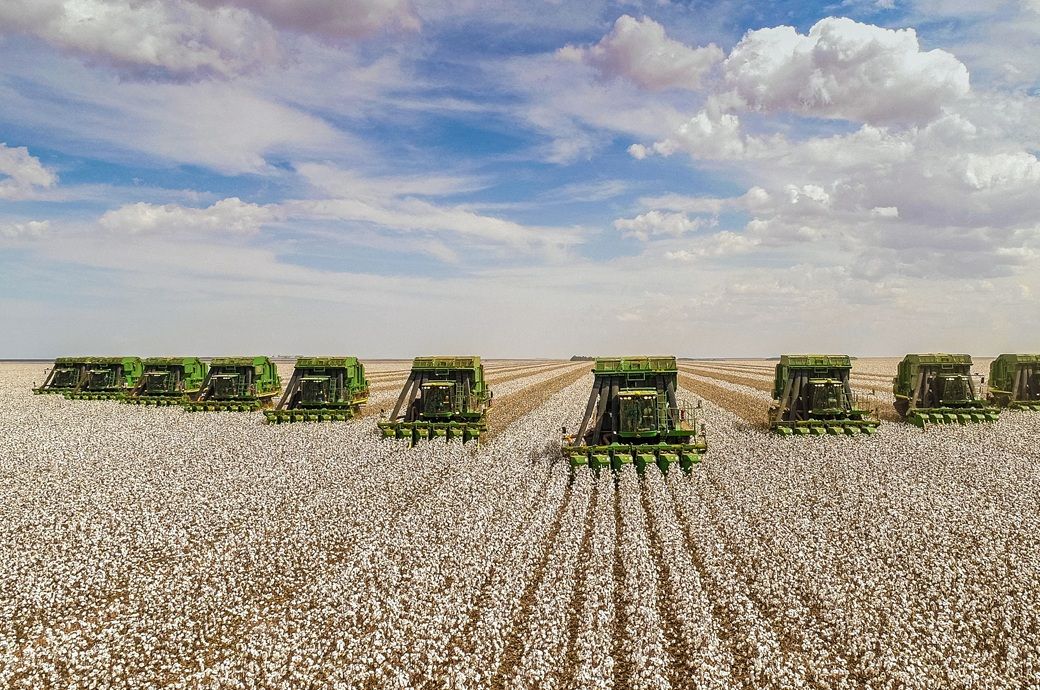
According to the latest report, among major cotton-producing states, Arizona and California were far ahead, with planting at 90 per cent each. Arkansas reached 66 per cent, Louisiana 62 per cent, Mississippi 58 per cent, and Tennessee 73 per cent. Alabama also moved ahead to 54 per cent. In the Southeast, Georgia stood at 38 per cent, North Carolina at 39 per cent, and South Carolina at 40 per cent.
US cotton planting remained broadly on schedule in mid-May, reaching 41 per cent completion by May 17, 2026, ahead of last year and slightly above the five-year average.
Favourable weather and field conditions supported progress across major producing regions, easing immediate crop concerns, although dryness in parts of West Texas and the Southwest continued to pose localised risks.
Texas, the largest US cotton-producing state, remained at 34 per cent planted, unchanged from the five-year average but higher than 27 per cent, a week earlier. Oklahoma was slower at 29 per cent, while Kansas reached 45 per cent. The mixed pace across the Southwest kept some regional uncertainty intact, even as the national planting rate remained broadly on track.
Weather across the Delta and Southeast cotton belt remained supportive for planting and early crop emergence. Vaisala Weather analysis indicated favourable soil moisture in these regions, helping crop establishment. However, portions of West Texas and the broader Southwest continued to experience dry soil conditions despite expected rainfall, leaving some localised crop stress risk in focus.
Fieldwork conditions were generally favourable across several cotton states. The USDA report showed Texas had 6.5 days suitable for fieldwork during the week ended May 17, while Georgia had 6.2 days, Mississippi 6.2 days, Alabama 5.3 days, North Carolina 4.0 days, and South Carolina 5.1 days.
Soil moisture conditions across the wider US remained mixed. Nationally, topsoil moisture across 48 states was rated 16 per cent very short, 26 per cent short, 50 per cent adequate, and 8 per cent surplus. Subsoil moisture was rated 17 per cent very short, 27 per cent short, 51 per cent adequate, and 5 per cent surplus. These readings suggest that while moisture availability is adequate in many regions, dryness remains a concern in parts of the cotton belt.
The USDA said its crop progress and condition estimates are based on weekly survey data collected from early April, through the end of November, using inputs from around 3,600 respondents who provide visual observations of crop stages, field activity, and crop conditions.
Overall, the latest data point to a US cotton crop that is developing close to its normal seasonal pace. Favourable weather and steady planting progress have reduced immediate upside risk from crop concerns, though dryness in West Texas and the Southwest remains an important factor for cotton traders to monitor in the coming weeks.
Fibre2Fashion News Desk (KUL)


Oil-led inflation may trigger fresh polyester price hikes

PSX extends gains on Middle East peace hopes

The EU Is Going Through a Trump-Fueled Breakup With Big Tech

-

 Entertainment1 week ago
Conan O’Brien hat tricks as Oscar host
-

 Fashion1 week ago
Italy’s Zegna Group’s Q1 growth boosted by strong organic performance
-
 Business1 week ago
Pound wobbles and bonds suffer as Starmer battles on
-

 Fashion1 week ago
US T&A exports decline 10% to $5 bn on softer regional demand
-

 Entertainment5 days ago
Where Pete Davidson, Elsie Hewitt stand after breakup: Details revealed
-

 Sports1 week ago
2025-26 NBA Title Odds: Thunder, Spurs Favored; Knicks Rising
-
 Business7 days ago
Jersey Election 2026: Cost of living concern in St Helier Central
-

 Sports1 week ago
Noman Ali becomes oldest player to complete 100 Test wickets